If you want to know how to eat more fiber without bloating, add about 3 to 5 grams of fiber every few days rather than all at once, and drink extra fluid alongside it. That single habit solves most of the discomfort people hit when they jump from a low-fiber diet straight to 30 grams a day. Give your gut two or three weeks to adjust and the gas usually settles.
I say that from experience, not theory. Years of doing this the hard way — going from roughly 10 grams a day to 40 over a weekend — is what taught me that almost nothing about fiber works as a sudden change. The same advice shows up on every credible source I checked, from UCLA Health to the Mayo Clinic, which all point at a slow ramp and steady fluid.
Table of Contents
- What You Need to Eat More Fiber Without Bloating
- Step-by-Step
- How to Eat More Fiber Without Bloating: Start Gradually
- Increase Soluble and Insoluble Fiber With Familiar Foods
- Add High-Fiber Foods One Serving at a Time
- Spread Fiber Throughout the Day
- Drink Enough Fluids and Adjust Meal Timing
- Cook and Prepare Fiber-Rich Foods Gently
- Common Mistakes
- Frequently Asked Questions
- How much fiber should I eat per day?
- Why does eating more fiber cause gas and bloating?
- Does drinking more water really help with fiber-related bloating?
- Are fiber supplements easier on the stomach than high-fiber foods?
- Should I stop eating fiber if it makes me bloated?
- Conclusion: Start With One Small Change
What You Need to Eat More Fiber Without Bloating
Nothing special. There is no equipment, no tracking gadget required, and no meal plan you have to follow exactly.
What you do need is a rough idea of where you are right now, because “more” means something different at 12 grams than at 28. Most adults land somewhere in the teens. Take a few minutes over a typical day and add up the fiber in what you actually eat — the nutrition label on your cereal, the fiber grams per serving on the back of the box, a rough count for anything without a label.
- A baseline estimate. A best guess is fine. Precision here is wasted energy.
- Fluid you actually like. Water is the obvious choice, but herbal tea and sparkling water count too. The point is volume, not a specific drink.
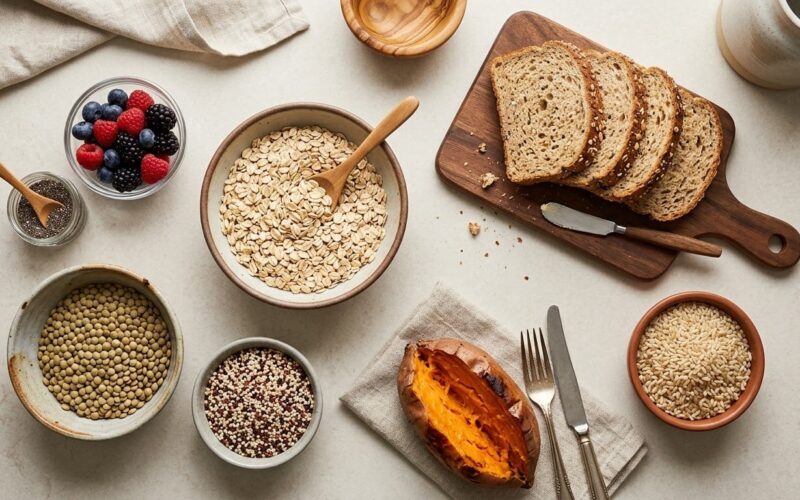
- Two or three fiber foods you already tolerate. Oats, berries, avocado, or a spoon of seeds are usually gentle starting points.
- Two to three weeks. That is roughly how long gut bacteria take to adjust to a meaningfully higher fiber intake.
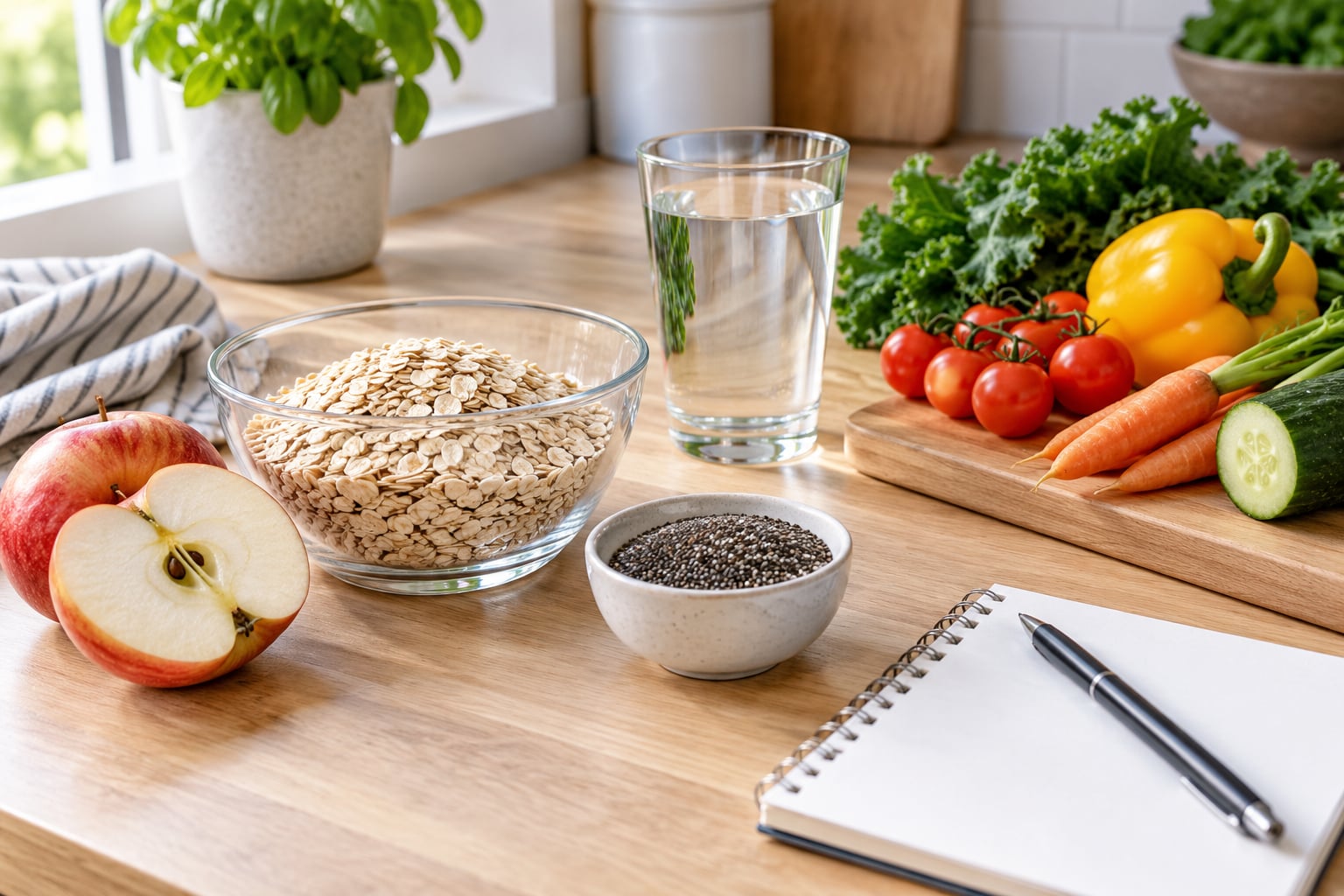
Keep a notebook or your phone’s notes app for a week. What you ate, roughly how much fiber it contained, and how your stomach felt that evening and the next morning. Sounds fussy, but it is the fastest way to find your personal ceiling instead of guessing at it.
Step-by-Step
How to Eat More Fiber Without Bloating: Start Gradually
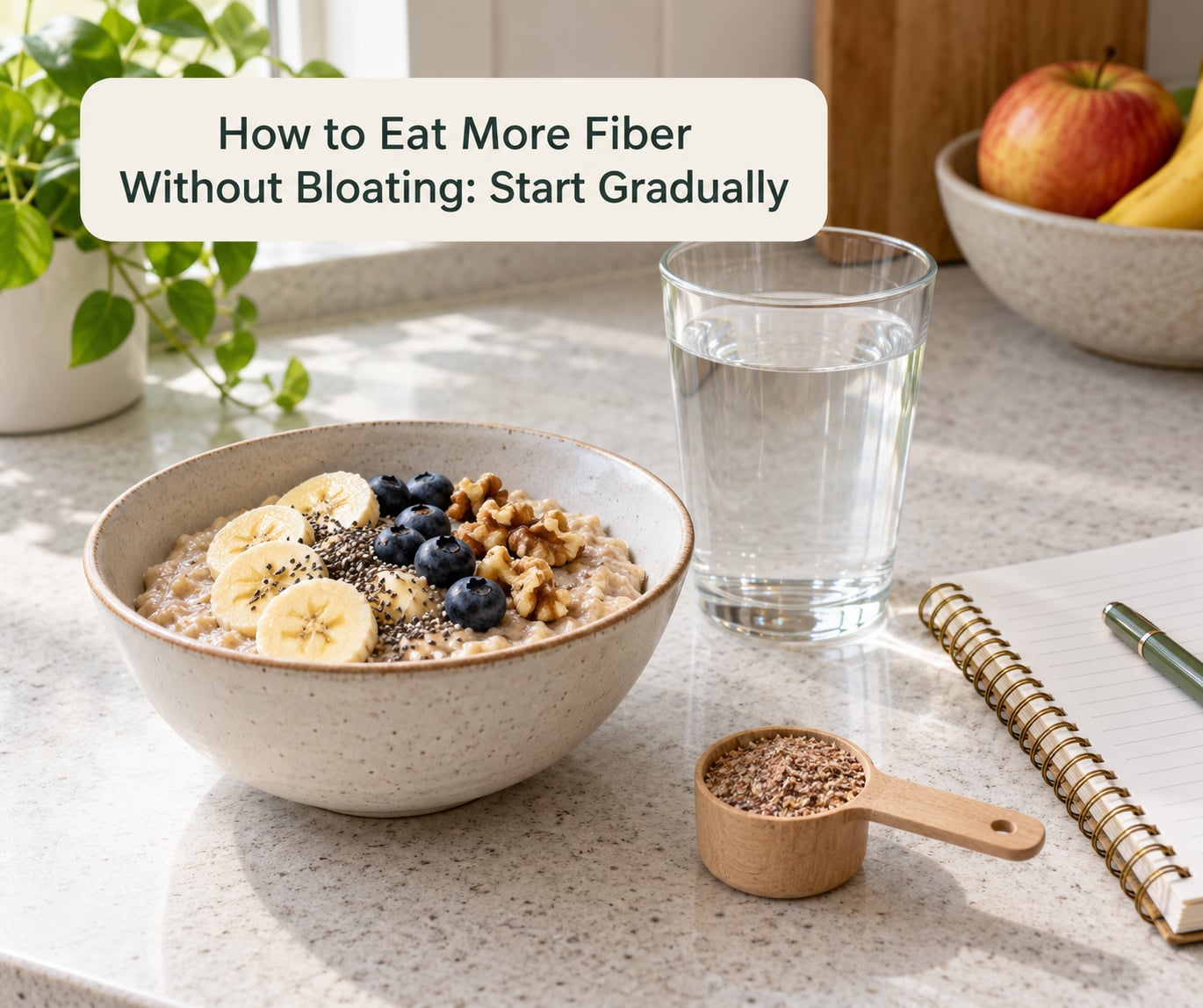
Add 3 to 5 grams of fiber every three to four days, then hold steady for a week before adding more. Most of the bloating attributed to fiber comes from the speed of the change, not the fiber itself.
University of Michigan’s high-fiber guide suggests a similar pace, adding roughly 5 grams at a time, and the American Institute for Cancer Research suggests spreading the ramp across one to two weeks rather than a single day.
Here is how a two-week ramp looks for someone starting near 15 grams:
| Period | Daily fiber target | What that looks like |
|---|---|---|
| Baseline | Your current intake, unchanged for three days | No changes at all. Just notice how you feel. |
| Week 1, days 1-3 | Add 3-5 g (about 18-20 g total) | Swap white bread for whole grain, or add berries to breakfast. |
| Week 1, days 4-7 | Hold at the new level | No additions. Watch for gas or bloating in the log. |
| Week 2, days 1-3 | Add another 3-5 g (about 23-25 g total) | Introduce one new food, not three. |
| Week 2, days 4-7 | Hold again | By now most people notice bowel movements improving. |
| Week 3 onward | Keep climbing 5 g a week toward your goal | Add legumes or larger vegetable portions here, not earlier. |
You know an increase is tolerable if your stomach feels full after a normal meal rather than distended, you are not cramping, and digestion feels mostly predictable. Mild gas in the first few days is normal. Sharp pain, nausea, or a day of disrupted sleep is not — that is your cue to hold at the current level for another week rather than push on.
Increase Soluble and Insoluble Fiber With Familiar Foods
Soluble fiber dissolves in water and forms a gel in the gut, which softens stool and slows digestion. Insoluble fiber does not dissolve; it adds bulk and moves food along faster. You need both, and adding them together is gentler than a large serving of either alone.
| Type | What it does in the gut | Common sources | Bloating tendency |
|---|---|---|---|
| Soluble | Absorbs water, forms gel, softens stool, feeds gut bacteria | Oats, barley, psyllium, chia, flax, apples, citrus, beans | Lower to moderate, though fermentable sources like beans and apples still produce gas |
| Insoluble | Adds bulk, speeds transit, rough texture | Wheat bran, whole grains, nuts, seeds, skins on fruit, many vegetables | Low, but large amounts at once are hard on a sensitive gut |
Because fiber reaches the large intestine mostly intact, gut bacteria ferment it and produce short-chain fatty acids along with gas as a byproduct. That is not a malfunction. It is the mechanism behind most of the side effects people dislike, and it is also why fiber supports gut-barrier health over time.
If you already bloat after vegetables, start with the soluble column and stay there for a couple of weeks. Several people on r/ibs described tiny increments as the only workable approach for them — smaller steps than general advice suggests, and consistent for weeks rather than days.
Add High-Fiber Foods One Serving at a Time
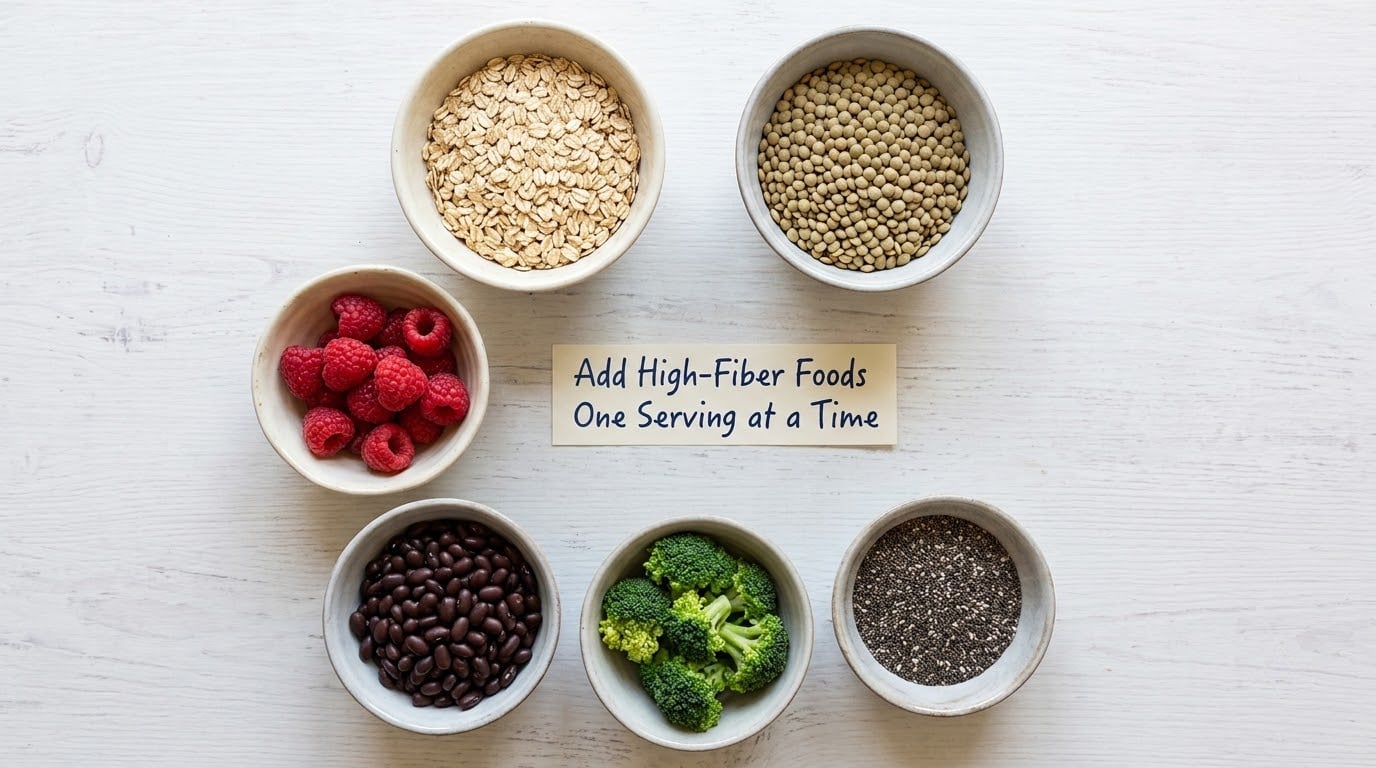
Measured servings are what make this work. Unmeasured is how a “healthy” salad bowl turns into an afternoon of discomfort.
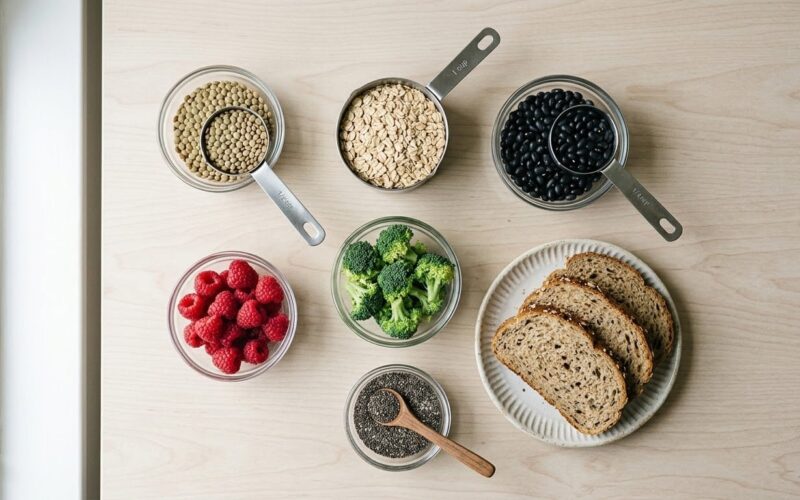
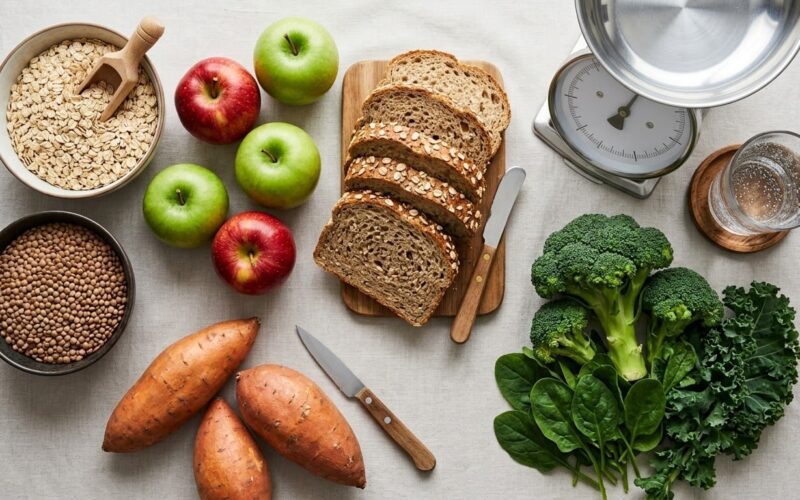
For a roughly 30-gram day, common servings look like this. Label numbers vary between brands and crops, so treat them as a guide:
| Food | Typical serving | Approximate fiber |
|---|---|---|
| Oatmeal, cooked | 1 cup | 4 g |
| Raspberries | 1 cup | 8 g |
| Black beans, canned and rinsed | 1/2 cup | 7 g |
| Lentils, cooked | 1/2 cup | 8 g |
| Broccoli, cooked | 1 cup | 5 g |
| Chia seeds | 1 tablespoon | 5 g |
| Whole wheat bread | 2 slices | 4 g |
| Apple with skin | 1 medium | 4 g |
Legumes are the biggest source of trouble for beginners, and they are also the cheapest fiber available. The practical move, which shows up again and again in r/PlantBasedDiet threads, is capping them near a half cup a day at first and raising that number slowly.
For a gentler start, favor oats, psyllium, cooked vegetables, bananas, melon, avocado, and hummus over raw cruciferous vegetables, wheat bran, and large bean servings. You are not banning anything forever. You are sequencing it.
Spread Fiber Throughout the Day
Aim for roughly 8 to 10 grams at your main meals and about 3 to 5 grams in a snack, rather than one enormous serving at dinner. The same daily total feels very different when it arrives in one sitting.
A workable 30-gram day: oatmeal with raspberries and chia at breakfast, a whole grain sandwich with avocado on a side salad at lunch, lentils with cooked broccoli at dinner, and a handful of nuts as a snack. That comes to about 30 grams without a single heroic portion.
Some people on forums mentioned ordering meals soluble-fiber-first to reduce next-day bloating. It is not a rule, but if you notice evening discomfort, changing the order you eat foods within a meal is a cheap thing to try.
Drink Enough Fluids and Adjust Meal Timing
Fiber holds water. Extra fluid keeps things moving and reduces the hard, uncomfortable feeling that sometimes gets mistaken for bloating. Most mainstream sources point at around 8 cups, or 64 ounces, of fluid a day from all sources, though your own needs vary with activity, climate, and how much water you get from food.
Consistency matters more than volume in one sitting. A glass with each meal is a habit that survives; a jug you force down at night is not. If you are ever unsure about individual fluid needs, a doctor or registered dietitian can tell you more than a general article can.
On timing, most people feel most comfortable with regular meals at roughly the same hours. Some notice that heavier high-fiber meals late at night sit badly, and find moving that serving to lunch resolves it. Test it against your own day rather than a schedule someone else set.
Cook and Prepare Fiber-Rich Foods Gently
Cooking breaks down some of the starches that feed gas-producing bacteria, which is why a steamed carrot is usually easier than a raw one. Start with well-cooked vegetables, then work toward raw over the weeks.
- Beans: soak dried beans overnight, change the water, and cook them fully. Cooked beans typically produce less gas than undercooked ones, and many people find rinsing canned beans noticeably easier on the stomach.
- Vegetables: steam, roast, or simmer rather than eating raw. Canned vegetables, drained, are another gentle option.
- Grains: cook in familiar portions and, if brown rice or whole wheat bothers you at first, start with white rice and lentils and add the whole grains later.
- Chia and flax: grind flax and stir chia into liquid, which tends to be easier to digest than swallowing them dry.
If you know you react to certain fermentable carbohydrates, a low-FODMAP approach gives you plenty of fiber to work with: oats, quinoa, potatoes, cucumber, strawberries, and spinach all fit. That is worth a structured elimination and reintroduction with a registered dietitian rather than guesswork.
Common Mistakes
1. Going from 12 grams to 40 over a weekend. This is the single most common cause of fiber bloating and the easiest to fix. Fix: climb 3 to 5 grams every three to four days, holding at each level for a week.
2. Starting with a full plate of beans and a raw salad. Both are excellent foods that deserve a place in your diet. Neither is a fair first test. Fix: pick one, serve half a cup, and see how the day goes before adding the second.
3. Treating supplements as the easy route. A large dose of psyllium or inulin delivers fiber faster than food does, so it often produces the same discomfort with less variety. Several people on r/nutrition found psyllium more tolerable than bran, which is a real difference between fiber sources. Fix: get fiber from food first, and if you use a supplement, start at a small dose and increase slowly.
4. Increasing fiber and forgetting fluid. Dry fiber is uncomfortable in a way people blame on fiber itself. Fix: pair every fiber addition with a drink, and keep fluid steady through the day.
5. Changing five meals at once. If three things change at the same time and your stomach objects, you learn nothing. Fix: change one thing, hold for a week, and note the result.
A note on how long this lasts: the 2-to-3-week mark is the point where most people say things start working, mentioned over and over in community discussions. If bloating continues past that with steady fluid and sensible portions, the tolerance level, not your willpower, is the issue.
For immediate relief when you are already distended, a short walk, gentle movement, and time help more than anything else you can eat. Cutting back temporarily until you feel normal, then resuming from a lower baseline, is a reasonable move. Several people in r/PlantBasedDiet put it plainly: fiber itself is not the problem, bloating without constipation or gas is not a reason to give it up.
Talk to a doctor or registered dietitian if bloating comes with severe pain, blood in stool, unexplained weight loss, vomiting, or difficulty swallowing. Ongoing pain and major changes in bowel habits deserve a proper look, and nothing here replaces that.
Reviewed for accuracy in October 2026. This article is general information, not medical advice.
Frequently Asked Questions
How much fiber should I eat per day?
General guidance recommends about 25 grams of fiber a day for adult women and 38 grams for adult men. That is a daily target, not something to reach in a single meal. Most adults start well below it, so work upward in 3 to 5 gram increments every few days and stay near your target once you get there.
Why does eating more fiber cause gas and bloating?
Fiber travels largely undigested into the large intestine, where gut bacteria ferment it and produce gas as a byproduct along with short-chain fatty acids. When the amount arriving at once is more than your gut is used to, that gas builds up faster than you can pass it, which shows up as bloating, cramping, and flatulence until your microbiome adapts.
Does drinking more water really help with fiber-related bloating?
Yes, and for a simple reason: fiber absorbs water, so adequate fluid keeps the contents of your gut moving rather than sitting heavily. Most sources suggest roughly 8 cups, or 64 ounces, of fluid daily from all sources. Individual needs differ with activity, heat, and how much comes from food, so ask your own clinician for a number that fits you.
Are fiber supplements easier on the stomach than high-fiber foods?
Usually the opposite. A supplement delivers a concentrated dose quickly, which is why many people find psyllium or inulin causes more discomfort than the same amount from food, though psyllium is often better tolerated than bran. Start with a small dose, take it with plenty of fluid, and build up slowly if your clinician has cleared you to use one.
Should I stop eating fiber if it makes me bloated?
No. Dropping fiber means giving up fullness, regularity, and gut health to avoid temporary discomfort. Better to back down to the last level that felt fine, stay hydrated, and increase again every three to four days. Persistent pain, blood in stool, or unexplained weight loss is a different matter and deserves medical attention rather than self-management.
Conclusion: Start With One Small Change
The whole answer to how to eat more fiber without bloating is speed, not restriction. Add 3 to 5 grams every few days, keep fluid steady, spread your intake across meals, and hold each level long enough to judge it before climbing again.
Pick one change tomorrow: a half cup of rinsed beans at lunch, or whole grain bread instead of white, or oats instead of a sugary cereal. One thing, for a week, with a drink alongside it. That is how you build tolerance instead of abandoning fiber three days in.