Most adults need between 25 and 38 grams of fiber a day. If you have searched “how much fiber per day do you need,” that range is your starting point: women 19 to 50 are advised to get 25 grams, men 19 to 50 get 38 grams, and both numbers drop a little after age 50.
Those figures come from federal dietary reference intakes, which were set as a general population target rather than a personal prescription. Your own number depends on how many calories you eat, your age, and whether a health condition changes how fiber moves through you.
Most people miss it badly. Federal diet surveys keep showing the average adult landing somewhere near 15 grams a day, so the gap is roughly half of what the guidelines suggest. This guide covers the target, how to calculate it, which foods actually deliver, and how to raise your intake without wrecking a week.
Table of Contents
- How Much Fiber Per Day Do You Need?
- How Much Fiber Per Day Do You Need for Most Adults?
- Why Fiber Matters for Digestion and Weight Management
- How to Calculate Your Daily Fiber Goal
- Which Foods Provide the Most Fiber?
- How to Increase Fiber Without Discomfort
- Who May Need a Different Fiber Target?
- When Too Much Fiber or Sudden Changes Are a Concern
- Frequently Asked Questions
- Is fruit better than juice for getting fiber?
- What is the best fiber intake for a low-carbohydrate diet?
- Do I need a fiber supplement if I eat vegetables?
- Are gluten-free foods automatically higher in fiber?
- Is more fiber always better for weight loss and digestion?
- Conclusion
How Much Fiber Per Day Do You Need?
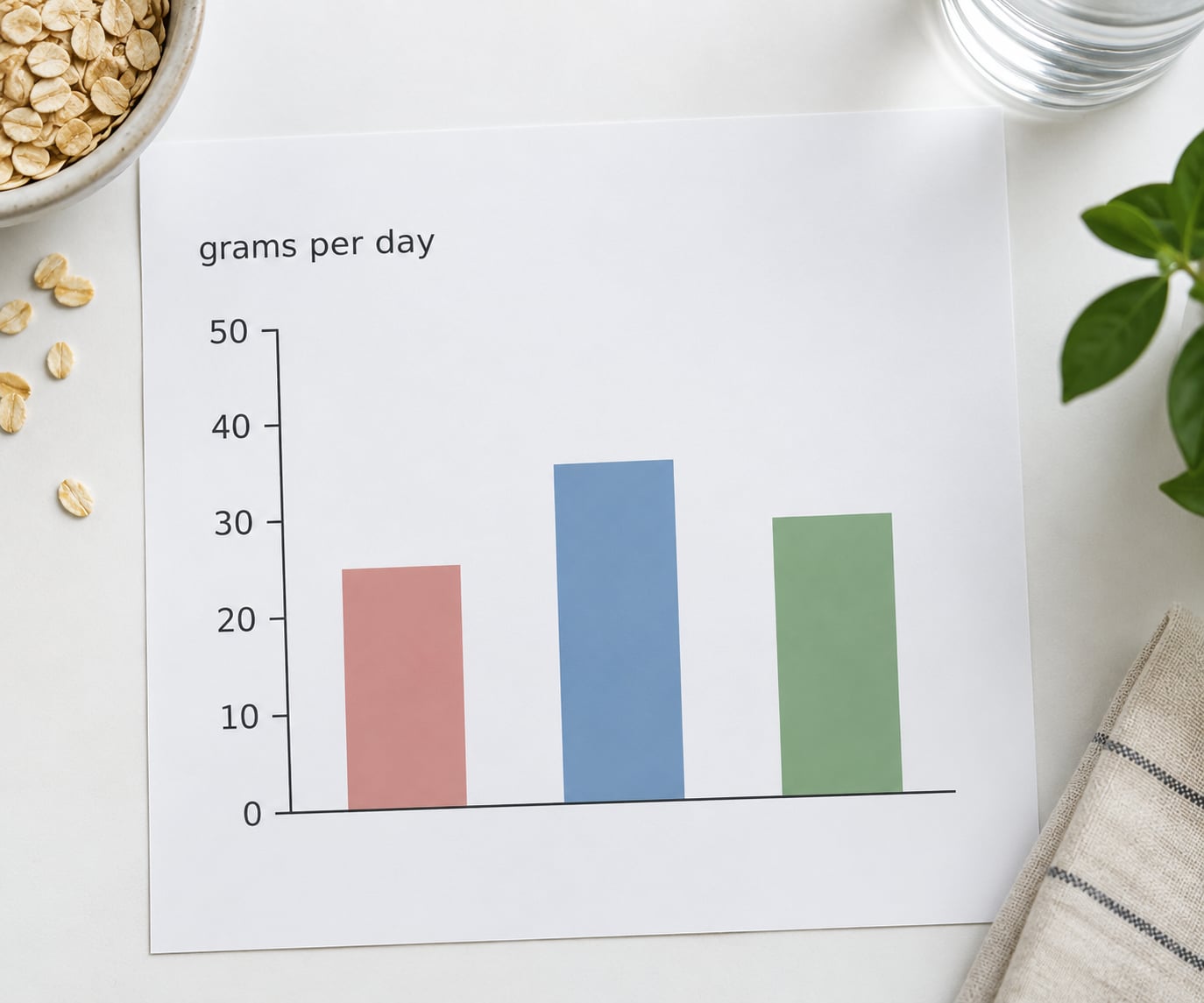
For most adults, the answer is 25 grams a day for women and 38 grams a day for men. After age 50 the recommendations step down slightly, to 21 grams for women and 30 grams for men, because calorie needs fall with age.
Here is the full breakdown from the Institute of Medicine’s Dietary Reference Intakes, which is what the USDA and FDA use for labeling and guidance.
| Group | Recommended daily fiber |
|---|---|
| Children 1 to 3 years | 19 grams |
| Children 4 to 8 years | 25 grams |
| Boys 9 to 13 years | 31 grams |
| Girls 9 to 13 years | 26 grams |
| Women 19 to 50 years | 25 grams |
| Men 19 to 50 years | 38 grams |
| Women 51 and older | 21 grams |
| Men 51 and older | 30 grams |
| Pregnancy | 28 grams |
| Lactation | 29 grams |
These are Adequate Intake values, which is a slightly softer category than a Recommended Dietary Allowance. Adequate Intake is set when there is not enough evidence for a firm daily requirement, but the amount is still believed to be beneficial for nearly everyone.
How Much Fiber Per Day Do You Need for Most Adults?
The short version: 25 grams for women under 51, 38 grams for men under 51. If you eat roughly 2,000 calories a day, you land on 28 grams either way, which is the Daily Value printed on every nutrition label.
There is a second way to look at it, and it is the one dietitians prefer for anyone whose calories are far from 2,000. Divide your daily calories by 1,000 and multiply by 14. At 1,800 calories that gives about 25 grams; at 2,600 calories, roughly 36 grams.
The underlying logic is simple. Fiber adds bulk without adding much energy, so the recommendation scales with how much you eat. Someone eating 3,000 calories burns through fiber faster than someone eating 1,500.
If you have diabetes, are managing a digestive condition, take medication that slows digestion, or have had bariatric surgery, ask a registered dietitian to set your target. The general numbers assume a healthy adult gut, and they do not adjust for the ones that have yours.
Why Fiber Matters for Digestion and Weight Management
Fiber does several different jobs, and the type determines which one. Soluble fiber dissolves into a gel in the gut and includes pectin, beta-glucan, and inulin. Insoluble fiber does not dissolve and includes cellulose and wheat bran.
Insoluble fiber adds bulk and holds water, which is why it supports regular bowel movements and helps with constipation. It moves through you largely intact, physically sweeping the intestine along the way.
Soluble fiber slows digestion. It forms a thick gel in the stomach and small intestine, so sugars from food are absorbed more slowly, which helps flatten blood sugar spikes after a meal. It also binds bile acids, and the liver makes new ones using cholesterol, which is one route by which soluble fiber supports healthy cholesterol levels.
There is a third category worth knowing about: fermentable fiber, often called prebiotic fiber. Bacteria in the colon ferment it and produce short-chain fatty acids including butyrate, which the colon uses for fuel. When people on high-fiber diets describe a shift in bowel habits during the first couple of weeks, that fermentation is usually part of what is happening.
On weight, fiber is helpful because it takes up room. Foods high in fiber are bulky and calorie-dense in a satisfying way, so meals land larger in the stomach without landing large in calories. That fullness tends to lower total intake. Fiber also slows gastric emptying, which flattens the blood sugar curve and the hunger curve that tends to follow it.
Longer-term population research links higher fiber intake with lower rates of heart disease, type 2 diabetes, colorectal cancer, and weight gain. Those are associations across large groups, not promises about what will happen to one person, and fiber is not a treatment for any of those conditions on its own.
How to Calculate Your Daily Fiber Goal
Searches for how much fiber per day do you need usually stall because there is no single number to find. Pick one method instead, and the whole thing takes about a minute.
Method one: the 14-grams-per-1,000-calories rule. Take your average daily calories and multiply by 0.014. Somebody eating 2,000 calories gets 28 grams. Somebody eating 2,400 calories gets 33.6, which rounds to 34 grams. A 1,600-calorie day gives 22 grams.
Method two: the Daily Value. Every nutrition label in the United States lists fiber with a 28-gram Daily Value, set for a 2,000-calorie diet. Add up the fiber from everything you eat in a day and see where you land. This is a general reference point rather than a personalized prescription, but it is accurate enough for most people eating near 2,000 calories.
For the label method, look for three specific things. Total dietary fiber, and soluble fiber if the label lists it separately. Serving size, because a “1 cup” of one cereal and a “1 cup” of another can be very different volumes. And fiber added, which usually means inulin or polydextrose added during processing rather than fiber naturally in the food.
Apps and food databases help when you want a running total across a day. They are only as accurate as the entries, so a rough estimate beats none at all.
Which Foods Provide the Most Fiber?
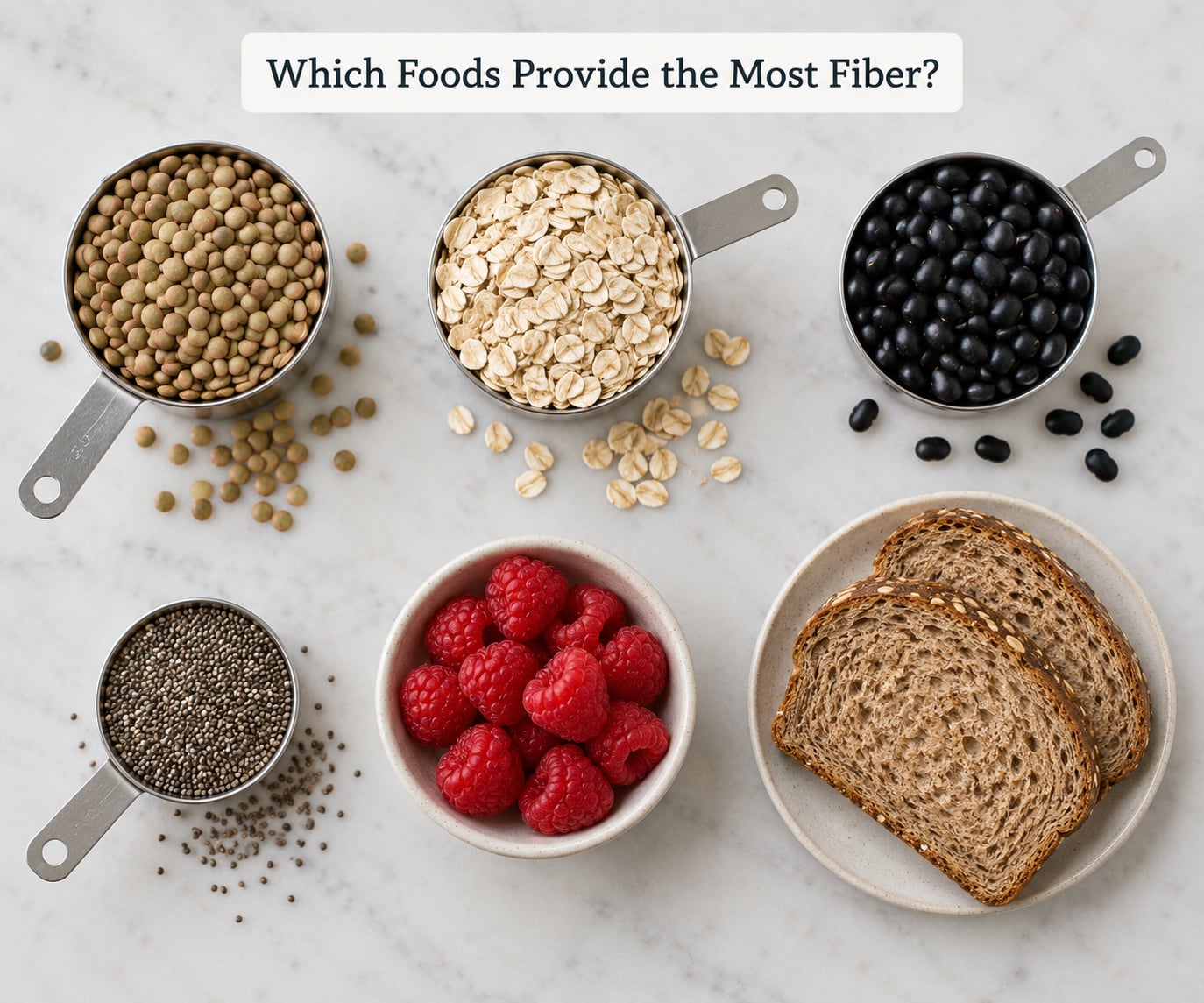
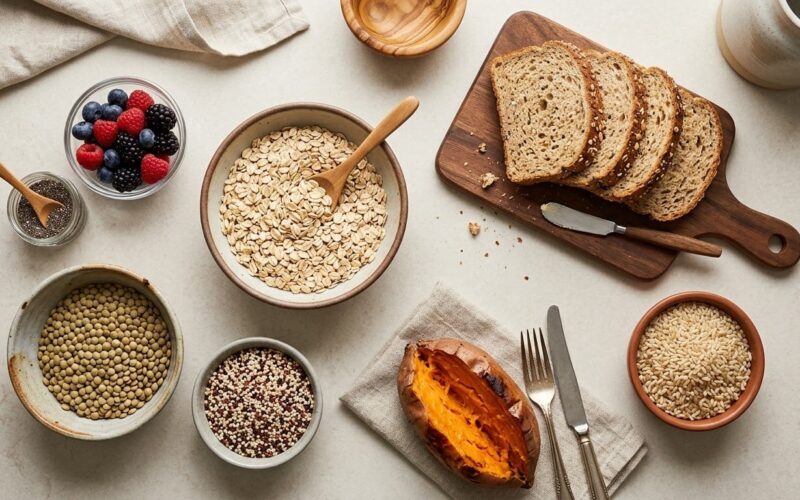
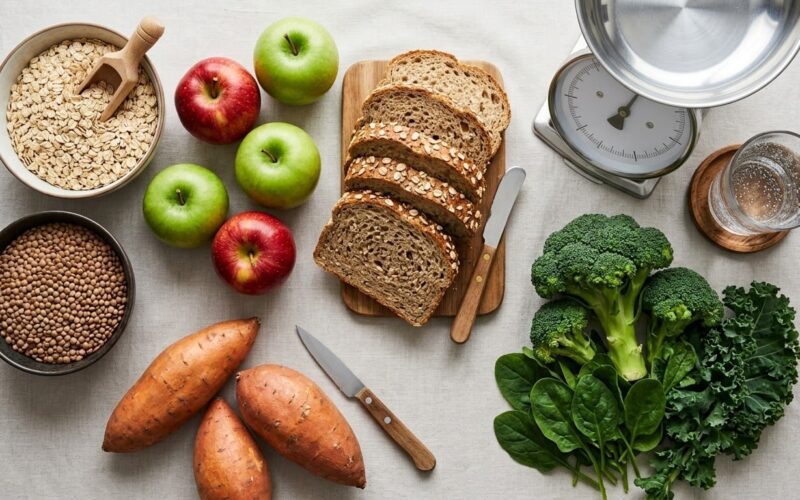
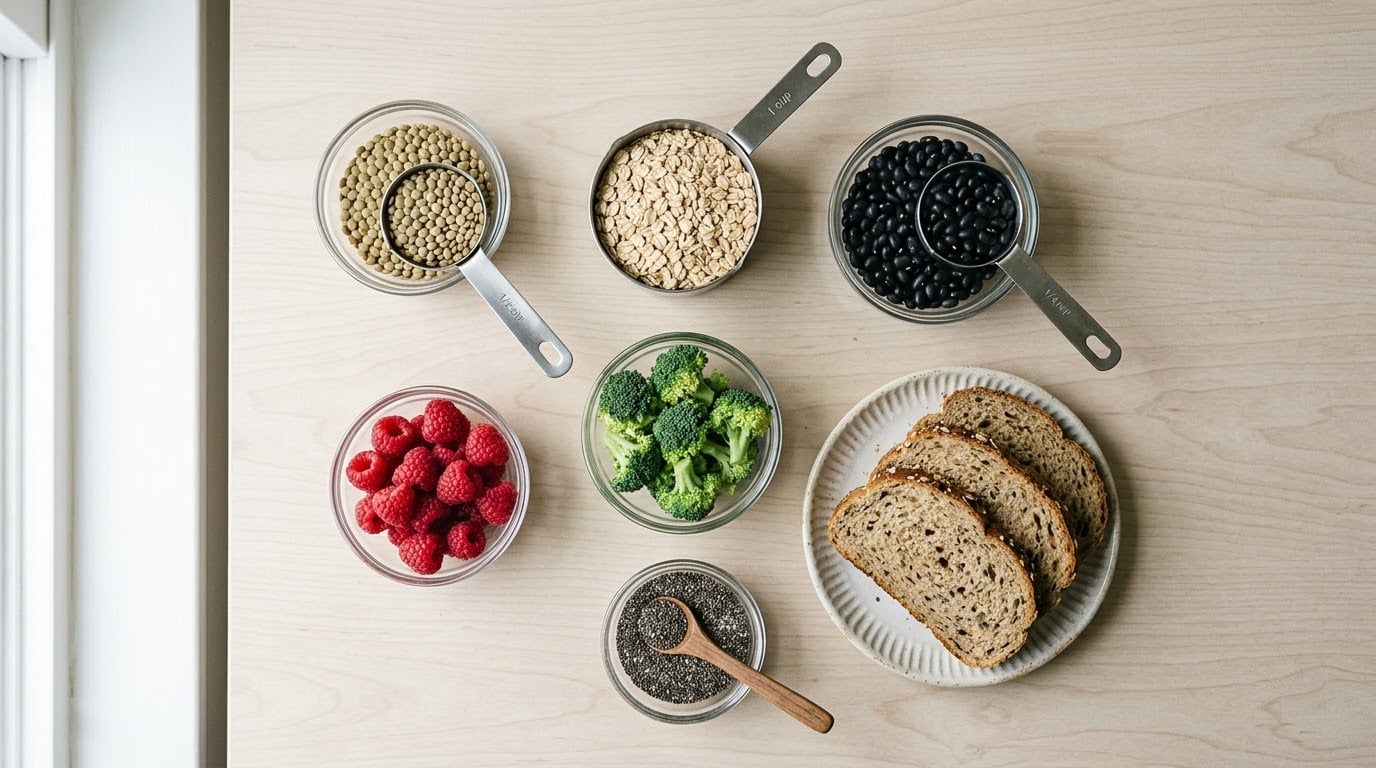
Beans, lentils, and oats do the heavy lifting. Most plant foods are decent fiber sources, and most animal foods contain none at all, which is why omnivores tend to fall short without deliberate effort.
Here is what a normal serving actually delivers, using standard USDA composition values.
| Food | Serving size | Fiber |
|---|---|---|
| Lentils, cooked | 1 cup | about 15.6 g |
| Black beans, cooked | 1/2 cup | about 7.5 g |
| Chia seeds | 1 ounce | about 10 g |
| Avocado | 1 medium | about 10 g |
| Raspberries | 1 cup | about 8 g |
| Pear, with skin | 1 medium | about 5.5 g |
| Broccoli, cooked | 1 cup | about 5 g |
| Old-fashioned oats, cooked | 1 cup | about 4 g |
| Whole wheat bread | 2 slices | about 4 g |
| Apple, with skin | 1 medium | about 4.4 g |
| Almonds | 1 ounce | about 3.5 g |
A cup of cooked lentils is more than half the daily target for women. This is the number that makes the whole problem feel manageable: a few high-fiber staples, used consistently, get you most of the way there without thinking about it.
Some straightforward swaps add real fiber. White bread to whole wheat bread is roughly 2 grams per two slices. Refined cereal to bran or a high-fiber whole grain cereal is closer to 5 grams per bowl. Apple juice to a whole apple with the skin is about 4 grams. Rice to lentils or black beans is 3 grams against 15.
Two details change the math more than people expect. Whole fruit beats juice almost every time, because juicing removes the pulp and insoluble fiber along with it. And grinding flaxseed before eating it releases the oils trapped inside, which is why a spoonful of ground flax does more than a spoonful of whole seed.
How to Increase Fiber Without Discomfort
The most common mistake is doubling fiber overnight. Your gut bacteria need time to shift and your colon needs time to adjust to bulkier stool, and skipping that step is what turns a good change into three days of bloating and cramps.
Add about 5 grams at a time, and give each step a week before going higher. That is slow enough to stay comfortable and fast enough to reach 30 grams in roughly a month from a 10-gram starting point.
- Look at one meal, not the whole day. Pick breakfast, the meal you skip least, and add one fiber-rich food to it. Changing everything at once is the recipe for abandoning the plan.
- Swap rather than add. White rice becomes lentils or black beans. Refined bread becomes whole grain. Same roughage, more fiber, no extra volume.
- Increase beans and lentils slowly. They are among the highest-fiber foods available, and they are also the ones most likely to cause gas. Start with a quarter cup, or a spoonful over a salad, and build from there.
- Drink water. Fiber absorbs water in the colon, and adequate fluid intake is what keeps it moving smoothly. Dehydration makes the constipation side of the equation worse rather than better.
- Spread intake across meals. One meal carrying 20 grams is a lot for an unused gut. Three meals at 8 to 10 grams is far easier to absorb, and it also spreads the fullness effect across the day.
- Track loosely for a week. A food log or an app for seven days tells you more than any article, including this one. Most people find a surprising gap at lunch.
If a particular food consistently causes trouble, it is fine to limit it and get your fiber elsewhere. Beans for lentils, chia for ground flax, or oats for psyllium can be swapped without falling short on the total.
Who May Need a Different Fiber Target?
The 25 and 38 gram numbers assume a healthy adult digestive tract. Several groups need to think differently about their target, and a few need medical input before making large changes at all.
Pregnancy raises the recommendation to 28 grams, and the extra fiber often helps with the constipation that shows up in the second and third trimesters. Older adults may benefit from a steadier approach because appetite and calorie intake fall, and because some have narrowed bowel movement or take medication that slows things down.
People with irritable bowel syndrome often do better starting low. Insoluble fiber can worsen cramping in some, while a soluble or fermentable type may be better tolerated, though individual response varies enough that personal tracking matters more than any rule. A registered dietitian who works with IBS is worth the appointment.
Certain conditions call for caution about large increases rather than caution about fiber itself. That includes a history of bowel narrowing or strictures, an unresolved obstruction, gastroparesis, active inflammatory bowel disease, or swallowing problems that make fibrous foods hard to manage. People on medications that slow gut movement, including some diabetes and pain medications, should ask a doctor or pharmacist first, because fiber changes how some drugs are absorbed.
Restrictive eating patterns raise a different flag. Somebody eating mostly meat, dairy, and refined starch can hit zero grams a day without noticing, because none of those foods contain fiber. That is fixable with beans, lentils, oats, fruit, and seeds, but it is worth naming rather than treating as a personal failing.
When Too Much Fiber or Sudden Changes Are a Concern
More fiber is generally safer than less, but not without limit. Very high intakes, somewhere around 50 to 60 grams a day for a gut that is not used to it, commonly bring gas, bloating, cramping, and loose stools.
The bigger risk is speed. Someone jumping from 15 grams to 45 grams on a Monday is likely to regret it by Monday evening. Slow increases, plus steady water intake, are what make a high-fiber diet something you can actually keep.
Constipation that does not respond to more fiber usually means something other than a fiber shortfall. Not enough fluid, low physical activity, a medication side effect, or an underlying condition can all look the same from the outside.
Talk to a doctor rather than adjusting your diet yourself if you have persistent or worsening abdominal pain, vomiting, blood in your stool, unexplained weight loss, difficulty swallowing, or a persistent change in bowel habits that lasts more than a couple of weeks. In the meantime, do not push your intake higher. Talk to your doctor or a registered dietitian about your personal target.
Frequently Asked Questions
Is fruit better than juice for getting fiber?
Whole fruit, without exception. An apple with the skin gives you roughly 4 grams of fiber; a glass of apple juice gives you none, because the pulp is removed during pressing. Juice also concentrates the sugars without the bulk that slows their absorption. If you prefer juice, eat the whole fruit alongside it, or pick a juice with pulp left in.
What is the best fiber intake for a low-carbohydrate diet?
There is no separate number. Low-carbohydrate diets are usually built from foods that happen to carry fiber, so people often clear their target without noticing. Watch two things: the total on the label, and whether foods are counted as net carbohydrates, which subtract fiber. Keto plans that exclude legumes and whole grains usually need a deliberate fiber source such as chia, ground flax, or psyllium to stay near 25 to 35 grams.
Do I need a fiber supplement if I eat vegetables?
Only if your totals keep falling short. Vegetables are good sources, but most people eat four or five servings a day, and that rarely reaches 25 grams on its own. Supplements such as psyllium can close a small gap, and they cannot replace the vitamins, minerals, and phytonutrients that come with whole foods. Start any supplement at a small dose and increase slowly, with plenty of water.
Are gluten-free foods automatically higher in fiber?
No. Many gluten-free products are made with refined rice flour, tapioca starch, or sugar, and they often carry less fiber than the whole wheat version they replace. Gluten-free whole grains such as oats, quinoa, brown rice, and buckwheat are excellent fiber sources. Check the label, because the gluten-free label on its own tells you nothing about fiber content.
Is more fiber always better for weight loss and digestion?
No. For most adults, going from 15 to 30 grams a day is a meaningful improvement with real research behind it. Beyond that, extra grams add diminishing returns and can bring gas, cramping, and loose stools, especially if you ramp up quickly. Some people with narrowing of the bowel or certain digestive conditions should not raise their intake without medical advice first.
Conclusion
How much fiber per day do you need? For most adults, 25 grams for women and 38 for men, or the 28-gram Daily Value printed on a 2,000-calorie food label. If you have not been counting at all, pick one meal you eat every day, add one genuinely high-fiber food such as lentils, beans, oats, or berries, and raise it about 5 grams a week while drinking enough water. That is the whole project, and it is smaller than it sounds.