How to track food without obsessing comes down to swapping the metric, not the effort: note how hungry you were, how you felt an hour later, what your energy did, then review the pattern once a week instead of once a meal. You keep the awareness that actually changes habits, and you drop the guilt, the searching, and the daily number that tells you nothing useful.
Most people who quit food tracking did not quit because they stopped caring. They quit because logging every gram turned eating into arithmetic, and the arithmetic started to feel like a verdict. A few seconds of searching a database for the calories in a restaurant meal, or weighing a leftover slice of bread, is enough to make a normal dinner feel like a test you might fail.
This guide is a way to keep the useful part of tracking for a fixed period, answer one specific question, and then either step down a level or stop entirely. It is general information, not nutrition advice for your body. If tracking triggers anxiety, disordered eating, or compulsive behaviour, talk to a registered dietitian nutritionist or your doctor before starting anything here.
Table of Contents
- What You Need
- Step-by-Step: How to Track Food Without Obsessing
- Choose a Tracking Method That Answers Your Question
- Record What Helps You Notice Patterns
- Review Trends Instead of Perfect Days
- Use a Short-Lived Tracking Period
- Let Flexible Eating Be the Goal
- Common Mistakes When People Track Too Long
- Tracking for months instead of days
- Recording calories and nothing else
- Using guilt as motivation
- Chasing perfect adherence
- Reacting to every weight change
- Using exercise as a calorie offset
- Breaking shared meals into exact portions
- Quitting tracking entirely and losing accountability
- Quick Tips for Healthier, Less Stressful Tracking
- Frequently Asked Questions
- How often should I track food?
- Is there a food tracking app that doesn’t count calories?
- Do I have to count calories to lose weight?
- What should I track instead of calories and weight?
- How do I stop counting calories?
- When is food tracking a sign I should get professional help?
- Conclusion
What You Need
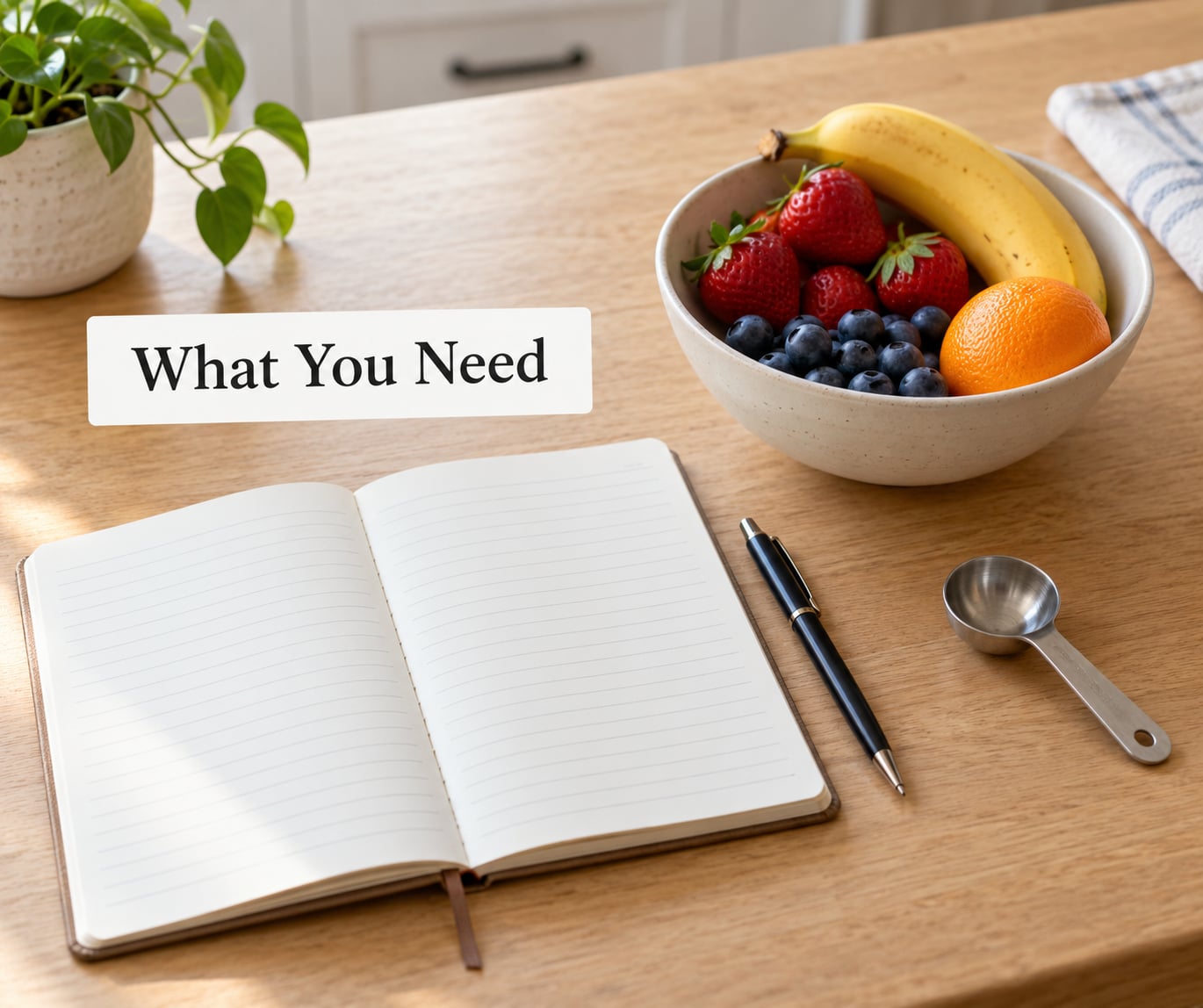
Formal tracking is optional. What you actually need is much smaller than an app subscription.
- One way to record things. A paper notebook, a notes app on your phone, or a plain photo album. Paper suits people who want to stay away from screens at meals; photos suit people who would rather not write.
- A written question. Something like “why do my afternoons fall apart” or “do I actually eat a proper breakfast”. A question gives you a stopping point and keeps you from tracking everything forever.
- A few minutes per meal. Thirty seconds is realistic for most methods. If a method needs five minutes of measuring per plate, it is the wrong method for you right now.
- A review rhythm. Pick a weekly slot, maybe Sunday evening, and treat it like the only time you look at what you wrote. Nothing gets checked mid-week.
- A flexible goal. Not a target number. A direction, such as eating a real meal before 9am on weekdays, or having something satisfying in the house for the 4pm slump.
You do not need a kitchen scale, a membership, or a spreadsheet. You do need a clear end date.
Step-by-Step: How to Track Food Without Obsessing
Choose a Tracking Method That Answers Your Question
Pick the least demanding method that can still answer your question. That is the whole selection rule. Anything more detailed than your question requires becomes work, and work around food tends to turn into pressure.
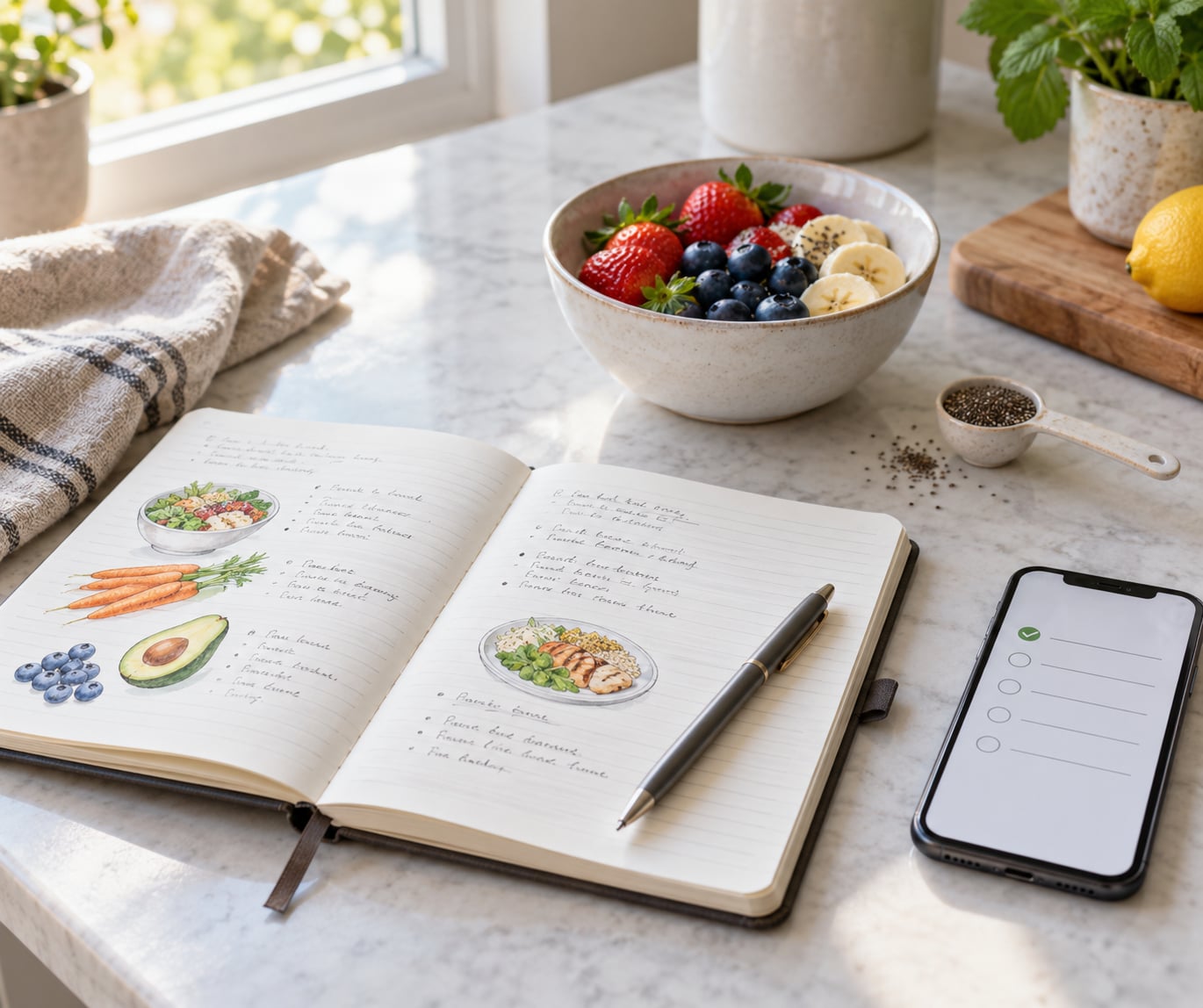
- Paper notes. A few words per meal: what you ate, roughly when, and how hungry you were. Effort is about twenty seconds a meal. It suits people who want zero app interaction and no way to see a calorie total.
- Photo log. Snap the plate, add a short caption. Effort is under a minute. People in eating-disorder recovery communities describe this as the method that keeps awareness without numbers, because calorie language itself can be a trigger.
- Hunger and fullness check-in. You rate hunger before a meal and fullness afterwards on a one to ten scale, or in plain words. Nothing about the food itself gets recorded. Effort is roughly fifteen seconds, twice a day.
- Non-numeric journal. Meals plus time, energy, digestion, sleep and mood. This is the richest of the four and the most useful for spotting patterns across a week. Effort is about two minutes a meal.
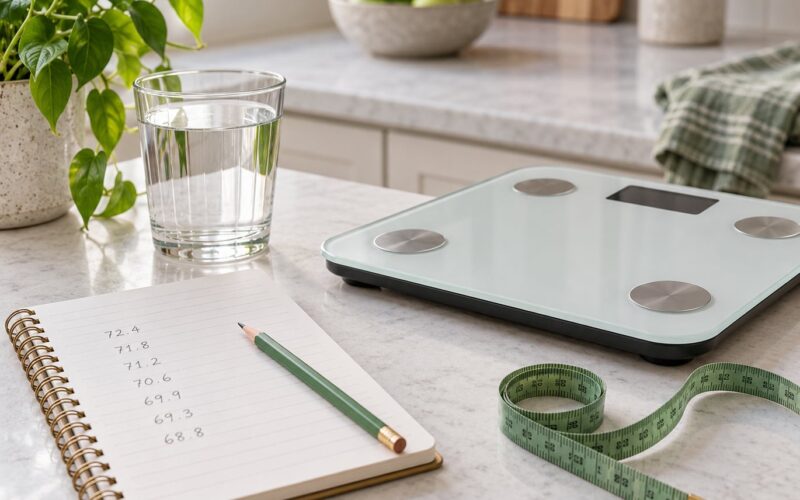
- Trend-based weigh-ins. Daily weight is off the table. You weigh in one or two mornings a week and look at the direction over a month. This is the only method here that produces a number, so it suits people who want scale data without daily emotional swings.
Barcode scanning and full macro logging sit at the far end of the effort scale. They are useful for short, specific projects, such as a week where you are training for something. They are a poor fit for a permanent habit, because they ask you to break every shared plate and restaurant dish into exact portions.
Give the method two weeks before you judge it. Most people quit a method in three days and then blame themselves, when what actually happened is that the method did not fit.
Record What Helps You Notice Patterns
Record what answers your question, and nothing else. Exact calorie counting is not required every day or for every person, and for many people it is the thing to remove first. These are the details worth a note:
- Hunger before a meal, one to ten. Shows whether you are starting meals too late. Note it every meal.
- Fullness an hour after eating. Shows whether portions and pace leave you satisfied. Also every meal.
- Energy and mood. Connects food choices to the part of the day you struggle with. Once or twice a day is enough.
- Sleep. Low sleep and next-day cravings are tightly linked. One number a day, no detail needed.
- Digestion. Bloating or discomfort often points at a food pattern you can change. Write it down as it happens.
- Context. Tired, rushed, at a restaurant, cooking for four people. A few words with the meal.
- Clothes fit. A slow, honest progress signal that does not move daily. Check it every two weeks.
Protein, fibre and whole foods matter more than counting, but tracking a serving of each is not required. A rule of thumb that comes up often in intuitive eating work is roughly 80 percent of meals from foods you genuinely enjoy and 20 percent from lighter or more processed options. It is a flexible guide, not a scoreboard.
One honest limit is worth knowing before you start. Studies of self-reported food diaries find people consistently under-report what they actually ate, often by around 100 to 200 calories a day. Logging is a rough instrument, and treating it as exact is how a simple habit turns into a source of false confidence followed by discouragement.
Review Trends Instead of Perfect Days
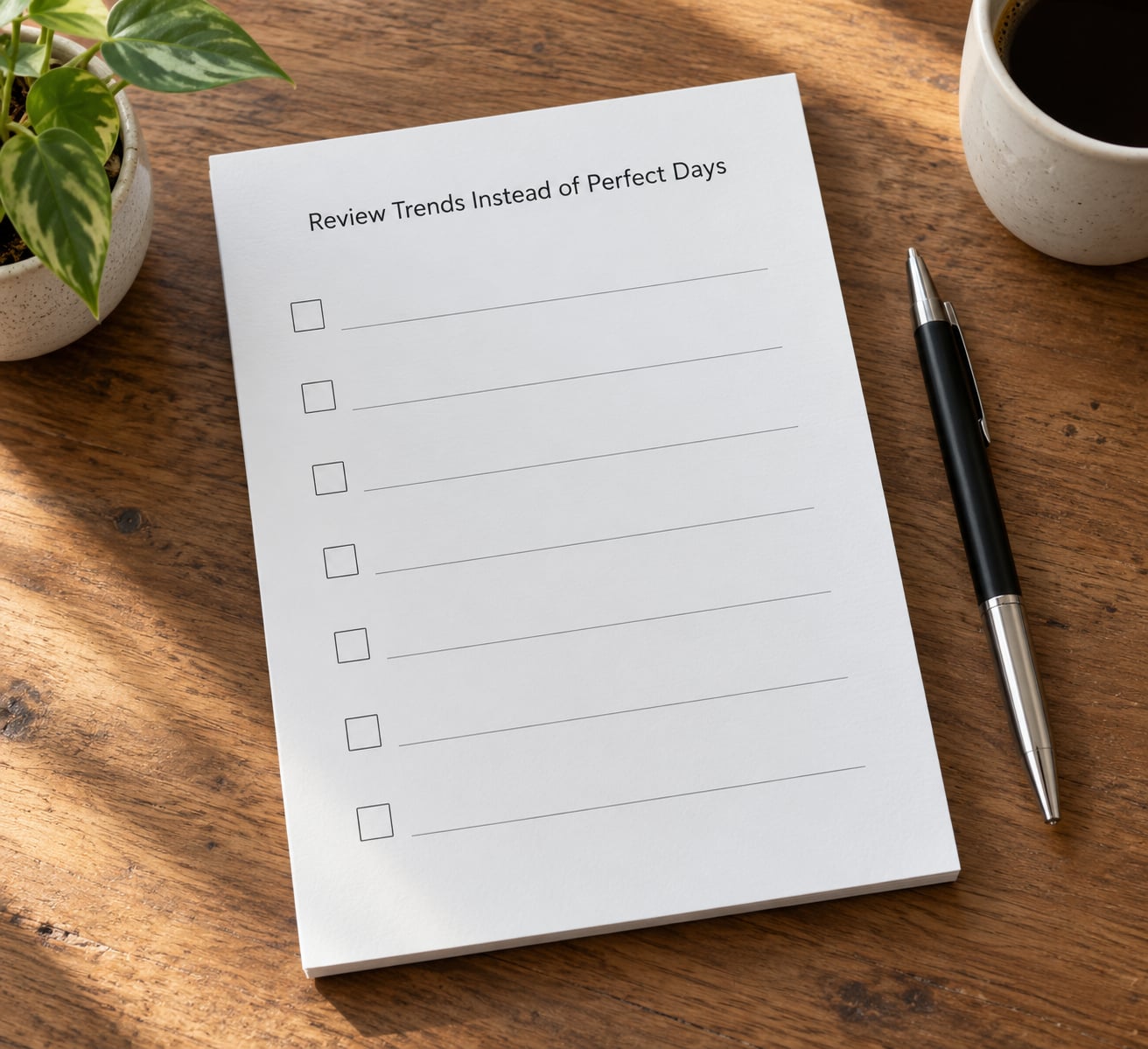
Review on a schedule, and only for a few minutes. Look for patterns across days, not verdicts inside meals.
Useful patterns to look for: a breakfast skipped four days out of five, a convenience dinner repeating on busy nights, the same low-energy slump every afternoon, or eating right up until bedtime after long days. Also useful: the days that felt good, so you can see what made them different.
Try writing two sentences and one small action. “Lunch at 1pm three times and I crashed at 3pm. Next week I am putting something in the fridge on Sunday so there is an easy option.” That is the whole review.
Do not, in the review, relitigate a meal you already ate. It is logged, it is done, and it has no bearing on the plan you are making. One meal is a meal. An honest review is a data collection, not a verdict.
Use a Short-Lived Tracking Period
Give tracking a defined life. Three to seven days answers most questions. A week of notes usually makes a pattern obvious enough to act on without more data.
When the period ends, choose one of three moves: keep the same method but drop to a weekly check-in, step down to a lighter level such as photo-only or monthly weigh-ins, or stop tracking. Decide this on day one and write the end date at the top of your notes, because the day the question gets answered is exactly the day the habit starts to look like a virtue worth keeping forever.
People who track indefinitely tend to fall into one of two patterns: obsessive tracking that ends in burnout, or an on and off cycle that ends with weight returning. A planned exit is what avoids both.
Let Flexible Eating Be the Goal
Turn one observation into one supportive change. Plan one easier meal. Keep a satisfying snack in the house. Buy the vegetables that are actually easy to cook on a Wednesday and skip the ones that need twenty minutes.
Flexible does not mean unstructured. It means the structure sits around your life instead of your life bending around a target. If a change turns eating into something you dread, it is the wrong change, and a smaller one usually works better.
If tracking stops and the change holds on its own, tracking did its job. Many people end up at no daily record at all and still keep a single weekly habit: checking that the week included real meals, some movement, and sleep that was not terrible.
Common Mistakes When People Track Too Long
Most tracking problems are the method’s fault, not the reader’s. The fixes below are ordered roughly by how often they come up.
Tracking for months instead of days
A short period answers a question. A long period starts generating its own feedback, and that is where numbers turn into self-evaluation. Fix: set an end date before you begin, and treat the last day as a normal day rather than an assessment day.
Recording calories and nothing else
Calorie data has no context. It cannot tell you that you slept four hours, that you ate standing up at the counter, or that you were ravenous by three in the afternoon. Fix: add hunger, fullness, energy and context, and drop exact counting for most days if the numbers are what make you feel worse.
Using guilt as motivation
Guilt feels like progress for about a day, then it stops working, and the rebound is usually bigger than the original slip. Fix: replace shame with curiosity. You ate the thing you wanted, so what would have made that meal easier to choose? That question leads somewhere useful.
Chasing perfect adherence
Aim for useful, not flawless. If you track five days out of seven, that is a good week, and the two missed days carry no information at all. Perfectionism here is just a slower route to quitting.
Reacting to every weight change
Daily weight moves with water, salt, bowel movements, sleep and what you drank yesterday. Reacting to single readings is reacting to noise. Fix: if you want to use the scale at all, weigh one or two mornings a week at the same time, then judge the direction after a month rather than the number after breakfast.
Using exercise as a calorie offset
Logging a walk to cancel dinner turns two ordinary parts of your day into a ledger that has to balance. Fix: keep movement for how it makes you feel, sleep, and stay strong, not as a penalty.
Breaking shared meals into exact portions
A family dinner or a plate of restaurant food will never split cleanly into grams, and pretending otherwise creates a daily small failure. Fix: describe it honestly. A shared plate at a table with friends is not a tracking problem; it is a Tuesday.
Quitting tracking entirely and losing accountability
The common failure mode is the opposite one: dropping everything on day three because the numbers felt heavy, then feeling lost without any check-in at all. Fix: step down a level instead of stopping. Move from a full journal to photo-only, or from photo-only to one weekly note. A calendar reminder for a Sunday look-back is enough once detailed tracking ends.
Quick Tips for Healthier, Less Stressful Tracking
- Track one question, not everything. A question you can finish in a week beats an open-ended habit every time.
- Use a minimum viable entry: hunger, what you ate in a few words, and fullness afterwards. Fifteen seconds is a complete entry.
- Set a stopping time on day one, and put it somewhere you will actually see it.
- Take a neutral day off rather than a guilt-laden cheat day. Not tracking is not the same as failing.
- Eat at a table, away from the phone, at least a few times a week. Attention during the meal does more for satisfaction than any logged metric.
- Ask a registered dietitian nutritionist for help if tracking brings up anxiety, binge and restrict cycles, or disordered eating. That is a health question, not a willpower failure, and it is the point at which a professional is more useful than any app.
Frequently Asked Questions
How often should I track food?
Most people get what they need from three to seven days of notes, because patterns like a skipped breakfast or a repeated 3pm crash show up within a week. After that, a weekly look-back or a monthly check is usually enough to keep you honest. Daily tracking is worth it only when there is a specific question to answer, such as whether a change in your routine affected your energy.
Is there a food tracking app that doesn’t count calories?
Yes. Several apps are built around check-ins and feelings rather than numbers. GentleCal focuses on how food makes you feel, Eated prompts a hunger check before eating, Intuitive Eating Buddy and Moderation are designed around intuitive eating, and photo-log apps in eating-disorder recovery communities are used for awareness without any calorie figures. Check current features and privacy terms yourself before you pick one.
Do I have to count calories to lose weight?
No. Many people lose weight and keep it off with structured, non-numeric methods: consistent meals, protein and fibre at most meals, vegetables most days, less liquid sugar, and movement they enjoy. Calorie counting works for some people and becomes a trap for others, often with a history of disordered eating or obsessive thinking. What matters is that the method stays sustainable for you.
What should I track instead of calories and weight?
Hunger before meals and fullness afterwards, daily energy, sleep, digestion, and the context around a meal, such as being rushed, tired or cooking for other people. Add slow markers like how your clothes fit every two weeks. These are cheap to record, they explain causes rather than outcomes, and they cannot move by two pounds between Tuesday and Friday.
How do I stop counting calories?
Taper rather than quit. Spend one week recording calories and nothing else, then one week adding hunger and fullness. After that drop the calories and keep the check-ins, then move to a photo log or a weekly note. Removing the number first is usually harder than removing the habit, so change one thing at a time and expect the first week to feel oddly empty.
When is food tracking a sign I should get professional help?
Seek support if tracking makes you anxious, if you skip meals to make numbers work, if you binge and restrict in cycles, if you hide what you eat, or if you cannot stop checking numbers even when you decide to. Seek support if you have OCD, a history of disordered eating, or an eating disorder diagnosis now. A registered dietitian nutritionist and a therapist who works with eating disorders can rebuild tracking around safety.
Conclusion
Choose one short tracking period of three to seven days. Record only hunger, fullness, energy and the context around each meal, review the pattern once at the end, then make one flexible change such as planning an easier dinner.
That is the short version of how to track food without obsessing: one question, one short window, one adjustment, then a decision about whether to step down or stop. Food awareness is a tool for taking care of yourself, not a test of your worth, and a period of tracking that ends on purpose is stronger than permanent tracking that ends in burnout. If tracking brings up anxiety, restriction, or binge and restrict cycles, that is worth raising with a registered dietitian nutritionist or your doctor.