A healthy grocery list on a budget is built the same way every week: a short set of versatile staples, frozen and seasonal produce, cheap proteins like eggs and beans, and a written page you take with you. Almost all of the saving happens before you reach the store, in the ten minutes you spend deciding what you will cook.
What follows is the system I use. Plan loosely, inventory the pantry, list by category, then shop the aisles in the same order every trip.
Table of Contents
- What You Need
- Step-by-Step: How to Build a Healthy Grocery List on a Budget
- Step 1: Set Your Weekly Food Budget
- Step 2: Check the Pantry Before You Shop
- Step 3: Plan Meals Around Flexible Ingredients
- Step 4: Build the List by Grocery Category
- Step 5: Compare Unit Prices and Flexible Substitutions
- Step 6: Shop and Store Your Groceries
- Common Mistakes That Blow the Budget
- Frequently Asked Questions
- What is the cheapest healthy grocery list for one person?
- Which foods are most affordable for healthy eating?
- Can I build a healthy grocery list on a budget without buying fresh produce every week?
- How should I compare grocery prices to save money?
- What should I buy first when my grocery budget is limited?
- How can I reduce food waste after grocery shopping?
- Conclusion
What You Need
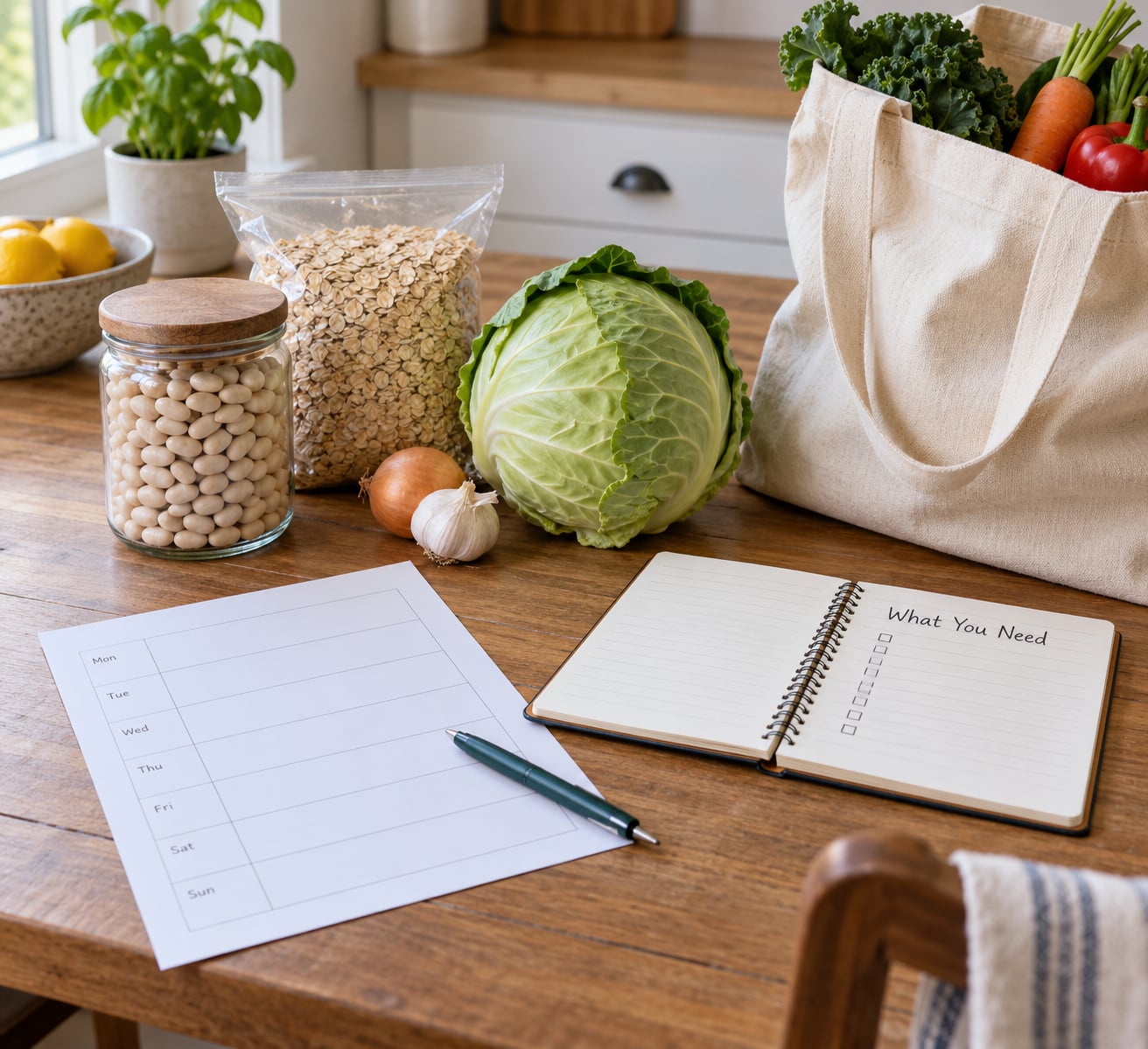
You need four things, and three of them are free.
- A meal skeleton. Not a detailed plan. Just the main protein, the grain and the vegetable for each evening, plus what breakfast looks like.
- A pantry inventory. A notebook or a note on your phone listing what you already have and roughly how much is left.
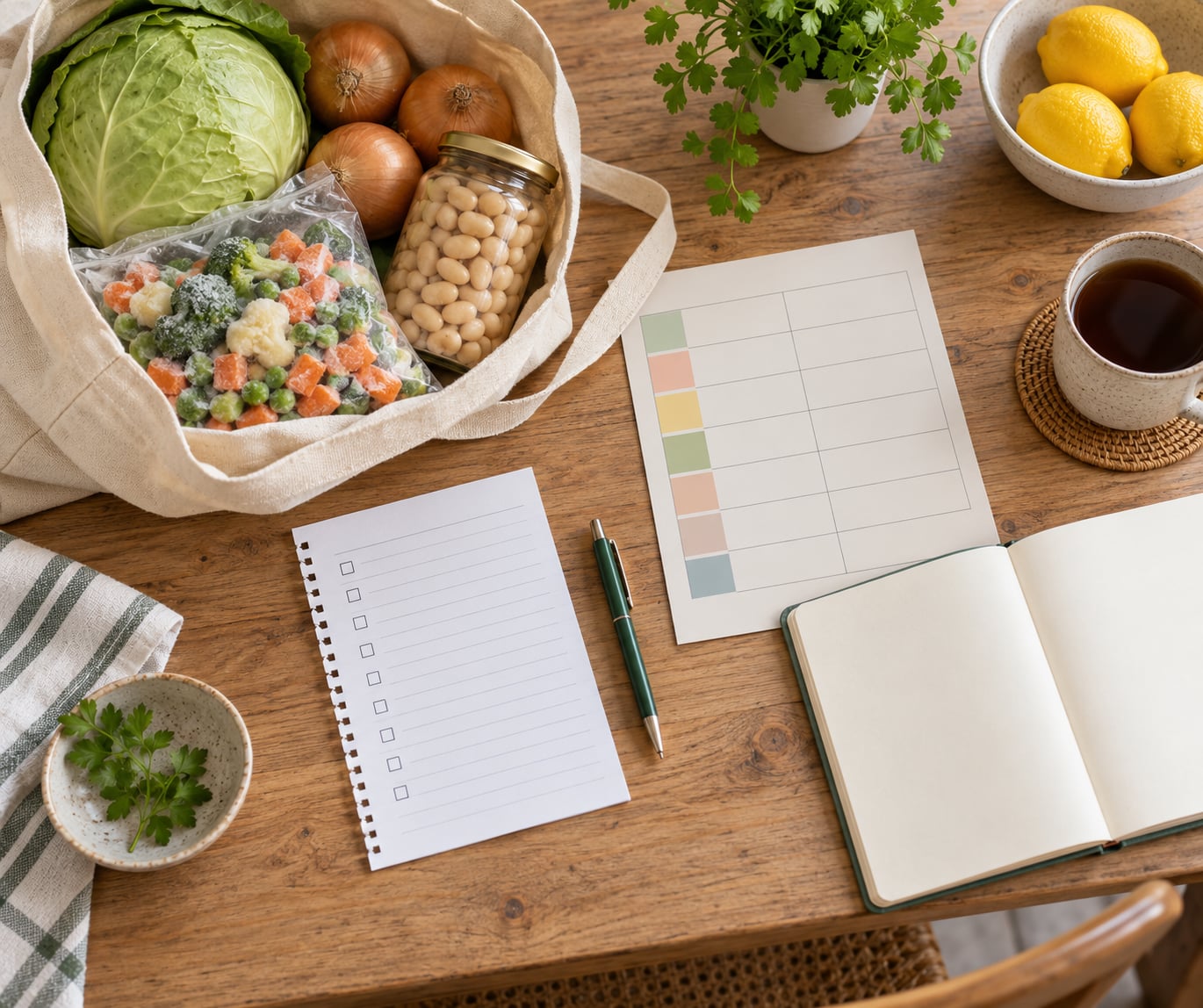
- A way to write the list. Paper and a pen taped to the fridge works better than an app for most households. The list has to be visible while you cook, not buried on a screen.
- A number. One realistic weekly figure you can defend. If you cannot name it, use last week’s total as the ceiling.
A pack of reusable bags and a cheap clipboard are the only equipment involved. Nothing else is required.
What you do not need is just as important: no specialty diet products, no imported ingredients you cannot pronounce, no powder mixes marketed as a shortcut, and no paid planning subscription. Whole foods from the regular aisles do the work.
Step-by-Step: How to Build a Healthy Grocery List on a Budget
The process takes about fifteen minutes and runs in a fixed order. Each step tells you what finishing it looks like, so you know when to move on.
Step 1: Set Your Weekly Food Budget
Write your ceiling at the top of the list page before you add a single item. Then divide it into rough envelopes: protein, produce, grains and starches, dairy or fortified alternatives, and a small pot of extras.
A workable starting split puts roughly a quarter of the budget on protein, a quarter on produce, a quarter on grains and pantry staples, and the remainder on dairy or alternatives plus extras. Household size matters more than the totals. A single person buying family-size portions pays a premium every time, so scale package sizes down instead of buying the same sizes as a family of four.
How you know it worked: the number is specific enough that you can say yes or no to an item in under two seconds. A vague number leads to a vague cart.
Step 2: Check the Pantry Before You Shop
Open every cupboard and the freezer, and write down what is there. Most overspending is duplicate buying, not price. Nobody wants a third jar of the same sauce while the first one sits at the back of the shelf.
Look specifically for oats, rice, dried or canned beans, canned tomatoes, canned vegetables, frozen vegetables, eggs, oil, vinegar and spices. Check dates and move anything expiring this week to the front of your plan. The step worked if your list is shorter than it was before the inventory.
People on r/Frugal describe the same core kit over and over: rice, beans or lentils, oats, peanut butter, eggs, cabbage, onions, potatoes and canned tuna. It is a good kit because every item on it becomes several meals.
Step 3: Plan Meals Around Flexible Ingredients
Choose four or five base foods that each appear in more than one meal. Beans work in soup, over rice, in a breakfast hash and mashed with salsa. Eggs become a five-minute scramble, a hard-boiled snack and a frittata using the vegetables you bought.
Write three to four evening meals, not seven. Leftovers are planned, not accidental: cook a larger portion on purpose so tomorrow’s lunch already exists. A 1970s-era approach of cooking extra portions is simply batch cooking, and it is the cheapest way to break the per-meal cost.
How you know it worked: you can name at least four meals before you shop, and three of them share at least one ingredient.
Step 4: Build the List by Grocery Category
Write the list the way you walk the store. Grouping by category stops the expensive, impulsive aisle from leaking into the cart.
Produce
- Cabbage, onions and carrots: cheap, long-lasting, work in soups, stir-fries and braises.
- Potatoes and sweet potatoes: filling starches that stretch a meal.
- Frozen broccoli, spinach, peas and green beans: cheaper than fresh, no waste, same nutrients.
- Bananas, apples and oranges: usually the least expensive fruit in the store, and they travel well.
- One in-season vegetable per week, chosen from what is displayed at the front of the produce area.
Protein
- Eggs: the most versatile item on this list.
- Canned tuna and sardines: no prep, long shelf life, shelf-stable.
- Dried beans, lentils and chickpeas, plus canned beans for the week you forget to soak.
- Chicken thighs or drumsticks, which are usually cheaper than breasts and stay tender.
- Plain yogurt or firm tofu for protein with a short ingredient list.
Grains and starches
- Oats, rice and pasta in the largest sensible size for your household.
- Tortillas or sandwich bread for quick lunches.
Dairy and fortified alternatives
- Milk or fortified plant milk; plain yogurt; hard cheese for topping.
Pantry staples
- Peanut butter, a neutral oil, canned tomatoes, broth, vinegar.
- Garlic powder, paprika, cumin, black pepper and chili flakes, which turn plain staples into different meals.
Extras
- One or two items that are purely for enjoyment. Removing all of them is how a plan collapses by week three.
As a rough balance check, some households use a 5-4-3-2-1 pattern: five fruits and vegetables, four protein servings, three dairy or calcium-rich servings, two grain or starch servings and one discretionary item across a day. Treat it as a loose guide rather than a rule, and adjust it if you have a medical condition or dietary restriction. For advice that fits your own situation, a registered dietitian is the right person to ask.
How you know it worked: every line on the list maps to a specific meal, and nothing on the list was added because it was on display.
Step 5: Compare Unit Prices and Flexible Substitutions
Read the shelf tag, not the front of the package. Find the price and the unit size, then divide to get the cost per ounce or per pound. Two brands of the same item can differ by a factor of three once you do that math, and the pricier one is often the one placed at eye level.
Substitutions are where a list becomes flexible. Swap ground chicken for ground turkey, canned corn for frozen corn, fresh chicken breasts for thighs, dried beans for meat in a soup or chili, and store-brand versions for national brands in pantry staples. Store-brand canned goods, rice, pasta and canned vegetables are nutritionally comparable to national brands in most cases; the differences are usually in sodium and added sugar, so compare those two numbers on the label rather than assuming.
Buy frozen produce and meat in bulk only if you will actually cook it within the freezer’s safe window. For shelf-stable items such as rice, beans, oats and canned goods, the largest size genuinely lowers the per-unit cost, and nothing spoils.
How you know it worked: you can point to three items on your list where you swapped or chose a store brand without losing anything nutritionally important.
Step 6: Shop and Store Your Groceries
Walk the store in the order you wrote the list. Start with produce, then protein, then the long aisles, and hold back end-cap displays, which are placed to slow you down and prompt impulse buys. Compare unit prices on the two or three items where the choice actually matters.
Do not shop hungry, and eat a real meal before you leave the house. Nearly everyone reports the checkout aisle as the point of failure.
At home, unpack before putting anything away and put perishables into the refrigerator at 40°F (4°C) or below, within two hours of getting home. Use the oldest items first so nothing gets pushed to the back. Cooked food keeps three to four days in the refrigerator; freeze portions you will not eat in that window.
Cook to safe internal temperatures and check with a thermometer. Poultry reaches 165°F (74°C), ground meat 160°F (71°C), and whole cuts of meat and fish 145°F (63°C).
How you know it worked: at the end of the week there is no food binned, and the written list still tells you what to buy next time.
Common Mistakes That Blow the Budget
Shopping with no meal plan. Fix: write three to four evening meals before you leave the house. A list without meals is a shopping list, not a food plan.
Buying oversized packages for a small household. A family-size bag of rice at a low per-unit price still spoils if one person cannot eat through it in a month. Fix: match the package to your actual weekly consumption, and buy larger only for shelf-stable items.
Buying only fresh produce. Fix: buy frozen for the vegetables you cannot finish in a week, and fresh for the two or three you will eat first. Frozen vegetables are picked and frozen at peak and lose no meaningful nutrition in the process.
Buying processed diet foods as shortcuts. Fix: spend that money on plain yogurt, frozen vegetables and beans, and flavor them yourself with spices. Prepared diet meals carry a premium for very few calories saved.
Letting food go off in the crisper. Fix: keep an “eat first” shelf at eye level in the refrigerator and move new groceries behind the older ones.
Shopping hungry or without a list. Fix: eat first, and take the written page. If you deviate, go back for one item only.
Ignoring weekly ads and store loyalty programs. Fix: scan the ad for the three proteins and the seasonal produce you would buy anyway, and leave the rest alone.
Buying because the package looked big. Fix: use the unit price every time. A large bag is only a good deal if you finish it.
Three habits keep the list working over time. Review the receipt when you get home and note anything you bought on impulse. Rotate one item each week so the same six dinners never repeat back to back. And keep the list visible, because a list nobody looks at during the week is a list nobody updates.
Frequently Asked Questions
What is the cheapest healthy grocery list for one person?
For one person, the cheapest healthy list is built on small packages and shelf-stable staples: oats, rice, dried beans, canned tuna, eggs, frozen vegetables, cabbage, onions, potatoes and bananas. Skip family-size produce you cannot finish. Most people do well buying the same core every week and rotating one or two items so meals stay varied.
Which foods are most affordable for healthy eating?
The most affordable healthy foods are dried beans and lentils, eggs, canned tuna, oats, rice, whole-grain pasta, frozen vegetables, cabbage, onions and potatoes. They are cheap per serving, keep well, and lose little nutrition in storage. Frozen produce is usually cheaper than fresh with no waste. Peanut butter and plain yogurt add staying power for very few ingredients.
Can I build a healthy grocery list on a budget without buying fresh produce every week?
Yes. Frozen vegetables and fruit are picked and frozen at peak ripeness, so they keep their nutrients and usually cost less than fresh with none thrown away. Buy fresh only for the two or three items you will eat in the first few days, such as bananas, apples and one in-season vegetable, and take the rest frozen.
How should I compare grocery prices to save money?
Read the shelf tag and divide the price by the package size to get a cost per ounce or per pound. That single step shows which item is actually cheaper, regardless of package size or brand. Compare it across a few staples you buy every week, and remember that items at eye level are usually placed there to cost more.
What should I buy first when my grocery budget is limited?
Buy the items that feed you the most times first: a large bag of dried beans or lentils, a bag of oats, rice, eggs, and a bag of frozen mixed vegetables. These stretch across breakfasts, lunches and dinners and keep for months. Add canned tuna and one fresh item per week, then build the rest of the list around what you already have.
How can I reduce food waste after grocery shopping?
Unpack and put away groceries immediately, then move older items to the front of the refrigerator at eye level. Cook an extra portion on purpose the day you make dinner so tomorrow’s meal already exists. Plan one meal a week that uses whatever is closest to spoiling, and check the crisper before you decide what to buy again.
Conclusion
Start with the pantry, not the store. Open the cupboards, write down what you have, pick three or four evening meals that share ingredients, and build the list by category in the order you walk the aisles.
A healthy grocery list on a budget is not a one-time document. It is a short page you rewrite every Sunday, and the second version is usually cheaper than the first.