A treadmill walking workout for fat loss is simply a walking session where you control speed and incline, hold a moderate effort for 25 to 45 minutes, and repeat it most days of the week. Fat comes off through a calorie deficit, and walking is one of the easiest ways to build that deficit without running, weather, or a gym membership.
Below is the session I send beginners to: about 30 minutes, built from named blocks with an incline and a speed for every minute of it. Then I show you how to progress it over four weeks and which mistakes stall the whole thing.
Table of Contents
- What You Need
- How to check the machine and pick a starting speed
- When to check with a doctor first
- Step-by-Step Treadmill Walking Workout for Fat Loss
- The 30-minute session, block by block
- Key rules for best results
- Why incline changes the calorie burn
- How to progress your treadmill walking workout for fat loss
- How much walking you actually need each week
- What fat loss to realistically expect
- Common Mistakes
- Frequently Asked Questions
- How long should I walk on a treadmill for fat loss?
- Should I use incline intervals on a beginner treadmill workout?
- What treadmill speed counts as a moderate walking pace?
- How many days per week should I do a treadmill walking workout?
- Does treadmill walking burn enough calories to lose fat?
- Is walking on a treadmill good enough if I do not see weight changes immediately?
- Conclusion
What You Need
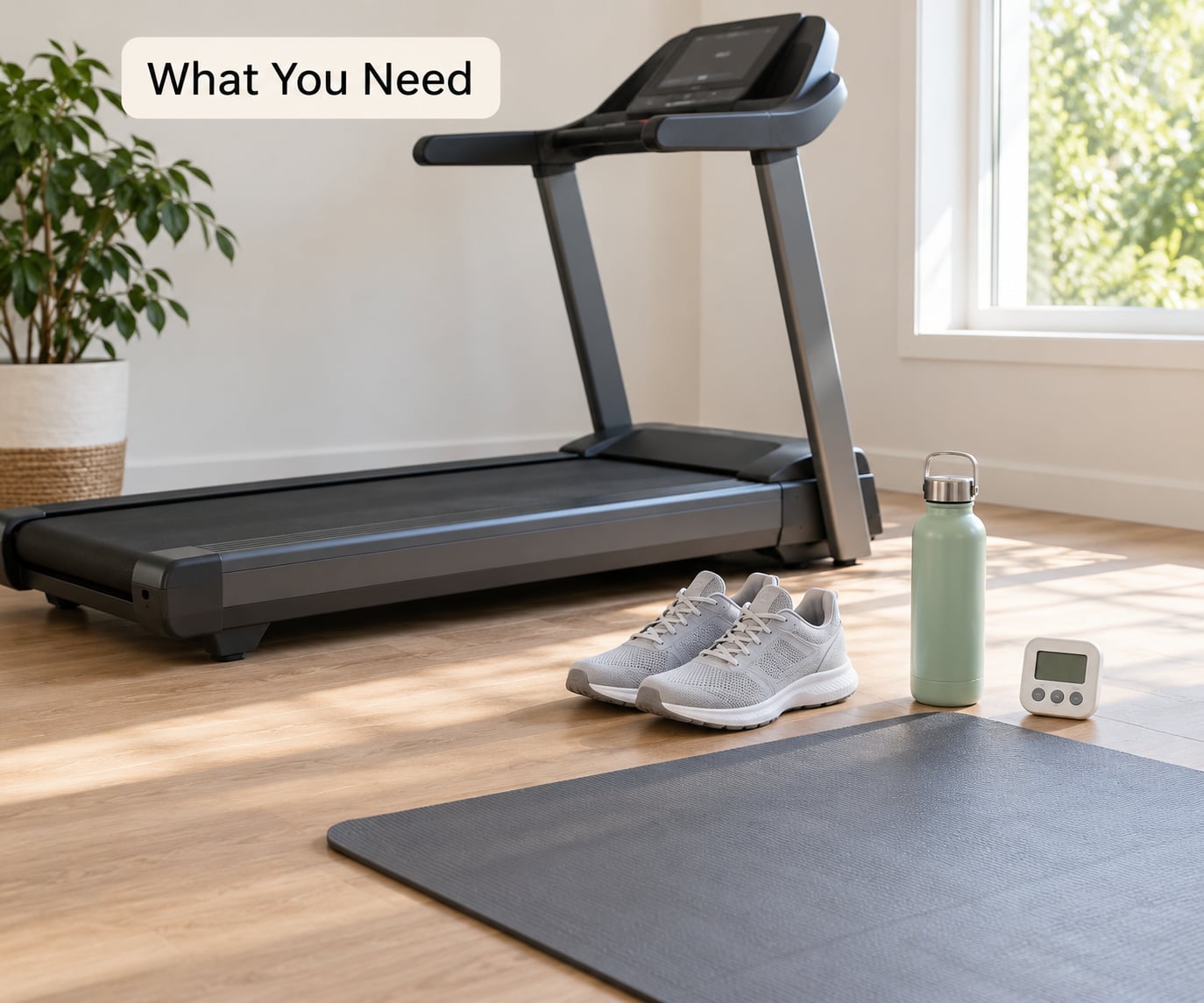
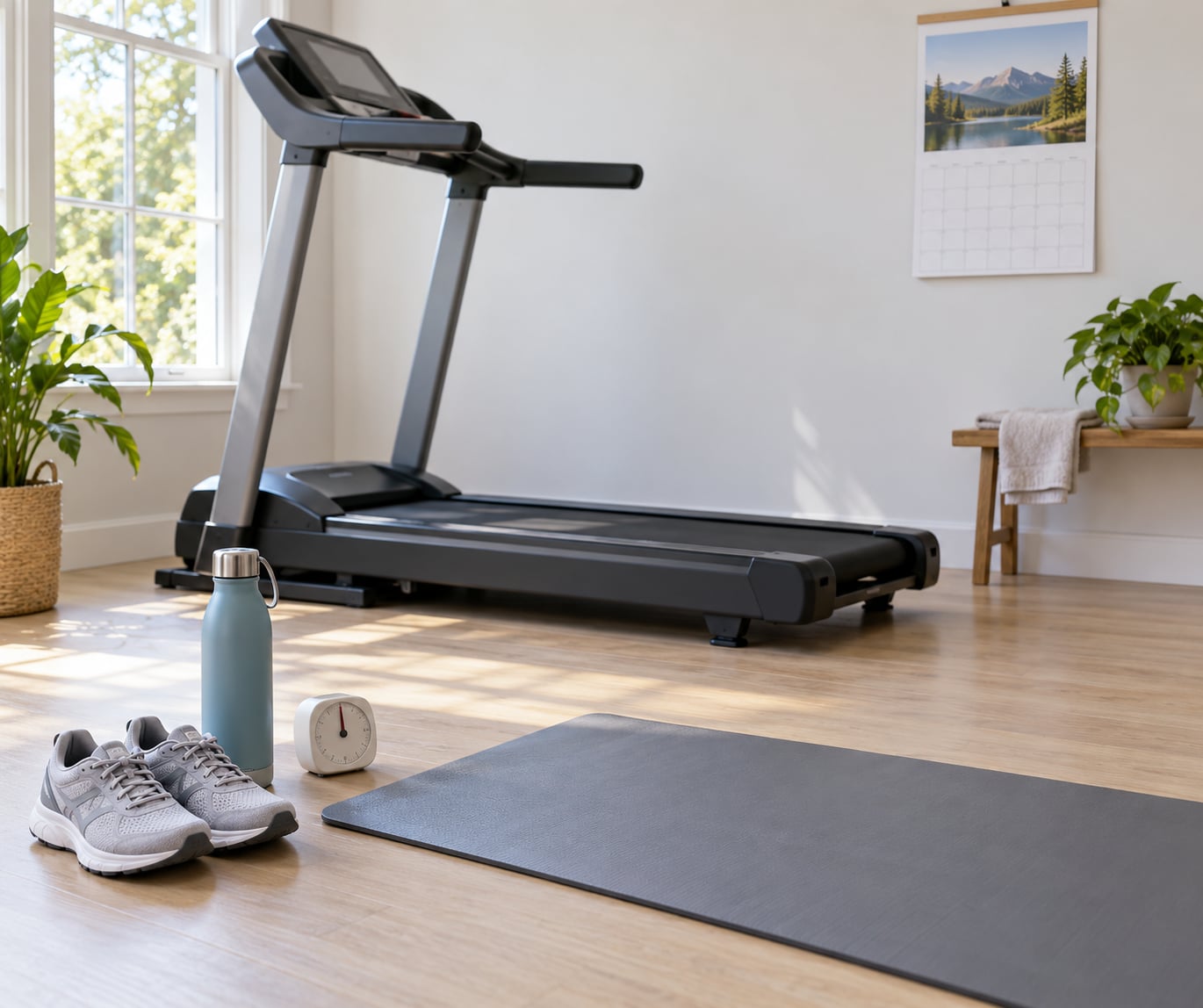
You need less gear than people expect. A treadmill with a working incline and a safety key does the heavy lifting, and everything else is support.
- A treadmill with manual or motorised incline. Most budget models top out at 10 to 12 percent. That is plenty for fat loss. If you are starting from a sedentary baseline, a flat deck for the first week is fine too.
- Supportive walking shoes. Cushioning matters more than fashion here, especially once you raise the incline and load the calves and Achilles tendon.
- Water. Keep a bottle within reach of the machine, not on it.
- A timer or a heart-rate strap. A phone timer is enough to structure the blocks. The chest strap only matters if you like numbers.
- Clear floor space around the belt. No shoes on the side rails, no water bottle within tripping distance.
How to check the machine and pick a starting speed
Before your first session, clip the safety key to your shirt. If you fall, the belt stops. Skipping this is the most common avoidable accident on a treadmill.
Then stand on the belt, hold the rails lightly with two fingertips, and start at 2.0 to 2.5 mph with zero incline. Let it run for three minutes. If you can speak in full sentences but would rather not chat, that is your base speed.
Anything faster than 3.5 mph on day one is borrowed from a future you have not earned yet. Most beginners settle at 3.0 to 3.5 mph for fat loss work, and that is a perfectly good number.
When to check with a doctor first
If you have heart disease, uncontrolled blood pressure, diabetes, a recent joint injury, or are pregnant, get medical clearance before starting anything with an incline. If you feel chest pain, dizzy, or short of breath in a way that feels wrong, step off and call a doctor rather than pushing through.
Step-by-Step Treadmill Walking Workout for Fat Loss
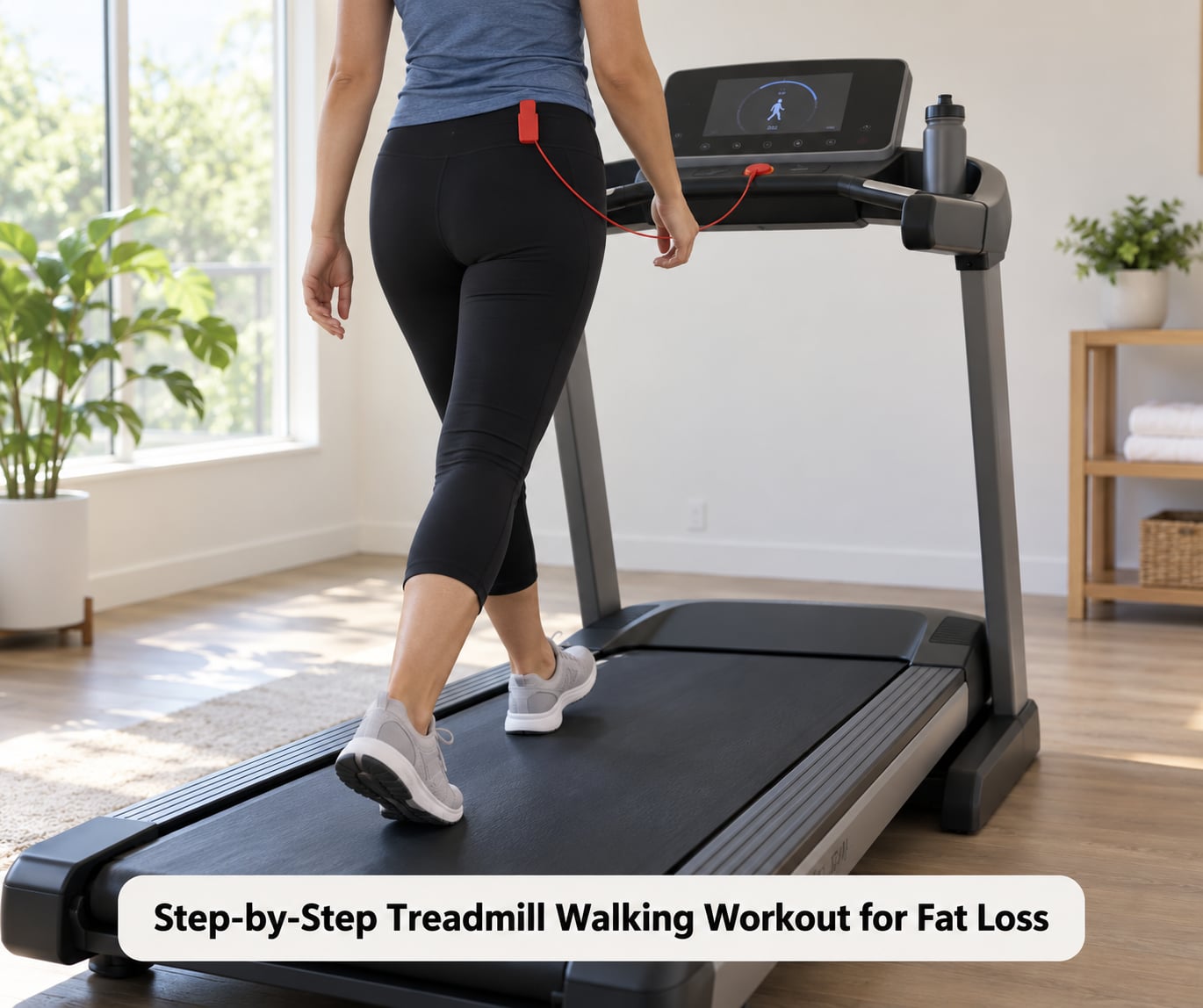
Attach the safety key and set the incline to zero. This session runs roughly 30 minutes and is built in blocks, so you never have to think about what happens next.
The 30-minute session, block by block
| Phase | Minutes | Incline | Speed (mph) | Why it is there |
|---|---|---|---|---|
| Warm-up | 5 | 0% | 2.5 | Raises heart rate gradually, warms the Achilles and calves |
| Hill 1 | 3 | 4% | 3.0 | First taste of hill work, easy effort |
| Hill 2 | 3 | 5% | 3.0 | Moderate effort, full sentences still possible |
| Hill 3 | 3 | 6% | 3.0 | Short sentences, this is the top of the block |
| Recovery | 1 | 0% | 2.5 | Flatten out so the next block is not a jolt |
| Pyramid | 6 | 6 / 4 / 2% | 3.0 | One minute at each incline, run twice through |
| Steady finish | 4 | 2% | 3.5 | Builds the aerobic base without another peak |
| Cool-down | 5 | 0% | 2.0 | Brings heart rate down, prevents the light-headed finish |
If you are brand new, drop every incline by half and keep the same minutes. Halving the incline changes the workout far less than cutting the session in half.
Key rules for best results
- Do not hold the handrails. Gripping the rails takes a large share of your bodyweight off the belt and off your legs. The console still counts you as walking, so the calorie number climbs while the work drops. Two fingertips on the rails for balance on the steep part is acceptable.
- Keep your chest up and your eyes ahead. Looking down at the console shortens your stride.
- Lean forward from the ankles, never from the waist. Leaning back to cope with a steep incline pushes your heels into the belt and loads the knees.
- Swing your arms naturally, elbows bent near 90 degrees. Loose arms waste energy you could be spending on the walk.
- Take short steps at high incline and longer steps on the flat. Reaching forward with your foot at 6 percent is how shin splints start.
- Use the talk test. Full sentences means moderate effort, which is the zone most of your fat-loss volume belongs in.
Why incline changes the calorie burn
Walking uphill recruits the glutes, hamstrings and calves, and those muscles cost more to run than the ones carrying you on flat ground. Published treadmill comparisons put a 5 percent incline at roughly 50 percent higher metabolic cost than flat walking at the same speed, and 10 percent at roughly double.
The number you can calculate yourself uses MET, or metabolic equivalent, from the Compendium of Physical Activities: calories per minute = MET x 3.5 x body weight in kg, divided by 200.
For an 80 kg person walking 30 minutes at 3 mph, flat at about 3.5 MET gives roughly 5.6 kcal per minute, or about 170 calories for the session. At 6 percent incline, around 5 MET, that rises to about 210 calories. At 200 lb instead, the same two efforts land near 190 and 240 calories.
Treadmill displays estimate calories from your weight and speed inputs, and walkers regularly notice them reading high. Treat the display as a rough trend, not a receipt.
How to progress your treadmill walking workout for fat loss
Add one thing at a time. The order that works for most beginners is duration first, then incline, then speed. Bumping speed early usually turns the session into a shuffle that burns less than you think.
| Week | Sessions | Minutes each | Top incline | Focus |
|---|---|---|---|---|
| Week 1 | 4 | 20 | 2% | Learn the machine, keep the talk test easy |
| Week 2 | 5 | 25 | 4% | Full block structure, warm-up and cool-down every time |
| Week 3 | 5 | 30 | 6% | Add the pyramid block, hold steady-state minutes |
| Week 4 | 5 | 35-40 | 7-8% | Push the hills, or split a long session into two |
Do not progress two variables in the same week. If you raise the incline and the time and your shins complain, you will not know which one did it.
How much walking you actually need each week
World Health Organization guidance for adults points to 150 to 300 minutes of moderate activity per week, and anything above 300 minutes brings additional benefit. For fat loss, most of the volume should feel boringly easy.
A useful split for beginners: 150 to 200 minutes of moderate walking across five days, plus two short resistance sessions. Walking builds the calorie gap and keeps cardiovascular fitness climbing. Resistance training tells your body to keep muscle while it loses fat, which is the difference between a lighter you and a smaller, weaker version of you.
Your daily step count counts too. NEAT, the calories burned through ordinary movement outside workouts, often does more over a week than the treadmill session itself, and it is free.
What fat loss to realistically expect
Fat loss is not spot reduction. A treadmill walk burns calories from your whole body, and the order in which fat leaves is mostly genetics. Ten minutes on a treadmill will not target belly fat, however many ab exercises you stack on top of it.
A commonly used starting point is a weekly deficit of roughly 500 calories, which works out to about a pound a week, or 4 to 5 kilos over three months. People often notice waist and clothing changes before the scale moves, and the first two weeks can hold water that makes it look like nothing is happening.
Fat loss stalls when the same session runs on repeat with no change in food intake. Change one of them: add an incline block, extend the cool-down walk to 20 minutes, or increase daily steps.
Common Mistakes
Holding the handrails while walking uphill. This is the most common mistake and the least obvious one. It removes bodyweight from the work and inflates the calorie display. Fix: fingertips only, or nothing.
Starting at 8 to 12 percent incline on day one. Beginners in fitness forums warn about this constantly, and they are right. A steep incline loads the Achilles, calves and knees faster than most untrained bodies can adapt. Fix: cap week one at 2 percent and raise the cap by 2 percent per week.
Starting too fast. A pace that feels hard in minute five usually ends in a walk, a slow jog, or an early stop. Fix: start a full mph below what you think you can hold.
Trusting the console calorie number. It is a formula, not a measurement. Fix: judge the session by effort and by weekly consistency instead.
Earning food back. Walking for 30 minutes and then treating it as permission to eat more quietly cancels the session. Fix: treat the walk as one input in a week, not a payment.
Skipping the cool-down. Stopping from a heart rate of 140 straight to sitting on the floor leaves some people light-headed. Fix: five easy minutes every time.
Doing everything on treadmill days. Four good sessions beat seven ruined ones. Fix: keep at least one full rest day, and use a walk outdoors on another day so the machine is not the only thing standing between you and a skipped workout.
Expecting one body area to go first. Fix: measure the whole picture, waist and hips as well as weight, and give it eight to twelve weeks.
Frequently Asked Questions
How long should I walk on a treadmill for fat loss?
Most beginners do well with 30 to 45 minutes per session, three to five times a week, which lands inside the 150 to 300 minutes of moderate weekly activity that World Health Organization guidance recommends for adults. Start at 20 minutes if you are new, because consistency matters more than session length. Add five minutes per session every week or two until you reach 30 to 40 minutes.
Should I use incline intervals on a beginner treadmill workout?
Yes, but gently. Short hills of three minutes at 4 to 6 percent are fine from week two onward, as long as you can still speak in short sentences during them. Beginners who jump straight to 9 or 12 percent often end up with knee or Achilles soreness. Cap your first week at 2 percent, raise the ceiling by about 2 percent a week, and stop a block early if your calves start to ache.
What treadmill speed counts as a moderate walking pace?
For most adults, 3.0 to 3.5 mph at zero incline is a solid moderate walking pace. Use the talk test: you can speak in full sentences but would prefer not to hold a conversation. A useful secondary marker is a cadence near 100 to 110 steps per minute. Anything faster than 4 mph for 30 minutes is hard work, not moderate, and belongs in a different session.
How many days per week should I do a treadmill walking workout?
Five days is a good target for most beginners, with one or two full rest days. Four days builds the habit reliably, and five gets you into the 150 to 300 minute weekly range. Keep at least one day completely off so joints, feet and motivation recover. If your schedule is tight, three 40-minute sessions works almost as well as five 25-minute ones.
Does treadmill walking burn enough calories to lose fat?
Yes, when the calorie gap comes mostly from food. An 80 kg person walking 30 minutes at 3 mph burns roughly 170 calories, and about 210 with a 6 percent incline. That adds up across a week, but on its own it rarely outruns ordinary eating. Treadmill displays also tend to read high, so judge the session by effort rather than the number on the console.
Is walking on a treadmill good enough if I do not see weight changes immediately?
Give it time before judging. Body weight moves slowly and the first two weeks can hold water that hides progress, while waist measurement and how clothes fit often change earlier. If nothing has shifted after eight to twelve weeks of solid sessions, change one variable: add an incline block, extend the time, raise daily steps, or tighten food portions. Do not add all four at once.
Conclusion
Your first move is small: clip the safety key, set 2.5 mph at zero incline, and run the warm-up. If the hills feel like too much on day one, halve the incline and keep the minutes.
Write down how the session felt at the end. That note is worth more than the calorie display, because it is what you use to decide when to add five minutes or two percent of incline. Recover properly, add one variable at a time, and pair the walking with food you can sustain. Do that for 2026 and the scale starts to follow.