To exercise with bad knees and still lose weight, train low-impact: walking on soft ground, water exercise, stationary cycling, the elliptical, and strength work that builds the quads, hamstrings and glutes around the joint. Aim for 150 minutes of moderate activity a week plus two strength sessions, eat in a modest calorie deficit, and check with a healthcare professional before you start if pain is sharp, recent or unexplained.
That is the whole idea in about forty seconds. Weight loss comes from a calorie deficit, not from a specific workout, but your knees decide which workouts you can actually keep doing for the months it takes to lose the weight. Pick the ones that let you keep moving.
The catch is that most “just lose weight” plans are built around running, jumping and burpees. For anyone with knee osteoarthritis, a meniscus tear or old ligament damage, those are the exact movements that keep you stuck. A plan you quit in week three loses nothing.
What follows is the routine I would hand a friend in this situation: what to gather, how to build the first four weeks, which mistakes set people back, and when the pain means you need a doctor rather than a harder session.
A note before you start. This is general information, not a diagnosis or a treatment plan for your specific knee. If your pain is new, severe, follows an injury, or comes with swelling, locking or instability, ask a doctor or physical therapist first. They can tell you which movements are safe for the joint you actually have.
Table of Contents
- What You Need
- Step-by-Step: How to Exercise With Bad Knees to Lose Weight
- Start With Gentle Warm-Ups
- Choose Low-Impact Cardio
- Add Safe Strength Training
- Build a Weekly Routine
- Increase Duration Gradually
- Common Mistakes
- When to Ask a Healthcare Professional
- Frequently Asked Questions
- Is walking good for weight loss if my knees hurt?
- What exercises are safest for someone with bad knees?
- Should I avoid strength training with knee pain?
- How long should I exercise with knee pain before seeing a doctor?
- Can cycling or swimming help me lose weight with knee problems?
- What signs mean I should stop exercising immediately?
- Conclusion
What You Need
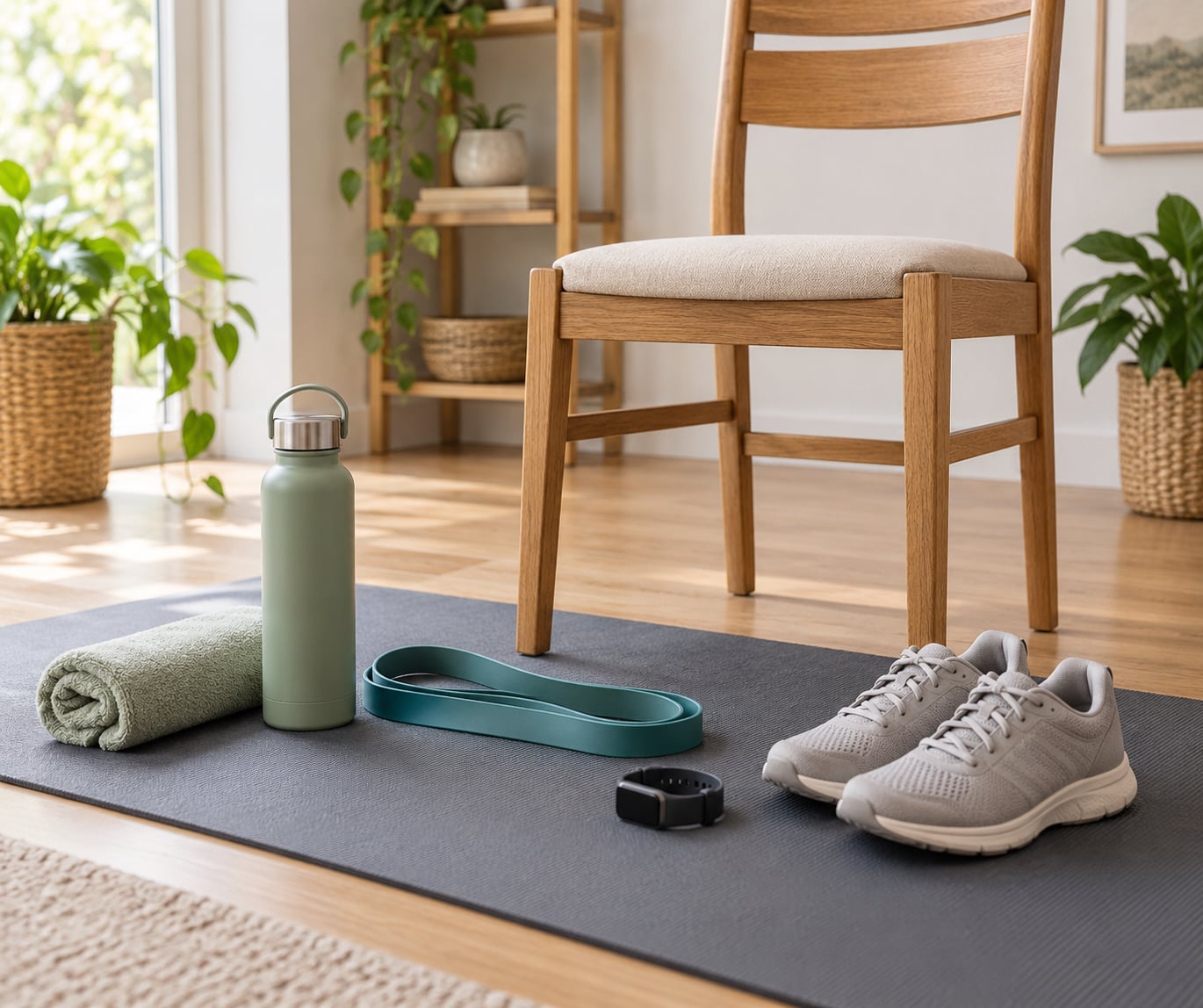
You need less gear than most people assume. Here is the short list.
- Supportive footwear. A well-fitting walking shoe with a cushioned midsole and a stable heel. If you are walking a lot or carrying more weight than you used to, budget for replacing shoes roughly every 300 to 500 miles, because a worn midsole stops absorbing anything.
- Clothing that moves. Loose, breathable layers. Nothing knee-specific is required.
- A stable, non-slip surface. Carpet, a rubber mat, or a flat path. Avoid slick tile if your knees are the shaky type.
- A sturdy chair. A dining chair with a firm back is enough for support during standing work. It becomes your depth limit for squats and step-ups.
- A water bottle. Especially for indoor cycling and water exercise, where breaks are awkward.
- A way to track. A phone note is fine. Write down how long you moved, what you did and how the knee felt that night. Three weeks of notes will teach you more than any article.
- Optional: a light resistance band and a low step. Both help, and neither is required. A resistance loop and a single 4 to 6 inch step covers nearly every strength move in this guide.
- Clearance, when you need it. If pain is constant, started after an injury, or comes with swelling or instability, get a healthcare professional’s go-ahead before your first session.
Swimming or cycling needs a pool or a machine, which is the one place this plan asks for spending money. Water walking and a home strength routine give you a real fallback for weeks when the pool schedule or the gym is not happening.
Step-by-Step: How to Exercise With Bad Knees to Lose Weight
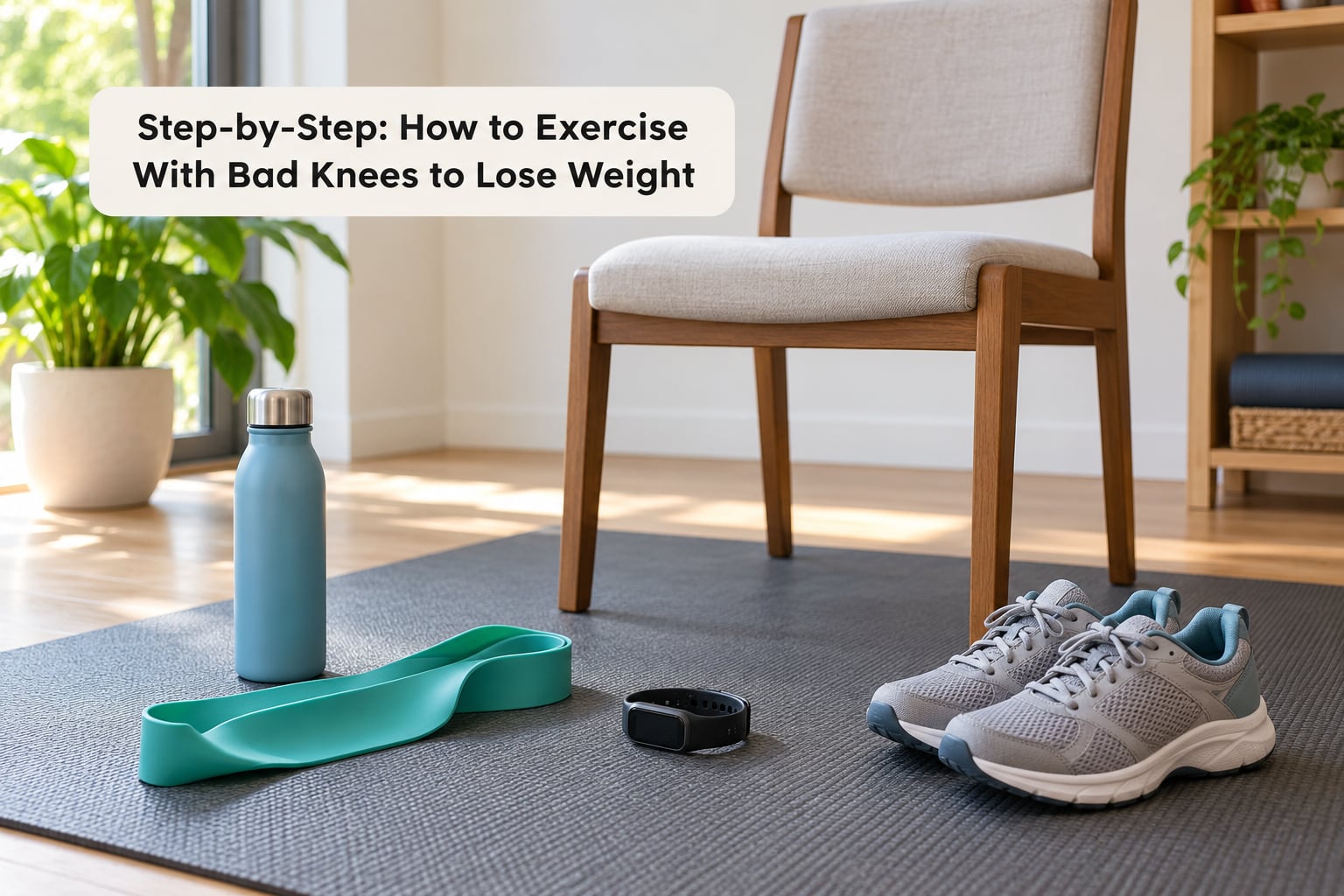
The routine has five parts, and they build on each other. Warm up, get your cardio in, add strength, lay out a week, then stretch the time slowly. Do them in that order and each one makes the next easier.
Start With Gentle Warm-Ups
Five to eight minutes of easy movement prepares your joints before you ask them to do real work. Skipping this is the most common reason a session goes from fine to flared.
Start with the ankles: sit tall, lift one foot and draw slow circles, then switch. Ten each side gets blood moving through the lower leg. Add seated leg extensions, straightening one knee at a time and lowering it under control, about 12 per leg.
From standing at the counter, shift your weight side to side and roll from heel to toe so the ankle and knee move through their range. Then do low step-ups on a 4 inch step, leading with one foot and keeping the knee tracking over the middle toes. Eight per side is plenty for a warm-up.
Finish with hip shifts, pushing your hips gently back as if you are closing a drawer behind you. That pattern is the one you want during strength work, and rehearsing it now makes it stick.
Warm-up pain is fine. Sharp pain, or a knee that feels unstable or about to give way, is your stop signal.
Choose Low-Impact Cardio
Cardio is where the calories come from. Low-impact options let your heart rate climb while the joint stays unloaded or only lightly loaded, which means you can sustain them long enough to burn fat without paying for it the next morning.
Start with 10 to 15 minutes per session and aim for the talk test: you can speak in full sentences, but not sing. That is the standard marker of moderate intensity, and it is enough to move the needle.
Here is how the main options compare.
| Exercise | Joint impact | Fat burn | Best for | Equipment |
|---|---|---|---|---|
| Walking on grass or a track | Low, rises with pace | Moderate to high | Beginners, most reliable daily option | Supportive shoes |
| Water walking | Very low, buoyancy unloads the joint | Moderate | People who cannot walk on land without pain | Pool, waist to chest depth |
| Stationary cycling | Very low | Moderate to high | Bad knees with no floor-impact tolerance | Bike or spin bike |
| Elliptical trainer | Very low, no floor contact | Moderate | Gym or home trainers | Machine |
| Swimming and aqua aerobics | Very low | Moderate | Full-body conditioning, stiff joints | Pool |
| Rowing machine | Low if the technique is right | High | Cardio plus upper body, legs stay supported | Machine |
| Tai chi or Pilates | Very low | Low to moderate | Balance, stiffness, confidence moving | None |
A few technique details matter more than people expect.
Cycling. Set the seat so your knee has a slight bend at the bottom of the stroke, roughly a 25 to 35 degree angle. Too low and the knee closes under load, which is exactly what you are trying to avoid. Turn the resistance down and add pedalling time rather than pushing harder.
Swimming. Freestyle and backstroke are usually kinder to knees than breaststroke, whose frog kick puts the joint through heavy rotation and abduction. If breaststroke is your only stroke and it hurts, pick a kick-focused aqua class instead.
Walking. Shorter strides beat long ones, your foot should land under your body rather than out in front, and holding light hand weights is optional rather than recommended. Start on a flat route and stay off hills and stairs until your knee is quiet for a full session.
Elliptical. Keep the pedals as level as the machine allows and resist the urge to stand up and lean into the stride. Sitting down with a controlled push is the knee-friendly version.
Rowing. Push with the legs, pull with the back, and avoid bending and extending the knees deeply at the catch. Beginners often get more from an elliptical or a bike than from rowing.
Water work deserves a special mention because it is the most reliable option for people who already feel pain just from walking. In chest-deep water your body carries much less of its own weight, and you can walk, march and kick for 30 minutes without the joint taking a pounding. It is what several long-time forum members describe as the only form of cardio that got them started without a flare-up.
Add Safe Strength Training
Strength work is the part most people skip, and it is the part that makes the other four parts last. Weak quads and glutes mean every step lands harder; building them reduces the load the joint has to absorb, and people often report sessions feeling easier as the weeks pass.
Do these two or three times a week, on non-consecutive days, for two sets of 10 to 12 reps at first. Stop each set while you still have two or three good reps left in the tank.
- Shallow box squat. Sit toward a chair, hips back, hands on the chair back for balance, and stand up before your thighs pass parallel. Depth is set by the chair, not by ambition.
- Straight leg raises. Lie on your back, one knee bent, the other leg straight, and lift the straight leg to about 20 inches. Lock the knee and lift from the hip. Excellent for people who cannot bend the knee at all.
- Glute bridges. On your back with feet flat and close to your hips, push through your heels and lift until your body forms a line from knee to shoulder. Hold two seconds at the top.
- Calf raises. Hold a counter, rise onto both toes, pause, lower slowly. These build the muscle that absorbs the small shock of each step.
- Seated knee extension. From a firm chair, straighten one leg until it is level with your hip, squeeze for two seconds, lower slowly. Banded resistance makes it harder as you progress.
- Step-ups. Step up to a 4 inch step, drive through the whole foot, step down slowly and quietly. Raising the step by an inch every couple of weeks is plenty of progression.
Keep the knee tracking over the middle toes throughout, and never hold your breath during a rep. If a movement needs deep knee bend or twisting under load, it does not belong in this plan. A chair, a wall and a band cover everything you need.
Build a Weekly Routine
Consistency beats intensity, and for weight loss a moderate session you repeat is worth more than a punishing one you cannot repeat. Here is a realistic week for someone starting from a low-impact baseline.
| Day | Session | Minutes |
|---|---|---|
| Monday | Walk plus calf raises and seated knee extensions | 20 walk, 10 strength |
| Tuesday | Rest or an easy swim | 15 optional |
| Wednesday | Glute bridges and straight leg raises | 15 |
| Thursday | Water walking or cycling | 25 |
| Friday | Rest | 0 |
| Saturday | Longer walk or aqua aerobics class | 35 |
| Sunday | Shallow box squats, step-ups, stretching | 20 |
That totals about 135 minutes of activity. Over a few weeks, the standard target is 150 minutes of moderate activity plus two strength days, which is the guideline the American Heart Association gives adults, and it is enough for weight loss on its own once food intake comes down.
Two rest days are not wasted. They are when the tissue you asked to adapt actually adapts, and they are your early warning system for a problem with the schedule.
Increase Duration Gradually
Progress one variable at a time, and time is the safest one. Add minutes before you add resistance, and add resistance before you add speed or incline.
A workable progression runs like this. Week one is 10 to 15 minutes per session, five days. Week two is 20 minutes, five days, adding a little resistance or a slightly higher step. Week three is 25 to 30 minutes, five days, with the strength sessions still at two sets. Week four holds that volume, and you should feel like it is manageable rather than heroic.
If a session leaves you sore for more than a day or two at the same volume, hold the previous week’s numbers. If your knee is fine and you have room, add five minutes.
Keep a pain diary while you do this. Note the activity, how long it took, and what the knee felt like during, right after and the next morning. That third entry is the informative one: mild muscle stiffness in the thigh the morning after is normal training, while a joint that is more painful than it was yesterday means the volume was too much.
On the food side, keep it simple. Estimate what you currently eat, cut roughly 300 to 500 calories a day, and hold that. Cutting hard usually fails within weeks; a smaller deficit you can keep is what actually takes the weight off. Weight loss then feeds back into the knees, since every extra pound adds roughly three to four pounds of force through the knee when you walk, and considerably more on stairs. Losing 20 pounds removes about 60 to 80 pounds of force from each step. That is a meaningful reduction, and it is why many people notice less pain before they notice a smaller scale.
Common Mistakes
These are the errors that keep people stuck, in rough order of how often they cost someone weeks.
- Exercising through sharp or worsening pain. Muscle fatigue feels like a broad, dull tiredness in the thigh or hip. Joint pain feels specific, sharp, inside or behind the kneecap, and often arrives during the movement rather than after it. The first is training; the second is a stop signal. Fix: change the activity, not your willpower.
- Starting with high-impact movement. Running, jumping, burpees and deep squats are the most common exercises in weight loss content and the least useful here. Fix: build up to anything higher impact only after weeks of quiet, symptom-free sessions, and check with a clinician before you try at all.
- Skipping the warm-up. Five minutes of ankle circles and hip shifts is what keeps a routine from going sour. Fix: make it the first five minutes of every session, no negotiation.
- Progressing too fast. Going from nothing to 45 minutes in week one is the single most avoidable flare. Fix: add roughly 10 percent more time per week, and hold whenever your knee complains.
- Treating pain relievers or supplements as the plan. Relying on painkillers to push through a painful session, or on supplements marketed for joints, hides the signal you need. Fix: use only what a clinician recommends and never use medication to mask pain in order to train.
- Focusing on exercise and ignoring food. People on r/loseit describe this consistently: exercise made them feel better and occasionally slightly stronger, while diet is what moved the scale. Fix: decide your calorie number before you set your session length.
- Relying on one activity. Walking only, forever, gets boring and stops building strength. Fix: cross-train. Two strength days plus two or three cardio options keeps the plan durable.
- Comparing your timeline to someone else’s. Progress here is slow and mostly invisible on the scale, because a few sessions a week do not outrun eating much more than you need. Fix: track reps, minutes and pain-free sessions as your primary wins. Weight follows.
One more worth naming: giving up in the first three weeks. The early period is when your knee is adapting to being used, and it is genuinely the hardest. Most people who push through that stretch report the pain settling rather than climbing, but if yours is climbing instead, that is information, not weakness.
When to Ask a Healthcare Professional
Ask before you start if your knee pain is constant rather than activity-related, if it began after an injury or a fall, if you cannot bear weight comfortably for a normal walk, or if you have swelling, redness or warmth around the joint. Also worth asking about: a knee that locks, catches or gives way; a diagnosis you already have, such as an advanced meniscus tear or inflammatory arthritis, where some movements are specifically contraindicated; and any history of joint replacement.
A physical therapist is the most useful referral here, and underused. They will assess your range of motion, your quadriceps strength and your gait, then give you a progression matched to your joint instead of a generic list. If you are not sure whether your pain is arthritis, a meniscus problem or something that needs imaging, that is exactly the kind of question to ask before you build a plan on top of a guess.
Stop exercising and seek medical attention rather than working through it if you notice severe pain that does not settle with rest, a knee that locks or will not straighten, visible deformity, an inability to bear weight after an injury, a hot red swollen joint with fever, or calf swelling and pain that suggests something other than the knee.
The distinction that matters most day to day is this: discomfort that is symmetrical, mild and clears with movement is usually fine to train through. Pain that is sharp, one-sided, worsening between sessions or accompanied by swelling is not. When in doubt, back off for a week and see whether it improves. If it does not, that is your answer.
Frequently Asked Questions
Is walking good for weight loss if my knees hurt?
Yes, if the surface and the pace suit your joint. Walking is one of the most reliable low-impact ways to burn calories, and it needs no equipment. Start on flat, softer ground with short 10 to 15 minute sessions, keep a pace where you can talk but not sing, and lengthen the time before the speed. Skip hills and stairs until your knee is quiet after a full session. If walking on land still hurts, water walking removes most of the joint load.
What exercises are safest for someone with bad knees?
Non-weight-bearing and low-impact options are the safest starting point: swimming, water walking, aqua aerobics, stationary cycling, the elliptical and a rowing machine. Add strength work that builds the muscles around the joint without deep bending, such as straight leg raises, glute bridges, calf raises, seated knee extensions and shallow squats to a chair. The pattern is the same for all of them: little impact, controlled range, no twisting under load.
Should I avoid strength training with knee pain?
No, and skipping it is one of the most common mistakes. Weak quadriceps and glutes make every step land harder, so building them reduces the load on the joint rather than adding to it. Start with two sets of 10 to 12 reps of straight leg raises, glute bridges, calf raises and seated knee extensions, twice a week on non-consecutive days. Stop each set with a couple of reps left in reserve, and keep the knee tracking over the middle toes throughout.
How long should I exercise with knee pain before seeing a doctor?
Get checked before you start if the pain is constant, started after an injury, or comes with swelling, locking or instability. If it is mild and only appears during activity, a sensible trial is two to four weeks of gentle low-impact work with symptoms settling within 24 hours. If pain is worsening between sessions, sharper each week, or limiting your normal walking after that trial, stop and see a doctor or physical therapist rather than pushing further.
Can cycling or swimming help me lose weight with knee problems?
Both can, because they let you raise your heart rate with almost no joint load, so you can sustain them for 25 to 40 minutes. On a bike, set the seat high enough to keep a slight bend at the bottom of the stroke and add pedalling time rather than resistance. In the pool, prefer freestyle, backstroke or kick-focused classes over breaststroke, whose frog kick rotates the knee under load. Either option makes a good stand-in when walking is not possible.
What signs mean I should stop exercising immediately?
Stop the session and get medical advice for sharp pain that arrives during the movement, a knee that locks or will not straighten, visible deformity, an inability to bear weight after an injury, or a hot red swollen joint, particularly with a fever. Also stop and reassess if the same session is worse than the last one or pain is worse the next morning rather than easing. Mild symmetrical muscle tiredness that clears with movement is normal training, not a reason to stop.
Conclusion
Start with one decision today: if your knee pain is sharp, recent or unexplained, book a doctor’s appointment or ask for a physical therapy referral before your first session. If it is mild and activity-related, put on your walking shoes and do 10 gentle minutes today, then build from there.
From there the shape is simple. Warm up for five minutes, get 20 to 30 minutes of low-impact cardio most days, add two short strength sessions a week for your quads, hamstrings and glutes, and add time before you add anything harder. Keep a short note on how the knee felt that night. Hold your food intake 300 to 500 calories below what you need, and let the weight come off at a pace your knees can live with.
Weight loss drives the scale. Low-impact training is what lets you keep going long enough to get there.