A full body workout routine three days a week trains your legs, hips, chest, back, shoulders, arms and core in every session, usually on Monday, Wednesday and Friday. Each workout runs 35 to 50 minutes and follows the same simple structure: one heavy squat-pattern lift, one push, one pull, one accessory, and a short core block. You need a pair of dumbbells, a resistance band and about six feet of floor. Beginners usually see strength gains in the first six to eight weeks, provided they keep the same three days and add a little weight over time.
I’ve built this for people who can’t train five days and don’t want a spreadsheet to figure out what to do. There are no affiliate products here and no gear you have to buy beyond a decent set of dumbbells. Read the plan, set up three calendar reminders, and start with Day 1 next week.
Table of Contents
- What You Need
- Step-by-Step: Your Full Body Workout Routine Three Days a Week
- Set Up Your Weekly Schedule
- Workout Day 1: Lower Body and Push
- Workout Day 2: Upper Body and Legs
- Workout Day 3: Full Body Conditioning
- How to Progress Without Overtraining
- Make This Full Body Workout Routine Work for Your Schedule
- Common Mistakes to Avoid
- Frequently Asked Questions
- Are full body workouts 3 days a week good?
- What is the 3-3-3 rule for working out?
- What is a good 3x week full body workout routine?
- Is it okay to workout only 3 days a week?
- How long should a full body workout take?
- Do you need weights for a full body workout?
- Conclusion
What You Need
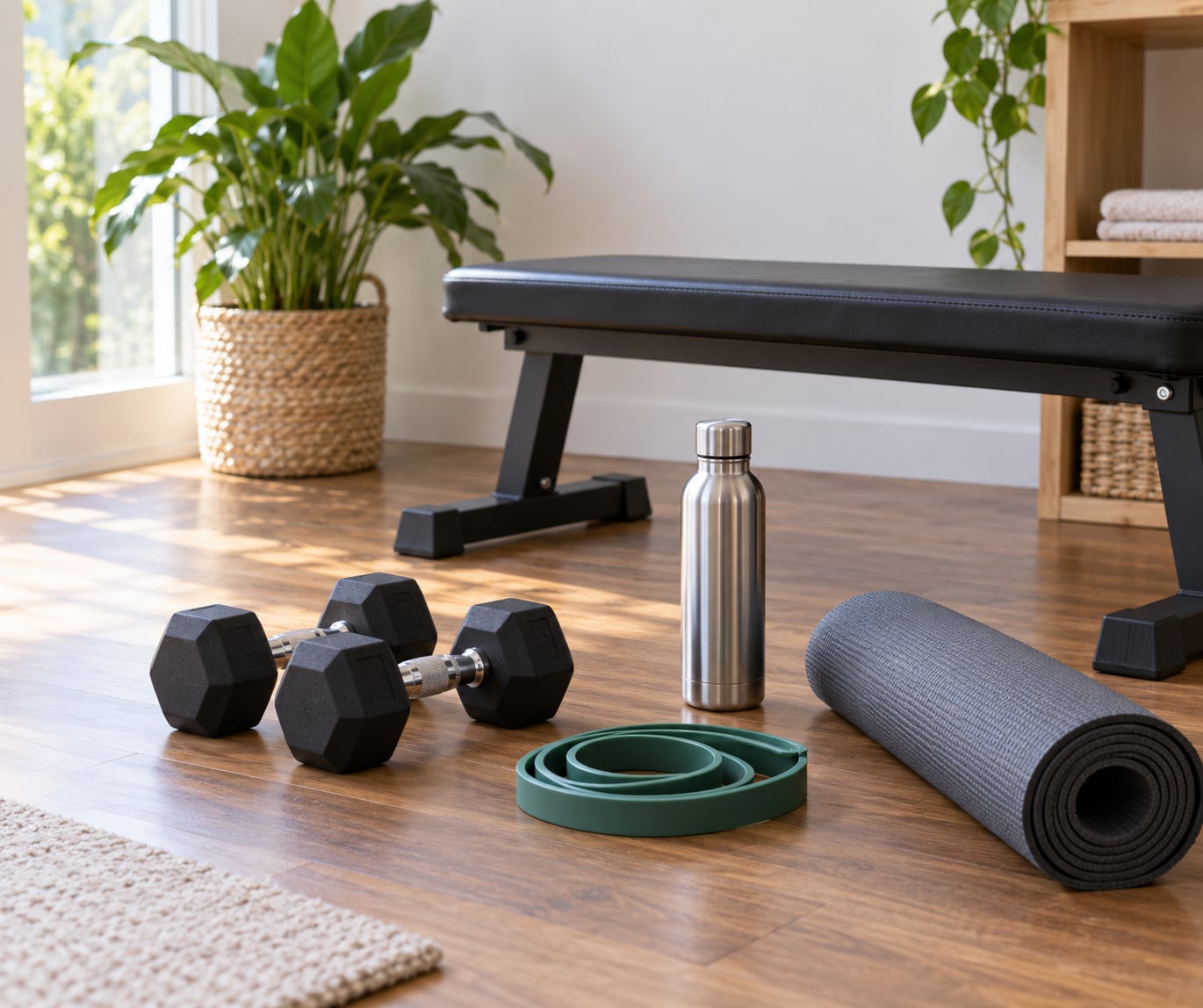
You need less gear than most beginner routines assume. A set of dumbbells that you can comfortably lift for 8 to 12 repetitions covers every movement in this plan. A resistance band handles the pull work if a rack isn’t available, and a sturdy chair or low bench replaces a barbell bench.
A yoga mat or a folded carpet gives you a non-slip surface for planks and split squats. Two or three square feet of clear floor is genuinely enough space. Water, a small towel and a phone for your timer round out the kit.
You do not need to be fit before you start. Do two weeks of three 15-minute bodyweight sessions first if you have been completely inactive, been injured in the past year, or get winded climbing one flight of stairs.
Check with a doctor before starting if you have heart disease, uncontrolled high blood pressure, diabetes, a recent surgery, persistent joint pain, or are pregnant. Those are all cases where a clinician’s go-ahead comes first, and where they may also point you toward a physical therapist rather than a barbell.
Step-by-Step: Your Full Body Workout Routine Three Days a Week
Set Up Your Weekly Schedule
Monday, Wednesday and Friday is the default, and it is the spacing most lifters settle on. The 48 hours between sessions is what lets your muscles repair and your nervous system reset. Sunday and Tuesday are rest days, Saturday is a full rest day unless you enjoy walking.
If your week runs differently, shift the whole pattern rather than squeezing two sessions together. Tuesday, Thursday and Saturday works identically. Monday, Wednesday and Saturday also works, though your Friday becomes a rest day and your weekend ends late.
Here’s the shape of the week at a glance:
| Session | Day | Focus | Priority lift |
|---|---|---|---|
| Workout A | Monday | Lower body and push | Squat pattern |
| Workout B | Wednesday | Upper body and legs | Vertical push |
| Workout C | Friday | Full body and conditioning | Hinge pattern |
Each day has a different priority, but all three hit your whole body. That matters because you can train a muscle three times in one week if you keep the plan, and skipping back and legs on “upper body” days is exactly how people end up with a weak lower body and sore shoulders.
One question comes up constantly on lifting forums: can you run this four days a week? You can, and here’s the honest version. Four days doubles your recovery demand while your muscle hasn’t caught up yet. Many people do it and do fine. Plenty of others add a fourth session, feel beat up for two weeks and quit. Stay at three until you have completed at least eight weeks of clean sessions.
Workout Day 1: Lower Body and Push
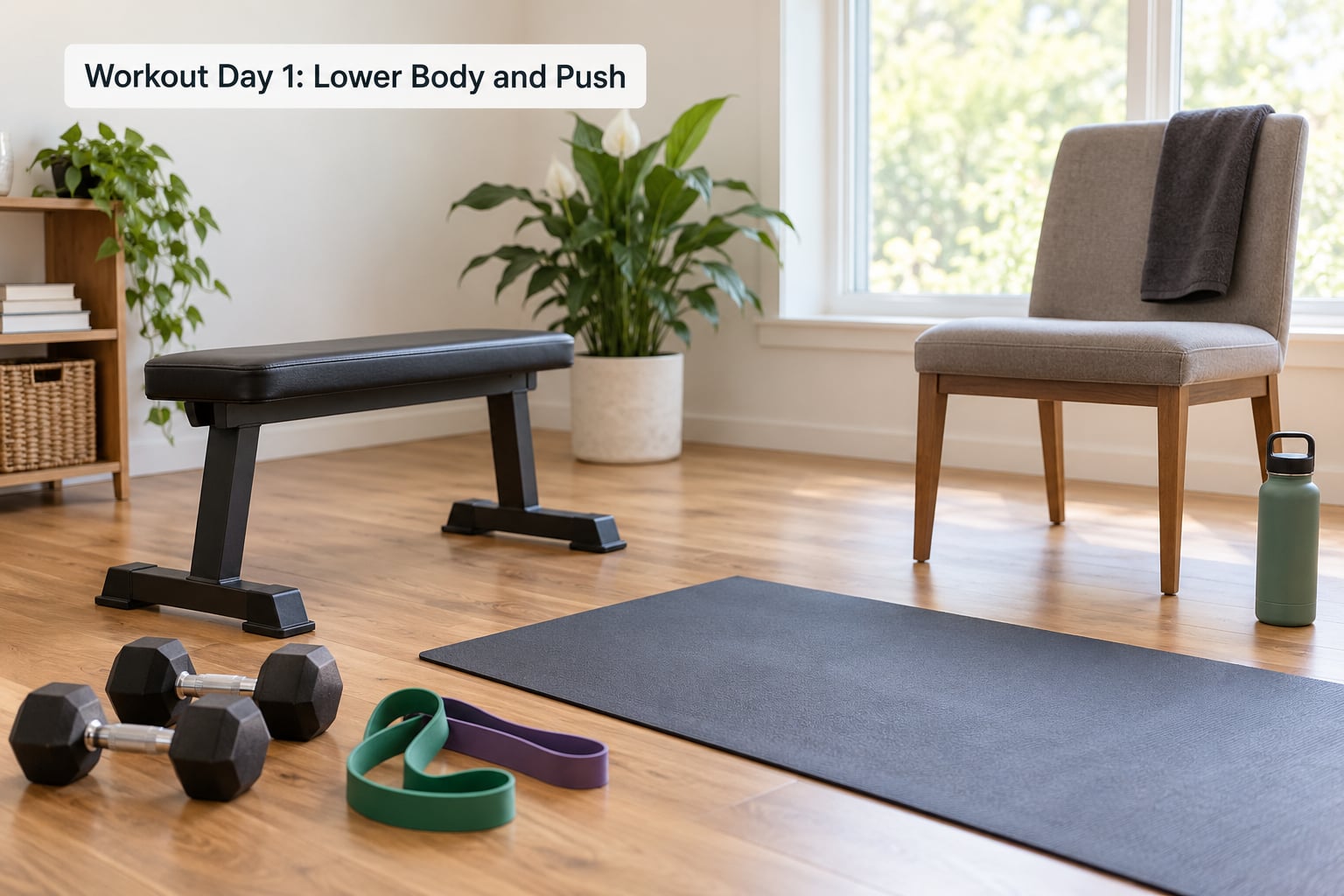
This first session front-loads your legs and gives you a heavy horizontal push. Rest 2 to 3 minutes on the first two exercises and 60 to 90 seconds on everything else.
| Exercise | Sets x reps | Rest | Notes |
|---|---|---|---|
| Goblet squat or dumbbell squat | 3 x 8-12 | 2-3 min | Dumbbells held at the chest, sit down between the knees |
| Dumbbell bench press or push-up | 3 x 8-12 | 2-3 min | Elbows at about 45 degrees, shoulder blades pinned back |
| Bent-over dumbbell row | 3 x 8-12 | 90 sec | Flat back, pull elbows toward your hips |
| Romanian deadlift with dumbbells | 3 x 10-12 | 90 sec | Soft knees, push your hips back, feel the hamstrings stretch |
| Dead bug | 3 x 8 each side | 60 sec | Lower back stays flat on the floor the whole set |
That is roughly 45 minutes including the warm-up. If you’re new, drop to 2 sets on every movement for the first two weeks, then add the third set. Repetition quality beats load, and beginners rarely fail a set, so there is no reason to chase heaviness here.
Workout Day 2: Upper Body and Legs
Day two shifts the emphasis upward but still trains the legs hard with a single-leg movement. Vertical pulling replaces Monday’s horizontal row, which is how you keep shoulders balanced over the week.
| Exercise | Sets x reps | Rest | Notes |
|---|---|---|---|
| Dumbbell overhead press | 3 x 8-12 | 2-3 min | Brace hard, don’t lean back to heave the weight up |
| Dumbbell reverse lunge | 3 x 8-10 each leg | 90 sec | Step back far enough that the front knee stays behind the toes |
| Banded pull-up or lat pulldown | 3 x 8-12 | 90 sec | Pull to the collarbone, not the chin |
| Incline dumbbell press | 3 x 10-12 | 90 sec | Use a chair or box, this is the easy press so save effort for the overhead |
| Side plank | 3 x 20-40 sec each side | 60 sec | Stack your shoulders, push the floor away |
Old muscle soreness after the first week usually peaks around day three and settles by day five. If Wednesday feels terrible because Monday was heavy, keep the weight the same on Day 2 rather than adding load. The plan works at a slower pace, and that is fine.
Workout Day 3: Full Body Conditioning
The third session repeats the whole-body pattern with a hinge at the front and adds a short conditioning piece at the end. This is the day that raises your work capacity without turning into a cardio class.
| Exercise | Sets x reps | Rest | Notes |
|---|---|---|---|
| Dumbbell swing or kettlebell swing | 3 x 12-15 | 90 sec | Hips snap, arms stay loose, stop at chest height |
| Goblet squat | 3 x 10-12 | 2 min | Slightly heavier than Day 1 if the 12 reps felt easy |
| Band row or single-arm dumbbell row | 3 x 10-12 | 90 sec | Two seconds squeezing at the top |
| Dumbbell floor press | 3 x 10-12 | 90 sec | Stop the dumbbells gently at the floor, no bouncing |
| Bear plank or mountain climbers | 3 x 30-45 sec | 60 sec | Hips level, move slowly enough to stay quiet |
Finish with two rounds of 5 minutes of easy effort: a brisk walk, a bike, a rowing machine or jumping jacks. Stop around 60 to 70 percent of your maximum heart rate, which should still let you hold a short conversation. It burns calories, helps blood flow back to your legs and does not eat into the next day’s recovery.
How to Progress Without Overtraining
Progress by adding reps before you add weight. Pick a rep range, say 8 to 12, and stay at the same weight until you complete 12 clean repetitions on every set of that exercise. Then increase the weight by roughly 5 percent for upper body and 10 percent for lower body, and drop back to 8 reps.
Two to four repetitions in reserve is the right target as a beginner. Reps in reserve means you stop the set while you could still do a couple more good reps with clean form. Training to failure with no spotter and no training history is how people learn to dislike lifting.
This is what the next 12 weeks look like:
| Weeks | Sessions per week | Volume | What to focus on |
|---|---|---|---|
| 1-2 | 3 | 2 sets per exercise | Learning the movements, light loads |
| 3-4 | 3 | 3 sets per exercise | Full rep ranges, add weight via double progression |
| 5 | 3 | 2 sets per exercise | Deload week, cut the weight back by about 40 percent |
| 6-8 | 3 | 3 sets per exercise | Build back up, new rep targets |
| 9 | 3 | 2 sets per exercise | Second deload, lighter weights, tighter form |
| 10-12 | 3 | 3 sets per exercise | Push the double progression as far as form allows |
Two deloads in 12 weeks sounds like a lot. It is the difference between a plan you run for a year and one you abandon by spring, because fatigue quietly replaces progress when you never step back.
Watch for these overtraining signals: your resting heart rate is higher than usual for several days, sleep gets worse, you feel flat and unmotivated, performance drops on lifts that used to be easy, and soreness lasts more than 72 hours. When two or more show up, take a week off or drop to 2 sets. A missed week costs almost nothing. Three months of grinding on broken sleep costs a lot.
Make This Full Body Workout Routine Work for Your Schedule
On a day you have 25 minutes instead of 50, keep only the first three exercises and cut the rest. Squat, press and row is a legitimate full body session, not a wasted one. Same for time-pressured days: the priority lift and one push or pull movement is enough.
Substitutions are allowed. One of the biggest causes of stalled beginners is believing they need the exact equipment listed. Swap the barbell bench press for dumbbell bench press or push-ups. Swap the lat pulldown for banded pull-ups, or a chest-supported row if your wrists complain. Swap the Romanian deadlift for hip thrusts, which are easier on the lower back and just as effective for glutes.
Without any weights at all, you can still run the full plan. Use push-ups, bodyweight squats, single-leg squats on a chair, prone Y-raises for the upper back, a band or towel row, glute bridges, and a plank plus side plank rotation. Banded versions add load cheaply and most people own one.
If you miss one session, just continue the rotation where it belongs. Workout B on Thursday instead of Wednesday is not a problem. If you miss a whole week, restart at whatever the last completed week’s weight was rather than trying to make up lost sessions. And if only two days a week are realistic, run Workout A and Workout B on Monday and Thursday. You keep every movement pattern, you just train each one twice instead of three times.
Common Mistakes to Avoid
Skipping the warm-up. Five minutes of easy movement, then two light warm-up sets of your first exercise, is the minimum. Joints and nervous systems appreciate it more than muscles do. A quick version: 1 minute of marching or arm circles, 10 bodyweight squats, 10 hip hinges, 10 band pull-aparts, then 10 light reps of the day’s first lift.
Starting with too much weight. If your first set feels like a two-rep max, you’ve started too heavy. Pick a weight where the last rep of set one feels like you had three more in you. Strength comes from doing it again next week, not from being humbled in week one.
Training on consecutive days. Backing the routine into Tuesday, Thursday and Saturday only for a few weeks and then rotating is fine, but running the same full body session Monday and Tuesday is not. Fatigue stacks and you get weaker, not stronger.
Ignoring form to chase numbers. A rep that drops halfway down with a rounded back counts as zero. Film one set every couple of weeks, and if the weight is moving faster than the range of motion is staying clean, drop it about 20 percent.
Copying a 10-exercise routine. Overwhelm is the single most common reason beginners stall. Six exercises done for six months beats ten exercises done for six sessions. Cap every session at six working movements.
Switching programs every two weeks. Progress lives in the logbook, not in the program design. Give any routine eight honest weeks before judging it, and write your sets, reps and weight down each session so you can see the trend.
Quitting at the first plateau. Strength gains arrive in bursts, not in a straight line. Two sessions where nothing improves usually means you need a deload or a small weight increase, not a new routine.
Two habits carry most of the results. Protect the three calendar slots before anything else, because a routine you complete at 80 percent effort beats a better one you skip. And keep a record, even a notes-app list. Seeing a squat go from 25 to 45 pounds across eight weeks does more for motivation than any motivational quote.
Frequently Asked Questions
Are full body workouts 3 days a week good?
Yes. Three full body sessions a week trains every major muscle group two to three times, which is enough weekly volume to build strength and muscle for most people. Studies on training frequency show that hitting a muscle two to three times per week works as well as four or five for most lifters. The bigger reason it works is recovery: each session is 35 to 50 minutes, so the time cost stays manageable and you are more likely to keep doing it.
What is the 3-3-3 rule for working out?
The 3-3-3 rule is a coaching guideline rather than a proven law. The common version says do three full body workouts per week, spend roughly three months building the habit, and track your numbers across all three sessions to see progress. A second popular version describes three sets, three times a week, per muscle group. Either way, the useful idea is consistency over three months with enough weekly volume to grow.
What is a good 3x week full body workout routine?
A good three-day full body routine trains a squat pattern, a push, a pull, an accessory movement and core work in every session, on non-consecutive days like Monday, Wednesday and Friday. Run three different sessions rather than repeating the same one, use 3 sets of 8 to 12 repetitions, rest two to three minutes on heavy compound lifts and 60 to 90 seconds on accessories, and leave two to four reps in reserve until you have eight weeks of training behind you.
Is it okay to workout only 3 days a week?
It is fine. Three days is enough to build strength and add muscle for beginners, returning lifters and anyone who cannot train more often, and the recovery you get makes it a better use of three days than grinding through five poorly. Progress really slows for advanced lifters who already train five or six days a week, but you can extend this plan to a fourth session once you have completed eight weeks of clean sessions.
How long should a full body workout take?
Plan on 35 to 50 minutes including the warm-up. Five to eight minutes for warm-up sets, about 30 to 35 minutes for the working sets with 60 to 150 seconds of rest between them, and a few minutes to log your numbers. If your session regularly runs past 60 minutes, you are resting too long or running too many exercises, and cutting one movement is a better fix than speeding up the rest.
Do you need weights for a full body workout?
No, you can run this plan with no equipment at all. Bodyweight squats, push-ups, single-leg squats on a chair, hip bridges, banded or towel rows, and planks cover every movement pattern in the plan. Dumbbells make progression much easier because adding 5 pounds beats staring at the ceiling trying to find a harder push-up variation, and a resistance band adds load for pull work for a few dollars.
Conclusion
Put Workout A on the calendar for your next Monday, pick a dumbbell weight that leaves three or four reps in reserve, and do two sets rather than three if you have to. The plan works because it is repeatable: same structure every week, three different sessions, and one simple rule for adding weight when you hit the top of the rep range. Write down what you lifted, come back next week, and let the log tell you whether this full body routine is moving you forward.