Building walking endurance comes down to three things: add a little time each week, keep the pace easy enough to hold a conversation, and take recovery days so your legs can adapt. Most beginners see real change between week six and week twelve, not in the first few days.
The mistake that stops people early is treating a hard walk as proof of progress. Soreness is not the same as getting fitter, and the number of minutes you can walk at a comfortable pace matters far more than how fast you covered them.
Table of Contents
- What You Need
- How to Build Walking Endurance Step by Step
- Step 1: Establish a Comfortable Baseline
- Step 2: Add Walking Time Gradually
- Step 3: Build Consistency Before Speed
- Step 4: Use a Comfortable Talk-Test Pace
- Step 5: Include Recovery and Easier Weeks
- Step 6: Progress Toward Longer, Stronger Walks
- Common Mistakes
- Frequently Asked Questions
- How often should I walk to improve stamina?
- How long should each walking session be?
- How do I know when to increase my walking distance?
- Do hills help build walking endurance?
- How do I recover from sore legs after walking?
- When should I see a doctor about walking pain?
- Conclusion
What You Need
Almost nothing. You do not need a watch, a membership or new shoes to start this week. What you do need is somewhere safe and flat to walk, and a way to keep track of time so your progress is visible.
A pair of shoes you can walk in for an hour without rubbing is worth more than anything else on this list. If yours are worn through the sole or pinch your toes, replace them before you add distance. Socks matter more than people expect too, especially once you are past an hour.
Pick a route you know. A quiet sidewalk loop, a flat park path or a school track will do. If weather or daylight is the obstacle, an indoor corridor or a treadmill covers the same ground at the same pace, so a bad week does not break the streak.
Finally, start inside your current fitness level rather than at the finish line you want. If your longest continuous walk right now is twelve minutes, begin there.
How to Build Walking Endurance Step by Step
Step 1: Establish a Comfortable Baseline
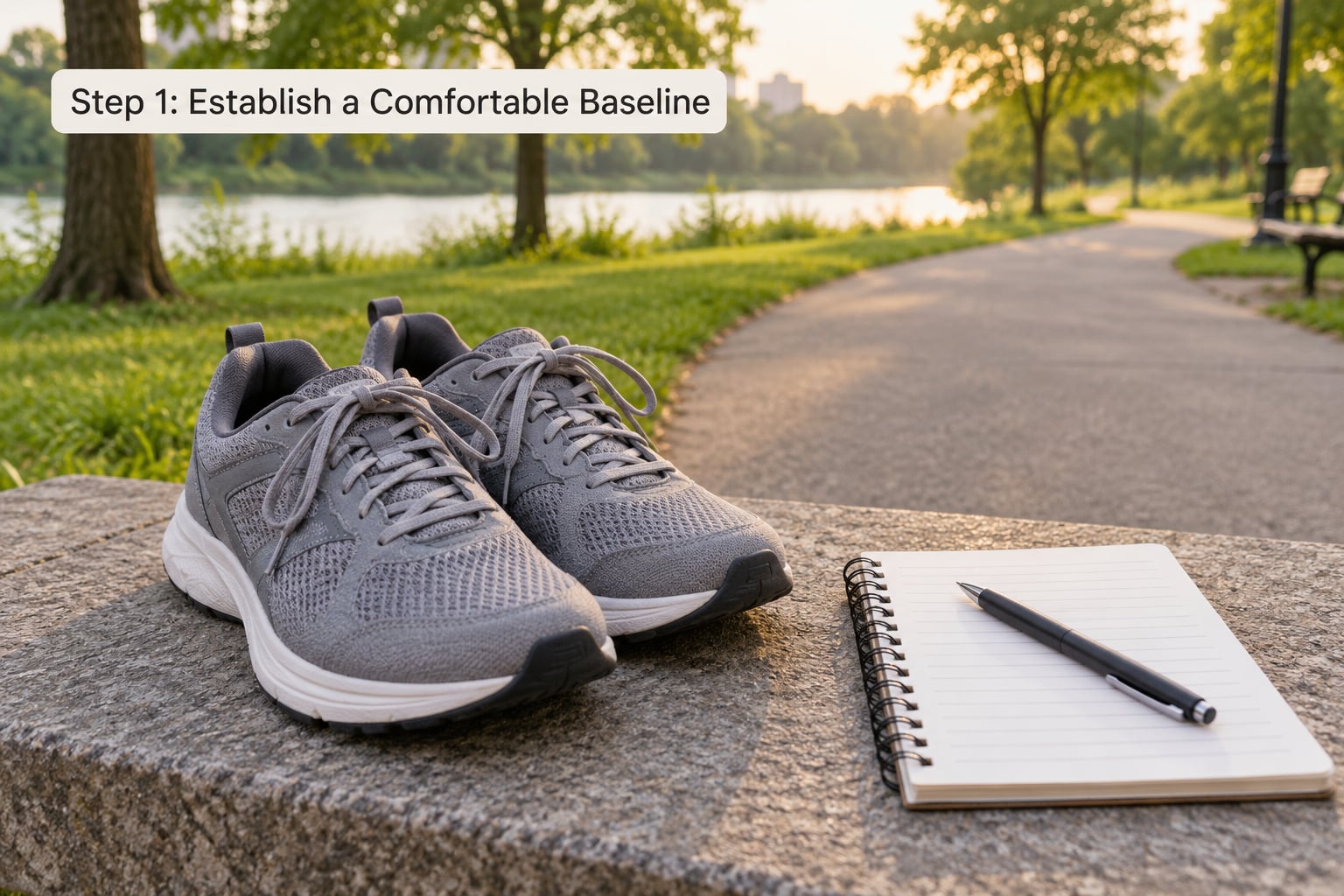
For five or seven days, walk the same amount of time every day and write it down. Twenty minutes on Monday, twenty on Tuesday, however many you can do without your breathing going ragged. That number is your baseline.
The pace you want at baseline is the pace where you could hold a full conversation but not comfortably sing. Brisk but controlled. This is the same yardstick most walkers and runners use in practice, because it needs no equipment and no numbers to interpret.
Write down the duration and how it felt on a scale of one to ten. On a bad day, ten means you could not have gone much further. On a good day, three or four means you had room to spare. Anything harder than six on your first few walks is too much starting volume.
Step 2: Add Walking Time Gradually
Add two to three minutes per session per week. That is the whole rule, and it is slower than it sounds, which is exactly the point. Anything faster is the most common cause of shin and knee pain in new walkers.
Keep the added effort easy. If a longer session pushes you past the talk test every single week, you have added too much. Spread your sessions across the week instead of stacking them, and keep at least one full rest day between harder walks.
Six weeks of this puts most beginners at roughly forty-five minutes of continuous easy walking. That is a real change, and it is where the first honest conversation with yourself should happen: what is still easy, and what needs more time.
Step 3: Build Consistency Before Speed
Four or five walks a week beats three long ones and one punishing weekend effort. Endurance is mostly about the number of days you show up, not how fast any single session feels.
A simple weekly shape works well: two or three sessions at your standard duration, one slightly longer easy walk, and one day where you add short faster bursts if you want to. Rest days are part of the plan, not a missed workout.
Anchor the walks to something you already do. A ten-minute walk after lunch, a phone call at lunch instead of at your desk, or a parked car a few blocks further away. Routines tied to existing habits survive bad weeks better than resolutions do.
Step 4: Use a Comfortable Talk-Test Pace
Walking endurance comes from time at a sustainable effort, not from sprinting uphill until you cannot speak. Most of your weekly minutes should sit at the talk-test pace described in step one.
Once you have three or four consistent weeks behind you, add a little contrast. Walk brisk for three to five minutes, then easy for five, and repeat. That kind of interval walking raises your ceiling without spending a whole week feeling wiped out.
Do not judge progress by speed. What you are actually watching is how the same effort feels: a walk that used to leave you breathless at fifteen minutes now leaves you slightly warm at thirty. That difference is the adaptation.
Step 5: Include Recovery and Easier Weeks
Every third or fourth week, do less. Cut the duration by a quarter, keep the pace easy, or skip a session entirely. Your body builds the capacity during the recovery days, not during the walk itself.
Mild muscle soreness the day after a longer walk is normal and usually settles within a day or two. Sharp pain, pain that changes your stride, or joints that stay sore for more than a couple of days are different signals, and those mean stop and rest.
Two or three sessions a week is enough to keep the gains while you recover from a busy stretch. Consistency at a lower level beats an interrupted high level every time.
Step 6: Progress Toward Longer, Stronger Walks
Once three sessions of forty to sixty minutes feel genuinely easy, you have options. Add a second walk on a rest day before you make the existing walks harder. A ten-minute walk most days beats one hard hour twice a week.
After that, hills and incline. On a treadmill, raise the incline by two to three percent and hold your speed rather than speeding up; the community consensus among treadmill walkers is that incline costs less than sprinting. Outdoors, add gentle rises only after a few pain-free weeks at one level.
Keep your form while you do it. Shorten your stride going downhill and keep your knees soft, because downhill walking pushes roughly three to four times your body weight through the knees. Uphill, take slightly shorter steps and let your torso lean forward a touch.
For anyone training toward a long hike or a 20 mile walk, the last eight weeks should add load gradually, and a light backpack on flat ground is a better use of a training block than a brutal weekend distance.
Common Mistakes
Starting with your longest walk. A first session of ninety minutes guarantees soreness and a lost week. Fix: start at a duration that feels almost too easy, then build from there.
Increasing too fast. Adding twenty minutes a week instead of two or three is the fastest route to shin splints and knee complaints. Fix: change one variable at a time, and let the pace stay easy.
Treating soreness as progress. Soreness reflects a novel stimulus, not an improved aerobic system. Fix: measure progress by how a familiar walk feels, not by how your legs felt the next morning.
Walking hard every single session. If every walk is at maximum effort, there is no easy work to recover with. Fix: keep most sessions conversational and let the hard efforts be short and rare.
Skipping the warm-up. Ten easy minutes at the start is not optional once your sessions pass half an hour. Fix: walk slower for the first five minutes and add a few calf raises and gentle leg swings.
Ignoring footwear or terrain. Worn soles and long downhill stretches are how comfortable walkers pick up knee pain. Fix: check your shoes every few hundred miles and shorten your downhill stride.
Pushing through sharp pain. Fatigue is not injury, but sharp or localised joint pain is a different category. Fix: stop, rest, and see a doctor or physiotherapist if it persists or keeps coming back. This is general information, not a diagnosis or a treatment plan, and personal advice is worth getting from a professional.
Frequently Asked Questions
How often should I walk to improve stamina?
Most beginners do best with four or five walks a week, spread out with at least one rest day between harder sessions. Three walks a week is enough to keep the gains you have already made, which makes it a good floor on busy weeks. Consistency matters more than any single session, so a shorter walk on a low-motivation day beats skipping it.
How long should each walking session be?
Start with what you can manage comfortably, even ten or fifteen minutes, and add two to three minutes per session each week. Most people reach forty-five minutes of continuous easy walking in about six weeks and an hour within three months. Stop adding time when a session regularly leaves you breathless rather than simply warm.
How do I know when to increase my walking distance?
Wait until your current duration feels genuinely easy rather than merely tolerable, you have no lingering soreness, and the pace still passes the talk test. Then add a small amount, usually two to three minutes, and hold that level for a week before going further. Increase one variable at a time so you know what your legs are reacting to.
Do hills help build walking endurance?
Yes, once you are walking forty to sixty minutes a few times a week without pain. Incline raises the effort without asking you to cover more ground, which is why treadmill walkers prefer a two to three percent incline over speeding up. Outdoors, add gentle rises after a few pain-free weeks and take shorter strides on the way down to spare your knees.
How do I recover from sore legs after walking?
Light movement usually helps more than sitting still, so a short easy walk the day after a harder session beats nothing at all. Gentle calf and hamstring stretches, normal sleep and normal meals do most of the rest. Soreness that clears within a day or two is ordinary training fatigue; pain that lingers, sharpens or alters your gait is not.
When should I see a doctor about walking pain?
See a doctor or physiotherapist if joint pain lasts more than about 48 hours, keeps returning, or comes with swelling, numbness or a noticeable limp. Stop walking through sharp or localised pain rather than trying to push past it, and get an assessment before you resume. A doctor can also check whether your footwear or an underlying joint issue is the cause.
Conclusion
Start with one week of walking at the same easy duration every day and write down what that number is. Then add two or three minutes a week, keep the pace conversational, and take an easier week every third or fourth week. That is how to build walking endurance without collecting shin splints along the way.