Most beginners do best with 20 to 45 minutes per session, three to four days a week, and a much shorter first week while the body adapts. So if you are starting from zero, 10 to 15 minutes on your first few sessions is a perfectly legitimate workout, not a warm-up for the real thing. Duration matters far less than showing up consistently, and consistency is easier when the session fits your actual day.
So how long should a beginner workout last, exactly? There is no single number that is right for everyone. A 30-minute walk, a 30-minute full-body strength session and a 30-minute cycle class are not the same workout, and they do not tax your body the same way. What sets your ideal length is the intensity, how many hours you have to recover, and how much experience you have with the movements.
Table of Contents
- How Long Should a Beginner Workout Last?
- What changes the answer day to day
- Beginner Workout Length by Activity
- How long should a beginner workout last by goal?
- How often should beginners work out?
- How to tell if a workout is too long
- How to increase workout duration safely
- A simple beginner workout schedule
- Beginner workout examples
- Frequently Asked Questions
- Is a 20 minute workout enough to lose weight?
- Is a 30 minute workout enough for beginners?
- How long should a strength training session last for a beginner?
- How sore should I be after my first workouts?
- Should beginners do 15 or 30 minute workouts?
- Conclusion
How Long Should a Beginner Workout Last?
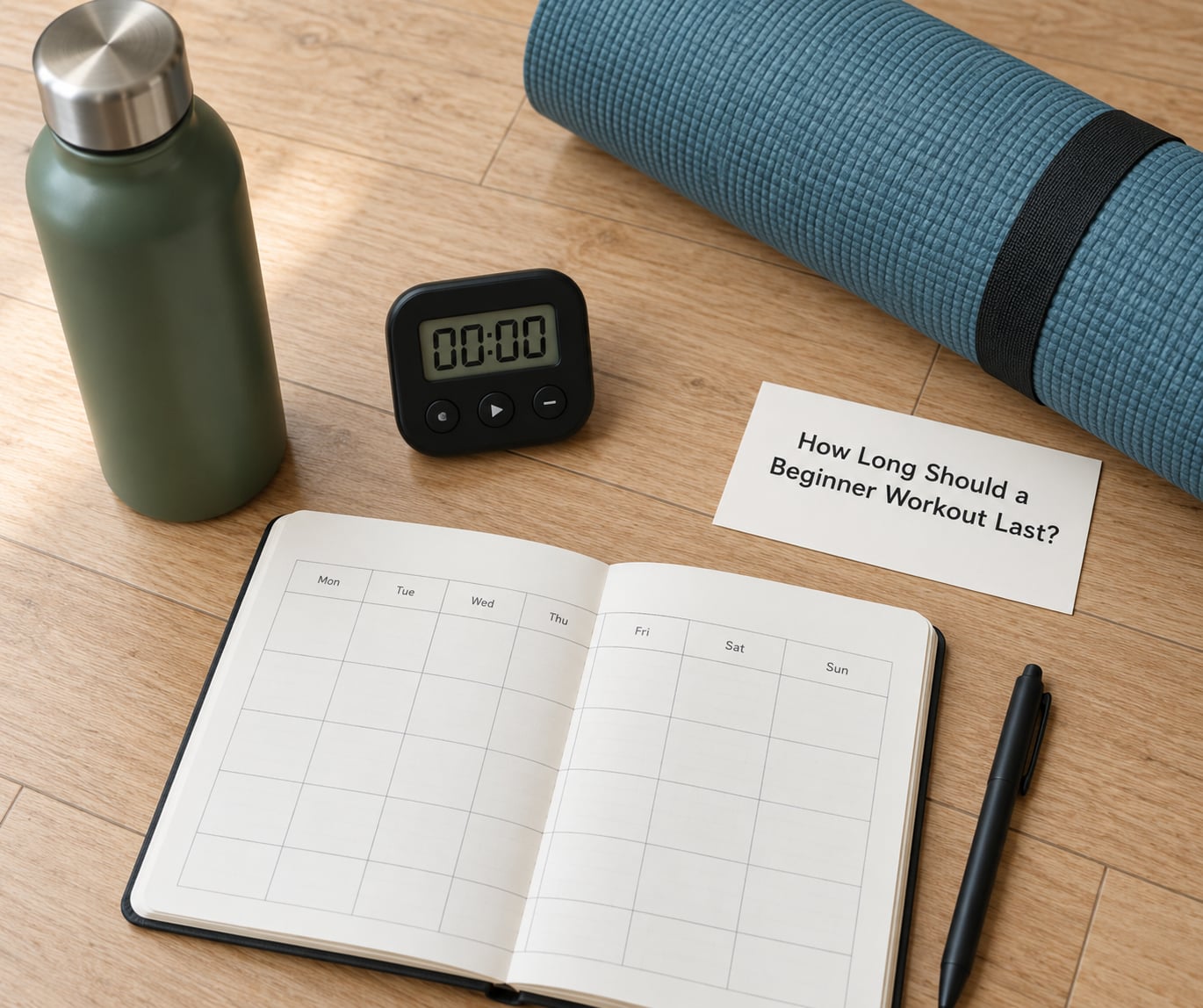
Here is the honest short answer. For someone with no recent training background, aim for 10 to 15 minutes in week one, 15 to 20 minutes in week two, 20 to 25 minutes in week three, and 30 to 45 minutes once you have four weeks behind you. Do that three or four days a week and you are meeting the same weekly activity target the CDC Physical Activity Guidelines for Americans set out for adults: 150 minutes of moderate-intensity activity spread across the week.
Notice what that answer is not. It is not 90 minutes. It is not a number to hit every session no matter how you feel. It is a starting point that you adjust as your recovery improves.
What changes the answer day to day
Intensity is the biggest variable. A session where you can talk in short sentences but not sing is moderate intensity, and 30 minutes of it counts for a lot. Twenty minutes of near-maximum intervals is a completely different demand, even though the clock says less.
Recovery is the second variable. Sore joints or muscles from a session two days ago usually mean the next one should be shorter, not longer. Plenty of beginners describe their first win as simply finishing one full week of training three days in a row, which tells you the constraint at the start is showing up, not the number of minutes.
Prior experience is the third. If you trained regularly within the last six to twelve months, you are not a beginner in the sense used here, even if you have been away for a few weeks.
Beginner Workout Length by Activity
Different activities fit different time budgets. This table gives a starting point per activity type, with the number of days per week to pair with it. Adjust the intensity column down first if the duration feels hard.
| Activity | Starting duration | Days per week | Intensity to aim for |
|---|---|---|---|
| Walking | 20 to 30 minutes | 5 to 7 | Brisk, but able to talk |
| Steady-state cardio (bike, elliptical, swim) | 15 to 25 minutes | 3 to 4 | Moderate, conversational pace |
| Strength training, full body | 25 to 40 minutes | 3 | Moderate load, 2 to 3 reps left in reserve |
| Mobility and stretching | 10 to 15 minutes | 5 to 7 | Easy, no pain at end range |
| Beginner full-body circuit | 20 to 30 minutes | 3 to 4 | Moderate, minimal rest between movements |
| Interval training | 15 to 20 minutes | 1 to 2 | Hard bursts, full recovery between |
Walking sits apart from the rest because it is low-impact and easy to repeat, which is why it can be daily. Interval training sits apart in the other direction: it is the one category where a short session can be more demanding than a long one, so beginners usually keep it to once or twice a week.
How long should a beginner workout last by goal?
Your goal shifts the number, usually by a small amount.
- General health: 20 to 30 minutes three times a week. This is where the 150-minute weekly guideline does most of its work.
- Weight management: 30 to 45 minutes, four to five days a week. Duration matters less than the weekly total, and a mix of strength and cardio sessions tends to hold up better than cardio alone.
- Endurance: start with 20 minutes and build the long session only, keeping the rest of the week short. Adding time to every workout at once is the fastest way to stall progress.
- Muscle gain: 35 to 45 minutes, three days a week. Full-body sessions fit a beginner well because every muscle gets worked each time.
- Habit formation: 10 to 15 minutes, daily or five days a week. The CDC recommends about two minutes of activity a day as a starting point, and habit researchers generally put automaticity at a little over two months, so small and daily beats long and sporadic at the start.
How often should beginners work out?
Three days a week is the standard starting frequency, and three full-body sessions a week is enough to build real strength and a visible change in body composition. Four days is a reasonable second step once three feels easy and your schedule allows it.
Put at least one rest day between strength sessions for the same muscle group. Beginners often add days too quickly and end up sore for a week, then conclude that exercise does not suit them. It does; the pace did not fit.
Is three days a week too little? No. Three is the recommended starting frequency and plenty can be maintained long term. If three sessions of 45 minutes each feels better than six of 20, do the three. Total weekly minutes matter more than how you carve them up.
Chunking is the underrated habit here. A 20-minute block before lifting gets you the same weekly volume as one long session, split into pieces that fit a real morning.
How to tell if a workout is too long
The session should end while you could still do a bit more, not after you have nothing left. Watch for these signs during and after.
- Your form breaks down in the last few reps of every set, and the reps stop being reps.
- You feel light-headed, dizzy, or sick to your stomach during the main work.
- Sharp pain in a joint, as opposed to muscle effort, appears partway through.
- You are still wiped out the next day in a way that makes the following session unpleasant.
- Performance drops session after session even though nothing changed.
A two-hour session is well past the useful point for a beginner. It usually means quality fell away somewhere in the middle and recovery got harder. Two 45-minute sessions spread across the week will serve you better, and stacking three 20-minute classes across four to six days works for exactly this reason.
Stop and get medical advice rather than pushing through chest pain, severe shortness of breath, fainting, or pain that lingers for days. If you have a heart condition, joint replacement, or a condition affected by exercise, ask your doctor before starting, and do it again before you increase duration.
How to increase workout duration safely
Progress in this order, and only one step at a time. Jumping straight from 15 minutes to 45 is why beginners get hurt and quit.
- Add a few minutes. Five extra minutes per session, once per week, is plenty early on.
- Add reps. One or two more per set costs almost no extra time and is the best move once you hit 40 minutes.
- Add load. Heavier weight for the same reps, still leaving two to three in reserve.
- Add a set. Only after the rep count and weight have stalled for a couple of weeks.
- Add a day. A fourth session per week, placed away from your heaviest strength day.
Give each change two to three weeks before judging it. Soreness that settles by the next session is normal early on; soreness that outlasts 48 hours means you added too much at once, so drop back to the last level that felt easy.
A simple beginner workout schedule
This is a seven-day framework for someone starting from scratch. Swap sessions around freely; the only rules are that no two strength days sit next to each other, and that at least one full rest day stays in the week.
- Monday: full-body strength, 25 minutes
- Tuesday: brisk walk, 30 minutes
- Wednesday: rest or easy mobility, 10 minutes
- Thursday: full-body strength, 25 minutes
- Friday: brisk walk or cycle, 30 minutes
- Saturday: full-body strength, 30 to 40 minutes
- Sunday: rest
Busy week? Keep Monday, Thursday and Saturday and let the walks go. Missing one walk is a small loss; missing two strength sessions in a row is the pattern that stalls progress.
If you are over 65, returning after a long break, or managing a chronic condition, start with the walking slots only and add strength work once that feels routine. That is not a slower path, it is just a different order.
Beginner workout examples
These three sessions use the same structure: warm-up, main work, cool-down. Knowing where the minutes go is often more useful than the total, because it stops a 30-minute session from being 25 minutes of warm-up.
The 15-minute session: 3 minutes easy movement such as marching or arm circles, 9 minutes of main work as a circuit of 3 exercises for 30 seconds with 30 seconds of rest, and 3 minutes of slow walking plus a calf and chest stretch. Nothing here needs a gym.
The 30-minute session: 5 minutes warm-up, 20 minutes of main work, 5 minutes cool-down. For the main work, pick four or five movements such as a squat, a push-up, a row, a hip hinge and a plank. Do 2 to 3 sets of 8 to 12 reps with 60 to 90 seconds of rest between sets. Going the other way, 3 sets of 6 to 12 reps with 2 to 3 minutes of rest works just as well if you prefer fewer sets and longer pauses.
The 45-minute session: 7 to 10 minutes warm-up including a few light sets of your first movement, 30 minutes of main work across two blocks of 3 exercises done as supersets, and 5 minutes cool-down. Keep rest between paired exercises at 60 to 90 seconds rather than three minutes, which is what keeps a superset session inside the time box.
Count the commute and the changing room too. If a gym round trip eats 30 minutes, a 45-minute session becomes a two-hour block, and a 25-minute home session is the realistic answer for the same training effect.
Frequently Asked Questions
Is a 20 minute workout enough to lose weight?
Yes, for weight loss what matters most is your weekly total and whether you keep it up. A 20-minute session done five days a week beats a 60-minute session done once, because the weekly total is higher and you are more likely to repeat it. Pair a couple of those short sessions with two longer strength sessions if you want to keep muscle while you lose fat, and remember that diet does more of the work than session length.
Is a 30 minute workout enough for beginners?
Thirty minutes is a strong target for a beginner. Three of them a week gives you 90 minutes of activity, and adding two brisk 30-minute walks brings you to the CDC guideline of 150 minutes of moderate-intensity activity per week. If 30 minutes is unrealistic right now, a 15-minute session on the same days keeps the habit intact while you build toward the longer version.
How long should a strength training session last for a beginner?
Plan for 35 to 45 minutes, three days a week, using full-body sessions. Most beginners can complete five or six exercises for two or three sets inside that window with 60 to 90 seconds of rest. Once you pass 45 minutes, the better move is usually one more rep per set or a slightly heavier weight, not a longer session, because long strength sessions are where form starts to fall apart.
How sore should I be after my first workouts?
Some muscle soreness in the first two weeks is normal and tends to ease as your body adapts. Joint pain, sharp pain, or soreness that lasts longer than 48 hours is a signal to do less next time, not more. Keep the load light, leave two or three reps in reserve on every set, and stick to three days a week for the first month. Soreness is not a measure of whether the workout worked.
Should beginners do 15 or 30 minute workouts?
Start with 15 minutes if you are completely new or returning after a long break, and add five minutes a week until you reach 30. Fifteen minutes done daily builds the habit fastest, while 30 minutes three times a week builds fitness fastest. Many beginners do better by running both for a few weeks, using the short session on busy days and the longer one when the schedule is clear.
Conclusion
Start with 10 to 15 minutes, three days a week, and treat that as a real workout rather than a warm-up. Add five minutes a week, or a rep, or a day, one change at a time, and stop adding whenever soreness or form tells you to. Most beginners settle around 30 to 45 minutes a few months in, and that is where the useful work happens anyway.