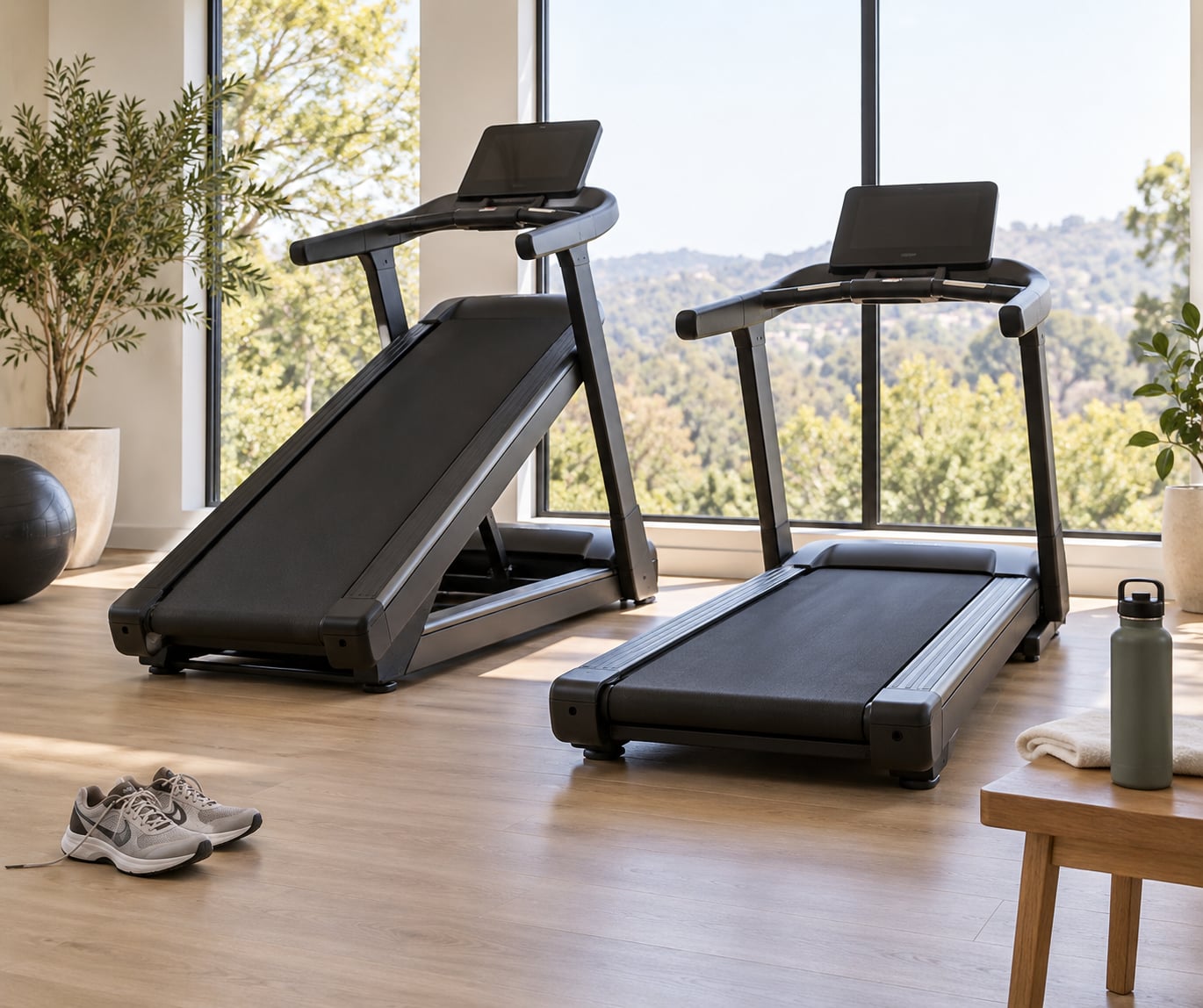
Neither one is automatically better. Fat loss comes from a sustained calorie deficit, and the modality you pick only changes how quickly you burn calories, how your joints feel, and whether you can still be doing it in three months.
Here’s the honest split. Running burns more calories per minute, roughly 13 against about 10 for incline walking at a matched effort, so it wins on time efficiency. Incline walking burns a higher share of your calories from fat and asks far less of your knees, ankles and hips, so it wins on volume and longevity. If you compare incline walking vs running for fat loss and stop there, you’ll miss the point.
Table of Contents
- Incline Walking vs Running for Fat Loss at a Glance
- Which Burns More Fat and Calories?
- Incline walking vs running for fat loss at the same effort
- Which Is Better for Weight Loss?
- How Does Incline Walking Work for Fat Loss?
- How Does Running Affect Fat Loss?
- Joint Impact and Injury Considerations
- Which Should You Choose?
- Frequently Asked Questions
- Does incline walking burn more calories than running?
- Is walking 30 minutes the same as running 30 minutes?
- What is a 12 incline on a treadmill equivalent to?
- How long should I do incline walking for fat loss?
- Does 12/3/30 actually burn fat?
- Is incline walking or running better for belly fat?
- Conclusion
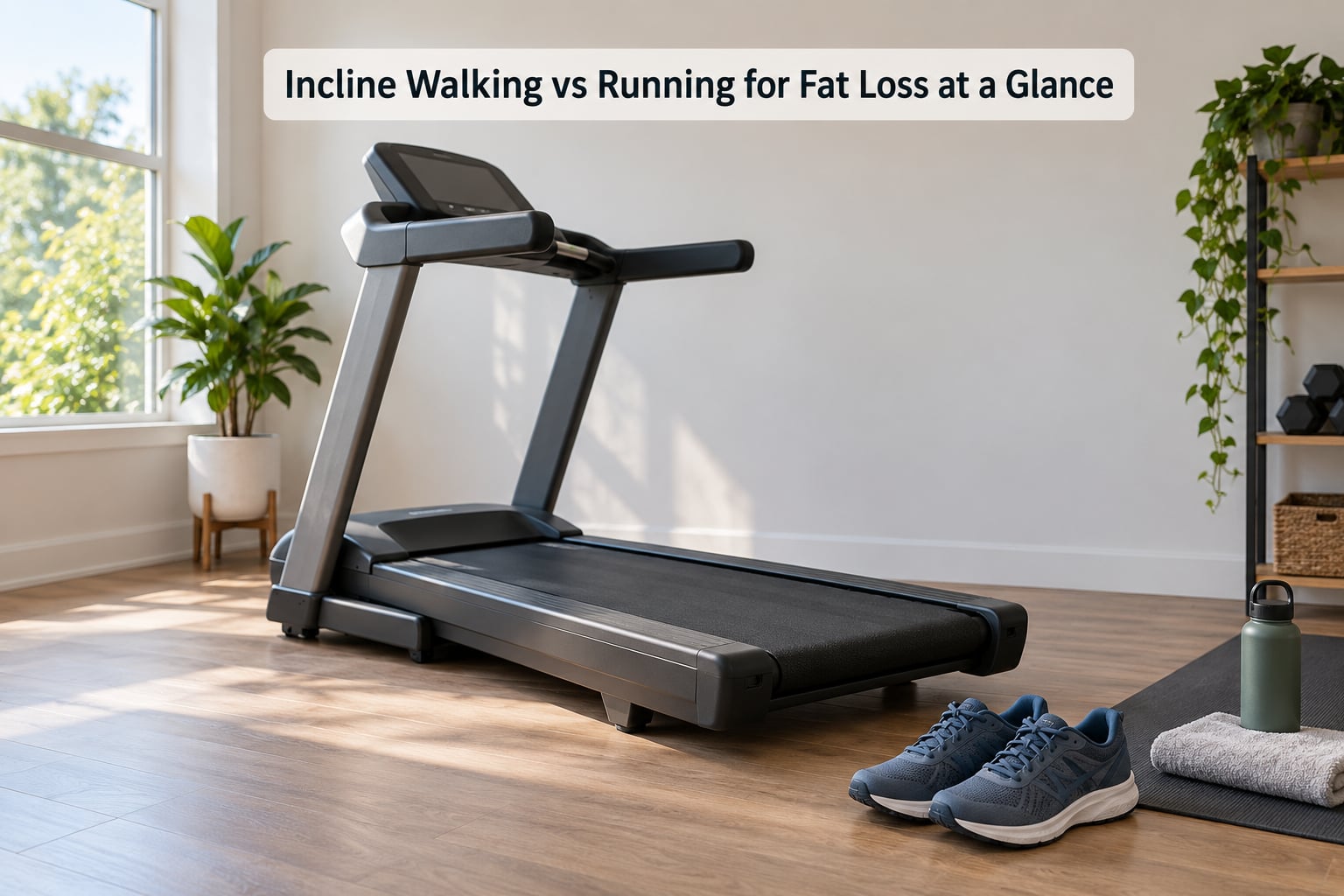
Incline Walking vs Running for Fat Loss at a Glance
| Factor | Incline walking | Running | Edge |
|---|---|---|---|
| Calories per minute at matched effort | About 10 kcal/min | About 13 kcal/min | Running |
| Calories in 30 minutes (155 lb person) | About 300 kcal | About 390 kcal | Running |
| Time to burn a similar amount | Longer | Shorter | Running |
| Share of energy from fat | Higher (about 40.6%) | Lower (about 33%) | Incline walking |
| Joint and tendon impact | Low | High, repetitive | Incline walking |
| Overuse injury risk | Low to moderate | Moderate to high | Incline walking |
| VO2 max and aerobic ceiling | Moderate gains | Strong gains | Running |
| Afterburn (EPOC) | Short | Longer | Running |
| Weekly volume you can sustain | High | Limited by recovery | Incline walking |
| Hunger and recovery cost | Low | Moderate | Incline walking |
| Skill and joint prerequisite | None | Several weeks of buildup | Incline walking |
| Best for | Beginners, joint comfort, high volume | Trained joints, limited time | Depends |
Read the table as a set of trade-offs rather than a scoreboard. Incline walking takes the joint and durability rows; running takes the speed and cardiovascular rows.
Which Burns More Fat and Calories?
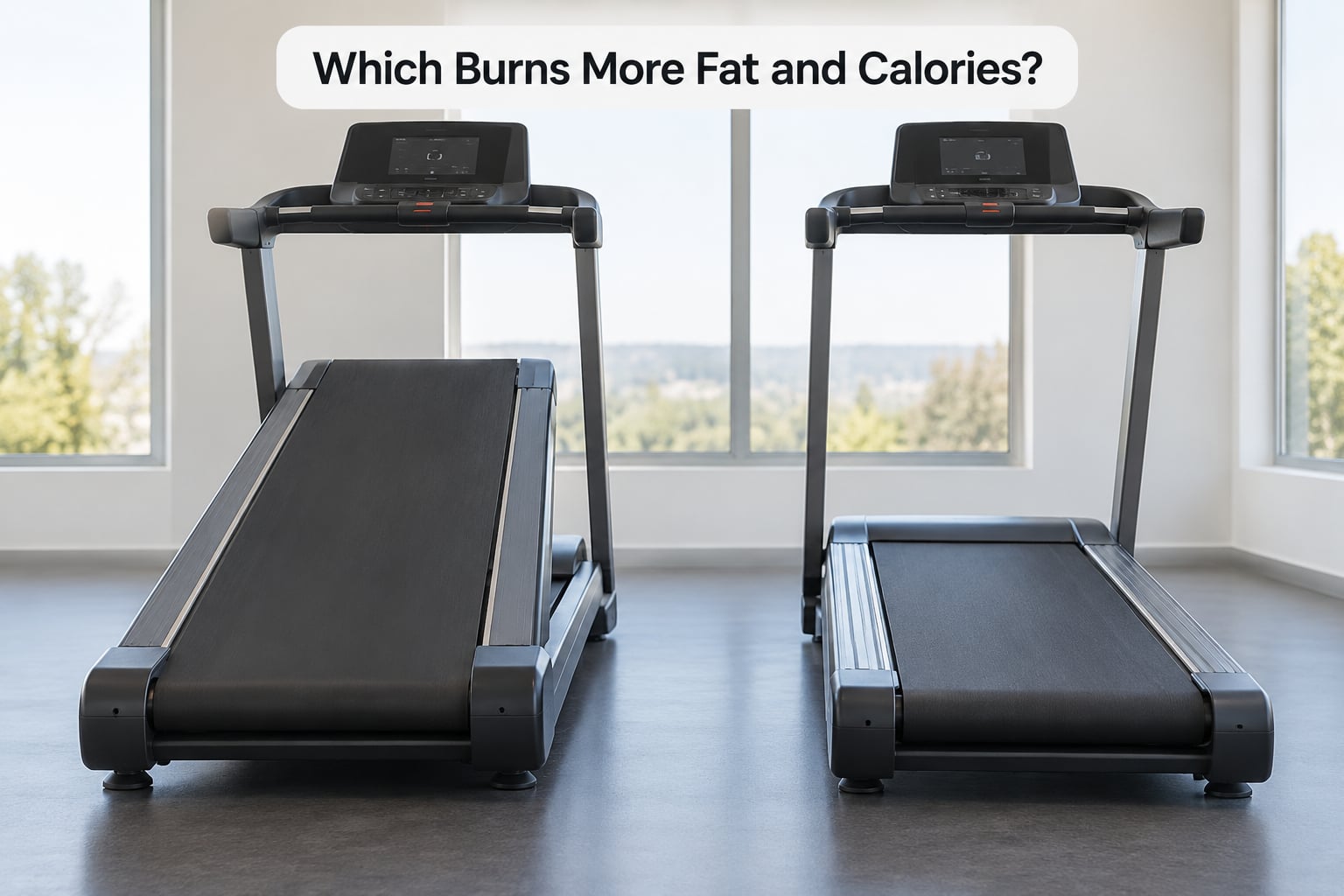
Running burns more calories per minute. Incline walking burns a higher percentage of those calories from fat, which sounds like it should matter more but mostly doesn’t.
The way to think about it: calories out is the whole game for fat loss, and the body blends fat and carbohydrate fuel continuously at most intensities. A study widely cited in GQ write-ups put incline walking at roughly 40.6 percent of energy from fat against roughly 33 percent for running. Both numbers describe fuel mix during a session, not fat lost by the end of the week.
Here’s the table that actually helps. Figures are approximate, based on a 155 lb person using standard MET values, and your own burn will differ with body weight, pace, duration and fitness.
| Activity | Approx. kcal/min | Approx. kcal per 30 min |
|---|---|---|
| Brisk walking, 3.5 mph, flat | About 4.5 | About 135 |
| Incline walking, 3 mph at 8% | About 7 | About 210 |
| Incline walking, 3.5 mph at 12% | About 10 | About 300 |
| Incline walking, 3 mph at 15% | About 11.5 | About 345 |
| Jogging, 6 mph | About 13 | About 390 |
| Running, 7 mph | About 15 | About 450 |
An r/Fitness thread asked how a 15 percent incline could burn roughly three times the calories of flat walking at the same speed. The answer is mechanical: you’re climbing, and climbing costs energy per step no matter how slow your feet move.
Weight matters more than most calculators admit. A 220 lb person at the same speed and incline burns meaningfully more than a 155 lb person, which is why two people doing identical workouts get different numbers and end up arguing online about who’s right.
Incline walking vs running for fat loss at the same effort
At the same effort, the calorie gap narrows. Running still costs more per minute, but a hard 12 percent incline walk and an easy jog can land within a few calories of each other.
Use the talk test to match them. A full sentence or two is moderate effort, roughly where fat loss work happens for most people. One or two words is vigorous. If you can chat comfortably at 3 mph on a 12 percent grade, add incline or pace, not both at once.
A treadmill that reports a higher heart rate but fewer calories on an incline walk is not lying exactly, it’s just estimating from different inputs. People on r/C25K found this genuinely confusing. Use perceived exertion and time on your feet as your real tracking metrics rather than the console’s number.
Which Is Better for Weight Loss?
Neither wins on paper. What wins is adherence, and the option you can do more often usually produces a bigger deficit over a month.
Time efficiency is running’s genuine edge. If you can only spare 25 minutes, a run gets you more done. That’s real and it’s why serious time-boxed programs work.
Appetite is walking’s genuine edge, and nobody covers it well. On r/WeightLossAdvice, people point out that a high weekly walking volume can be done without the hunger spike that follows a hard run. A deficit you can tolerate is worth more than a bigger one you abandon.
Recovery cost matters more than beginners expect. Running builds real fatigue that needs sleep and food to clear. Incline walking at the same energy cost usually leaves you able to strength train the next day, which protects lean mass during a deficit.
Pair either modality with two or three resistance sessions a week if muscle retention is a goal. Cardio burns calories; resistance tells your body what to keep.
How Does Incline Walking Work for Fat Loss?
Incline walking raises the grade under your feet, so every step requires lifting your body against gravity. That loads the glutes, hamstrings and calves, raises heart rate at a fixed speed, and increases energy expenditure without any airborne phase.
Research published in Sports Medicine and Health Science, and cited in NordicTrack’s review, found incline walking reduces loading on the front of the knee, which is exactly the tissue that tends to complain during running.
Most consumer treadmills top out near 12 percent incline, with higher-end machines reaching 40 percent. That ceiling matters because it’s roughly where incline walking stops being a walk in effort terms.
In real-world terms, a lot of people land around 12 to 15 percent at 3 to 3.5 mph. One r/workout user described sustaining that setup for months and preferring it to running because of how it felt the next morning.
A four-week progression that most people can tolerate:
- Week 1: 5 percent incline, 3 mph, 25 minutes, three sessions.
- Week 2: 8 percent incline, 3 mph, 30 minutes, three sessions.
- Week 3: 10 percent incline, 3.5 mph, 35 minutes, three to four sessions.
- Week 4: 12 percent incline, 3.5 mph, 40 minutes, four sessions.
Add incline before you add time, and add time before you add days. The failure pattern on r/C25K was people jumping to max incline immediately and ending up with shin splints or tight calves within a fortnight.
Two form rules that people break constantly. Don’t hold the handrails, since leaning on them cuts the effective effort and invalidates the calorie estimate. And step mid-foot with a tall core instead of leaning forward from the ankles.
How Does Running Affect Fat Loss?
Running creates a higher energy demand per minute and a longer afterburn once you stop. That excess post-exercise oxygen consumption, or EPOC, keeps burning elevated for a while after a run, though it’s modest unless the session was genuinely hard.
It’s also the more efficient way to build VO2 max. If your goal is aerobic capacity, an easy run beats an incline walk at the same calorie cost because the cardiovascular system adapts to the demand being placed on it.
The trade is recovery. Running delivers more impact per repetition and more central fatigue. Most people can absorb a run a few times a week; few can absorb daily running while also lifting.
Roughly 30 minutes of jogging handles about 390 kcal for a 155 lb person, which is meaningful. The mistake is treating a single run as a shortcut, then eating the difference back. A 400 kcal deficit once a week is a rounding error against a week of eating.
Joint Impact and Injury Considerations
Incline walking is the low impact option. It keeps you in contact with the ground for the whole session, which is why the Mayo Clinic’s general guidance treats walking-type movement as gentler on painful joints than running.
Running carries repeated impact plus a landing phase you don’t get on a walk. That combination makes shin splints, plantar fasciitis, patellofemoral pain and Achilles tendinopathy the classic overuse cluster. They’re not dramatic, but they’re stubborn, and they stall fat loss more than most people expect.
Higher body weight raises the load on every step, which is one reason the mechanism behind incline walking matters more the more you weigh. The same grade is a heavier job at a higher bodyweight.
Incline walking is not risk-free either. Go too steep too fast and you trade knee complaints for calf, shin and Achilles problems, which is the trade runners make with their knees.
If you have current knee, hip or ankle pain, get it assessed before changing your exercise. Your doctor or a physical therapist can tell you whether pain is something to work around or something that needs rest first. Stop any session that produces sharp or worsening pain rather than something that fades as you warm up.
Which Should You Choose?
Pick incline walking if you’re starting out, if your joints have a history, if you want more weekly cardio than running can give you, or if you need to move on days you’re also lifting.
Pick running if your joints already tolerate it and you have a hard time limit on your sessions. Twenty-five minutes of running is hard to match with walking once you account for the incline you need to get an equivalent burn.
Pick both if you can. A run/walk hybrid, often called the run-walk method, gets running’s time efficiency and running’s aerobic stimulus with walking’s recovery built into the same session. That’s the compromise most people can actually hold for a year.
Skip the treadmill calorie readout when you’re deciding whether a session worked. Your belt time, your incline, your pace and how hard it felt are the numbers worth keeping.
Frequently Asked Questions
Does incline walking burn more calories than running?
No. Running burns more calories per minute, roughly 13 kcal/min against about 10 for incline walking at a matched effort. Incline walking closes the gap when the grade is high enough, so a steep walk over a longer period can match or beat a short jog. For fat loss, total weekly calories matter far more than the per-minute number.
Is walking 30 minutes the same as running 30 minutes?
No. For a 155 lb person, 30 minutes of jogging burns roughly 390 calories while 30 minutes of incline walking at 3.5 mph and 12 percent burns roughly 300. The gap narrows as you extend the walk or steepen the grade. Over a week, though, most of that difference disappears if both sessions happen consistently.
What is a 12 incline on a treadmill equivalent to?
A 12 percent incline is about a 7 degree grade, which is roughly a steep hill or a long flight of stairs. At 3 mph it puts most people at about 9 to 10 METs, close to a 6 mph jog on a treadmill. Outdoors, runners call the equivalent effort a hilly trail or a brisk climb rather than a flat jog.
How long should I do incline walking for fat loss?
Most people need 30 to 45 minutes at a moderate effort to get a useful calorie total, or two shorter sessions. What matters more than duration is weekly consistency: three 30-minute sessions will beat one 90-minute session in almost every real schedule. Build duration gradually, since jumping straight to steep grades invites shin and calf problems.
Does 12/3/30 actually burn fat?
It burns plenty of calories, roughly 300 for a 155 lb person over 12 minutes, but it works by intensity rather than by hitting a special fat-burning zone. Fat loss still depends on the weekly deficit. It is a fine short session on busy days, though 12 hard minutes is not a substitute for a longer steady walk or a run.
Is incline walking or running better for belly fat?
Neither targets belly fat specifically. Visceral fat responds to a sustained calorie deficit, and spot reduction is not something either modality does. If you carry more fat around the middle, running burns more per minute while incline walking is easier on the hips and knees, which can mean more total volume over time.
Conclusion
Choose the one you’ll still be doing next year, start at an effort where you can still talk, and build up gradually. If your joints are the reason you’re hesitating, incline walking gets you a real deficit with less risk. If time is the constraint, running does more per minute. Track belt time, pace and incline rather than console calories, and pair whichever you pick with resistance training and a balanced eating plan.
This is general information, not personal medical advice. If you have pain, a health condition, or a history of injury, talk to your doctor or a registered dietitian before changing your exercise or eating routine.