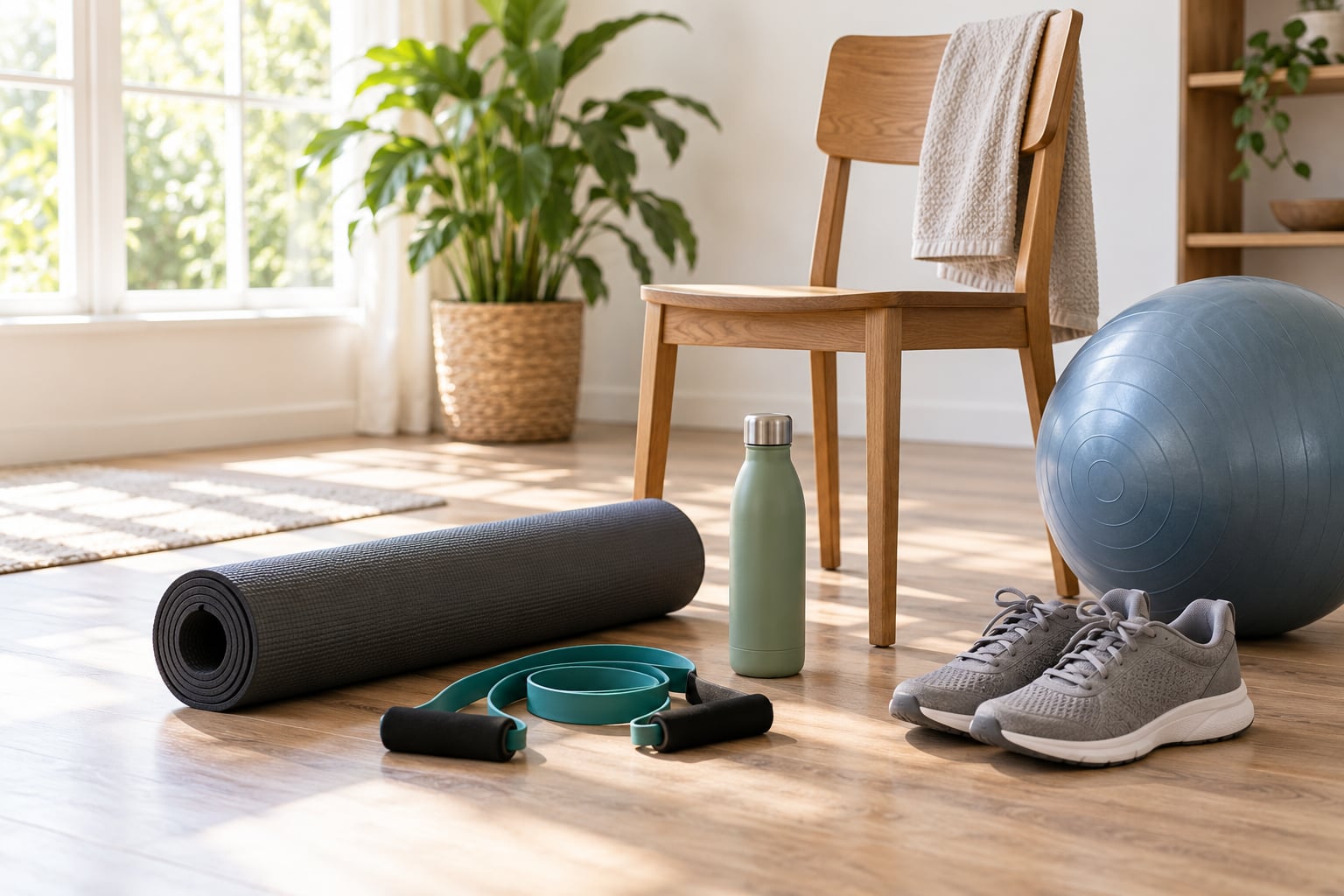
The best low impact workouts for overweight beginners are the ones where your feet stay on the ground and your joints take almost no shock, like walking, water walking, cycling and chair cardio. Low impact simply means one foot is always in contact with a surface, so there is no jumping or running. You still raise your heart rate and burn calories, just without the pounding that puts beginners on the sofa for three days. Pick one from the list below and start smaller than feels silly.
I want to say the quiet part first. Most people who search this have been handed advice that assumes they can already run, jump, burpee or get flat on the floor, and it makes them feel like the problem is their body rather than the programme. It isn’t. The fix is a plan built for where you are now, not where a fitness video thinks you should be.
One safety note before anything else. If you have heart disease, diabetes, high blood pressure, a joint replacement, an injury, or have been mostly sedentary for years, talk to your doctor or a qualified health professional before you start, and mention any pain you already have. The guidance here is general information, not a personal prescription. The CDC recommends around 150 minutes of moderate-intensity aerobic activity a week plus two days of muscle strengthening, and for most beginners that target is reached in stages over months, not in week one.
Last updated for 2026.
Table of Contents
- Low Impact Workouts for Overweight Beginners at a Glance
- 1. Beginner Walking Workout
- 2. Low Impact Marching in Place
- 3. Seated Step and Arm Workout
- 4. Low Impact Water Aerobics
- 5. Stationary Cycling
- 6. Gentle Elliptical Workout
- 7. Low Impact Aerobic Dance
- 8. Chair-Based Strength Workout
- 9. Resistance Band Full-Body Workout
- 10. Bodyweight Squat and Wall-Sit Progression
- 11. Gentle Hip and Knee Mobility Routine
- 12. Low Impact Circuit for the Full Body
- Frequently Asked Questions
- What is the easiest low impact exercise to start with?
- How long should a beginner workout be when starting at a higher weight?
- How do I exercise when I get out of breath almost immediately?
- Can I lose 20 pounds in a month with low impact workouts?
- Which low impact workouts are best if my knees hurt?
- How often should a beginner work out each week?
- Conclusion
Low Impact Workouts for Overweight Beginners at a Glance
Here is the whole list in one view so you can pick without reading twelve sections. The intensity column uses the common scale: low means one foot stays in contact with the ground throughout, so there is no landing from a jump or a running stride.
| Workout | Where | Equipment | Intensity | Main areas | Start with |
|---|---|---|---|---|---|
| Walking | Outdoors or indoors | Supportive shoes | Low | Legs, hips, heart | 5 to 10 minutes |
| Marching in place | Anywhere | None | Low | Full body, calves | 60 seconds, 3 rounds |
| Seated steps and arms | Home or chair cardio class | Stable chair | Low | Legs, shoulders, back | 5 minutes seated |
| Water aerobics | Pool | Towel, water shoes | Low to moderate | Full body, joints unloaded | 15 to 20 minutes |
| Stationary cycling | Home or gym | Recumbent bike ideal | Low to moderate | Legs, cardiovascular | 5 to 8 minutes |
| Elliptical | Gym | Elliptical trainer | Low | Full body, low impact | 5 to 10 minutes |
| Aerobic dance | Home or class | None, optional step | Low to moderate | Full body, coordination | 10 minute routine |
| Chair-based strength | Home or gym | Chair, wall, light weights | Low | Legs, chest, arms | 1 set of 8 to 10 |
| Resistance band | Home or gym | Light band or tube | Low | Back, chest, shoulders | 10 to 15 reps |
| Squats and wall sits | Home or gym | Wall, chair | Low | Legs, glutes | Partial range, 8 reps |
| Hip and knee mobility | Home | Chair, stable surface | Low | Hips, knees, ankles | 5 to 8 minutes |
| Full-body circuit | Home or gym | Chair, optional band | Low to moderate | Everything | One circuit, 2 rounds |
1. Beginner Walking Workout
Walking is the easiest low impact exercise to start with, and the reason is simple: you already know how to do it, nobody is watching, and you can stop the second it feels like too much. Five to ten minutes of flat ground on day one is a legitimate workout, not a warm-up.
Two things matter more than anything else. First, shoes. A supportive pair with a roomy toe box and a firm midsole spreads load across your foot instead of pinching it, and sore feet and arches are the fastest way to talk yourself out of walking. Second, terrain. Start flat and hard, then move to grass or a softer track once a session feels easy. Community walkers on Reddit point out that sand and grass reduce shock through the joints, which is why a soft trail ends up feeling easier on knees even though the effort looks higher.
Judging your pace needs no fitness tracker. Use the talk test: if you can speak a full sentence without pausing for breath, you are at moderate intensity, which is exactly where you want to be. If you can only manage a few words, slow down. That single rule keeps most beginners from blowing past what they should be doing on day one.
Track progress by time, distance or speed, not by calories. The r/workout thread that ranks on this very query makes that point repeatedly, and it is the right attitude: calories burned are an estimate that gets less accurate the more you weigh, while minutes covered are real. Start at five minutes, add two or three minutes per session, and stop adding when the next session is no longer the hardest one of the week.
2. Low Impact Marching in Place
Marching is the do-anywhere option that needs no floor, no shoes change and no equipment, which makes it the fallback for hotel rooms, bad weather and low-energy days. Lift one foot a few inches off the ground and alternate, arms swinging naturally at your sides.
Keep it simple: stand tall with your weight even across both feet, ribs stacked over your hips, and land softly rather than pounding. If your knees object, shorten the height of each lift until you barely clear the floor, or sit the march down into intervals of 30 seconds rather than continuous minutes.
The interval format is what makes it a workout rather than a warm-up. March for 60 seconds, rest or walk it out for 60 seconds, repeat three to five times. Nobody outlasts you at that ratio in week one, and the pattern travels well: as fitness builds, the march intervals get longer while the rest stays the same.
3. Seated Step and Arm Workout
Seated work removes the standing question entirely, which matters for anyone who spends most of the day sitting or whose knees and back object to weight-bearing work. Chair cardio is also the most searched format in this category for plus-size beginners, and it is genuinely effective rather than a watered-down compromise.
Choose your chair carefully. A stable dining chair with a firm back and no wheels beats a sofa, and if you can sit back fully with both feet flat on the floor, you are set. From there, alternate a seated step touch, lifting one foot slightly and returning it, with arm work like shoulder rolls, forward reaches or light arm circles.
Eight to twelve repetitions per movement is plenty, and let your range of motion be whatever feels comfortable today rather than where you think you should be. Pause whenever you need to. If you feel wobbly getting in or out of the chair, move closer and use the arms of the chair to push yourself up, and tell a doctor if that difficulty is new or worsening.
4. Low Impact Water Aerobics
Water is the closest thing to weightlessness you can get without leaving the ground, and buoyancy is why. When your body is partly supported by water, the load running through your knees and hips drops noticeably, so you can move faster and longer without the joint cost that ends a dry-land session early. If your knees hurt most, this is the one to try first.
Stay in the shallow end and keep it simple: walking forward and back, side steps, arm sweeps across the water, gentle kicks and heel lifts with your hands on the pool wall. Nothing here needs to be fast. The resistance of the water does more work than most people expect.
Pool entry is the part people worry about, and steps or a ramp at most public pools solve it. Wear water shoes for grip. If you take a class, tell the instructor it is your first time and that you need low-impact options, because they can usually swap every movement for a walking or seated version. Aim for the talk test here too: warm water feels effortless, and easy feels good, but easy should still raise your breathing.
5. Stationary Cycling
Cycling removes impact almost entirely while still giving your legs a serious cardiovascular load, which is why it sits near the top of any low impact list. Upright bikes are fine if getting on and off is easy for you. Recumbent bikes, where the seat reclines and you sit back rather than folding forward, are usually the better pick at higher weights because they take pressure off the tailbone and lower back and let you adjust the seat without swinging a leg over.
Set the seat so your knee is slightly bent at the bottom of the pedal stroke, not locked straight. Start with no resistance or the lightest setting, and let your cadence be a pace where you could still hold a conversation. Five to eight minutes flat out is a fine first session, and you can build to short intervals of slightly harder pedalling with easy spinning between them.
If the seat hurts, adjust it before you quit. Discomfort on a bike is almost always fit, not fitness.
6. Gentle Elliptical Workout
The elliptical keeps both feet on the pedals the whole time, so the loading pattern is a low-impact one while the machine still asks a lot of your cardiovascular system. It is a good choice if you like a gym machine that does not require you to change clothes in a locker room, or if walking feels hard on your feet but cycling does not.
Use the handrails for balance at the start, and I mean use them. Holding on is not cheating; it lets you get your rhythm and your breathing right before you add anything else. Keep the resistance at zero for the first few sessions and work on staying on the machine smoothly rather than fast.
When five to ten minutes at zero resistance feels ordinary, add two minutes to the session before you add resistance. Progressing time first and load second is a sound order, because the day you cannot finish your planned minutes is the day you stop progressing.
7. Low Impact Aerobic Dance
Dance workouts work because you forget you are exercising. Most beginner formats use step touches, side steps, marches and simple arm patterns, and none of them require you to leave the ground, which makes low impact dance a legitimate cardio choice rather than a soft one.
What separates a good beginner routine from a frustrating one is whether it lets you pause and modify. Search for videos labelled all standing, low impact, no jumping, and check the description for whether the instructor offers a lower-impact version of each move. If a routine has you in a squat for forty seconds with no option, skip it and find one that does.
Classes have the same advantage of a person to slow you down. Pick a beginner or low-impact session and tell the instructor it is your first class so they watch your transitions. That instruction alone prevents most of the soreness people blame on dancing.
8. Chair-Based Strength Workout
Strength work is the part most beginners skip, and it is the part that matters most for keeping muscle while you lose fat. The CDC guidance puts muscle-strengthening activity on two days a week for a reason. You do not need a gym to do it, and you do not need to lift heavy to benefit.
A chair-based session can be: sit-to-stands from a firm chair, supported squats with hands on the seat, wall push-ups, seated leg extensions or knee straightening, and light arm raises with a water bottle or a couple of pounds. Two rounds of 8 to 12 repetitions each is a complete session.
Stability is the thing to get right. Sit near the front of the chair, feet under your knees rather than far forward, and push through your legs rather than dragging yourself up with your arms. On the way down, control it rather than dropping. If your knees hurt, do a partial squat to a range that stays comfortable, and treat that range as the real exercise for now.
9. Resistance Band Full-Body Workout
Bands give you strength work with almost no floor time and no heavy loading, which makes them a good fit for anyone who cannot comfortably get down to the ground and back up. That transition is a genuine barrier at higher weights, and most standard beginner videos ignore it completely.
Anchor a light band to a sturdy chair leg or a door hinge and work through band rows for the back, chest presses, overhead presses with a wide grip, and supported leg movements with the band around your ankles or above the knees. Two sets of 10 to 15 repetitions is plenty for a start.
Light is the right resistance. You should be able to control the return, not fight it. Keep a soft bend in your elbows, avoid pulling the band toward your neck or shoulder, and check the anchor point before every set, since bands do fail. If a band snaps, it snaps away from you at the anchor, not into your face.
10. Bodyweight Squat and Wall-Sit Progression
Squats build leg strength and they are the movement most beginners are wrongly told they are too heavy for. The fix is support and range, not avoidance. Start with your hands on the back of a chair and squat only as far as you comfortably can, then stand back up. A partial squat that you can control is worth more than a full-depth squat you cannot.
Feet about shoulder width, weight through the whole foot rather than the toes, chest up, and a neutral back. Breathe out on the way up and do not hold your breath. Eight to twelve repetitions, two or three sets, with a rest in between.
Wall sits are the progression. Stand with your back flat against a wall and slide down to the depth that feels manageable, even if that is a small angle, hold for 10 to 20 seconds, and come back up. Depth and hold time come later. The rule for both moves is the same: stop before pain, and treat soreness that lasts more than a couple of days as a sign that you went too far rather than that you need to push through it.
11. Gentle Hip and Knee Mobility Routine
Stiff hips and ankles change how everything else moves, and they are why a knee that used to be fine starts complaining. A five to eight minute mobility routine is a good companion to your cardio sessions, especially on days when the legs feel tight.
Keep the movements small and slow: heel raises holding a counter, controlled knee bends with a hand on the chair, supported hip hinges by pushing your hips back with hands on your thighs, and small step-ups onto a low step with a hand on a wall. Five to ten repetitions each, two rounds, no bouncing.
Move to the point where you feel the work, not the point where it hurts. Range of motion that is pain-free today will be noticeably bigger in a month, and forcing it only buys a few days of grumbling. Sore joints that last more than two days mean the dose was too high, so halve the repetitions next time.
12. Low Impact Circuit for the Full Body
A circuit is simply the movements above arranged so you move through them in sequence. It is the format most beginners end up with, because it removes the decision-making and can be done in a small space. One round takes roughly 10 minutes.
Try: two minutes of walking or marching, one minute of seated step touches with arm reaches, 10 sit-to-stands, 12 wall push-ups, 15 band rows or water bottle rows, 10 supported squats, 20 seconds of balance work holding a wall with one foot slightly forward, then back to walking or marching for two minutes. Rest 60 to 90 seconds between movements in the first week, and do two rounds only when one round feels ordinary.
Reduce intensity by cutting the work periods in half, adding rest, or sitting down between movements. Increase it by adding a round or extending the walk segments, not by adding speed to everything at once.
Keep a fallback. On a low-energy day, do five minutes. Walk to the end of the street and back, or march for five rounds of 60 seconds with rests. A five-minute session keeps the habit alive, and the habit is what produces the results, not the intensity of any one day.
Frequently Asked Questions
What is the easiest low impact exercise to start with?
Walking is usually the easiest, because you already know how to do it, you can stop whenever you want, and it needs nothing but a supportive pair of shoes. Start with five to ten minutes on flat ground and use the talk test to set your pace. Chair-based or pool options are the next easiest if walking bothers your feet or knees.
How long should a beginner workout be when starting at a higher weight?
Ten minutes is a full workout in week one. Consistency matters far more than length at the start, so short sessions you repeat beat long sessions you abandon. Add two or three minutes per session, or add one round per week, and only progress when the current amount feels ordinary rather than hard. Reaching around 150 minutes of moderate activity a week can take months.
How do I exercise when I get out of breath almost immediately?
Use intervals instead of continuous work: one minute of the movement, one minute of rest, repeated five times. Slow the pace down until you can speak a full sentence during the work interval. Seated movement, water walking and cycling all allow longer recovery than standing cardio, and breathlessness that does not settle during rest is a reason to stop and speak to a doctor.
Can I lose 20 pounds in a month with low impact workouts?
Not through exercise alone, and any plan promising it is misleading you. Weight change of that speed is uncommon and usually unsustainable, and calorie-burn estimates are least accurate at higher body weights, so tracking them causes more frustration than information. Exercise protects your joints, builds muscle and improves how you feel, while eating patterns drive most weight change. Talk to a registered dietitian for individual guidance.
Which low impact workouts are best if my knees hurt?
Start with the options that unload the joint: water walking, swimming, seated exercises and cycling on a recumbent bike. When standing work is included, keep range small and use support, as with sit-to-stands or wall sits. Avoid anything involving jumping, deep squatting or fast stair work while the knee is reacting. Persistent or sharp knee pain is a medical question, not a training one.
How often should a beginner work out each week?
Three to five short sessions per week is a good starting frequency, and it gives recovery days between them. Two or three of those sessions can be muscle-strengthening work such as sit-to-stands, wall push-ups or band rows, which matches the CDC guideline of strength work on two days a week. Soreness lasting more than two days is the signal to do less, not more.
Conclusion
If you take one thing from this list, choose the low impact workout for overweight beginners that you will actually repeat: walking or seated chair work, ten minutes at a comfortable pace, three days a week. Build the strength work in once walking feels ordinary, use the talk test to keep the effort honest, and measure progress in minutes and distance rather than calories or the scale.
Stop and see a doctor or physical therapist if you hit sharp joint pain, chest pain, dizziness, or breathlessness that does not settle when you rest. Starting slowly is not a compromise here. It is the reason you will still be moving next month.