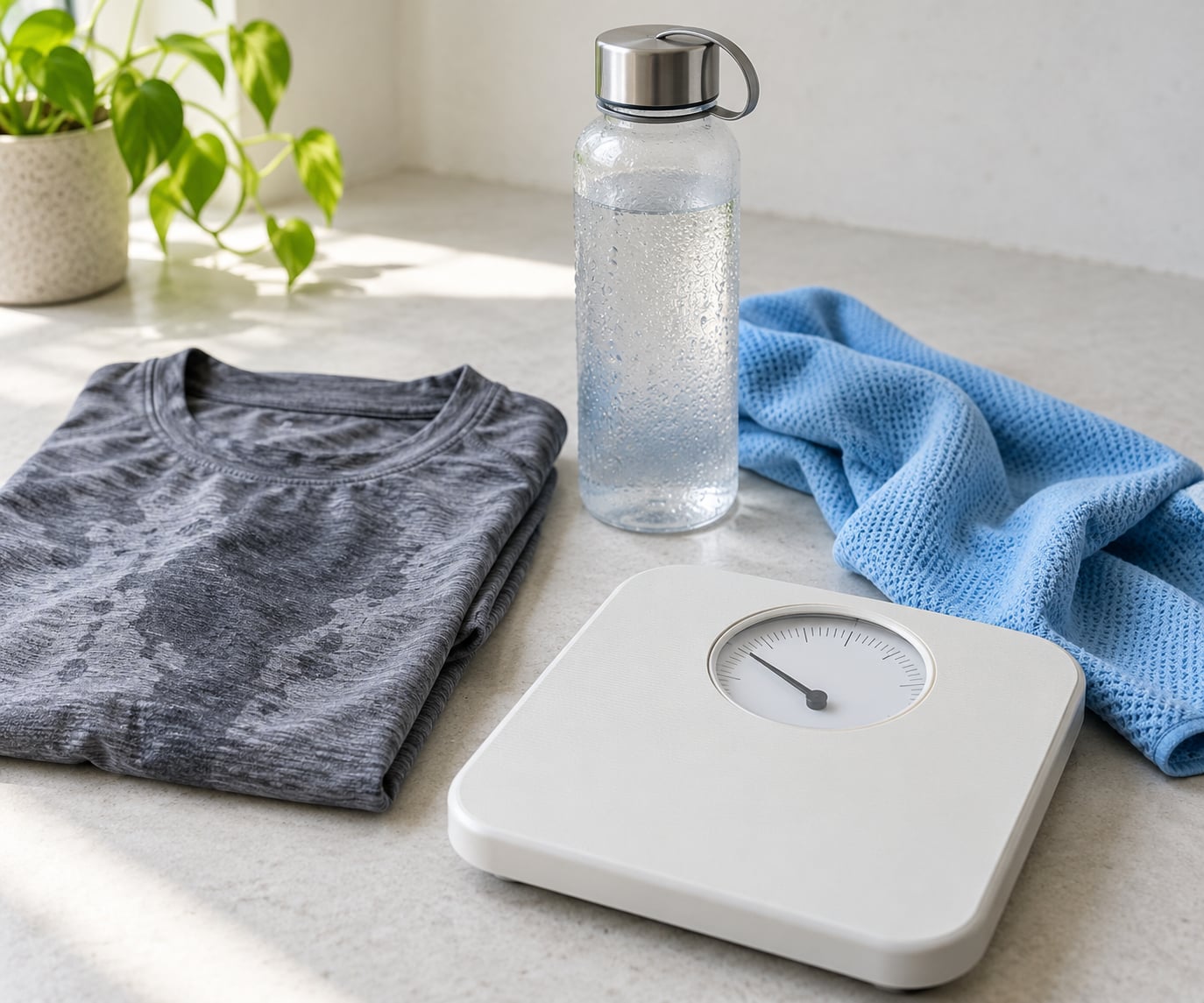
Sweating is how your body sheds heat, not how it melts fat. If you have ever stepped off a treadmill soaked to the waist and then watched the number on the scale jump back up the next morning, you already know how confusing this question gets. Short answer: no sweat, no extra fat burned. Here is what is actually happening in your body and what to measure instead.
Table of Contents
- Does Sweating Mean You’re Burning More Fat?
- Three things sweat does and does not mean
- Where fat loss actually comes from
- Why Does Your Body Sweat During Exercise?
- What Does Sweat Tell You About Fat Loss?
- How Many Calories Are You Really Burning?
- Does Sweating More Mean You Are Working Harder?
- What Actually Helps You Lose Body Fat?
- Can You Sweat More Without Burning More Calories?
- How Can You Exercise Safely in the Heat?
- Frequently Asked Questions
- Is sweating a sign that fat is being burned?
- How much weight do you lose from sweating?
- Do hot workouts burn more calories than normal workouts?
- Why do some people sweat more than others?
- Should I use a sweat band or sweat belt to measure calories burned?
- When should heavy sweating during exercise be a concern?
- Key Takeaways
Does Sweating Mean You’re Burning More Fat?
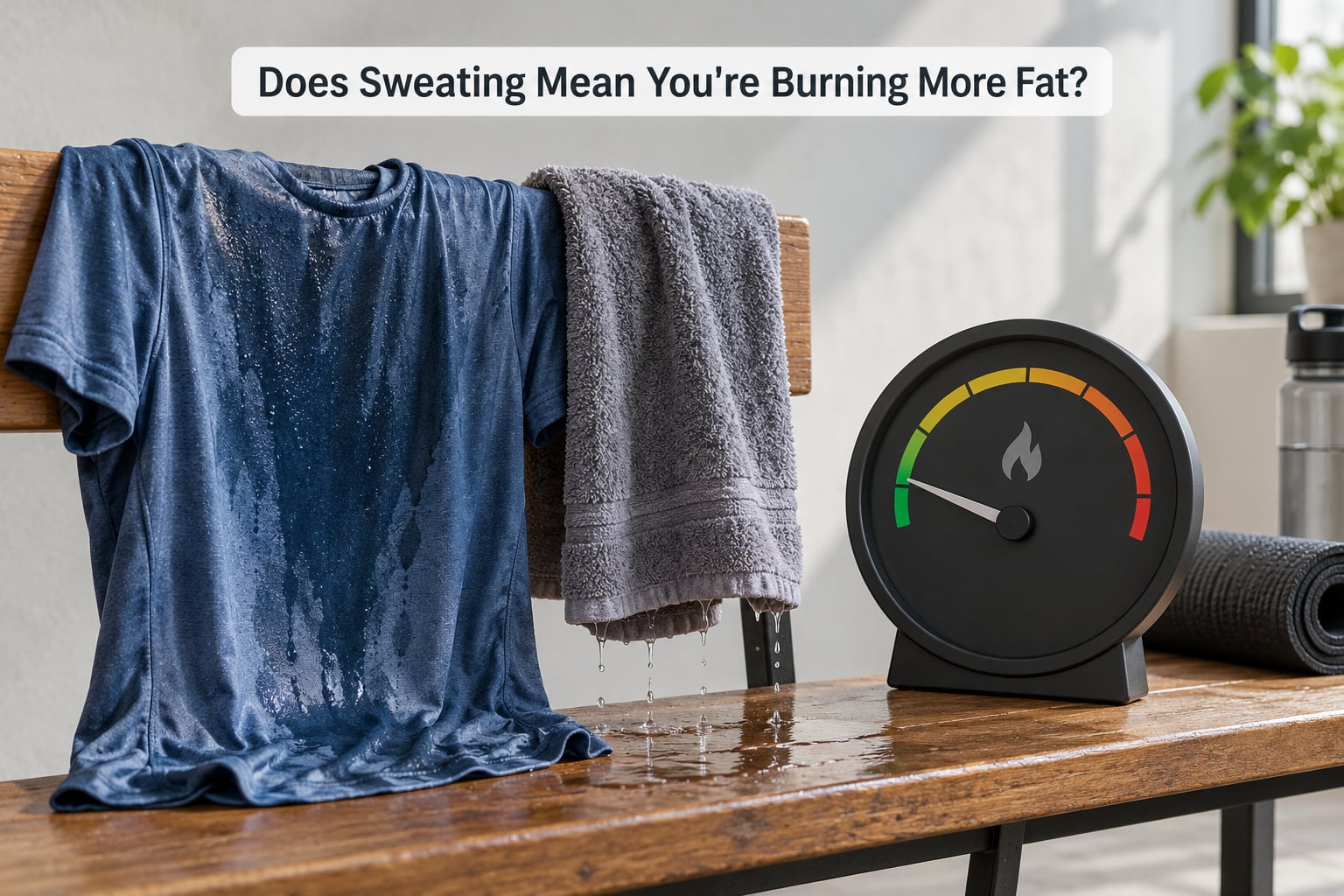
No. Sweating means your body needed to cool down, nothing more. Working muscles generate heat, and sweat evaporates off your skin to bring your core temperature back toward roughly 37C. Sweat is water carrying salts and trace amounts of other compounds, not liquefied body fat.
So the honest answer to does sweating mean you are burning more fat is that the two things are unrelated. A hard cross-country ski session in freezing air can burn serious calories with almost no sweat, because the cold air is doing part of the cooling work. A person sitting still in a sauna suit in a hot room can drip for an hour on a very small calorie bill.
That said, sweating is not useless information. It tells you something real about your effort and environment, which matters for training decisions. It just does not tell you anything about fat loss.
Three things sweat does and does not mean
Sweat does tell you that your body is producing heat faster than it can shed it passively, and it tells you how well acclimatised you are to the conditions you are in.
Sweat does not tell you how many calories you burned, how much fat you oxidised, or whether the session was better than yesterday’s dry one. Anyone who has trained hard in a cold gym knows a dry shirt can follow a genuinely tough workout.
Where fat loss actually comes from
Fat leaves your body when fat cells release fatty acids and glycerol to feed energy demand, and when you sustain a calorie deficit over weeks. That process runs quietly, in the background, and it does not announce itself with dripping shirts.
Why Does Your Body Sweat During Exercise?
Your body runs on chemistry, and chemistry makes heat. When you run or lift, muscles convert fuel into movement and a large share of that energy leaves as heat. Skin is your radiator, and sweat is the coolant sprayed on it. Evaporation is the whole trick, which is why sweat dripping off you without drying does you no cooling at all.
The glands doing the work are mostly eccrine glands, spread across your skin and concentrated on palms, soles and forehead. A smaller set, apocrine glands, mostly in the armpits and groin, contribute to body odour once bacteria get involved rather than doing meaningful cooling.
Sweat volume moves with several inputs, and none of them is effort:
- Heat in the environment. A July afternoon run and a February one produce very different sweat volumes for identical effort.
- Humidity. Sweat only cools when it evaporates. In humid air it sits on your skin, so you sweat more to get the same cooling.
- Clothing. Synthetic layers and neoprene suits trap moisture and stop evaporation, so you keep dripping and keep heating up.
- Body size. A larger person has more mass for heat to warm and a bigger surface to lose it through, so they generally sweat more.
- Genetics. Sweat gland density and baseline sweat rate differ a lot between individuals. Two people of similar size and fitness can differ by a factor of three.
- Acclimatisation. After a week or two of heat exposure, your body starts sweating earlier and more predictably, and loses less sodium.
- Age, illness, medication and stress. Fever, thyroid problems and some prescriptions all shift sweat output, and so does nerves or anxiety.
That list is the answer to the question why do some people sweat more than others. Very little of it has anything to do with how hard they are working.
What Does Sweat Tell You About Fat Loss?
It tells you how much fluid left your skin, which is a different number entirely. One kilogram of body fat, if you were somehow to lose it instantly, would occupy a little over a litre of volume. A hard session can easily deposit half a kilo to a kilo of sweat on your skin and kit, and that mass comes straight back the moment you drink and rehydrate.
Here is the pattern almost everyone learns the hard way: sweat heavily in a sauna or a sweat suit, step on the scale, see a drop of one to two kilos, and assume the last few weeks just paid off. Then you drink a litre of water and eat, and the number is back to where it started. The simple physics gives it away: any mass you lost in the sauna came off as water, and water goes straight back on.
Compare the two cases side by side.
A hot walk in July. You sweat heavily, your shirt is soaked, the scale may drop a kilo that night. That kilo is fluid. It leaves when you drink.
Twenty minutes of sauna after an ordinary workout. No added fat loss, no added calorie burn of any consequence, and roughly the same temporary fluid shift. Sauna marketing has quietly conceded the point, which tells you where the industry has landed.
Real resistance training. You may sweat very little in a cool, air-conditioned gym, yet this is one of the highest-quality sessions you can have for changing body composition.
The people who sweat but do not lose weight are not doing anything wrong. They are watching the wrong number. The people who lose weight while sweating lightly are not a mystery either.
How Many Calories Are You Really Burning?
Energy expenditure during exercise depends on how much work you are doing, how fast you are doing it, how long it lasts, and how much body you are moving around. Exercise scientists group activities by intensity using METs, a metabolic equivalent of task. Walking at an easy pace sits near 2 to 3 METs, a brisk walk around 4 to 5, a steady run near 8 to 10, and interval work can spike well above that in short bursts.
Multiply METs by body weight and duration and you get an estimate. Here is the honest version: those numbers are estimates, sometimes generous by 30% or more, and wrist or ring trackers are not measuring your metabolism. They are running the same rough formulas from heart rate, so treat all of them as a consistent trend rather than a receipt.
The pattern below shows why sweat volume and calorie demand drift apart so badly.
| Activity | How much you would sweat | Realistic energy cost | Fat-loss value |
|---|---|---|---|
| Easy run in cold weather | Very little | About 8-10 METs | High, if the pace stays up |
| 90-minute hot yoga class | Pours off you | About 330 kcal for women, 460 for men in Colorado State University research | Modest, more about mobility and adherence |
| Sauna session, 20 minutes | Dripping | Roughly the same as sitting quietly | None |
| Sauna suit over a normal workout | Extreme | Adds heat stress, not much energy | None, plus a dehydration hit |
| Brisk walk, 45 minutes | Light to moderate | About 4-5 METs | Real, and easy to repeat |
| Steady cycling or rowing | Varies with airflow | About 6-8 METs | Real, low joint cost |
| Resistance session, 45 minutes | Light in a cool gym | About 5-6 METs | High, preserves muscle while losing fat |
Read that table twice and the pattern is obvious. The hot yoga row is the interesting one. It breaks the claim that a Bikram class burns up to 1000 calories an hour. Real measured work by Colorado State University researchers put a 90-minute hot yoga session at roughly 330 calories for women and around 460 for men, a useful figure rather than the marketing number that circulates.
The sauna rows are worse than useless. Sitting in a hot room costs you about what sitting quietly costs you, while a sauna suit can actually work against you, because trapped moisture blocks the evaporation your body depends on.
Does Sweating More Mean You Are Working Harder?
Not reliably. Two fit people running side by side on the same loop in the same weather can produce very different amounts of sweat, and the quieter one may be working harder. Fitter people often sweat less per unit of effort, because heat acclimatisation expands plasma volume and the body learns to start cooling sooner and more efficiently. That is an adaptation, not a failure.
There are better effort cues, and they are all free:
- The talk test. If you can speak full sentences, you are in a moderate range. One or two words between breaths means hard.
- Breathing pattern. Nasal breathing is easy work. Mouth breathing and audible grunting usually mean you are near your limit.
- Pace and power. If the same section of your run got faster, or the same weight moved the same number of clean reps, the work went up.
- Heart rate zones. A rough percentage of your estimated maximum tells you more than a wet shirt does.
- Recovery. A session you can recover from quickly and repeat next week is a better signal than raw sweat volume.
Winter training gets an unfair rap for the same reason air conditioning does. A cold-weather run that leaves you dry is still a real run.
What Actually Helps You Lose Body Fat?
Fat loss comes down to a sustained calorie deficit, and the rest is making that deficit survivable. General guidance only, not a prescription, and your own results may differ.
- Eat enough to keep training. Cut too hard and you lose strength and energy, then stall.
- Get protein at every meal. Protein keeps you full and helps you hold muscle while losing fat.
- Build meals around whole foods. Vegetables, fruit, legumes, whole grains and unsaturated fats fill you up for fewer calories than processed snacks.
- Move most days. Walking after meals and two or three sessions of resistance work each week do more for body composition than any sweat-inducing trick.
- Add aerobic work progressively. Base miles first, then intervals, rather than the other way round.
- Sleep. Seven to nine hours for most adults. Short sleep makes hunger harder to manage.
Now the metrics that actually tell you whether fat loss is happening. These are the numbers that have zero relationship to how wet your shirt gets.
- Seven-day weight averages. Daily weight swings with water, salt, bowel movements and menstrual cycle. Average a week at a time and compare weeks.
- Waist circumference. Measured at the same point, at the same time of day, monthly. It often moves before the scale does.
- Body fat percentage. Useful as a trend from a reputable method, useless as a single reading, since hydration shifts the number more than fat loss does.
- Progress photos. Same lighting, same angle, every four to six weeks. Nobody’s eye catches two percent changes, but a camera does.
- Strength and pace. If you are lifting more or running faster at the same effort, your composition is moving in the right direction.
- Fit and appetite. Better conditioning, easier recovery and steadier energy between meals are signs you are on track even when the scale stalls.
If you want a sanity check on whether you are moving in the right direction, that last list is the one to use. It answers the question what are signs your body is burning fat in a way a wet t-shirt cannot.
Can You Sweat More Without Burning More Calories?
Constantly, and it is easier than most people think.
- Sauna or steam room. A short session can strip half a kilo to a kilo of fluid while costing roughly what sitting still costs.
- Sauna suits and sweat belts. These add heat stress and block evaporation. They reliably drop the scale number for a few hours.
- Warm layers. Training in heavy clothes in mild weather produces a lot of sweat and a lot of nothing else.
- Humidity. A tropical climate produces heavy sweat from ordinary effort because sweat cannot evaporate.
- Genetics. Some people simply run wet at rest.
- Anxiety and nerves. Stress sweating has nothing to do with metabolic demand at all.
- Untrained heat tolerance. Walking into a hot room after a sedentary week produces a startling amount of sweat.
The flip side is worth knowing too: if you are fitter and heat-acclimatised, you may sweat very little and still be working hard. Dry skin on a cold day is not a wasted session.
How Can You Exercise Safely in the Heat?
Chasing sweat in high heat is where this myth stops being harmless. You are adding risk without adding benefit.
- Drink before you train. About half a litre in the couple of hours beforehand is a reasonable starting point.
- Sip during, not after. A few hundred millilitres every 20 minutes or so, more in humid conditions.
- Replace fluid afterwards. A commonly cited target is around half a litre for every kilogram of body mass you lost during the session.
- Wear light, breathable clothing. Lighter colours, loose fits, nothing plastic.
- Lower the intensity. Cut pace and distance rather than pushing through, and move your session to shade or cooler hours.
- Take breaks in the shade. Especially if you are new to heat training.
- Skip it when you are unwell. Fever plus heat is a bad combination, and water weight already sits higher than usual.
Warning signs that mean stop and get help: dizziness, headache, nausea, chills, confusion, clammy skin, a racing or pounding heartbeat, or fainting. Heat exhaustion can turn into heat stroke, which is a medical emergency. Get immediate medical attention for confusion, fainting, or sweating that stops while you are still hot, and talk to a doctor first if you sweat heavily outside exercise, sweat heavily with no obvious cause, or notice palpitations and dizziness during training.
The same advice applies to sauna suits. They have one legitimate job, which is helping a fighter or grappler make a competition weigh-in the day before, and no useful one for fat loss. The marketing has quietly caught up with the evidence, with several sauna brands now publishing their own myth-busting guides.
Frequently Asked Questions
Is sweating a sign that fat is being burned?
No. Sweat is your body’s thermoregulation system at work, releasing water and salts to cool you down. Fat loss happens when fat cells release fatty acids and glycerol for energy and you hold a calorie deficit over weeks. You can sweat heavily with almost no fat loss, or train hard with very little sweat and still be losing fat. Judge sessions by effort and consistency, not by how wet your shirt is.
How much weight do you lose from sweating?
Only fluid, and it comes straight back. A hard hot session or sauna can take off roughly 0.5 to 1 kg of water weight in a couple of hours, and most of it returns as soon as you drink and eat. That is why a sweaty workout followed by rehydration lands you back at your normal weight. Real fat loss is measured in weeks, not hours, on seven-day weight averages.
Do hot workouts burn more calories than normal workouts?
Not meaningfully. A 90-minute hot yoga class measured by Colorado State University researchers burned about 330 calories for women and 460 for men, far below the 1000 calories an hour often claimed for Bikram yoga. Sauna sessions cost roughly the same as sitting quietly, and a sauna suit adds heat stress rather than energy demand. Train hot if you enjoy it, but not for the calorie maths.
Why do some people sweat more than others?
Genetics, body size, humidity, clothing, age, medication, stress and heat acclimatisation all play a part. Sweat rate is only loosely related to fitness, and fit, heat-acclimatised people often sweat less for the same effort because their bodies start cooling earlier and more efficiently. If your sweating changes suddenly or happens without exertion, mention it to your doctor.
Should I use a sweat band or sweat belt to measure calories burned?
No. Sweat bands measure lost fluid, and calorie bands such as heart-rate straps rely on rough formulas that can be off by a third either way. Neither tells you anything about fat loss. Better signals are your seven-day average weight, waist circumference, strength progression, pace at the same effort, and how hard the session felt on a one to ten scale.
When should heavy sweating during exercise be a concern?
Treat heavy sweating as a concern when it comes with dizziness, nausea, headache, chills, confusion, a pounding heartbeat, or when you stop sweating while you are still hot. Those are signs of heat illness and need prompt medical attention. Be careful with sweat suits and hot rooms generally, especially if you are unaccustomed, unwell or already dehydrated, and check with a doctor if you sweat excessively outside exercise.
Key Takeaways
Sweat is a cooling response, not a fat-loss measurement. Everything you lost during a sweaty session came from water, and it returned when you drank.
Focus instead on the things with a track record: consistent activity you can repeat, a calorie balance you can hold week to week, protein and whole foods at every meal, and enough sleep. Track seven-day weight averages, waist circumference and how your training is progressing. Do that first this week, and stop grading your sessions by how wet you got.
For sweating that is excessive, new, or happening without exercise, or for any warning signs like dizziness or confusion during a hot workout, speak to a doctor or a registered dietitian rather than pushing through.