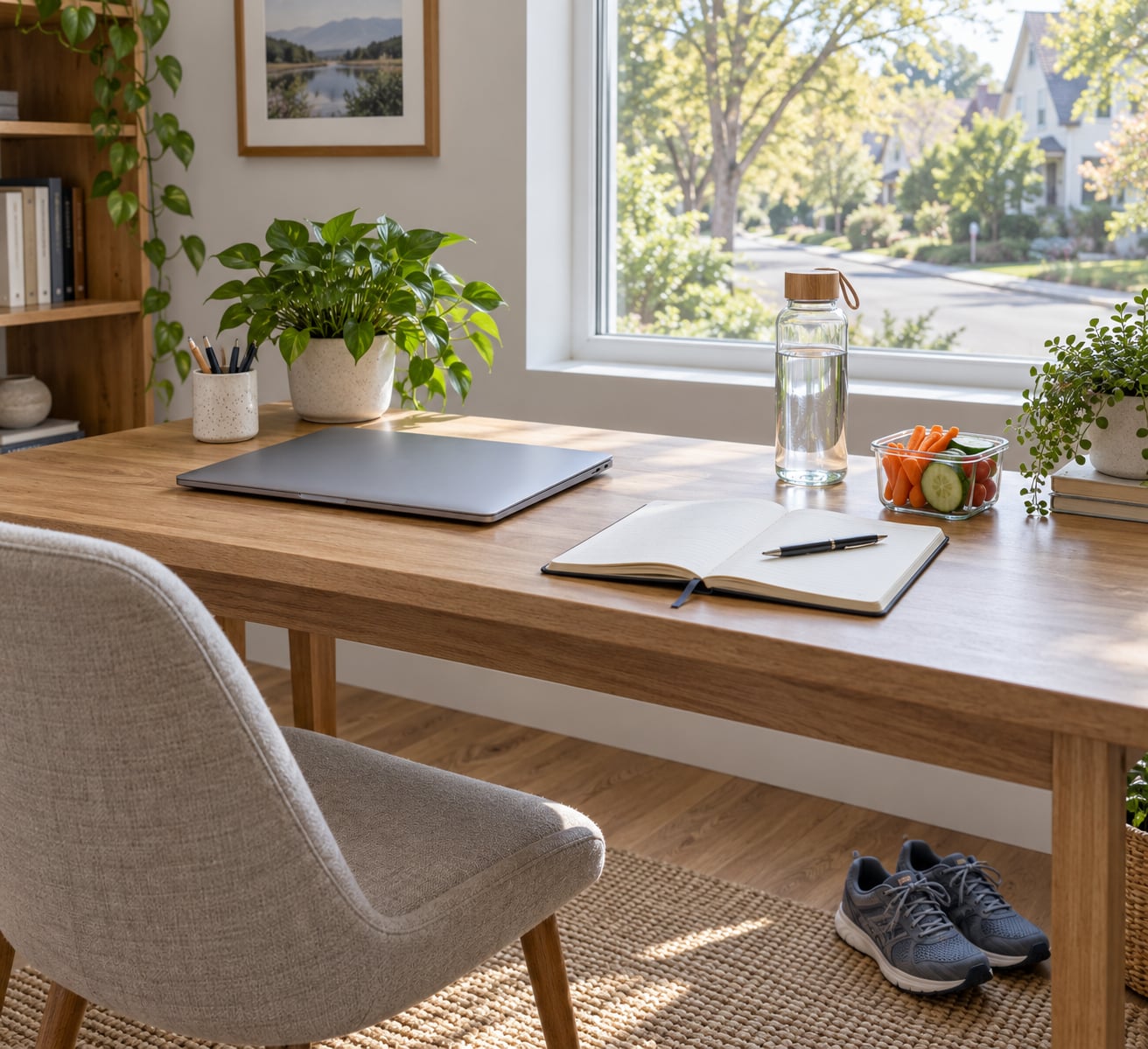
You can lose weight with a desk job by eating slightly less, moving in small chunks spread across the working day, and adding two or three strength sessions a week. The weight gain comes from low daily movement plus constant access to food, not from laziness. Most people notice a change in 4 to 8 weeks.
That is the whole mechanism. Sedentary work shrinks what researchers call NEAT, non-exercise activity thermogenesis, which is the calories you burn just by being a person who walks, climbs and fidgets. Fewer than 8,000 steps a day adds up quietly, and a desk means food is never more than 30 seconds away.
The routine below takes about 20 minutes of setup a week and fits around a normal 9-to-5. No gym membership, no meal prep marathon, no 1,200-calorie plan.
Table of Contents
- What You Need
- Step-by-Step
- 1. Establish a Sustainable Eating Routine
- 2. Plan Desk-Jobs Meals Before You Leave Home
- 3. Add Short Movement Breaks Throughout the Workday
- 4. Build a Regular Strength and Cardio Routine
- 5. Manage Stress, Sleep, and Long Sitting Periods
- 6. Use Progress Markers Beyond the Scale
- 7. Review and Adjust Every Week
- Common Mistakes
- Frequently Asked Questions
- How to lose weight when I work a sedentary job?
- How do I get 10,000 steps when I work a sedentary job?
- Is a standing desk good for weight loss?
- Is it normal to reach a weight loss plateau after 6 weeks?
- How to get out of a weight plateau?
- What is the 3 3 3 rule for weight loss?
- Conclusion
What You Need
Nothing special. The useful tools are ordinary and mostly free.
- A water bottle you keep in sight. Most desk snacking happens because you are thirsty and the snacks are closer than the tap.
- Walking shoes that you can keep at work, if your commute or building allows it.
- One or two containers for packed lunches and desk snacks.
- A phone or watch with a step counter, mostly as feedback. The number matters less than noticing it dropped.
- A calendar block, 15 minutes long, three times a week, for training. Booking it is what makes it survive a busy week.
- Resistance bands or a pair of adjustable dumbbells, if you train at home. Bodyweight sessions work fine until they do not.
A standing desk is optional. Standing burns only around 9 more calories an hour than sitting, so it is a posture and back-comfort tool first and a weight-loss tool second. Walking is where the calories are.
Step-by-Step
Seven parts, roughly in the order they matter. Take them at your own pace and expect the first two weeks to feel like nothing is happening.
1. Establish a Sustainable Eating Routine
Most desk-job weight gain is a calorie problem, not an exercise problem. On the WeightLossAdvice subreddit, the most repeated line is that weight loss is mostly about intake and exercise is the helper, not the engine. That matches what mainstream guidance says.
Build three meals around the same simple template: a protein, a vegetable or fruit, a whole grain or starch, and a small amount of fat. Chicken and rice with broccoli works. Greek yogurt with berries and oats works. Beans and a side salad with a piece of fruit works.
The part people get wrong is skipping meals and then overeating at night. Long gaps without food usually end with a bigger, faster meal, and much of it eaten while scrolling. Three regular meals, timed roughly three to four hours apart, keeps that pattern from happening.
How do you know the routine works? Track energy first and weight second. If you are getting through the afternoon without a crash, your meals are working. If you are ravenous by 4 p.m., the portions are too small or missing protein.
2. Plan Desk-Jobs Meals Before You Leave Home
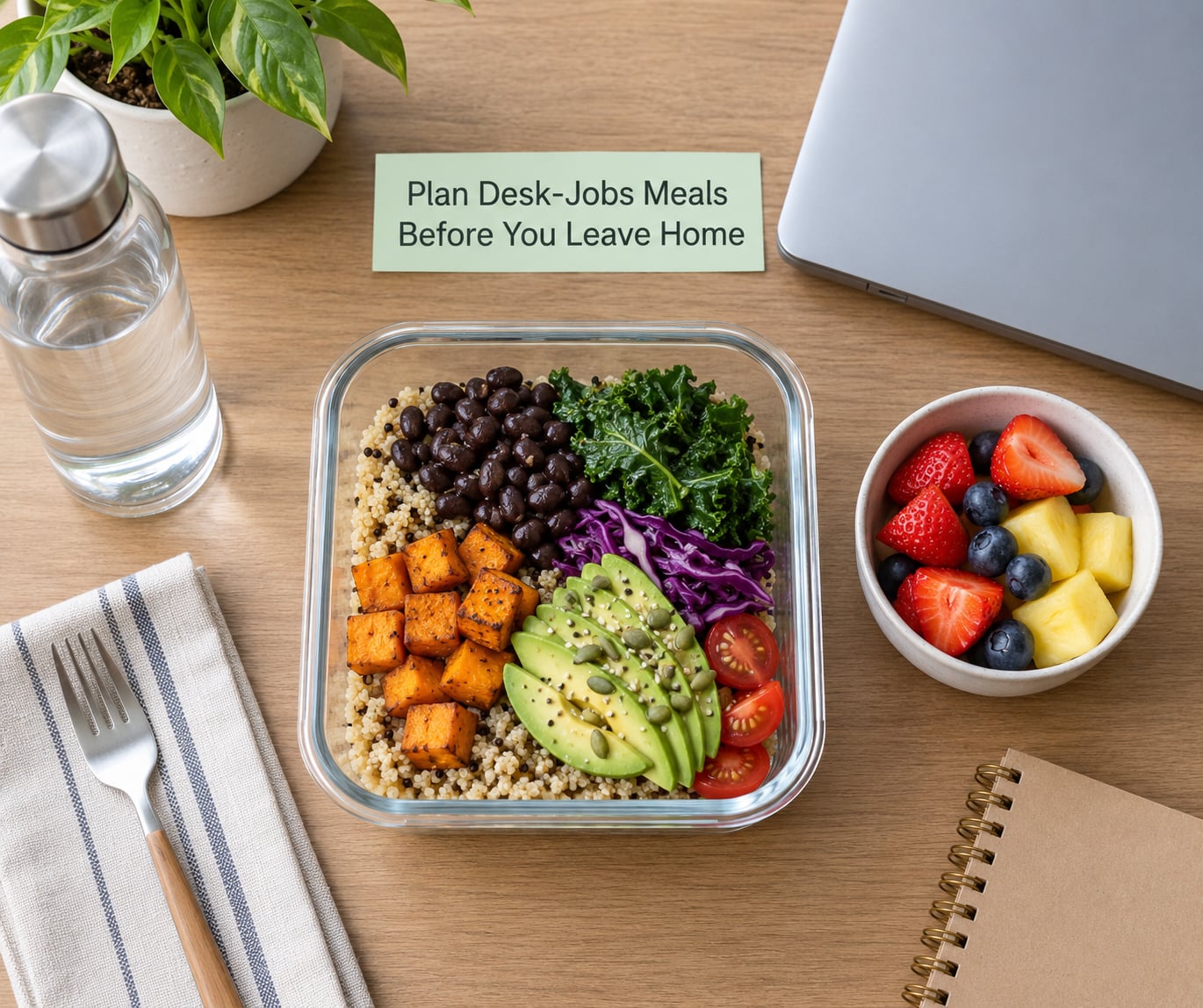
Whatever arrives at your desk unplanned was decided by whoever staffed the vending machine or by the delivery app. Plan lunch the night before, even if you assemble it in the morning.
Two lunches cover most weeks. A sandwich on whole-grain bread with chicken, a piece of fruit and a yogurt pot takes four minutes to build. A grain bowl with roasted vegetables, chickpeas or grilled tofu and a spoon of dressing takes slightly longer and lasts better for a long afternoon.
For snacks, pack two a day and put them where you cannot see them without standing up. Greek yogurt, a small handful of nuts, boiled eggs, cheese sticks, apple slices with peanut butter, or roasted chickpeas all travel well and hold for a few hours.
Protein matters more than most desk-job advice admits. A snack with protein blunts the blood sugar spike and the crash that follows, which is the real reason people eat again at four.
One rule worth trying: eat away from your screen. Lunch at a table, or on a bench outside, breaks the boredom-snacking loop that plays out when meals happen at the keyboard.
3. Add Short Movement Breaks Throughout the Workday
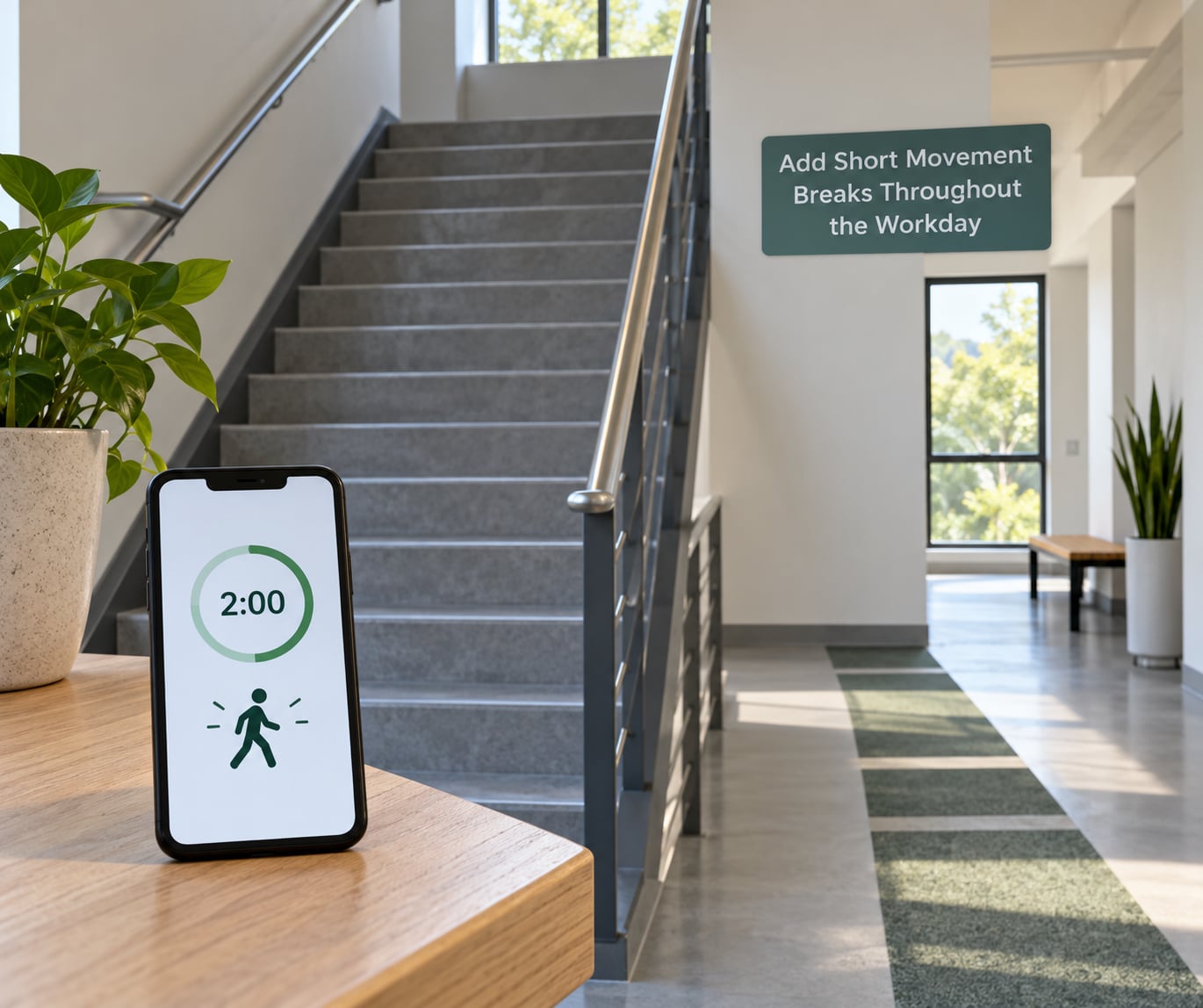
Two minutes every hour beats one hour on Saturday. The point is to break up sitting, not to sweat.
Set a repeating reminder. When it fires, stand, take 20 steps, roll your shoulders, and sit back down. Over an eight-hour day that is roughly 90 minutes of standing and walking spread thin, which is easier on your back and hips than one long block.
Then add three specific things:
- A 15-minute walk at lunch. Outdoors when possible, since daylight matters for sleep later in the day.
- Walking calls. Every five-minute call becomes five minutes of walking. People who fit their steps into calls report that this is the single change that held.
- Stairs instead of the elevator, both directions when your knees and lungs allow.
Walk at a pace where you could talk but would prefer not to. That is roughly 3 to 4 calories a minute for most adults, which makes a 15-minute lunch walk worth about 50 calories and a 30-minute one worth closer to 100.
If your workplace makes walking around awkward, you are not imagining it, and it is one of the most common complaints in desk-job weight-loss threads. Keep the movements small and private: seated leg extensions on a call, chair squats at your desk, calf raises while a document loads, standing stretches between meetings. Nobody notices those.
4. Build a Regular Strength and Cardio Routine
Movement breaks keep your metabolism honest; strength training is what changes your body composition and gives you the muscle to handle more activity without feeling wrecked.
Two to three sessions a week of 30 to 45 minutes is enough. Squats, hinge movements, rows, presses, carries, and a core exercise cover the basics. Keep the load or the reps progressing slowly, session to session.
Why bother, if diet does the heavy lifting? Muscle raises your resting metabolic rate and keeps your weight loss from eating muscle along with fat. It also makes daily steps and stairs feel easier, which quietly increases NEAT.
Cardio can come from the workday: a brisk walk with headphones at lunch, a longer walk on one weekend day, cycling or swimming once a week if you enjoy it. No need to run if you do not like running.
People who succeed with this tend to book the session in the calendar before the week starts. Fifteen-minute blocks marked as appointments survive. Open-ended intentions like I will work out more do not.
5. Manage Stress, Sleep, and Long Sitting Periods
Stress eating at work is usually appetite disguised as boredom, and a tired brain reaches for quick energy more often than planned eating does.
A few habits help. Keep water and a prepared snack within reach so the impulse has something to land on. Take a two-minute pause before opening the snack drawer and ask whether you are hungry or just restless. Put eating into a specific place in your routine, like a 3 p.m. break, rather than leaving it open all afternoon.
Sleep is the piece people skip. A short night raises hunger hormones and cravings for high-energy food the following day, which works directly against a calorie deficit. Consistent sleep and wake times help more than an extra gym session ever will.
Sitting itself deserves attention. Long stretches of stillness are linked to back, neck and wrist complaints, and pain is the fastest route to avoiding movement entirely. Adjust your screen so your neck stays neutral, support your lower back, and change position often even if you never buy a desk that raises.
If pain is limiting what you can do, that is a conversation for a doctor or physical therapist, not something to push through.
6. Use Progress Markers Beyond the Scale
The scale is one noisy measurement. Daily weight swings with water, salt, bowel movements and cycle timing, and reacting to a single number leads most people to quit a plan that is actually working.
Watch weekly averages instead. Weigh in the same time each morning, ideally after using the bathroom and before eating, and look at the seven-day trend rather than the day.
Alongside that, track markers you can feel:
- Energy through the afternoon.
- How your clothes fit, particularly the waistband.
- Sleep quality and how quickly you settle.
- How long you can walk without stopping.
- Strength at your main lifts.
- How many meals you actually planned and ate.
For readers also chasing muscle, these markers matter more than the scale. The weight may barely move while the mirror and the bench press tell a better story. That is usually a good trade.
7. Review and Adjust Every Week
Seven minutes on a Friday or Sunday closes the loop. Look at the week with a short list.
Check: how many planned meals did you actually eat, how many movement breaks happened, how many training sessions, average sleep, afternoon energy on a 1 to 5 scale, and the weight trend.
Then find the single thing that broke most often. Not every problem. The one. A common answer is that lunch was unplanned five days out of seven, so next week you prep two dinners that double as lunches. Or breaks got skipped on meeting-heavy days, so the reminder moves to a different time. Or breakfast never happens, so the 11 a.m. crash drives snacking.
Change one thing per week. Small changes stacked over three months beat a dramatic overhaul that lasts nine days.
Common Mistakes
Sitting all day and hoping the evening workout offsets it. A 45-minute session burns a few hundred calories. Eight hours of sitting quietly costs far more than that, and the session does not repay it. Fix: hourly breaks plus the session.
Standing at the desk and calling it exercise. Standing adds roughly 9 calories an hour over sitting. That is not nothing, but it is a rounding error. Standing helps your back, posture and blood sugar. Walking is the calorie lever. Fix: keep the standing desk if it feels better, then add a lunch walk.
Skipping meals and overeating at night. The restriction looks disciplined on paper and ends in a larger, faster meal, often eaten mindlessly in front of a screen. Fix: three steady meals with protein.
Counting exercise as the whole plan while eating freely. You cannot reliably out-walk poor eating, and the math is unfriendly. Fix: handle food first, then treat movement as what keeps the result.
Expecting fast results. Nobody should promise you a specific amount in a specific number of weeks, and anyone who does is guessing. A realistic first milestone is feeling better at the end of the workday by week four, with the trend on the scale moving slowly after that.
Two more worth naming: spot reduction is a myth, and no exercise needs to target fat from a specific area. Crunches build abdominal muscle under the fat; they do not remove it.
For motivation, keep it simple. Pair the new habits with things you already do, put the training block in the calendar, and tell one person your plan for the month. People who keep a visible plan tend to keep the plan.
Frequently Asked Questions
How to lose weight when I work a sedentary job?
Eat slightly less than you currently do, keep meals steady with protein at each one, and move in two-minute chunks every hour plus a 15-minute walk at lunch. Add two or three strength sessions a week. Aim for a modest calorie deficit rather than a drastic cut, and judge progress on weekly averages rather than daily readings.
How do I get 10,000 steps when I work a sedentary job?
Front-load the day and use the middle of it. Walk during phone calls, take the stairs, walk out for a 15-minute lunch, park or get off the transit stop farther away, and stand or pace during the last few minutes of a meeting. Most people who hit the target do it by stacking short walking blocks rather than one long walk.
Is a standing desk good for weight loss?
Only slightly, on its own. Standing burns roughly 9 more calories per hour than sitting, so a full day upright is worth about 70 calories. A standing desk is genuinely useful for back comfort, posture and blood sugar, and it makes movement breaks easier to take. For weight, walking adds far more calories per minute than standing does.
Is it normal to reach a weight loss plateau after 6 weeks?
Yes, it is common, and it usually is not a failure. Your body weighs less and needs fewer calories, while water weight moves up and down day to day. Weeks four to eight are a common stretch for the trend to flatten. Keep the same routine for another two weeks before changing it, and judge it on the monthly line.
How to get out of a weight plateau?
Check four things in order: portion creep at lunch, oil and sauces that quietly add up, weekend days that undo the week, and sleep that is short. Fix the first one you find rather than all of them. If your weight has been flat for three to four weeks and your eating is honest, add two sessions of strength work or 2,000 daily steps.
What is the 3 3 3 rule for weight loss?
The 3 3 3 rule is a social-media framing, not a clinical standard. It is usually described as walking 3,000 steps, doing 3 sets of an exercise and drinking 3 glasses of water at some point during the day. There is no research supporting the exact numbers. The habit behind it is sound: small repeatable targets spread across a day beat one heroic effort.
Conclusion
Losing weight with a desk job is mostly arithmetic plus repetition: regular meals with protein, two-minute movement breaks every hour, a walk at lunch, two or three strength sessions a week, and a weekly review where you fix one problem.
Start with one action today. Plan tomorrow’s lunch now, set a two-minute movement reminder, or book a 15-minute walk in the calendar before you close the laptop.
This is general information, not medical advice. If you have a health condition, take medication, or are pregnant, talk to a doctor or a registered dietitian before changing how you eat or exercise.