Does eating late at night make you gain weight? Not on its own. Your weight responds to the total calories you eat across the day, and late eating pushes weight up only when it quietly adds extra calories, crowds out better food, or wrecks your sleep.
That sounds like it settles the argument. It does not, because the research genuinely disagrees with itself on timing, and plenty of people report gaining weight while staying inside their calorie target. The useful question is not whether a 10pm snack is forbidden. It is what is actually driving the gain.
Table of Contents
- Does Eating Late at Night Make You Gain Weight?
- How Does Late-Night Eating Affect Weight Gain?
- Does eating late slow down your metabolism?
- Does eating late at night make you gain weight? What three studies found
- Why the after-6pm rule stuck around
- What Time Is Considered Eating Late at Night?
- Is It the Timing or the Total Number of Calories?
- What About Late-Night Hunger, Stress, and Poor Sleep?
- When night eating is worth raising with a doctor
- What Can You Eat Before Bed Without Weight Gain?
- How Can You Stop Late-Night Weight Gain?
- Frequently Asked Questions
- Is it true that eating late at night makes you gain weight?
- Can I eat at 10pm and still lose weight?
- Is eating late at night good for weight loss?
- Is it normal to gain 5 lbs after eating?
- Does eating late at night then sleeping cause weight gain?
- Should I eat at 2am if I am hungry?
- What is the number one worst food for weight gain?
- Conclusion
Does Eating Late at Night Make You Gain Weight?
The honest answer has two halves. Total daily calorie balance is the driver of weight change, and clock time is a weak signal on its own. Late-night eating becomes a weight problem when it stacks extra calories on top of a full day, when the food choices shift toward things high in calories and low in fibre, or when a big meal before bed breaks your sleep and you eat more the next day.
Think about it as net fat balance. Over weeks and months, what changes your body composition is the gap between calories in and calories out. A late meal shifts a few calories around inside that day; it does not open a separate fat-storage switch at a particular hour. Your body does not check the clock before deciding to store energy.
What late eating does change is your behaviour, your food quality, and how you feel the next morning. That is where the real risk sits, and it is the part most advice on this topic skips.
How Does Late-Night Eating Affect Weight Gain?
Five things happen between the last meal of the day and the scale the next morning, and only some of them involve fat.
- Calories get added, not replaced. Late snacking rarely substitutes for a meal. It stacks on top of one.
- Nobody is portioning. Eating straight from a bag or box while scrolling removes the part of eating where you would notice you were full.
- The food changes. Evening food skews toward chips, crackers, ice cream, and pastries, which pack more calories per bite than the meals you planned earlier.
- Sleep suffers. A large meal right before lying down causes reflux, and disrupted sleep raises hunger and ghrelin the following day.
- Alcohol joins in. A couple of drinks lowers restraint and adds calories with none of the fullness you get from food.
Does eating late slow down your metabolism?
Not in the way the phrase suggests. Your metabolism does not shut down at 10pm. It shifts composition. Total daily energy expenditure breaks down roughly as basal metabolic rate at about 70%, non-exercise activity thermogenesis around 15%, the thermic effect of food near 10%, and exercise activity thermogenesis around 5%.
Basal metabolic rate dominates, and it keeps running while you sleep. What sleep does is account for roughly 80% of the energy your body burns while awake, so you burn less of that daytime activity energy at night. That shift is real, and it is also small in the context of a full day of eating.
Does eating late at night make you gain weight? What three studies found
A 2022 trial from Brigham and Women’s Hospital, led by Nina Vujovic and published in Cell Metabolism, fed 16 people the same meals at different times and found that eating later raised hunger, pushed ghrelin up and leptin down, and shifted gene expression in fat tissue toward storage and away from breakdown. It was small, most participants had prediabetes, and it measured what happened over days of shifted meals rather than long-term weight change.
Ruddick-Collins and colleagues published related work in the same period on how later eating changes appetite regulation. Fleischer’s analysis of the CALERIE study, which tracked people eating a calorie-restricted diet long term, found the advantage of an earlier last meal was on the order of one percent of weight lost. Small, real, and nothing like the penalty the old rules imply.
Meanwhile a study following roughly 1,600 children found no link between eating a late dinner and weight status at all. The evidence is mixed, and anyone telling you it settles the question in either direction is overselling their one paper.
Why the after-6pm rule stuck around
The rule has no clear scientific origin. It grew out of a 1980s advice that overweight people tend to be light eaters during the day and heavy at night, which is an observation about behaviour rather than proof that night food causes the weight. It then got repeated for decades because a simple cutoff is easier to repeat than a calorie ledger.
Long-standing community myth-busting on fitness forums makes the same point. There is no magic time after which the body stores fat. The people who were overweight in those studies were not fat because they ate dinner at 8pm. They were fat because of everything they did across the whole day, night eating included.
What Time Is Considered Eating Late at Night?
Late is relative to your bedtime, not to a clock on the wall. Eating within about three hours of going to sleep is generally treated as late-night eating, so a 9pm dinner followed by bed at midnight and a 9pm dinner followed by bed at 10pm are not the same thing.
A nurse finishing a shift at 7am, eating a meal before driving home, is eating late. A parent eating after a 9:30pm bedtime is eating late. A student working until 1am with a sandwich is eating late. Each of them faces the same question a person at 10pm does: was that meal planned, was it filling, and did it cost me sleep?
Two different situations get lumped together here. Eating after dinner because a workout ran late is usually fine and often helpful. Eating an unplanned portion of whatever is in the cupboard at midnight is a different pattern entirely, and it is the one that moves weight.
Is It the Timing or the Total Number of Calories?
Totals. Here is the same person over two weeks, eating differently but landing at the same calorie intake by the end of the week.
| What happens | Late but on target | Early but over target |
|---|---|---|
| Example day | 1,800 calories, dinner at 9:30pm, small snack at 11pm | 2,400 calories, all food finished by 7pm |
| Weekly intake | About 12,600 calories | About 16,800 calories |
| Two-week scale trend | Flat or drifting down slowly | Rising |
| Sleep and reflux | Fine if the late snack is small | Fine, no late meal |
| What actually happens | Weight holds steady | Weight climbs about 0.4 kg a week |
The early eater gains. The late eater holds. Nobody has to be told to move the dinner to avoid a problem that only one of them has.
What About Late-Night Hunger, Stress, and Poor Sleep?
Most midnight eating starts as a coping strategy rather than hunger. Stress, boredom, loneliness, and the low self-restraint that comes with a long day all point the same direction, and screen time makes it easy to keep eating without registering a single serving.
Poor sleep feeds the loop. Less sleep raises ghrelin and lowers leptin, so the next day you feel hungrier and reach for more of the same quick food. In r/loseit, people who stay on target but eat dinner late put it plainly: it is not hurting their progress, but the scale will not move while their stomach is full and they are holding water.
Some common triggers worth naming: skipping meals during the day and arriving at 10pm starving, medicines that affect appetite, alcohol, working through dinner, and eating while watching television or scrolling.
When night eating is worth raising with a doctor
Occasional hunger before bed is normal. Night eating that shows up several times a week and keeps happening despite attempts to change it is different, and so is eating that brings shame or a loss of control rather than simple hunger.
Ask your doctor or a registered dietitian if late eating comes with insomnia, low mood, or eating large amounts very fast to the point of feeling unwell afterwards. Night eating syndrome and binge eating disorder are real clinical conditions and both respond well to treatment. The same goes for night-time hunger that started after a new medicine. Do not manage those with a firmer rule about food.
What Can You Eat Before Bed Without Weight Gain?
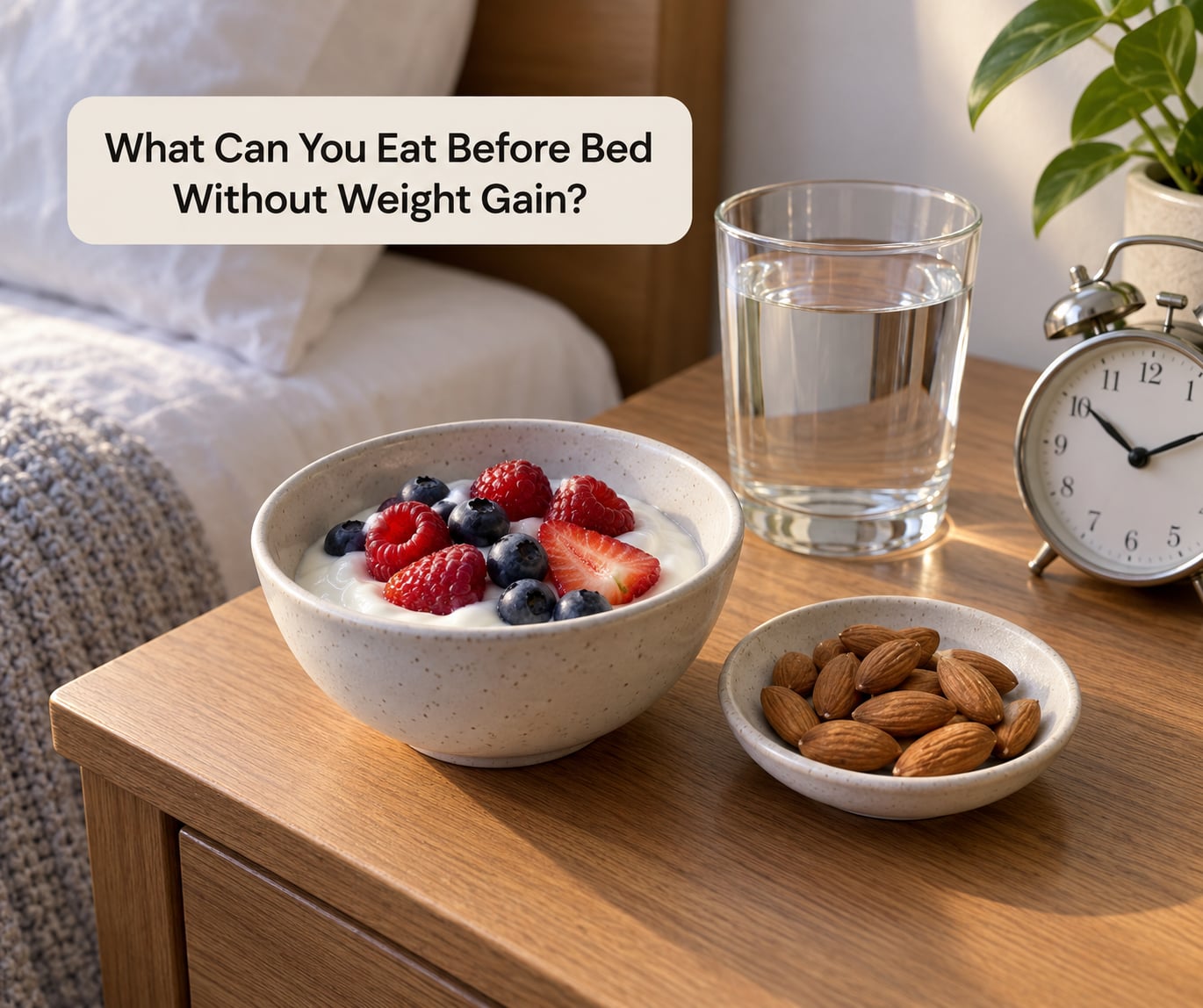
Pre-bed snacks are fine if they fit inside your day. Here are portions that are filling and low in calories, with protein doing most of the work of keeping you satisfied until morning.
| Option | Rough calories | Protein | Why it works |
|---|---|---|---|
| Plain Greek yogurt, half a cup | 90 to 120 | About 15 g | High satiety, low calorie load |
| Cottage cheese, half a cup | 90 to 110 | About 12 g | Slow to digest, mild |
| One small apple or pear | 70 to 100 | About 1 g | Fibre and volume for few calories |
| A small bowl of berries | 50 to 80 | About 1 g | Sweet without the added sugar |
| Boiled eggs, two | 140 to 160 | About 12 g | Protein that sits well before bed |
| Handful of almonds, about 15 | 100 to 110 | About 3 g | Portioned, so no mindless eating |
| Small piece of fruit with 10 g nut butter | 150 to 180 | About 3 g | Balanced, still modest in calories |
Two caveats. If you finish eating within an hour or two of lying down, reflux is common, so keep the portion small and skip anything fried or spicy. And if a snack sends you back for a second one, that is a hunger-signal problem, not a food-choice problem.
How Can You Stop Late-Night Weight Gain?
Seven habits that hold up better than a curfew.
- Eat enough during the day. Under-eating at 6pm reliably produces a bigger intake at 10pm.
- Plan a real dinner. Most midnight raids start from an unfinished meal, not real hunger.
- Keep one satisfying snack ready. Deciding in advance beats improvising in front of an open cupboard.
- Portion it out. A small bowl, not the bag. This alone changes a lot of evenings.
- Turn off the screen before you eat. Most unplanned evening eating happens somewhere other than at a table.
- Keep a steady bedtime. Sleep is the cheapest way to reduce tomorrow’s hunger.
- Look at two weeks, not two days. A single morning reading says almost nothing. Trends do.
If you do weigh in daily, keep the time consistent and ignore the day after a late meal. Salt, carbohydrates, and a large gut volume all move the number without touching fat tissue. Fat gain shows up slowly; a two-kilo jump overnight is water and contents.
Frequently Asked Questions
Is it true that eating late at night makes you gain weight?
Not by itself. Controlled trials feeding the same people the same meals at different times found late eating raised hunger and shifted fat-tissue gene expression toward storage, but those studies ran days, not months. Across months, weight change follows total calorie balance. Late eating becomes a problem when it adds calories, crowds out protein and fibre, or breaks your sleep.
Can I eat at 10pm and still lose weight?
Yes. If a 10pm meal fits inside your daily calorie target and does not cost you sleep, there is nothing about the clock that stops weight loss. A study of long-term calorie restriction found the advantage of an earlier last meal was around one percent, which is far less than most advice implies. The people who do lose weight eating late are the ones who planned that meal instead of finding it.
Is eating late at night good for weight loss?
Not as a strategy on its own, but it is not harmful either. Skipping meals to compress your eating window often backfires: people arrive at 9pm starving and eat more than they would have at 6pm. Time-restricted eating works when the shorter window suits your schedule and you are not hungry through it. For most people, a consistent meal pattern plus a calorie target matters more than the hours on the clock.
Is it normal to gain 5 lbs after eating?
A several-pound jump the morning after a late meal is water, salt, carbohydrate stores, and gut contents, not fat. To gain 3.6 kg of actual fat you would need roughly 29,000 calories beyond maintenance, which cannot happen in one evening. Hold the extra fibre and salt down for a couple of days and the reading settles. Judge fat trends over two weeks, never overnight.
Does eating late at night then sleeping cause weight gain?
Not directly. Lying down soon after a large meal is more likely to give you acid reflux and broken sleep than fat gain. Poor sleep is the part worth caring about, because short or disrupted sleep raises hunger and ghrelin the following day, which leads to more eating. If reflux keeps waking you, shrink the late portion, eat earlier, or skip it on nights you do not need it.
Should I eat at 2am if I am hungry?
If you are genuinely hungry, eat something small rather than lying there. Half a cup of yogurt, a boiled egg, or a piece of fruit will do the job. Eating at 2am is no different from eating at any other time for weight purposes; the problems come from unplanned portions, alcohol alongside it, and reflux when you return to bed. Night shift workers gain nothing from skipping meals entirely.
What is the number one worst food for weight gain?
No single food does it on its own, but ultra-processed, high-calorie-density foods win the title in practice. Combinations of refined starch, added sugar, and fat deliver a lot of energy in a small volume and are easy to overeat. Alcohol is a close second because it adds calories and lowers your ability to notice you are full. Portion and frequency decide the outcome more than the label.
Conclusion
Clock time is a weak predictor of weight. Total calories, food quality, sleep, and the eating context around that meal are what actually move the scale, and a late snack sits perfectly fine inside a day that adds up.
Start by writing down what a normal evening looks like for you for three days. Most people find their late eating is either compensation for an under-eaten afternoon or an unplanned portion of something they were never hungry for, and one of those two is fixable this week.