Do you have to eat six small meals a day? No. Eating more often does not raise your metabolic rate, does not burn more calories and does not make weight loss faster. Meal frequency is a preference and a scheduling choice, not a rule your body depends on.
Most healthy adults do well on anything from two meals to six, as long as the food is decent and the total amount is roughly what their body needs. The six-meal rule gets repeated so confidently that it sounds like physiology. It is closer to gym culture than to research.
I’ve watched people reorganise their whole day around six eating windows, then feel genuinely cheated on a day when life got in the way. Understanding where the rule came from, and what actually happens when you change meal frequency, is a lot less work than living inside the rule.
Table of Contents
- Do You Have to Eat Six Small Meals a Day?
- Where the six-meal rule came from
- What the thermic effect of food actually is
- What the research actually shows
- How Does Six Small Meals a Day Differ from Three Meals?
- What Are the Potential Benefits of Eating More Often?
- Could Six Small Meals Make It Easier to Lose Weight?
- Which Eating Pattern Is Best for Your Routine?
- How to Build a Balanced Meal Pattern
- Are Six Small Meals Better for Everyone?
- Frequently Asked Questions
- Does eating six times a day speed up metabolism?
- Does the six-small-meals plan work without counting calories?
- Can I skip breakfast if I eat six small meals later?
- Does meal timing matter for weight loss?
- What should I do if six small meals make me hungrier?
- Conclusion
Do You Have to Eat Six Small Meals a Day?
Only if you personally find it easier to eat that way, or if a clinician has told you to. There is no physiological requirement for six meals, no evidence that six beats three for fat loss, and no point at which skipping meals damages your metabolism in the way the phrase “starving your metabolism” implies.
Where the six-meal rule came from
Modern advice to eat roughly every two to three hours traces back to bodybuilding magazines and the metabolism marketing of the 1980s and 1990s, not to a nutrition finding. Bodybuilders genuinely benefit from spreading protein and calories across a long training day, so the practice got generalised to everyone. The trouble is that a rule useful for a competitive lifter under heavy training got flattened into a rule for the whole population.
The skepticism is well earned. Searchers on Quora have been arguing about six small meals versus three large meals for years, a question that still shows up with dozens of comments and no consensus. Someone on Skeptics StackExchange put it plainly: they kept being told to snack every two to three hours to boost metabolism and wanted to know whether that held up. It doesn’t.
What the thermic effect of food actually is
The thermic effect of food, often shortened to TEF, is the energy your body spends digesting, absorbing and storing food. It is real, and it is roughly 10 percent of the calories you eat across a day. What it is not is a per-meal bonus.
TEF is a percentage, so the number of times you eat does not change the total. The macronutrient you eat does:
| Macronutrient | Thermic effect as a percentage of its calories |
|---|---|
| Protein | 20 to 35 percent |
| Carbohydrate | 5 to 15 percent |
| Fat | 5 to 15 percent |
Now the arithmetic that collapses the myth. Six 300-calorie meals give you 1,800 calories for the day. At roughly 10 percent, that is about 180 calories of thermic effect. One 1,800-calorie meal at lunch gives you the same 1,800 calories and the same roughly 180 thermic calories. Same total, same diet, same result. Six eating windows buy you nothing physiologically.
What the research actually shows
A systematic review and meta-analysis by Schoenfeld and colleagues, published in PLOS ONE in 2015, pooled the research on meal frequency and energy balance. Its central finding was blunt: when total calories and macronutrient composition are held equal, meal frequency does not meaningfully change energy expenditure, weight loss or body composition. Studies using the rigorous methods in this field, including whole-body calorimetry and doubly labelled water, have not found the metabolic advantage that the six-meal story needs in order to be true.
What about “starvation mode”, the fear that skipping meals parks you in a starvation state? Metabolic adaptation is real and has been measured, mostly in people dieting hard for a long time or competing in endurance sports. It is a slow, modest reduction in energy expenditure that happens over weeks, not a switch that flips because you ate at 1pm instead of noon. It does not justify carrying an extra meal through an entire day for protection.
How Does Six Small Meals a Day Differ from Three Meals?
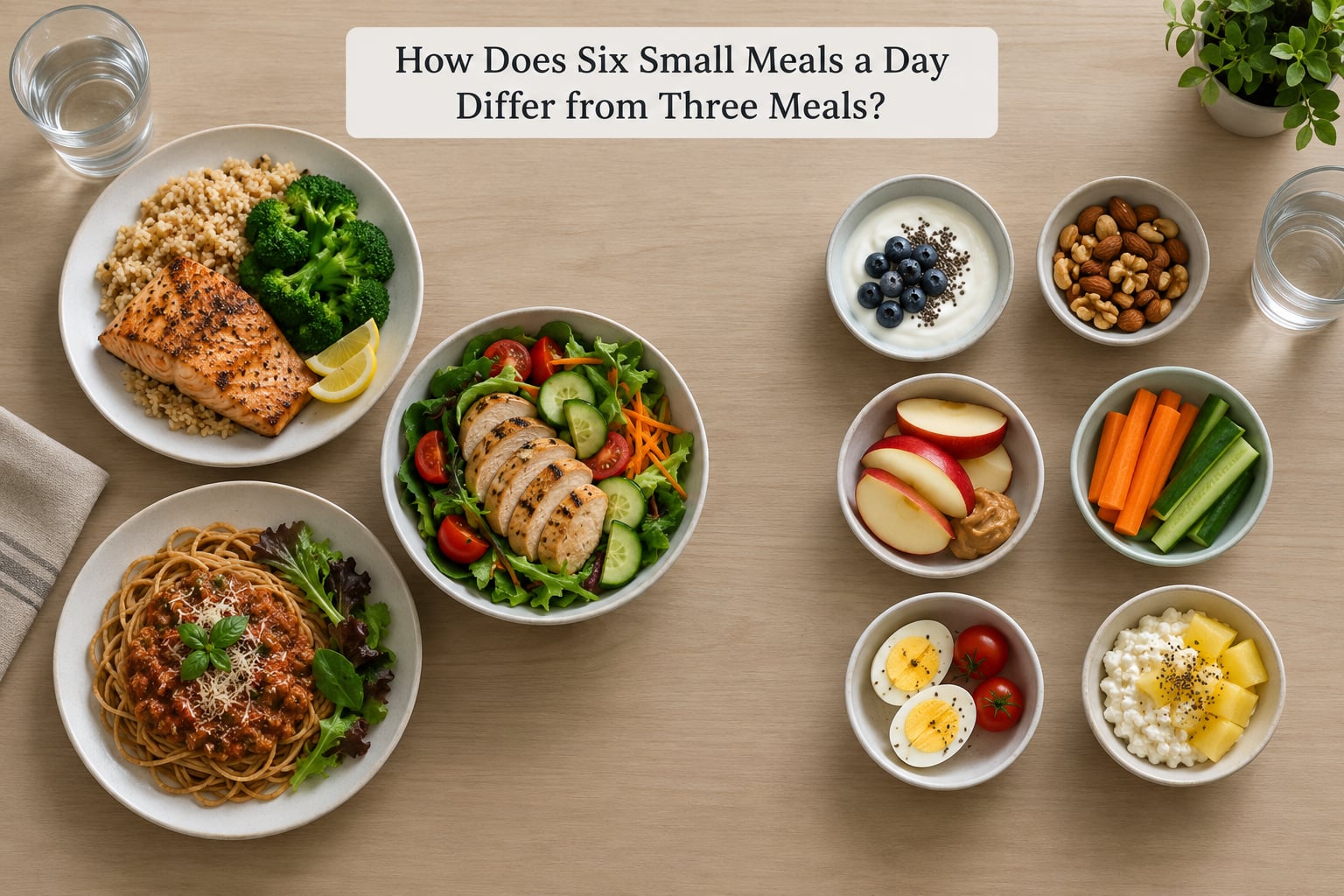
The differences are almost entirely about logistics and appetite, not about what happens to your metabolism. Here is how the three common patterns line up.
| Criteria | Three meals | Six small meals | Time-restricted eating |
|---|---|---|---|
| Total daily calories | Whatever you plan | Whatever you plan, but easier to overshoot | Whatever you plan, often lower without effort |
| Effect on metabolic rate | No meaningful change | No meaningful change | No meaningful change |
| Preparation effort | Lowest, three decisions | Highest, six decisions | Low, two or three decisions |
| Satiety between meals | Depends on portion size and protein | Easier for some people to stay on plan | Longer true hunger gaps |
| Effect on social life | Simple, matches most plans | Hard on normal work and social schedules | Simple, though it skips a window most days |
| Best for | Most healthy adults | Heavy trainers, people who genuinely prefer it | People who dislike the first meal of the day |
| Main downside | Some people overeat at dinner | Six chances to eat past your needs | Low blood sugar risk for some, hard socially |
Three meals is the default because it requires the least planning and blends into a normal day. Six small meals is the most administratively expensive option on the table, and it is the only one where the schedule itself can start feeling like a strain.
Time-restricted eating, where you compress your eating into a window such as 8 to 10 hours, works on the same principle in reverse. Fewer meals, same total calories, and for some people a much easier way to stop eating in the evening without white-knuckling it.
What Are the Potential Benefits of Eating More Often?
There are real situations where smaller, more frequent meals make sense. None of them make six meals mandatory, and none of them apply automatically to you.
Portion control is the big one. Some people genuinely find it easier to stop at a small plate three times than to resist a large one. If six smaller servings are how you hit your daily total without overeating, that is a legitimate reason to do it. It is a psychological win, and psychological wins count for more than thermic arithmetic ever did.
Appetite smoothing matters for a subset of people. For readers whose blood sugar dips sharply a few hours after eating, smaller and more even intake can feel steadier through the afternoon. If you use a glucose monitor or a continuous glucose monitor, that is worth a conversation with a clinician rather than an internet rule.
Convenience has its own logic. On a long shift, at a job with no real break, or on a week with almost no kitchen time, two or three substantial meals may simply not be possible while six small ones would be. Fewer decisions beat perfect decisions you never make.
Medication-related needs are the clearest case of all. People on insulin or sulfonylurea medications are routinely advised to eat regularly, because the drugs can drive blood sugar low if meals are skipped or pushed far apart. That is a real prescription, issued for a real reason, and it overrides anything general you read here.
Heavy training is the last honest case. A competitive lifter or an endurance athlete may genuinely need large daily totals spread across long windows, plus protein and carbohydrate timed around sessions. Even then, the evidence supports hitting the totals first. Meal frequency is the tool, not the point.
Could Six Small Meals Make It Easier to Lose Weight?
It can, for a specific person in a specific situation, and the reason is adherence rather than metabolism. Weight change comes down to total energy intake against total energy expenditure. Splitting the same 2,000 calories into six servings or three changes neither side of that equation.
Where it backfires is arithmetic of a different kind. Six meals means six opportunities to eat more than you meant to, and snacks are where extra calories hide most easily. An unplanned 150-calorie snack twice a day is 300 calories a day, which adds up to a little over 110,000 calories across a year. Whether that shows up on the scale depends on everything else you do, but it is not nothing, and it is the opposite of a metabolism boost.
So the honest version is this. If splitting your intake into smaller, more frequent servings helps you eat less over the day, do it. If it gives you six chances to overshoot and a schedule that fights you every week, it is adding friction to the exact job you are trying to make easier.
What actually moves a metabolic rate
Five things carry real weight, and none of them involve counting feedings.
- Resistance training. Working your muscles hard keeps the tissue that burns the most energy, which helps defend your resting metabolic rate as you lose weight.
- Enough protein, spread sensibly. Protein costs the most energy to process and helps you hold onto muscle while eating less. Higher protein also tends to feel more filling than the same calories from refined carbohydrate.
- Daily movement. Walking, stairs, housework, fidgeting. Non-exercise activity thermogenesis, usually shortened to NEAT, varies enormously between people and is a real part of your daily total without needing a workout.
- Sleep. Short or poor sleep raises appetite and cravings the following day. It is one of the least glamorous and most reliable levers on this list.
- Avoiding extreme deficits. Very aggressive calorie cuts drive hunger up and lean mass down, and make a pattern far harder to hold for long.
Which Eating Pattern Is Best for Your Routine?
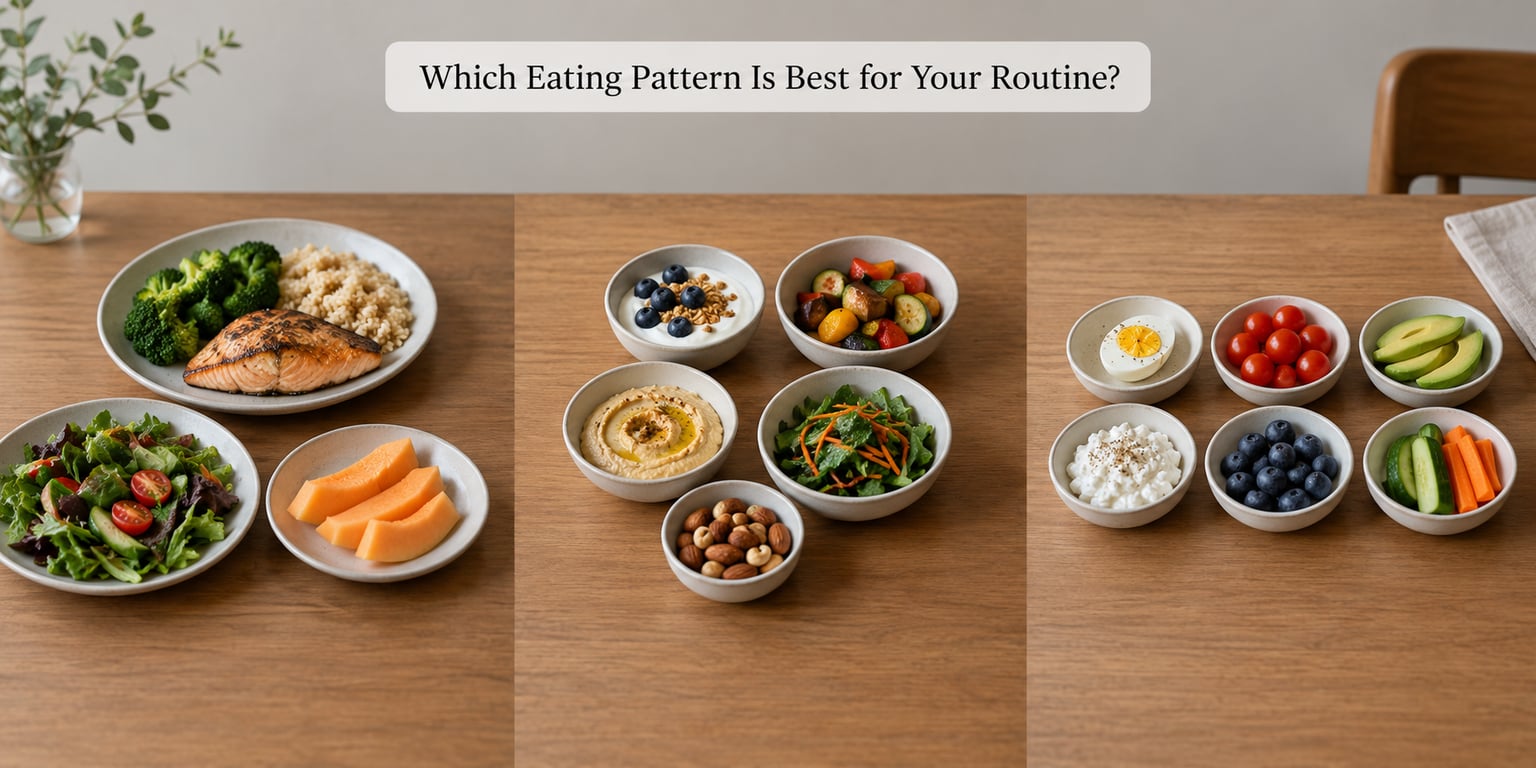
The best pattern is the one you can still run on a bad week. Work through these questions in order and the answer usually falls out on its own.
- What is your goal? Fat loss, maintenance and building muscle all work at three meals. Very heavy training with large totals may push you toward four to six. Nothing about weight loss specifically requires more meals.
- How does your appetite behave? If you get ravenous and then overeat at dinner, splitting the day into three meals plus a planned snack or two is a practical fix. If hunger barely registers, fewer meals are easier.
- What does your schedule allow? Shift work, long commutes and no kitchen at work all push toward flexible options like three meals plus snacks you can eat anywhere. Build around the day you actually have.
- What is your social life like? Six small meals is the hardest pattern to keep socially. If most of your eating happens with other people, three meals costs you nothing in effort.
- What can you afford? Six meals means roughly twice the packaging, the shopping decisions and the equipment. Three is cheaper in time and money before you count a single extra snack.
- Can you control a portion? If you have trouble stopping at a large serving, do not aim for three big plates. Smaller plates and set portions do more work here than the meal count ever will.
Three meals a day suits most people. Three meals plus one or two planned snacks suits people who graze well or need help with portion control. Six small meals suits heavy trainers and anyone who prefers it. Two meals a day suits people who genuinely do not feel hungry in the morning.
How to Build a Balanced Meal Pattern
Whatever pattern you pick, the same plate logic applies. Most of the benefit comes from what is in the sitting, not how many sittings there are.
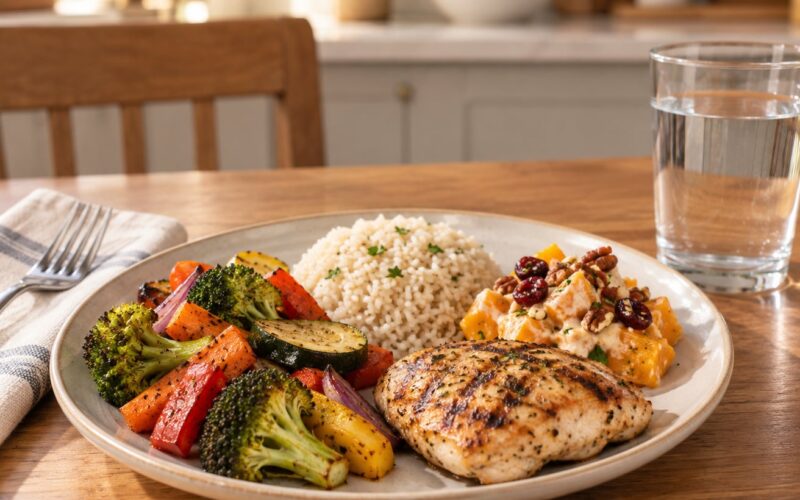
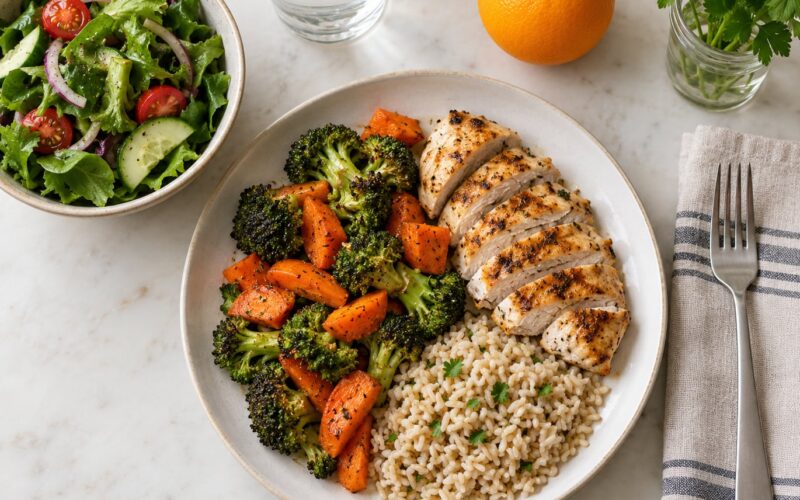
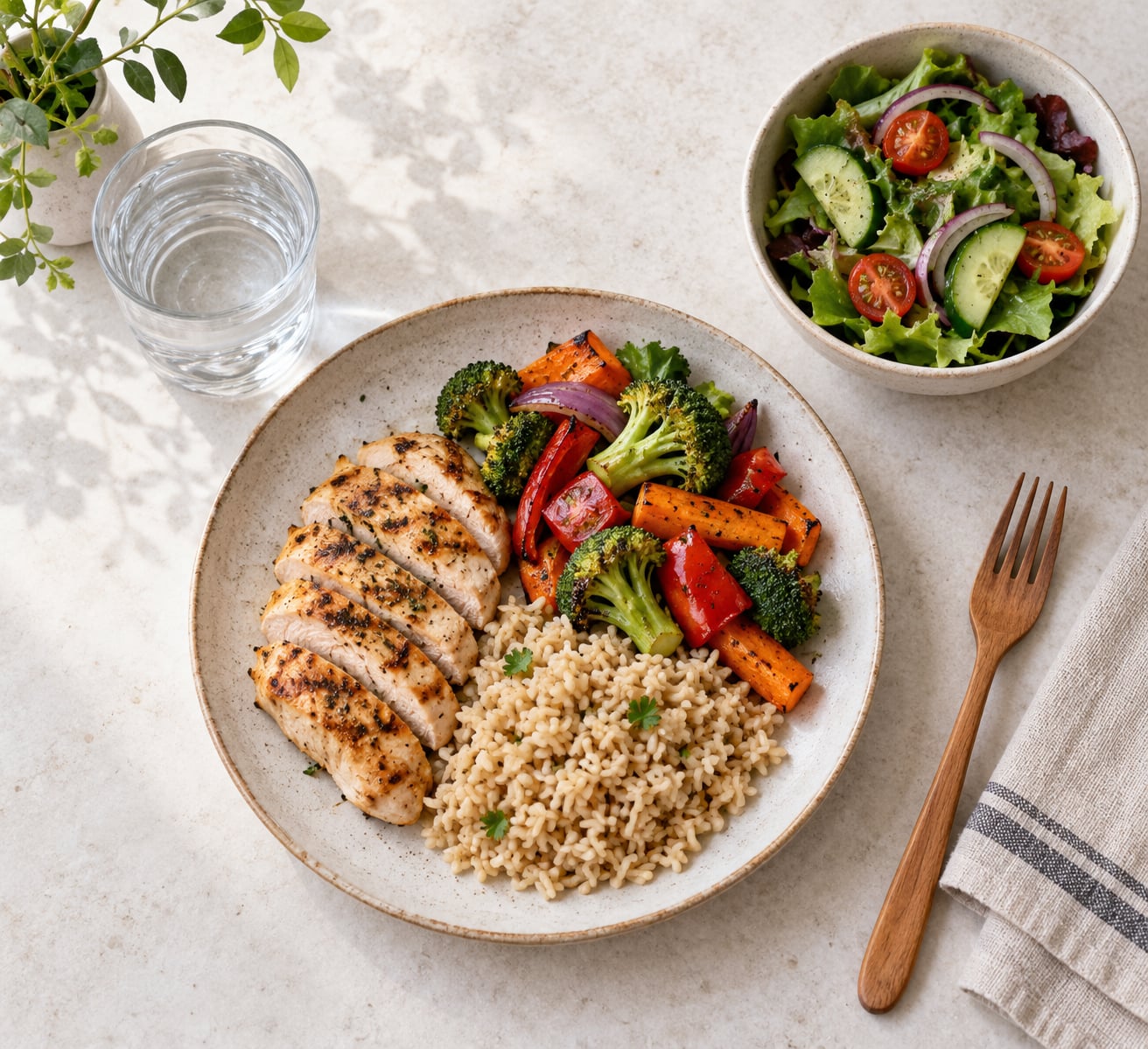
Build each meal around a protein source, a vegetable or piece of fruit, a whole grain or other starchy food, and a small amount of fat. Chicken with roasted vegetables and brown rice, Greek yogurt with berries and oats, eggs with spinach and whole-grain toast all follow the same shape. That shape works identically whether you eat it three times or six.
If you prefer six smaller meals, move calories around rather than adding them. Start from a normal day of roughly three meals and split two of them in half with a piece of fruit, a handful of nuts or a yogurt. Most people find that lands in the 2,000 to 2,400 calorie range without feeling like a restriction, and the total stays where it was.
Give each snack a job. A snack that exists only because it is mealtime has a habit of becoming a fourth meal in disguise. A snack attached to hunger, to a workout, or to a gap that is genuinely too long works better.
Late eating deserves a note of its own. Eating close to bedtime does not have a special metabolism effect, but it tends to add calories rather than replace them, and for plenty of people it wrecks sleep, and bad sleep makes everything else harder. Finishing two to three hours before bed is a reasonable default if it suits you.
Whichever route you take, give it two to three weeks before you judge it. Appetite takes a short adjustment period, and most people give up in the middle of it.
Are Six Small Meals Better for Everyone?
No, and for a fair number of people they are actively worse. Six meals a day is inconvenient on a normal work schedule, expensive in time and preparation, and harder on social plans. If it makes your life more complicated and your intake less controlled, it is not doing you a favour.
For some groups, though, frequent eating is genuinely recommended medicine or standard advice. This is where personal guidance matters more than anything written here.
| Group | Is frequent eating recommended? | Why |
|---|---|---|
| Type 1 diabetes | Often yes | Insulin dosing and carbohydrate counting are planned around regular carbohydrate intake |
| Type 2 diabetes | Sometimes | Regular meals can even out glucose for some people, and medication choice matters |
| Taking insulin or sulfonylureas | Yes, generally | These medicines can cause low blood sugar when meals are skipped or spaced far apart |
| Prone to low blood sugar | Yes | Regular intake is the standard safety advice |
| Pregnancy | Often | Nausea and blood sugar management both make steady intake easier |
| Heavy strength or endurance training | Optional but common | Useful for hitting large totals and timing intake around training |
| History of disordered eating | Use caution | A rigid six-meal rule can add pressure rather than take it away |
| Healthy adult, no medical conditions | No need | Pick whatever pattern you can sustain |
If you fall into any of the first rows, talk to your doctor or a registered dietitian before changing how often you eat, and follow their plan rather than general advice. The same goes if you have gastrointestinal symptoms, take regular medication, or are pregnant. This article is general information and is not medical advice.
One more caution. For readers with a history of disordered eating or restrictive patterns, rigid meal rules can tighten rather than loosen their grip on food. A flexible pattern with clear structure usually serves better than a strict six-meal schedule.
This article was last reviewed in October 2026. be-slimmer.net reviews nutrition content against published research and mainstream guidance from bodies such as the NIH and CDC, and separates what studies show from what is individual preference.
Frequently Asked Questions
Does eating six times a day speed up metabolism?
No. The thermic effect of food is a percentage of the calories you eat, not a bonus you earn per meal, so six 300-calorie meals and one 1800-calorie meal produce roughly the same thermic calories. A 2015 systematic review and meta-analysis by Schoenfeld and colleagues in PLOS ONE found that when total calories and macronutrients are held equal, meal frequency does not significantly change energy expenditure or weight loss.
Does the six-small-meals plan work without counting calories?
For most people, not reliably. Six small meals are six chances to eat past what you need, and snacks are the easiest place for extra calories to hide. If your day already fits into three meals without constant hunger or unplanned snacking, splitting the same food into six servings changes nothing but the number of decisions you make.
Can I skip breakfast if I eat six small meals later?
Yes, for most healthy adults. Skipping breakfast does not change your metabolic rate on its own, and total daily intake matters far more than whether it starts at seven in the morning. If you skip it, eat fewer times overall rather than cramming the same number of meals into a shorter window later in the day.
Does meal timing matter for weight loss?
Much less than most advice suggests. Timing has a modest effect next to total calories and food quality, though late-night eating tends to add calories rather than replace them, and eating too close to bed can disturb sleep. If you keep intake steady and finish a couple of hours before bed, the exact clock times matter far less than people assume.
What should I do if six small meals make me hungrier?
Go back to three meals or three meals plus one planned snack, and put more protein and fibre into each sitting. Grazing keeps some people appetite switched on rather than calmed down. If you are hungry within an hour of finishing a meal, that meal was probably too small or too low in protein and fibre, not that you need another eating window.
Conclusion
You do not have to eat six small meals a day. That rule came from bodybuilding culture, not from physiology, and the thermic effect of food does not work the way the story says. What matters is total intake, what is in each sitting, and whether you can actually keep doing it.
So pick a pattern you can sustain rather than one you admire. Start with three meals, add a snack if your appetite wants one, and adjust over the next few weeks based on how hungry you are, how your energy holds up and whether the scale is moving. If you have diabetes, take medication that affects blood sugar, are pregnant or have a history of disordered eating, make that decision with a doctor or registered dietitian instead of a rule from the internet.