
To transition from losing weight to maintaining it, stop dieting gradually: add roughly 50 to 200 calories a week, hold each increase for two or three weeks, and judge your progress by the two-week weight trend rather than the morning scale.
That is the whole mechanic, and it takes about six to ten weeks for most people. The harder part is emotional. A structured plan gives you a finish line, and taking it away feels like losing a framework, which is exactly why so many people slide back into old habits in the first month.
Research on long-term maintenance puts the honest number low: about a quarter of people who lose weight keep it off long term. The National Weight Control Registry, which tracks people who have held a loss of at least 30 pounds for five years or more, points to boring repeated behaviours rather than a perfect plan.
What follows is the transition I would give a friend who just hit their goal weight: six steps, a week-by-week calendar, and a rule for what to do when the number drifts. This is general information, not medical advice, and if you are coming off weight-loss medication or have a history of disordered eating, talk it through with your prescriber or a registered dietitian before changing anything.
Table of Contents
- What You Need
- A number to start from
- A routine that repeats
- One tracking tool you actually like
- A definition of done
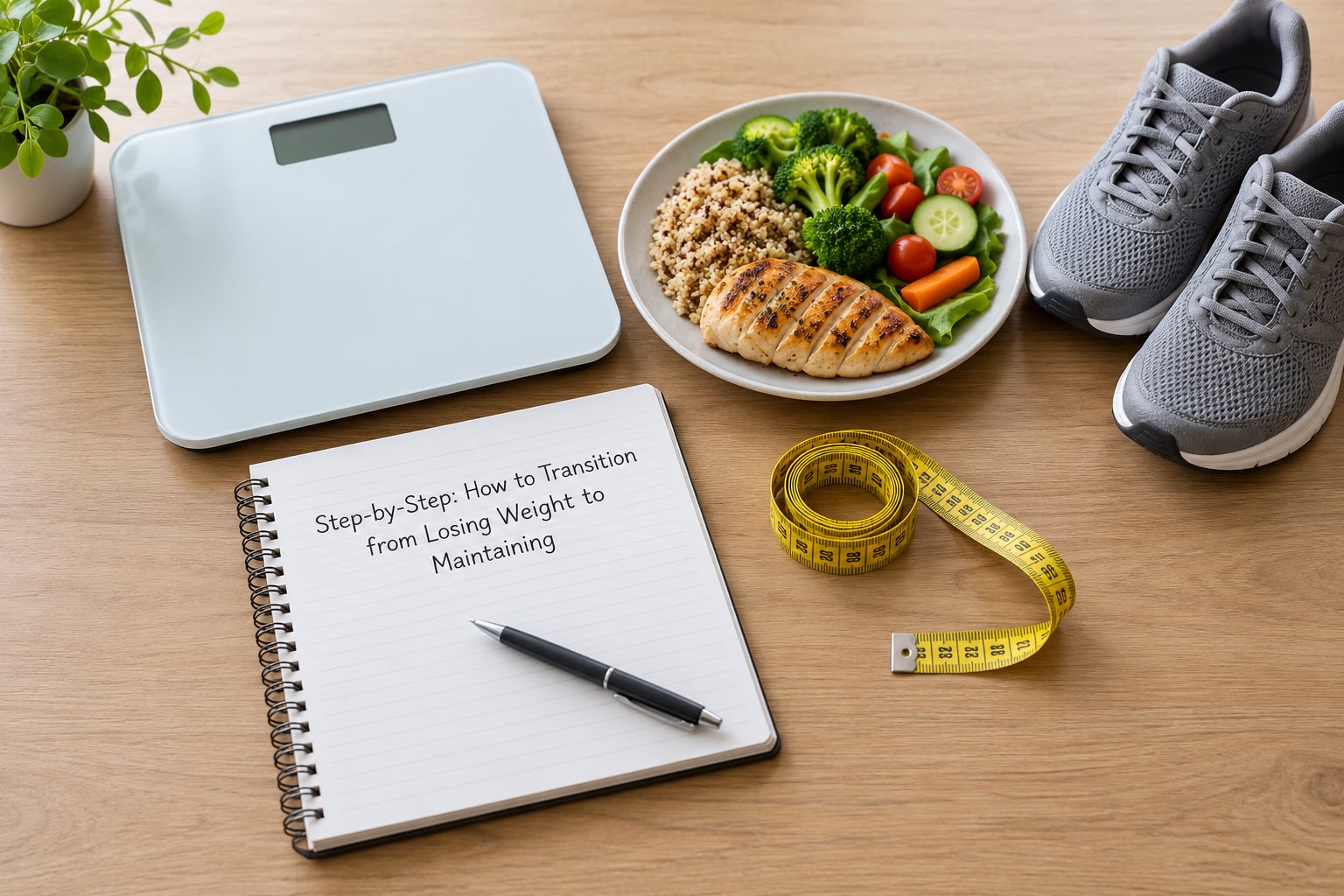
- Step-by-Step: How to Transition from Losing Weight to Maintaining
- Step 1: Establish Your Maintenance Baseline
- Step 2: Keep Your Eating Routine Consistent
- Step 3: Move Into Regular Physical Activity
- Step 4: Monitor Trends Instead of Daily Numbers
- Step 5: Adjust Before Weight Drifts Up
- Step 6: Make Maintenance an Ongoing Routine
- How Long Should You Stay at Maintenance?
- Does the Evidence Support Slow Reverse Dieting?
- How to Transition Off GLP-1 Weight-Loss Medication
- The Psychological Side of Leaving a Diet
- Common Mistakes
- Frequently Asked Questions
- How long should I stay in a weight-loss phase before focusing on maintenance?
- How many calories do I need to maintain my weight?
- How often should I weigh myself after reaching my goal weight?
- What should I do if my weight starts creeping up?
- How much exercise should I do to maintain weight loss?
- When should I ask a doctor or registered dietitian for help?
- Where to Start Tomorrow
What You Need
You need four things, and none of them cost money or need a special gadget.
A number to start from
Most people never measured their pre-diet maintenance, so they have no target to go back to. Work from your ending intake instead: take your average daily calories over the last two or three weeks of the deficit and add back roughly the size of that deficit.
A worked example. Someone averaging 1,900 calories a day while losing about 0.75 pounds a week is running a deficit of roughly 375 calories, so their starting estimate is about 2,275 calories. Add from there, not from the 2,800 they might have eaten before dieting.
The NIDDK Body Weight Planner is a free, credible place to check that estimate. Treat every calculator, including that one, as a starting guess rather than a verdict.
A routine that repeats
Maintenance is easier when the shape of your week stays the same: similar meals, similar timing, similar activity. You already built these habits during the deficit, so the job is to keep them rather than redesign them.
One tracking tool you actually like
A scale, a notebook, a spreadsheet or a weekly photo habit all work. Pick one you will still be doing in six months, because the tool matters less than the repetition.
A definition of done
Decide now what maintenance means to you. Most people do best with a range rather than a single number: roughly 1 to 2 percent either side of your new centre weight. A centre of 170 pounds becomes a working range of about 168 to 172 pounds.
Step-by-Step: How to Transition from Losing Weight to Maintaining
| Period | Calories and actions | What to watch | What not to react to |
|---|---|---|---|
| Weeks 1-2 | Move from your ending intake to your estimated maintenance, or add 100 calories and hold | Appetite returning, sleep, energy in the gym | A 1 to 2 pound rise on the scale |
| Weeks 3-4 | Add another 100 to 150 calories if the two-week trend is climbing | Trend weight, waist measurement, clothing fit | Single high weigh-ins, one salty meal |
| Weeks 5-8 | Hold steady for two consecutive weeks inside your range | Strength in lifts, daily step count | Day-to-day swings of 2 to 3 pounds |
| Month 3 onward | Stay put and check the trend monthly, or weekly if you like data | Waist, sleep, energy, how much you think about food | Any single number on any single morning |
Step 1: Establish Your Maintenance Baseline
Identify your stable starting weight and write down the last two to four weeks of habits before you change anything.
Your baseline number is your lowest sustained weight, not your lowest reading. Water weight moves a person up and down several pounds in a normal week, and if you set your target at the lowest thing you ever saw, you are chasing a number that was never stable to begin with.
You will also know your maintenance has genuinely changed. You carry less body mass now, and lean tissue burns more energy than fat tissue, so the calories that maintained you before the diet are almost always a little too high now. r/loseit regulars put it bluntly: do not jump back to the old number.
Step 2: Keep Your Eating Routine Consistent
Keep the meals you liked, keep your protein high, and let portions become flexible again.
Protein and fibre do the heavy lifting here. Enough protein preserves muscle while your calories climb, and fibre plus protein blunt the hunger that comes with bigger portions, which is what stops the transition turning into a binge-and-restrict cycle.
Regular meal timing matters less than people think, but skipping meals does not. A skipped breakfast followed by a much larger evening meal is the pattern most likely to end in a rebound.
Step 3: Move Into Regular Physical Activity
Keep the same general activity approach that supported the loss: regular cardio, strength training, and plenty of everyday movement.
Strength training is the one people drop first and regret most. Two or three sessions a week protect muscle mass while you eat more, and muscle is what keeps your maintenance calories higher later on.
Daily steps matter more than formal workouts because they happen without willpower. When you add calories back, adding a two-thousand-step walk is usually easier than adding a fourth gym session, and it costs you nothing but a pair of shoes.
Step 4: Monitor Trends Instead of Daily Numbers
Weigh yourself the same way every day, then look at the average over two weeks, not the individual reading.
Daily weights are noisy because of water, salt, bowel movements and sleep. A two-week average smooths that out and is what you should be making decisions on. If you weigh daily and averaging feels obsessive, weekly is perfectly workable.
Several other signals are worth tracking alongside the trend: waist measurement, how your clothes fit, your energy in the afternoon, sleep quality, and how heavy lifting feels. A trial of 3,768 adults published in the New England Journal of Medicine, the same trial Johns Hopkins Medicine frequently points to, found that people who weighed in regularly were better able to tell a real gain from ordinary fluctuation.
Step 5: Adjust Before Weight Drifts Up
Set your correction rule now, while you are calm, and write it down.
The rule should be boring: if the two-week average climbs for two consecutive weeks, take one small action, then watch for another two weeks before doing anything else. Small actions look like trimming a portion of starch at dinner, walking after meals, or going to bed an hour earlier.
| What you see | Likely explanation | Next action |
|---|---|---|
| Jump of 1 to 2 pounds in the first two weeks | Glycogen returning with carbohydrate, plus water and the physical mass of food | Nothing. Recheck in two weeks |
| Trend flat, waist steady | You are at maintenance | Nothing. Keep the routine |
| Trend up for two weeks, clothes tighter | Real surplus of a few hundred calories | Trim one portion or add 1,500 steps a day, then wait two weeks |
| Trend climbing with unusual fatigue, thirst or other symptoms | Medical cause such as thyroid or medication change | See a doctor rather than adjusting numbers |
Step 6: Make Maintenance an Ongoing Routine
Keep the smallest set of habits that holds your result and stop adding rules.
Most people need three or four of these, not all nine: eat protein at most meals, keep moving daily, weigh or check in weekly, and sleep at a reasonable hour. Everything else is negotiable.
Plan for the disruptions in advance, because travel, holidays, illness and stressful weeks are when maintenance breaks. r/CICO threads on this topic almost always come back to the same point: the week that goes wrong is not the failure, the four weeks in a row of those weeks is.
How Long Should You Stay at Maintenance?
Most people need at least four to eight weeks at maintenance, and often several months, before starting another cut.
The weeks right after a deficit are when your body, appetite and training all need to settle. Cutting again straight away is how weight cycling starts, and the National Weight Control Registry’s long-term members overwhelmingly report eating breakfast daily, eating four or five times a day, keeping daily activity high, and monitoring themselves regularly.
A maintenance phase also works as a plateau break. If you have been stuck for weeks during a cut, two weeks at maintenance will often break it.
Does the Evidence Support Slow Reverse Dieting?
Honestly, the evidence is weaker than the internet suggests, and slow reverse dieting is optional rather than required.
Reverse dieting means adding calories gradually instead of jumping straight to your estimated maintenance. The theory is adaptive thermogenesis, the idea that your energy expenditure falls after weight loss and slowly recovers. A systematic review of 33 studies found these effects were smaller than expected or statistically unclear, and that they diminish once weight stabilises.
That does not make a slow climb pointless. The slow climb’s real benefit is psychological: it lets you watch your appetite return before you commit to a much larger number, and it slows down the rate of gain if your estimate was low. It just is not a medical requirement, and you do not owe anyone six weeks of it.
How to Transition Off GLP-1 Weight-Loss Medication
If you used semaglutide or tirzepatide, this transition is a conversation with your prescriber rather than a spreadsheet.
Appetite suppression from these drugs makes it genuinely hard to judge how much food you actually need, and many people discover they are eating less than they think before the medication leaves their system. Dosing and tapering belong to your clinician, not to an article, and any dose change should be made with them.
What you can do in the meantime is slow down your food changes, keep protein and strength training locked in, and bring your weight trend to your next appointment. Two subreddit threads on long-term maintenance after these drugs are mostly people asking the same question: nobody has a roadmap, so ask the person who wrote the prescription.
The Psychological Side of Leaving a Diet
The hardest part of maintenance is often identity, not appetite. If you have spent a year thinking of yourself as someone on a diet, stopping feels like losing a purpose.
Two mindsets show up repeatedly. One is all-or-nothing thinking, where a high-calorie meal becomes proof the whole effort failed. The other is number-chasing, where a stable weight feels like a plateau to be defeated.
For people with a history of disordered eating, tracking can do more harm than good. Weighing and logging are optional. Waist measurement, how clothes fit, strength in the gym and a regular meal rhythm give you the same information without the arithmetic.
Common Mistakes
Staying on a very low calorie diet. If you were eating 1,200 calories or less, the gap between where you were and true maintenance is large, and jumping to it in one move is the classic route to a fast regain. Climb out of it in stages.
Suddenly increasing exercise to compensate. Adding hours of training while eating more usually leaves you exhausted rather than in balance. Add movement gradually, and let it support your energy rather than punish your plate.
Reacting to normal weight changes. A 2 to 3 pound swing overnight is water, not fat, and reacting to it is the single most common way people turn a normal week into a crisis.
Skipping meals. Grazing and skipping feel lighter, then produce the rebound eating that undoes the transition entirely.
Having no plan for travel and social eating. Decide in advance what your normal looks like at a wedding, an airport or a holiday week, because improvised decisions in those settings are what people regret.
Treating a lapse as a new phase. An event has an end date. A pattern has become your normal week, and that is the point to change something.
A few tips that carry most of the weight. Eat more than you expect to need, because hunger after a deficit is real and it is not a character flaw. Keep protein high and fibre steady so bigger portions stay comfortable. Weigh on a schedule, not on a mood. And give maintenance a fixed review date, so it stays a phase instead of a waiting room for the next cut.
Frequently Asked Questions
How long should I stay in a weight-loss phase before focusing on maintenance?
Plan on four to eight weeks at maintenance as a minimum, and longer if you trained hard or came off a very low calorie diet. That first stretch lets your appetite, energy and training settle before you consider cutting again. Cutting straight back out of a deficit is the most common route to weight cycling, which is the repeated losing and regaining pattern the National Weight Control Registry is designed to study.
How many calories do I need to maintain my weight?
Start with your average intake during the last weeks of your deficit plus the size of that deficit. A person averaging 1,900 calories and losing 0.75 pounds a week would begin around 2,275 calories. Then adjust by 100 calories in either direction and watch the two-week trend. Your maintenance is almost always lower than it was before you dieted, because you carry less body mass.
How often should I weigh myself after reaching my goal weight?
Daily weighing is fine if you then ignore the individual numbers and look at the two-week average. Weighing at the same time each day, ideally in the morning, gives you the cleanest trend. A trial of 3,768 adults found regular self-weighing helped people separate real gain from normal fluctuation. If weighing makes you anxious, weekly checks plus waist measurement work just as well.
What should I do if my weight starts creeping up?
Check the trend over two weeks rather than reacting to a few readings. If it has climbed for two consecutive weeks, take one small action such as trimming a portion of starch or adding 1,500 daily steps, then wait another two weeks before changing anything else. One action at a time keeps you from overreacting to water weight and ending up in a deficit again.
How much exercise should I do to maintain weight loss?
Aim for around 150 minutes of moderate activity a week, plus two or three strength sessions, and keep your daily steps high. Strength training matters most for protecting muscle while you eat more, which supports higher maintenance calories later. Daily walking is the most reliable piece, because it needs no willpower and survives busy weeks better than scheduled workouts.
When should I ask a doctor or registered dietitian for help?
Ask when weight drifts despite a consistent routine, when fatigue, thirst, sleep or other symptoms change, or when you are tapering a weight-loss medication. Dosing decisions are always your prescriber’s to make. A registered dietitian is worth the appointment if tracking triggers disordered eating thoughts, if you are coming off a diet under 1,200 calories, or if you simply want a second set of eyes on your numbers.
Where to Start Tomorrow
Start with your ending average and the deficit you were running, add those together, and write the number down as your first estimate. Then hold it for two weeks before changing anything.
That is how to transition from losing weight to maintaining in practice: add calories in small, measured steps, ignore the first two weeks of scale noise, judge the trend, and correct early with one small change rather than a whole new diet. Expect the scale to rise a pound or two at the start. It is glycogen and water, and it settles.
Last updated: October 2026. This article is for general education and is not medical advice. Speak with a doctor or registered dietitian before starting, stopping or changing any weight-loss medication.