
Yo-yo dieting is the repeated cycle of losing weight on a strict diet, regaining it, then starting over. It is also called weight cycling, and the honest answer to what is yo yo dieting and how to stop it is simpler than most plans make it sound: stop treating food as a punishment phase, build a routine you can run on an ordinary Tuesday, and plan for maintenance before you reach your goal weight.
Most people who cycle aren’t lazy or undisciplined. They follow a plan that was never built to last, then blame themselves when it collapses. Fixing that means changing the routine, not digging for more willpower.
Table of Contents
- What Is Yo-Yo Dieting and How to Stop It?
- What Counts as Yo-Yo Dieting?
- How Does Yo-Yo Dieting Happen?
- Why Do People Gain Weight After a Diet?
- How Can You Stop Yo-Yo Dieting Without Another Rigid Plan?
- Set a Weight-Neutral Goal First
- Create a Repeatable Everyday Eating Routine
- Add Small Forms of Movement You Can Maintain
- Plan for Maintenance Instead of a Perfect Finish
- What Can Help When the Cycle Keeps Repeating?
- Frequently Asked Questions
- How quickly do you regain weight after a crash diet?
- Do I have to lose a lot of weight for it to count as yo-yo dieting?
- Do I need to count calories to stop yo-yo dieting?
- How can I reset your metabolism after years of dieting?
- How do I keep weight off without tracking everything?
- How do I quit yo-yo dieting for good?
- Conclusion
What Is Yo-Yo Dieting and How to Stop It?
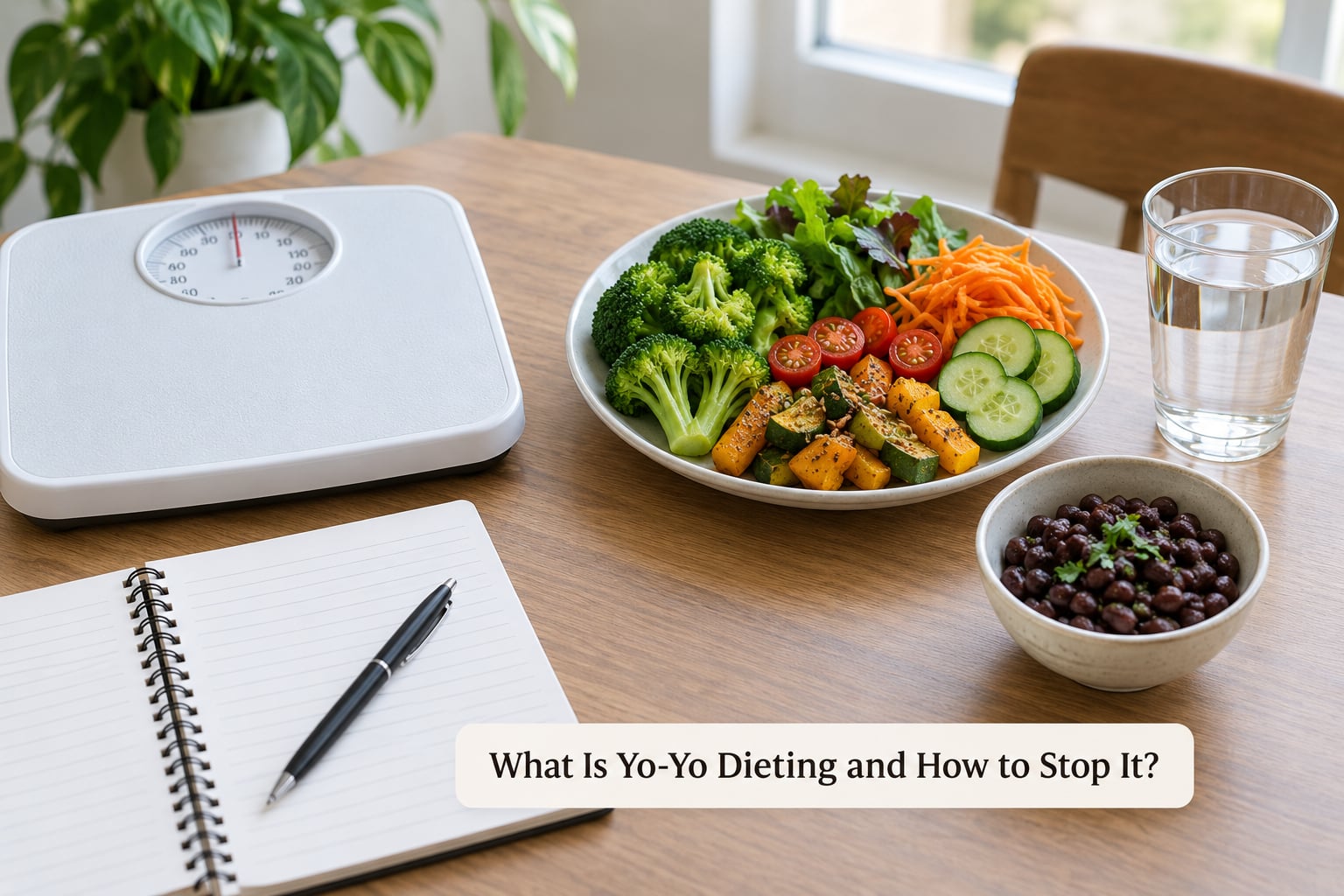
Weight regain after a diet is common, but yo-yo dieting is a pattern: lose, regain, repeat, often on the same 10 to 20 pounds, sometimes for a decade or more. Each cycle tends to take longer to lose the weight and less effort to put it back on.
The cycle usually runs in four stages. A starting event — a new year, a birthday, a doctor visit — prompts a restrictive plan. Weight drops quickly in the first few weeks. Hunger and low energy build while everyday movement quietly falls away. Then the plan ends, and the weight returns faster than it left.
How to stop it comes down to four parts: a sustainable eating pattern rather than a phase, gradual progress instead of aggressive targets, strength and movement habits that survive a bad week, and a maintenance plan you start on day one rather than on the last day.
What Counts as Yo-Yo Dieting?
Weight cycling is the repeated loss and regain of the same weight, usually across more than one attempt, usually with a diet in between. A single regain after years of stability is a setback. A third round in the same year is a cycle.
How much is lost and regained differs from person to person, and not every pattern looks identical. Some people drop 30 pounds and return to it within a year. Others lose 8 pounds, regain 12, and settle heavier than where they started.
It also helps to separate cycling from ordinary fluctuation. Weight moves up and down a few pounds across the week because of water, salt, bowel movements, and hormones. Cycling is a trend line, not a Tuesday morning reading.
How Does Yo-Yo Dieting Happen?
Severe restriction is the engine. A large deficit takes weight off quickly, and your body responds in two directions at once. Resting energy expenditure adjusts downward, and hunger hormones such as ghrelin rise while leptin falls. You feel hungry at times that normally pass without notice.
A second mechanism is behavioral. Intense exercise phases end, step counts drop back to baseline, and the daily structure that held meals in place disappears along with the scale going down. Emotional eating picks up the slack, sometimes triggered by stress, sometimes just by hunger that has been building for weeks.
Bodies and circumstances differ, so nobody regains weight on the same schedule. Blame is neither useful nor accurate here — regain after restriction is an expected response, not evidence of a character flaw.
Why Do People Gain Weight After a Diet?
Six explanations cover most cases, and they usually stack on top of each other rather than compete.
A large deficit ends. Once normal eating resumes, an appetite that had been suppressed quietly returns to its usual level. The missing piece is often a clear picture of how much food maintenance actually takes, so people guess low and drift upward.
The table below pairs the common triggers with the response that tends to hold up better.
| Common trigger | What usually happens | A response that holds up |
|---|---|---|
| A very large calorie deficit | Fast loss, rising hunger, strong rebound once the plan stops | A modest, sustainable change you could hold for a year |
| Appetite quietly rebuilding | Weight returns to the level the old intake supported | A repeatable meal routine with protein and fiber at each meal |
| Less everyday movement | Steps and activity fall back as the diet phase ends | Movement small enough to keep on a low-energy day |
| Emotional or stress eating | A hard day turns into a long stretch of overeating | A planned next meal and a short pause before decisions |
| All-or-nothing rules | One slip becomes “the diet is off,” and weeks pass | Flexible targets with no food permanently banned |
| Stopping the strategy too early | Weight loss is treated as the finish line, habits are dropped | Maintenance planning that starts before the goal weight |
How Can You Stop Yo-Yo Dieting Without Another Rigid Plan?
Rigid plans fail for a structural reason: they assume a version of your life that only exists for a few weeks. The way out is less dramatic. Regular meals, enough protein and fiber, changes small enough to keep, movement you actually like, decent sleep, and expectations that survive a bad day.
Work through the four steps below in order. Each one is simple on its own, and together they replace a diet with something you can still be doing in a year.
Set a Weight-Neutral Goal First
Before changing anything, spend one to two weeks watching your patterns without judging them. Note what you eat, when hunger shows up, how much you move, how you sleep, and how the weekly average shifts. The goal of this step is information, not a lower number.
Looking at weekly averages instead of daily readings keeps a normal fluctuation from reading as failure. Most people find one or two repeat triggers in two weeks: a skipped breakfast that turns into a 3pm binge, a work trip, a workout that only happens when motivation is high.
Create a Repeatable Everyday Eating Routine
Routine works because it removes the daily decision. Build most meals around four parts: a vegetable or fruit, a protein source, a whole-grain or starchy food, and something that makes the meal satisfying. You can adjust portions and timing alone, without banning anything.
Breakfast might be oats with berries, yogurt, and nuts. Lunch could be a bowl of beans and greens with whole-grain bread. Dinner is a protein, roasted vegetables, brown rice, and a sauce you like. Snacks are fruit with cheese or a handful of nuts. The meals are ordinary on purpose — that is what makes them repeatable.
Add Small Forms of Movement You Can Maintain
Ten-minute walks after lunch, a couple of sessions a week with weights, or a sport you genuinely enjoy tend to survive longer than punishing routines. The goal is a baseline you keep on weeks when everything else slips.
Start from your current ability. If walking is the only thing that fits right now, walk and add five minutes every week or two. Strength work matters here because muscle is what supports your weight as you age, and walking alone rarely replaces it.
Plan for Maintenance Instead of a Perfect Finish
Pick a range rather than a finish line — the band of weight where you sleep well, move easily, and are not thinking about food all day. When you reach it, your plan changes: you eat a little more, keep the movement, and keep weighing yourself as often as you always have, which for most people means weekly.
Decide in advance what a lapse looks like. One heavy dinner, a holiday week, a month of poor sleep. The rule to write down is the resume rule: after three days off the routine, the next breakfast is the restart. Weight that drifts back is a signal to resume, not a verdict on the effort.
What Can Help When the Cycle Keeps Repeating?
When the pattern continues, the sticking point is often emotional rather than nutritional. Constant weighing, guilt after eating, and a fixed number on the scale as a measure of worth all keep the cycle running. If that sounds familiar, treat it as information about the plan, not a personal failing.
Emotional eating, low mood around food, obsessive tracking, or repeated attempts to lose weight very fast are worth raising with a professional. A registered dietitian can work with you on a realistic eating pattern and help you get support for disordered eating if that’s present, and a doctor can look at sleep, thyroid function, medications, and hormone changes that affect weight.
Some situations need more than a general article. Rapid loss without trying, fainting, heart palpitations, or a preoccupation with food that crowds out daily life all deserve a prompt appointment rather than another self-directed plan.
Two life events commonly restart the cycle: pregnancy and menopause, and the end of a GLP-1 medication such as semaglutide. In both cases appetite returns while your habits have been built around suppression. The plan is the same — rebuild the routine before or as the medication or the hormone shift ends, and ask your prescriber about the timing rather than adjusting anything yourself.
Frequently Asked Questions
How quickly do you regain weight after a crash diet?
Regain speed varies, and early changes are often fluid rather than fat. A restrictive plan also raises hunger and makes your previous eating pattern harder to sustain. Many people see the first movement back within a few months and return to their starting weight or beyond over the following years, which is why a slower, repeatable routine tends to hold better than a fast one.
Do I have to lose a lot of weight for it to count as yo-yo dieting?
No. The pattern matters more than the number. Losing and regaining the same 8 pounds three times is weight cycling, even though nothing about it looks dramatic. Health and behavior research treats repeated cycles as a pattern with real metabolic and psychological costs, so the size of the loss is a poor measure of whether the cycle is worth fixing.
Do I need to count calories to stop yo-yo dieting?
Not permanently. Counting is useful for a few days as a way to see what a typical day actually looks like, and many people find it clarifying. Long-term calorie tracking tends to feed the all-or-nothing thinking that drives cycling. A repeatable meal structure gets you most of the benefit without the constant arithmetic or the guilt that comes with it.
How can I reset your metabolism after years of dieting?
There is no reset button, and your metabolism is rarely broken. Resting energy expenditure dips during restriction and recovers as you eat regularly, usually with activity and strength work. Return to regular meals with adequate protein, add resistance training two or three times a week if you can, sleep consistently, and expect the scale to move slowly while energy improves first.
How do I keep weight off without tracking everything?
Use a weekly average instead of daily numbers, and keep the four-part plate at most meals. A routine you can follow from memory survives travel, illness, and busy weeks in a way that a detailed log does not. If you want one checkpoint rather than continuous monitoring, a weekly weigh-in and a look at your waist will tell you more than a daily reading.
How do I quit yo-yo dieting for good?
You quit it by building a routine before you need it, not after another diet ends. Eat regular meals with protein and fiber, keep small amounts of movement going, and define a maintenance weight range with a plan for what to do after a bad week. People who keep weight off describe the same thing: less intensity, more consistency, and far less time spent thinking about the scale.
Conclusion
Start with one concrete action this week: pick a breakfast, lunch, or dinner you can repeat without thinking, and build the rest of the day around it. That single repeatable meal does more for yo yo dieting than another plan ever will.
Weight moves, weeks go badly, and numbers swing for ordinary reasons none of which say anything about your character. What breaks a cycle is a routine flexible enough to survive a bad day and a maintenance plan you wrote before you got there. If eating and weight are taking up more headspace than you would like, a registered dietitian or your doctor is a reasonable next call.