HIIT (high-intensity interval training) at home means short bursts of near-max effort, usually 20 to 40 seconds, followed by a rest of equal or shorter length, repeated for several rounds using nothing but your body weight and a few feet of floor. A complete beginner session takes about 20 minutes, including warm-up and cool-down, and the difficulty is low once you know the interval format.
The trick is that most “HIIT” follow-along videos are really moderate cardio with music. Real intervals need exact timing, honest effort, and a genuine recovery period, and that difference is what makes the workout effective. Get those three things right and you can build a routine that works in a studio apartment, a hotel room, or a living room with kids asleep down the hall.
Table of Contents
- What You Need
- How to Do a HIIT Workout at Home: Step by Step
- How to Do a HIIT Workout at Home: Warm Up First
- Choosing Your Interval Format
- Performing the Beginner Circuit
- Cooling Down and Record Your Results
- Common Mistakes
- Frequently Asked Questions
- How long should a home HIIT workout last?
- Is it safe to do HIIT every day?
- Can I do a HIIT workout at home with no equipment?
- How do I modify HIIT exercises for beginners?
- How do I make HIIT quiet enough for an apartment?
- What are the signs I should stop exercising?
- Conclusion
What You Need
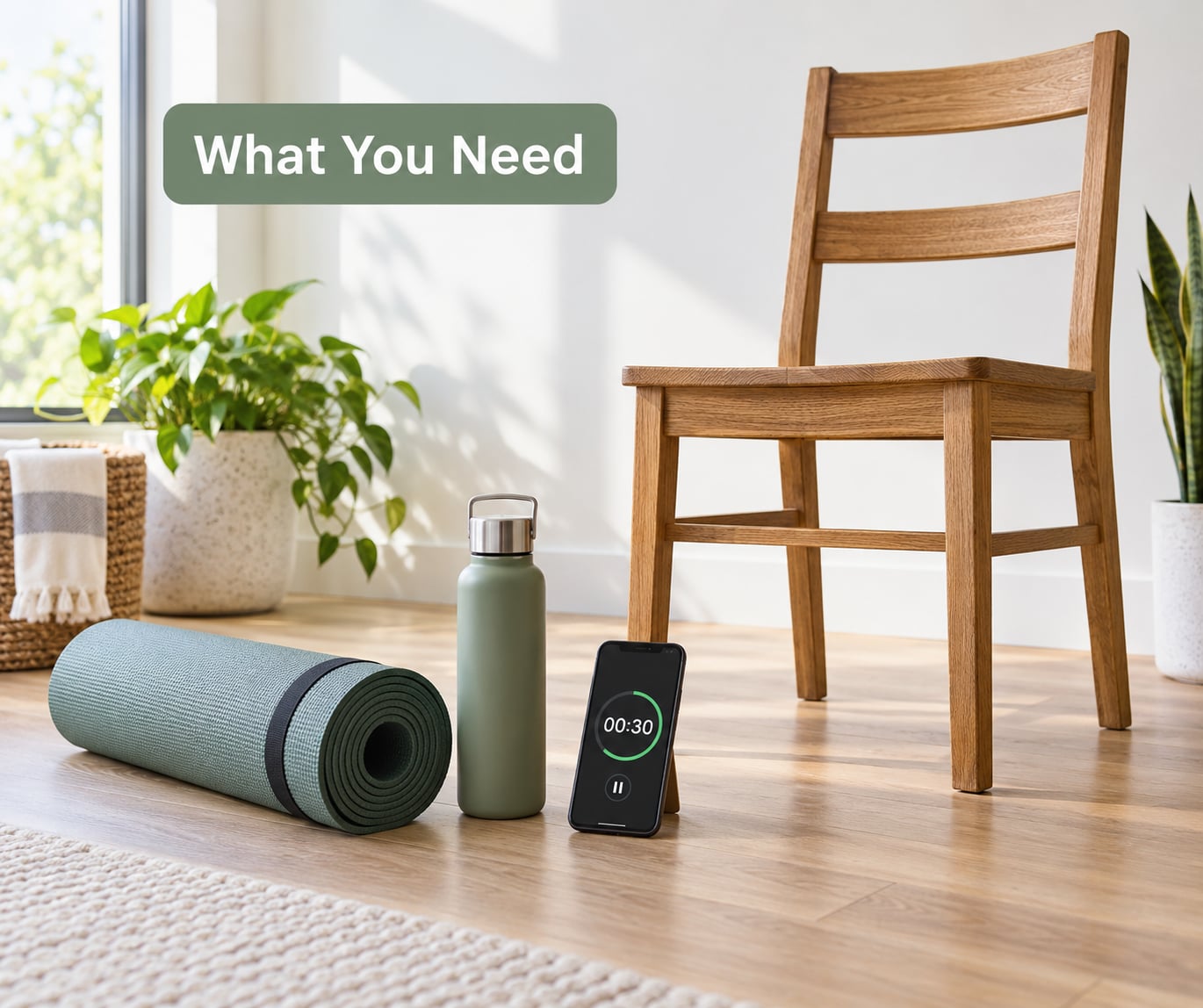
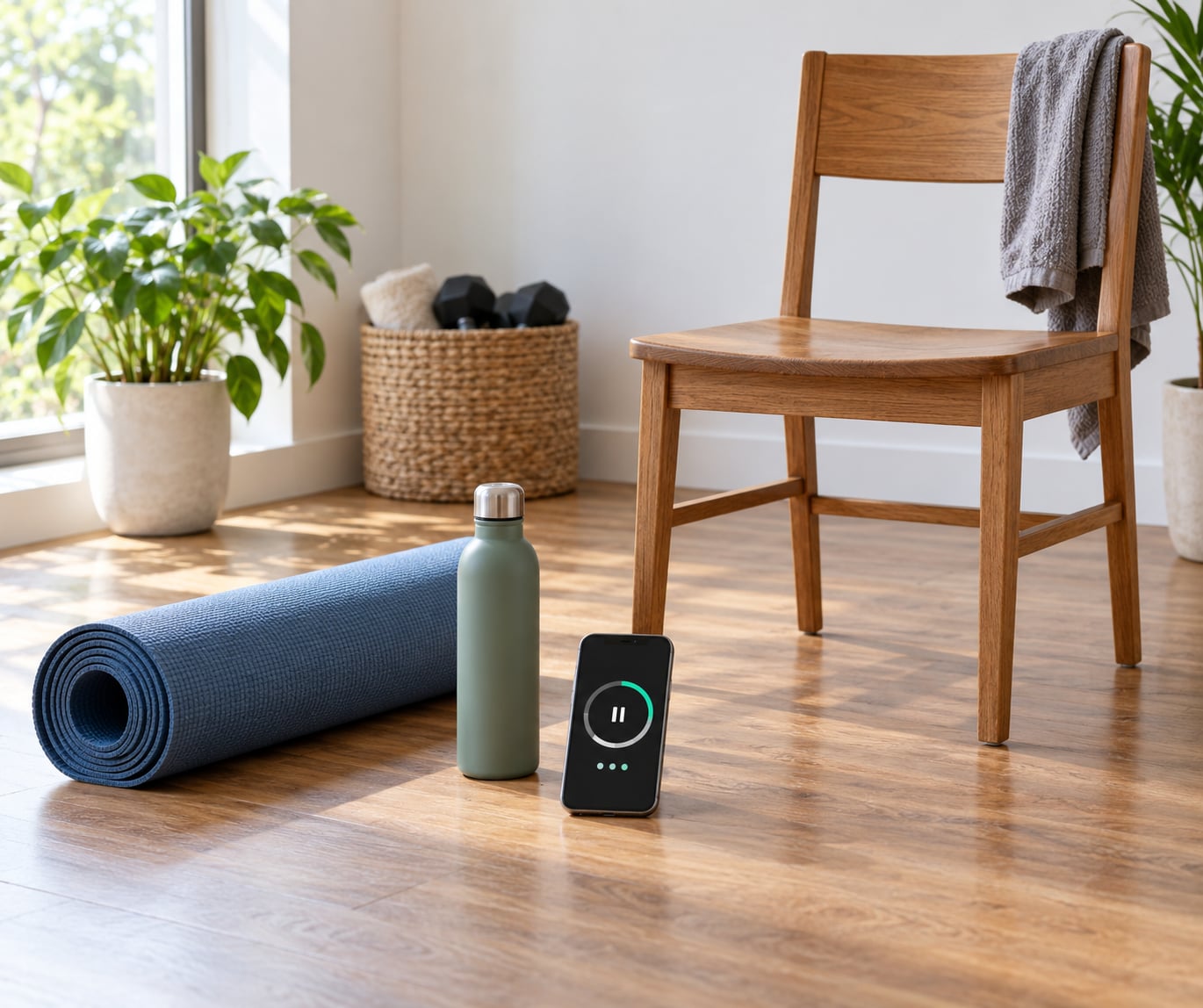
You need almost nothing, which is the whole appeal. A non-slip surface such as a yoga mat, carpet, or wooden floor is enough, plus a water bottle and a timer. A phone app or a kitchen timer handles the intervals more reliably than your own counting, because you cannot count accurately while gasping.
Clear roughly six feet by six feet, or about three arm lengths in every direction. That is enough for jumps, lunges, and floor work. If your ceiling is low or you have downstairs neighbours, add a rug or a foam pad under the landing area and pick the quiet swaps listed further down.
Optional household items earn their keep. A sturdy chair with no wheels handles inclined push-ups and step-ups, and a couch cushions a beginner’s range of motion during lunges. Skip anything that wobbles, and skip resistance bands until the bodyweight version feels easy.
One safety note before you start. If you have a heart condition, high blood pressure, a joint injury, are pregnant, or have been inactive for a long time and feel unsure, talk to a doctor or other qualified healthcare professional before starting intervals, and ask whether the low-impact version is the right entry point. The guidance here is general information, not personal medical advice.
How to Do a HIIT Workout at Home: Step by Step
How to Do a HIIT Workout at Home: Warm Up First
Spend four to five minutes moving before anything hard. March in place for 60 seconds, then add arm circles, forward and backward leg swings, hip circles, and ten bodyweight squats. Finish with a few cat-cow rounds on all fours if you have the space.
The point is to raise your temperature and get blood moving through the joints you are about to use. Skipping it does not make you faster; it makes the first interval feel far worse than the workout deserved, and that is how beginners convince themselves they hate HIIT.
Choosing Your Interval Format
Pick one format and repeat it exactly. The talk test is your gauge: during the work interval you should be able to say four or five words and nothing more comfortably. If you are holding a full conversation, add more effort; if you cannot get a sentence out, ease back.
| Fitness level | Work | Rest | Rounds |
|---|---|---|---|
| Brand new or returning after a break | 20 sec | 40 sec | 3 |
| Beginner, comfortable with bodyweight | 30 sec | 30 sec | 4 |
| Intermediate | 40 sec | 20 sec | 5 |
| Advanced | 45 sec | 15 sec | 6 |
Begin somewhere in that table that feels slightly uncomfortable, not maximally hard. When every round of the circuit finishes and your breathing settles within a minute of rest, you are ready for the next row up. That is how you progress the work-to-rest ratio: shorten the rest before you lengthen the work.
Performing the Beginner Circuit
Run six movements in order for the length of one interval, then rest. Repeat for the number of rounds you chose, resting 60 seconds between rounds.
- Bodyweight squat: Feet shoulder-width, hips back, chest up, knees tracking over the toes. Modification: sit to the edge of a chair and stand up. Form check: your heels stay down and your lower back stays neutral.
- Modified push-up: Hands wider than shoulders, body in one line, chest toward the floor. Modification: hands on a counter or sofa. Form check: elbows at roughly 45 degrees, no sagging hips.
- Reverse lunge: Step back, drop the back knee toward the floor, push through the front heel. Modification: hold a wall for balance. Form check: the front knee stays over the middle of the foot.
- Standing knee drive: Standing tall, drive one knee to hip height, alternate sides. Modification: hold a chair and lift the knee without leaning back. Form check: shoulders stay level and quiet.
- Plank shoulder tap: Forearms on the floor, body straight, tap one shoulder at a time. Modification: hands on a chair seat. Form check: hips do not rotate or lift when you tap.
- Glute bridge: Lie on your back, feet flat and close to your hips, lift until shoulders, hips, and knees form a line. Modification: shorten the hold or lift one leg at a time. Form check: the squeeze comes from the glutes, not the lower back.
| Block | Time | What happens |
|---|---|---|
| Warm-up | 4-5 min | Marching, arm circles, leg swings, hip circles, 10 squats |
| Circuit | 6 moves x 4 rounds | 30 sec work, 30 sec rest; 60 sec rest between rounds |
| Cool-down | 3-5 min | Walk, breathe, gentle stretches |
If your downstairs neighbours exist, most of that circuit survives quietly once you swap the moves. Replace anything jumpy with a step-in-place instead of a jump, a slow mountain climber from a plank instead of a fast one, and a knee drive with a slow controlled lift. You lose a little impact but you keep the interval structure, and structure is what counts.
Cooling Down and Record Your Results
Walk around for two minutes until your breathing returns to normal. Then take three slow breaths with a long exhale, roll your shoulders back, and hold a quad stretch, a hamstring stretch, and a hip stretch for about 20 seconds each. Stay inside a comfortable range and never bounce or force a stretch.
Then write five things down: the date, your interval format, how many rounds you completed, your effort on a 1 to 10 scale, and any discomfort you felt. That log is how you improve gradually rather than cranking the intensity every session because the last one went fast. Most people need weeks, not days, to get meaningfully fitter.
Common Mistakes
- Skipping the warm-up. Fix it with four minutes of marching and dynamic movement. It is the cheapest part of the session and the one that most reduces how awful interval one feels.
- Starting at maximum effort. Fix it by doing round one at about 70 percent. You cannot sustain all-out effort for four rounds if you have never done intervals, and burning out in round one means quitting in round three.
- Letting form collapse late. Fix it by scaling down mid-workout the moment your last two reps look wrong: shorter range, slower tempo, or a chair version. Cutting the range keeps the round, wrecking your form does not.
- Choosing moves above your level. Fix it by testing every movement during the warm-up. If you cannot do eight good repetitions of something, use the modification for the whole session.
- Confusing discomfort with pain. Fix it by learning the difference. Burning legs and a fast heartbeat are expected; sharp joint pain, chest pain, or anything that lingers is a stop signal.
- Having no recovery plan. Fix it by scheduling two or three HIIT sessions a week with easy walking or mobility days between them. Near-maximal intervals need recovery time, which is why back-to-back maximum-effort sessions tend to stall people.
- Progressing everything at once. Fix it by changing one variable per week: rounds first, then interval length, then exercise selection. Adding all three at the same time is how people injure themselves in the first month.
A simple four-week ramp for a beginner: week one is the 20/40 format for three rounds, week two moves to 30/30 for three rounds, week three adds a fourth round, and week four repeats that same circuit aiming for a solid effort. Once round four feels manageable, you are ready for the intermediate row in the table above.
Frequently Asked Questions
How long should a home HIIT workout last?
For a beginner, 15 to 20 minutes of actual work is plenty, and 10 minutes still counts. Add 4 to 5 minutes of warm-up and 3 to 5 minutes of cool-down for a complete session. Longer is not automatically better, because the last rounds are usually where form breaks down. Stop while you can still control the movement.
Is it safe to do HIIT every day?
Most people should not do true near-maximal intervals every day. Two or three sessions a week with recovery days in between is the widely recommended approach, and the recovery is what lets you work hard in each session. If you want daily movement, make the other days easy walks or mobility work rather than more intervals.
Can I do a HIIT workout at home with no equipment?
Yes, and bodyweight work is the standard version. Squats, push-ups, lunges, glute bridges, and mountain climbers need nothing but floor space and a timer. A sturdy chair is useful for inclined push-ups and assisted squats, but it is optional. Household items work as long as they are stable and will not slide.
How do I modify HIIT exercises for beginners?
Shorten the work interval and lengthen the rest first; that changes the intensity without changing the movements. You can also reduce range of motion, slow the tempo, or use a support like a wall or chair. Test every movement during the warm-up, and use the easier version for the whole session rather than switching mid-round.
How do I make HIIT quiet enough for an apartment?
Swap every jumping movement for a stepping or slow controlled version: step in place instead of jumping jacks, a slow plank mountain climber instead of a fast one, and a lifted knee instead of a hop. Add a rug or foam pad to cushion landings. The interval timing stays exactly the same, so you lose impact but not the workout.
What are the signs I should stop exercising?
Stop immediately for chest pain, severe shortness of breath, dizziness, faintness, or sharp pain in a joint. Stop and rest if your form breaks down repeatedly or your breathing stays ragged well into the recovery interval. Anyone with a heart condition, an injury, or pregnancy should get medical advice before starting, and ask about warning signs specific to them.
Conclusion
Your first session is simple: warm up for five minutes, run one circuit of six bodyweight movements at 30 seconds of work and 30 seconds of rest for three or four rounds, cool down for five minutes, and write down how it felt. That is the whole answer to how to do a HIIT workout at home.
Then repeat. Progress by adding a round, then by trimming the rest, and keep one slower day between hard sessions. Consistency and gradual gains do the work here, and results vary from person to person, so talk to a healthcare professional if you want advice tailored to you.