To find your max heart rate, subtract your age from 220 for a rough starting number, then run a hard all-out effort to measure the real thing. For a 35-year-old, 220 minus age gives 185 bpm. Treat that as a guess, not a fact, because the formula was never peer-reviewed and the average error runs 10 to 12 beats per minute either way.
The three equations most people search for are worth knowing before you do anything else. Each one is a population average, not a measurement of you.
- Fox and Haskell, 1971: 220 minus your age. The classic gym-wall version, with the widest error spread.
- Tanaka, Monahan and Seals, 2001: 208 minus 0.7 times your age. Built from thousands of treadmill tests and steadier across age groups.
- Nes and colleagues, 2013: 211 minus 0.64 times your age. Drawn from the large Norwegian HUNT fitness study.
All three are estimates. Only a graded exercise test in a clinic or a properly run field test tells you where your own ceiling sits.
Table of Contents
- What You Need
- Step-by-Step: How to Find Your Max Heart Rate
- Method 1: Use the 220-Age Formula
- Method 2: Calculate With the 208-Formula
- Method 3: Try a Supervised Step Test
- Common Mistakes
- Frequently Asked Questions
- How accurate is 220 minus age for max heart rate?
- Which max heart rate formula is most accurate?
- Is it healthy to hit your max heart rate?
- Is a heart rate of 170 bad when running?
- Is a heart rate of 200 normal while exercising?
- Do I need to retest my max heart rate every year?
- Conclusion
What You Need
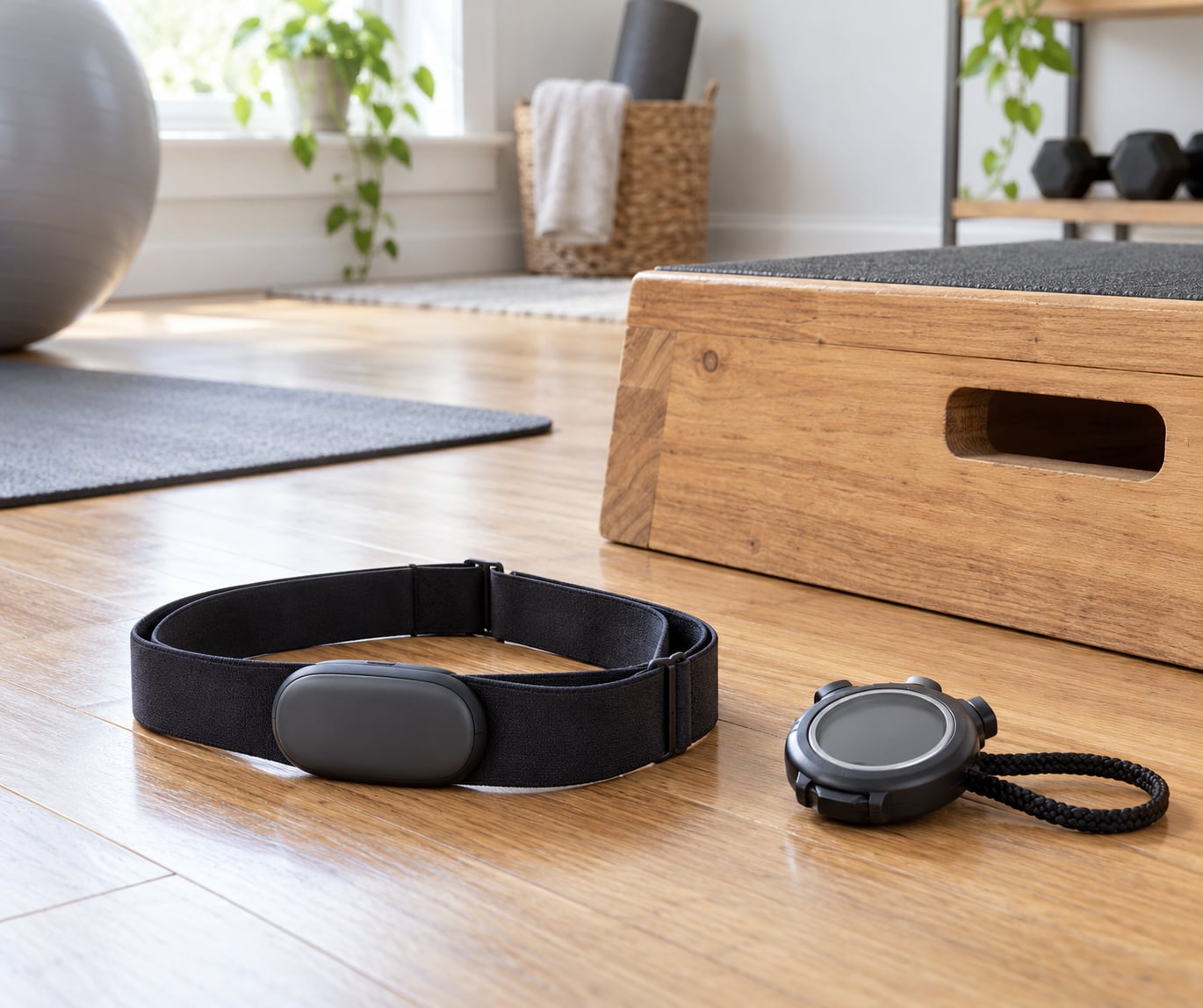
A stopwatch or phone timer, comfortable shoes you have already broken in, and a flat route you know well — a treadmill, track loop, or long straight path with no surprises.
A heart rate monitor helps, and a chest strap is worth the trouble for this one test. Wrist optical sensors tend to lag 30 to 40 bpm on hard efforts and can spike to 180 or above from nothing more than arm swing, so a wrist-only reading during a max test is guesswork. On bicycles.stackexchange.com, cyclists repeatedly report the same pattern: steady readings are decent, all-out readings are not.
Pick a cool day. Heat, dehydration, illness, and a bad night’s sleep all pull your peak down, and you will not get the number back.
Ideally test alongside someone, or at least have someone nearby who knows what you are doing. If you have a heart condition, take medication that affects heart rate, are pregnant, or are returning from an illness, skip self-testing and ask a doctor instead.
Step-by-Step: How to Find Your Max Heart Rate
Start with the cheapest method that fits your situation. The formulas take ten seconds and give you a number you can program into a watch tonight. The field test takes about 30 minutes and gives you a number you can actually trust. A graded exercise test takes an hour in a clinic and settles the question completely.
Method 1: Use the 220-Age Formula
Subtract your age from 220. At 35, that is 220 minus 35, or 185 bpm. At 40, it is 180. That is the entire calculation, and it is why the formula is everywhere.
Here is the part most articles skip. In 2002, researchers Robergs and Landwehr traced the formula back through decades of fitness literature and found no original study behind it. It appeared as a training shortcut, spread by word of mouth and gym posters, and was never validated in a controlled setting. Their analysis put the standard error at roughly 10 to 12 bpm.
Real people land well outside that band in both directions. A Garmin user in r/GarminFenix was lab-tested at 184 bpm max while 220 minus age predicted more than 196. On Quora, a runner with a resting pulse near 42 regularly hits 200 to 210 on hard efforts, so the formula ran far too low. Marathon runners in r/Marathon_Training make the same point: a fine group average, a poor personal one.
Use it if you need a number today and nothing more. Do not build a training week on it without a real number behind it.
Method 2: Calculate With the 208-Formula
The Tanaka equation is 208 minus 0.7 times your age. At 35, that is 208 minus 24.5, so about 184 bpm. Close to the classic formula here, and it diverges more where the classic one struggles: at 60, Tanaka gives 166 against 160, and at 70 it gives 159 against 150.
The Nes equation runs 211 minus 0.64 times your age. At 35 that is about 189 bpm, at 60 about 173, at 70 about 166. It tends to sit a little higher than Tanaka in older age groups, which is why it reads as the better fit for people over 60.
Pick Tanaka as your default estimate and Nes as a sanity check. If the two disagree by more than about 8 bpm, you are in the range where a field test is worth an afternoon.
| Formula | Age 35 | Age 50 | Age 70 | Best fit |
|---|---|---|---|---|
| Fox 1971: 220 – age | 185 | 170 | 150 | Quick general use |
| Tanaka 2001: 208 – 0.7 x age | 184 | 173 | 159 | Most adults, all ages |
| Nes 2013: 211 – 0.64 x age | 189 | 179 | 166 | Older adults |
Method 3: Try a Supervised Step Test
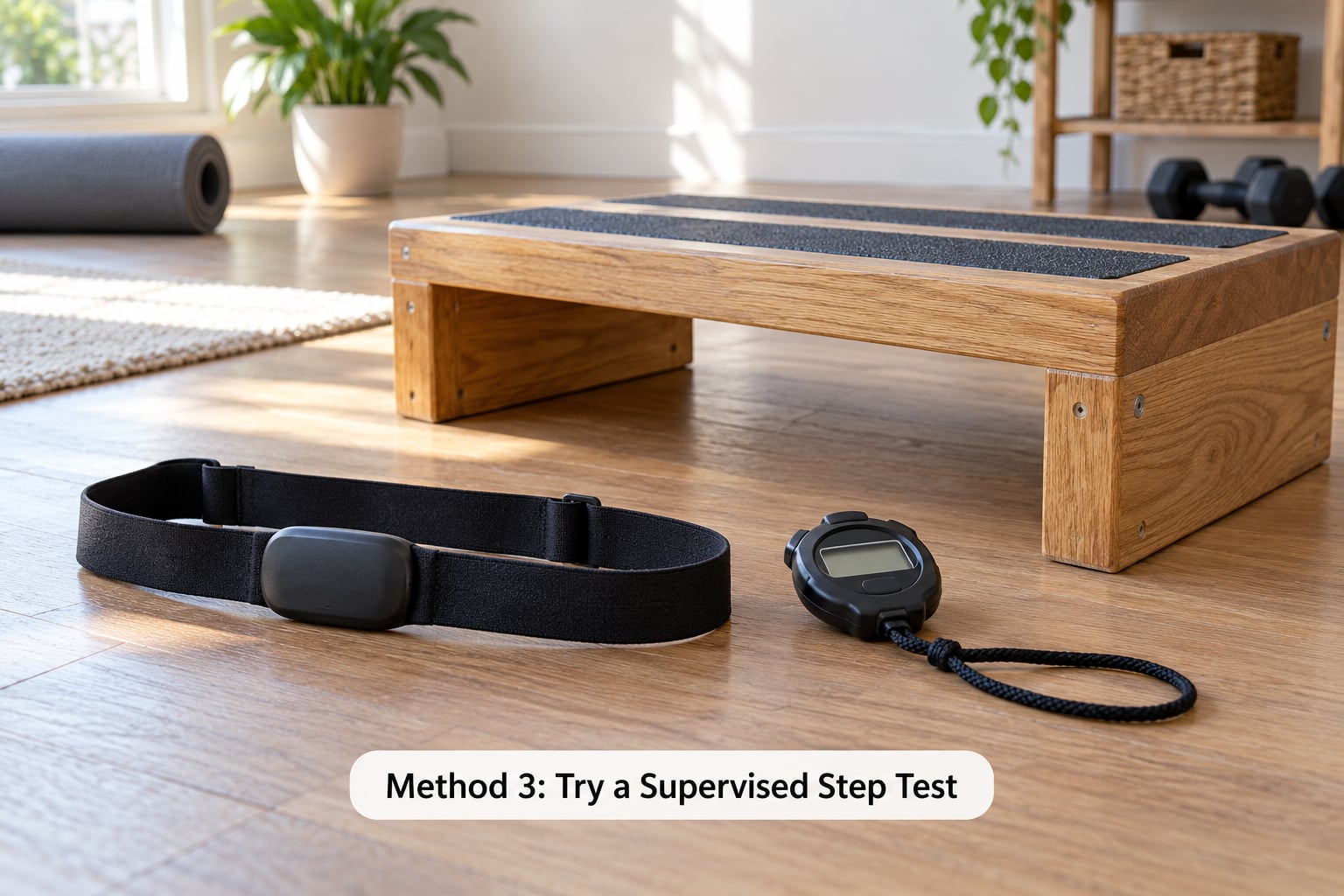
This is a field test: an estimate from your best effort, not a medical test. Everything about it depends on effort quality, so treat the result as your working number and retest it when something changes.
- Warm up for 15 minutes. Easy jog or cycling at a conversational pace. Starting cold produces a lower peak than your actual ceiling.
- Raise your heart rate to a hard effort. Run an 800 m rep as hard as you can hold, or cycle three minutes uphill at near-maximal effort. Aim for something like 90 to 95 percent of what you think your max is.
- Jog or spin easy for two minutes, then repeat the hard effort harder. A second effort slightly above the first is where the true number usually shows up.
- Finish with an all-out 200 m sprint or a fast uphill push. Watch the monitor and record the highest single beat. That is your peak for the session.
- Cool down for at least 10 minutes. Stopping abruptly after a peak is a bad idea.
- Repeat on a second day. If the two peaks land within 2 bpm of each other, you have a number worth using. If they differ more, the later reading is the more honest one.
Stop immediately and skip the repeat if you feel chest pain, unusual breathlessness, light-headedness, or anything that feels wrong. This is general fitness information, not medical advice, and a doctor can tell you whether an all-out effort is appropriate for you.
One more wrinkle from the forums: cyclists often find their cycling max heart rate runs 5 to 15 bpm below their running max, because cycling recruits different muscle mass and the arms are idle. Test the sport you actually train.
If your watch auto-fills max heart rate from 220 minus age, that default is worth overriding. On Garmin, open User Profile, find Heart Rate, and set Maximum Heart Rate manually to your measured value. On Apple Watch or Fitbit, it sits in the Heart Rate section of the app settings. WHOOP takes it in the profile and settings area, and Polar has it under User Settings. Changing it takes under a minute and fixes every zone your device calculates.
Common Mistakes
Treating a formula as a measurement. It is a starting guess with a 10 to 12 bpm error band. If you want a real number, you have to run a real effort or visit a clinic.
Confusing max heart rate with target heart rate. Zone 2 sits near 60 to 70 percent of max. Those are different questions, and a target zone set from an unmeasured max is the most common reason easy sessions feel impossibly hard.
Using a wrist sensor for the peak. Garmin user groups have compared wrist and medical-grade monitors and reported phantom drops and inflated spikes on hard efforts. A chest strap is the fix, and for a max test it is close to mandatory.
Testing on a bad day. Heat, dehydration, illness, poor sleep, and caffeine all cost you beats. If you feel flat, reschedule rather than recording a number you will program into your training.
Pushing without anyone watching. A max test is the hardest effort you will ever do. Do it on a familiar route, in good light, with someone aware of what is happening, and obey the stop rules above.
A few things worth doing regardless of which method you pick: measure your resting heart rate properly for seven mornings before calculating anything, since the Karvonen method depends on it. Skip the sprint if you take beta blockers or other rate-limiting medication. And retest every two to three years, or any time your fitness changes sharply.
Frequently Asked Questions
How accurate is 220 minus age for max heart rate?
Treat it as a rough starting point with an average error of about 10 to 12 beats per minute in either direction. A 2002 analysis by Robergs and Landwehr found no original study behind the equation, so it was never validated. Real measurements commonly land 15 to 30 bpm above or below it, which is why serious training programs measure a max instead of calculating one.
Which max heart rate formula is most accurate?
Tanaka’s 208 minus 0.7 times age is the best all-round estimate, built from thousands of treadmill tests and steadier across age ranges. Nes’s 211 minus 0.64 times age, from the Norwegian HUNT study, fits adults over 60 slightly better. None beats an actual measured maximum, so use a formula to start and a test to finish.
Is it healthy to hit your max heart rate?
For most healthy adults, a brief spike to max during a hard interval is normal and not damaging. What matters is duration, not the single peak beat. If you have a heart condition, take beta blockers or other rate-limiting medication, are pregnant, or are returning from illness, do not self-test. Ask a doctor first, and stop if you feel chest pain, unusual breathlessness, or light-headedness.
Is a heart rate of 170 bad when running?
Not for most people. At 35, 170 bpm sits at about 92 percent of a 185 bpm max, which is normal tempo-to-hard effort territory. For a 55-year-old, the same 170 would be near max, so context is age and fitness, not the number itself. If 170 shows up while you feel like you are walking, that is worth mentioning to a doctor.
Is a heart rate of 200 normal while exercising?
During an all-out sprint, 200 bpm can be entirely normal for an adult in their twenties or thirties, especially with a low resting heart rate. It becomes a problem if it happens at low effort, does not come down within a few minutes of resting, or comes with chest pain or dizziness. Anything persistent deserves a medical opinion.
Do I need to retest my max heart rate every year?
No. Max heart rate drifts down slowly, so retesting every two to three years is plenty for most people. Retest sooner if you have had a long layoff, recovered from illness or injury, started or stopped medication, or your resting heart rate has shifted noticeably. Retest on a different day each time and never on a hot or depleted day.
Conclusion
Start with 208 minus 0.7 times your age, check it against Nes, and enter the result into your watch tonight so your zones are not built on a guess.
Then, if a field test feels appropriate for you, run it on a cool rested day with a chest strap and someone nearby, repeat it a second day, and trust the higher confirmed number. If you want a clinical answer or you have any warning signs, a graded exercise test and a doctor are the right call.