Short answer: calorie labels are useful estimates, not measurements, and the FDA allows a packaged food to differ from its declared number by up to 20 percent. So on the question of how accurate are calorie counts on labels, the honest answer is that most are close enough to guide a choice, and none is exact enough to build a diet around to the single calorie.
I eat lunch at my desk most days with a package of crackers beside me, and the label on that box is the number I actually plan by. What I have never done is pretend it is a measurement of the food in my mouth. Understanding what sits between the printed number and the plate is most of what there is to know about calorie accuracy, and most of the confusion comes down to three things: regulation, arithmetic and serving size.
Last updated for 2026. This is general nutrition information, not medical advice.
Table of Contents
- How Accurate Are Calorie Counts on Food Labels?
- How accurate are calorie counts on labels for packaged snacks?
- Where labels are at their weakest
- What Does Calorie Label Accuracy Mean?
- How Do Companies Calculate Calories on Food Labels?
- Why do almost all calorie counts end in 0 or 5?
- Why Can the Same Product Vary From Label to Label?
- Serving size distortion is the big one
- Ingredients that move without appearing
- Foods where the same product genuinely differs
- One number that is yours alone
- How Can You Check the Calories in a Real Portion?
- Which tracking method is worth the effort?
- What Does Calorie Accuracy Mean for Weight Loss?
- Frequently Asked Questions
- Is 300 kcal the same as 300 calories?
- What does the 4/4/9 rule mean, and is it accurate?
- What should I do if I think a nutrition label is wrong?
- Are restaurant calorie counts accurate?
- Do small calorie counting errors affect weight loss results?
- Conclusion
How Accurate Are Calorie Counts on Food Labels?
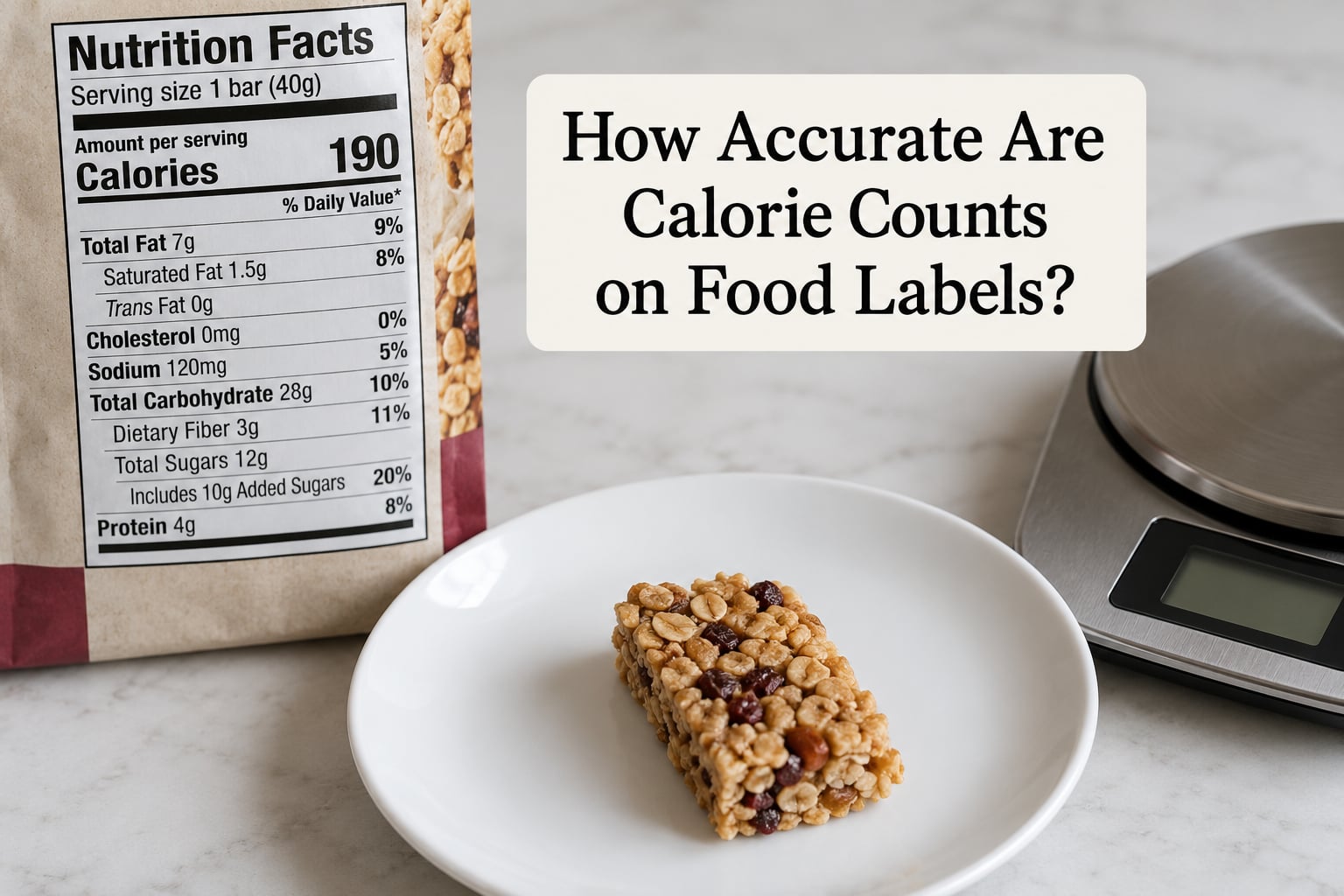
Within their legal limit, packaged-food calorie counts are accurate enough for normal eating decisions and inaccurate enough to trip you up if you treat them as gospel. The FDA sets a tolerance that lets a 200-calorie product contain as much as 240 calories and still be fully compliant, and lets it come in as low as 160.
Observed error in testing has generally been smaller than that ceiling. The only lab comparison among the current top results, published in 2026 by a company that sells its own tracking app, found packaged labels understated calories by roughly 6 to 9 percent on average. That study covered 50 meals in Ireland, only 30 of which carried a label, and nobody outside the company has checked the results, so treat it as a useful signal rather than a settled figure.
The same tolerance sits on top of a second source of error that has nothing to do with the manufacturer: how much of the package you eat. A bag of crisps with a 150-calorie serving figure is not wrong when you finish the bag. It simply answered a question you did not ask.
How accurate are calorie counts on labels for packaged snacks?
More reliable than most people assume, and more reliable than the same calories in a restaurant meal. Dry, single-ingredient, shelf-stable products such as crackers, cereal or canned goods are dense and uniform, which is the easiest case for a calculation from ingredient data. A packaged snack is your best bet when you want a number you can repeat tomorrow.
Where labels are at their weakest
Prepared and composite foods, where moisture, added cooking fat and recipe variation all move at once. A frozen meal or a jar of sauce is a recipe, and a recipe is only as reliable as whoever entered it. Restaurant food is weaker still, for a documented reason: a 2013 study in JAMA looked at menu calorie listings and found they overstated by about 18 percent on average, with the biggest errors on the largest dishes.
One limitation worth stating plainly. These figures come from regulation, industry testing and nutrition databases. They describe populations, not you, and the error in any individual case can sit outside every average above.
What Does Calorie Label Accuracy Mean?
Accuracy here means the gap between the energy printed on the panel and the energy actually in the food, expressed as a percentage. It does not mean the number matches your body, and it does not describe a whole package unless the panel says so.
Three separate things get tangled together, and untangling them settles most of the doubt about how accurate are calorie counts on labels once you know which of the three you are reading:
Calories per serving. This is the number in the largest type on the panel, and it applies to exactly the serving size printed next to it, usually in grams. If your portion is not that weight, the number does not apply.
Calories per container. Many packages now show both, because a serving size that is smaller than what people eat turns a correct label into a misleading one. Bags of crisps, tubs of ice cream and bottles of salad dressing commonly carry a second figure for the whole package. Multiply the serving figure by the number of servings and you have the container total, or read it straight off the panel when it is there.
Calories in the portion you ate. This is the only figure that matters to your log, and the label almost never states it. It is a calculation: the serving figure multiplied by the ratio of your portion to the listed serving size.
That third one is arithmetic, not inaccuracy. When someone says a label said 200 calories and they ate 400, the label was right and the serving was not what they ate.
How Do Companies Calculate Calories on Food Labels?
Most companies do not burn food in a laboratory to print a number. They calculate it, using nutrient values from reference databases such as USDA FoodData Central and a set of conversion factors developed in the 1880s by the physiologist Wilbur Atwater.
Atwater’s general factors are the famous three: about 4 kilocalories per gram of protein, 4 per gram of carbohydrate and 9 per gram of fat. Multiply each macronutrient on the panel by its factor and you land close to the printed calories. Alcohol runs at roughly 7, and many foods use specific factors instead of the general ones, because fat in olive oil behaves differently from fat in butter and protein in a steak behaves differently from protein in gelatin.
For composite foods the arithmetic is only part of the job. Roughly a fifth of the calories in packaged food come from sugars, fats and alcohols that nobody measures directly, according to a 2012 review in Nutrition Reviews, and those get estimated from ingredient weights and standard tables. Fibre gets its own correction, since some of it is fermented by gut bacteria and does not deliver the full 4 calories per gram. So a label is a chain of estimates, and each link adds a little uncertainty without anyone intending to mislead you.
Laboratories do get involved for some products, and the difference is worth understanding. A bomb calorimeter burns a sample and measures the heat released, which gives gross energy: everything in the food, including the portion your body does not absorb. That is a real measurement of the sample in front of it, but it is a measurement of a sample, not a guarantee about the batch you bought. Nothing is wrong with the number. It just answers a narrower question than shoppers assume.
Why do almost all calorie counts end in 0 or 5?
Because FDA rules round the components before they add them up. Calories from fat and carbohydrate are rounded to the nearest 5 below 50, and to the nearest 10 at 50 and above; calories from protein round to the nearest 10. Every part of the printed total is therefore a multiple of 5 or 10, which is why you will rarely see 137 or 242 on a package. It is a formatting rule, not tampering.
The rounding does add a real if small bias. A label that should read 141 prints 140, and one that should read 146 prints 150, so small numbers drift in both directions. It is rarely more than a couple of calories and it is not where meaningful error comes from.
Why Can the Same Product Vary From Label to Label?
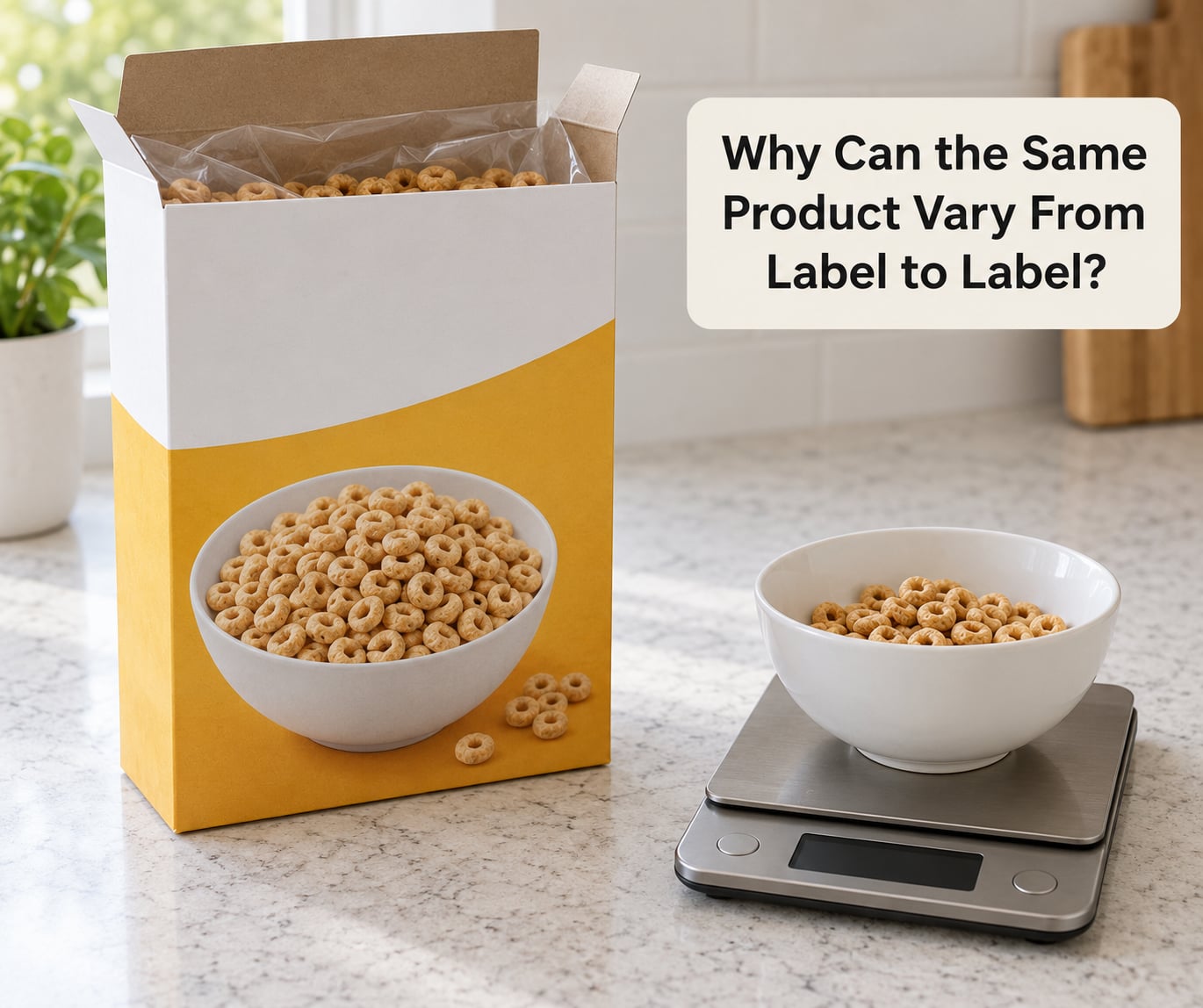
Because the number describes a defined quantity of a defined recipe, and the food in your kitchen is neither perfectly defined nor perfectly repeated. Here is where the gap comes from, roughly ranked by how much it moves the number you actually log.
| Source of error | Typical size | Which direction it goes |
|---|---|---|
| Serving size eaten differs from the printed serving | Can double the logged calories | Usually upward |
| Added oil, butter or sauce not counted at home or on a menu | 80 to 200 calories per meal | Upward |
| Recipe variation between production batches and database entries | A few percent | Either direction |
| Unmeasured sugars, fats and alcohols | Small, spread across the whole diet | Usually upward |
| Moisture and density changes, especially in dried foods | A few percent | Either direction |
| Regulatory rounding of each macronutrient | 1 to 5 calories | Either direction |
Serving size distortion is the big one
The most common complaint about labels, and the one that has a number attached: across packaged foods, the printed serving is often smaller than what an average person eats in one sitting. That is not a lie on the panel. It is a mismatch between the serving the manufacturer chose to make the nutrients work out and the portion you finished.
This is why so many packages now print two columns. If a package holds a large share of a day’s nutrition, the panel gives calories for one serving and for the whole container side by side, so nobody has to guess.
Ingredients that move without appearing
A tablespoon of oil is around 120 calories and occupies no visible space in a pan. The same is true of butter on bread, dressing on a salad and the sugar in a tomato sauce. Home-cooked meals have no panel at all, so any database figure for a pasta dish or a stir-fry is a generic template, not your dinner.
Foods where the same product genuinely differs
Crackers and cereal vary a little because of moisture and density, which is why a bag weighs more or less than the grams on the panel imply. Nut spreads vary with how much oil sits between the nuts. Anything with a filling, a drizzle or a topping changes from batch to batch by enough that two packages of the same product can differ noticeably. Restaurants hide the same variation behind a number that looks like a measurement.
One number that is yours alone
Even a perfectly accurate label does not describe how much energy you absorb. Digestibility differs between people, fibre changes how much energy reaches you at all, and the mix of bacteria in your gut shifts what gets fermented and what does not. On top of that, the amount of energy you burn varies with body size, sex, age and how much you move in a day. For that reason, energy labels are officially labelled metabolizable energy: an average for people, not a reading on your body.
How Can You Check the Calories in a Real Portion?
You do it in five steps, and step one does most of the work.
1. Read the serving size in grams, not just the calorie number. It is printed under Calories per serving, and it is the part most people skip.
2. Compare that weight with what you plan to eat. If the serving is 30 g and the portion in front of you looks like 45 g, your calories are one and a half times the printed figure. This is a visual estimate and it gets easier with practice.
3. Use the calories per container figure when the package shows one. If you intend to eat the whole thing, the panel has already done the multiplication for you.
4. Weigh what matters with a kitchen scale. A cheap digital scale settles oils, nuts, cheese, dressings and portioned snacks, which are exactly the foods that cause the biggest misses. Weighing a tablespoon of oil removes an entire category of error.
5. Keep a portion reference that does not depend on memory. After a couple of weeks of weighing the same bowl, the same glass or the same handful, you can estimate it well without the scale.
Which tracking method is worth the effort?
No method is exact. What changes is how much effort you spend shrinking the error, and the effort column here is my own judgement rather than a measured figure.
| Method | Where the number comes from | Accuracy in practice | Day-to-day effort |
|---|---|---|---|
| Package label | Manufacturer calculation within FDA tolerance | Good for dry, uniform products | Very low |
| Restaurant menu count | Restaurant estimate, audited by local rules in many places | Often overstated, largest on big dishes | Very low |
| USDA FoodData Central lookup | Analysed or calculated values for raw and generic foods | Strong for single ingredients | Low |
| Photo-based tracking app | Image estimate, with its own margin of error | Useful for portions, unreliable for oils and sauces | Low |
| Kitchen scale | Direct weighing of grams | Best available for the effort | Medium |
| Bodyweight calibration | Your own trend on the scales over weeks | Catches everything the food log misses | Low, but slow |
What Does Calorie Accuracy Mean for Weight Loss?
It means the number is good enough for the job as long as you never treat it as the job. An error of 10 percent on a 1,800-calorie day is about 180 extra calories, and over a week that is roughly 1,260 calories that never appeared in your log. Small, repeated and one-directional errors are the ones that matter, and a systematic understatement in packaged food is exactly that shape of error.
Here is the way I use labels. I track packaged food from the panel and weigh everything that hides calories: oil, butter, dressing, cheese, nuts. I hold restaurant meals to one entry for the whole plate rather than estimating three components badly. And I judge the whole approach by the scale, not by how many entries I collected.
That last point is the real calibration tool. Pick a two-week stretch, eat the same general pattern, and weigh yourself every morning under the same conditions. If your trend is flat while your log says you are in a deficit, something is going in that you did not log, and it is usually oil, a drink or a portion that grew. This runs directly against the tracking fatigue many people report, where obsessive counting starts to eat the attention the effort needed.
There is a second reason to hold labels loosely, and it is not about arithmetic. A 2025 report on research into calorie labelling found that seeing calorie information did not help people judge foods more accurately, and instead made them second-guess choices they had made confidently. Treating a number as a rough guide is both more accurate and easier to live with.
If you are counting calories for a medical reason rather than a general one, that is a different job with a different tolerance for error. A doctor or a registered dietitian can set a target and tell you which foods need weighing precisely. If you have a condition such as diabetes, kidney disease or an eating disorder history, get that guidance before you start counting anything.
Frequently Asked Questions
Is 300 kcal the same as 300 calories?
Yes. Nutrition labels use kilocalories, written kcal, and one kilocalorie equals 1,000 small calories. So a package reading 300 kcal contains 300 kilocalories, which is the figure everybody means when they say 300 calories. The confusion comes from the word itself: the scientific calorie is the amount of energy needed to raise one gram of water by one degree Celsius, which is a very small amount, and the two words have been used loosely for a century.
What does the 4/4/9 rule mean, and is it accurate?
The 4/4/9 rule uses 4 calories per gram of protein, 4 per gram of carbohydrate and 9 per gram of fat. Multiply each macronutrient on a label by its number and you get a total close to the printed calories. It is a fast estimate, not a measurement. For dry, uniform foods it is close. For foods with fibre, alcohol or mixed fats it drifts, because some energy never reaches you and some components do not follow the general factor.
What should I do if I think a nutrition label is wrong?
Compare the macros on the panel with the calories using the 4/4/9 rule. If they land far apart, check that the serving weight matches what you actually ate, since that solves most apparent errors. Then check the same food against a USDA FoodData Central entry to see whether one source agrees with the other. If a genuinely miscalculated label seems serious, you can report it to the FDA or to your state food safety agency.
Are restaurant calorie counts accurate?
Less so than packaged ones. Menu calorie figures are estimates supplied by the restaurant rather than tested for each plate, and a 2013 study in JAMA found they overstated calories by about 18 percent on average, with the largest shortfalls on the biggest dishes. Cooking oil, butter and sauce are added after the recipe is calculated. If a restaurant publishes a calorie count, read it as a floor rather than a fact.
Do small calorie counting errors affect weight loss results?
A single error of 20 or 30 calories changes nothing. Errors matter because they repeat in the same direction across a whole diet, and a 10 percent understatement on packaged food can add well over a hundred calories a day without you noticing. The practical fix is not perfect counting. It is weighing oily ingredients, keeping portions consistent and checking your progress against the bathroom scale every couple of weeks.
Conclusion
So how accurate are calorie counts on labels? They are calculated estimates with a legal tolerance of up to 20 percent, and in practice most land within a much tighter band than that. They are dependable enough to compare two products, and they are not precise enough to be treated as a measurement.
So here is the one thing to do first. Open the next package you pick up, find the serving size in grams, and weigh or eyeball what you are about to eat against it. Most of the distance between the printed number and your real intake is hiding in that one line, not in any lab result.