If you only remember one number from this guide, make it this: how long should cardio be for fat loss is best answered in weekly minutes, not a single perfect session length. Most healthy adults do well with 150 to 300 minutes of moderate-intensity cardio a week, or 75 to 150 minutes of vigorous work, spread across sessions of 20 to 60 minutes. The calorie deficit you hold over months does the actual work.
The trap is chasing one number for a reason. Twenty minutes feels too short to count, ninety feels like discipline. Both are arbitrary. What moves the scale is a routine you can repeat on a bad week, and food choices that keep you in a mild deficit.
This guide covers session length, intensity, weekly frequency, timing around strength training, and the signs you are doing too much. It is general information, not personal medical advice. If you have heart disease, joint problems, diabetes, or are recovering from an injury, talk to your doctor or a registered dietitian before changing your activity level.
Table of Contents
- How Long Should Cardio Be for Fat Loss?
- Cardio Duration at a Glance
- What Intensity Should Cardio Be for Fat Loss?
- How Many Days a Week Should You Do Cardio?
- Does Walking Count as Cardio for Fat Loss?
- Should You Do Cardio Before or After Strength Training?
- How to Use Cardio for Fat Loss Without Overtraining
- Frequently Asked Questions
- Is 20 minutes of cardio enough for fat loss?
- Will 30 minutes of cardio burn fat?
- How much cardio per week do I need to lose fat?
- Does cardio burn belly fat?
- Can I do cardio every single day?
- How do I know if I am overdoing cardio?
- Conclusion
How Long Should Cardio Be for Fat Loss?
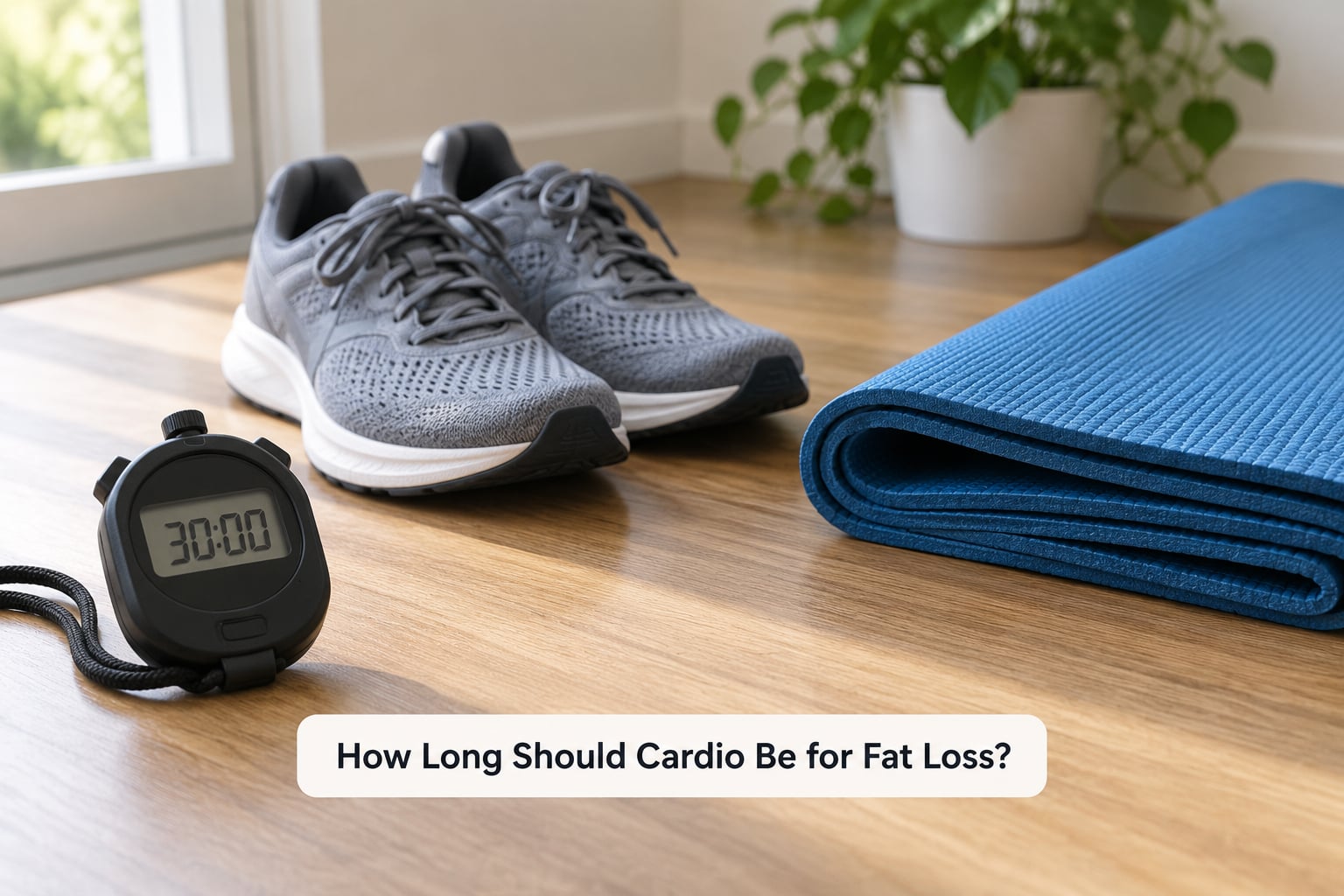
There is no single ideal length. A 25-minute brisk walk three times a week and a 45-minute jog twice a week can produce the same result, because what matters is total weekly volume, intensity and consistency.
For most beginners, 20 to 30 minutes of moderate cardio per session is a solid start. From there, work toward 30 to 45 minutes, or keep sessions shorter and do more of them. Three 20-minute sessions beat one painful 60-minute session for anyone who hates long workouts, and adherence is where most plans quietly fail.
Longer sessions burn more calories while you are in them. They do not reliably produce more fat loss over a month, because most people eat back some or all of the difference, and because very long steady-state work can eat into recovery and lean mass.
Cardio Duration at a Glance
| Session type | Minutes per session | Weekly target | What it feels like | Watch out for |
|---|---|---|---|---|
| Light movement | 10 to 20 | Any amount helps | Easy talking, warm-up pace | May not move body composition much on its own |
| Moderate steady state | 30 to 60 | 150 to 300 minutes | Can talk in full sentences, cannot sing | Very long sessions on low calories leave you flat |
| Brisk walking or cycling | 30 to 45 | 150 to 300 minutes | Breathing faster, short phrases only | Overheating indoors, knee tweak on hills |
| Vigorous cardio | 20 to 30 | 75 to 150 minutes | A few words at a time | Needs recovery days around lifting |
| HIIT intervals | 15 to 20 | 2 to 3 sessions | Hard pushes with short rests | Too much too soon for beginners and joints |
Ten-minute bouts are useful. Research on accumulated activity shows that short sessions spread through the day add up, which makes them a good fit for people who struggle to carve out an hour.
Here is how the weekly guidelines break down. Moderate work is 150 to 300 minutes a week for adults, and vigorous work is 75 to 150 minutes. Those figures come from the Physical Activity Guidelines for Americans and are repeated by the American Heart Association, and they are health targets first. Fat loss usually needs more than the minimum when calories are not already under control.
One rough way to think about burn rates, without trusting a machine: moderate walking sits near 3 to 4 METs, moderate cycling and jogging higher, and vigorous work well above that. Multiply METs by your bodyweight in kilograms and by the hours you spend moving, and you get a usable estimate for a week of sessions. Treat it as a rough guide rather than a target, because the readout on a treadmill or watch commonly runs high.
What Intensity Should Cardio Be for Fat Loss?
Moderate intensity is the sweet spot for most people losing fat, because you can sustain it for a full session and recover from it.
The talk test beats any calculator. If you can speak in complete sentences without gasping, you are in a moderate range. If you are down to a few words at a time, that is vigorous. Beginners often overestimate their moderate and underestimate their vigorous, so test it honestly rather than guessing.
On the heart-rate side, the standard estimate for maximum heart rate is 220 minus your age. Zone 2, where fat oxidation is highest, sits around 60 to 70 percent of that number. The Karvonen method uses your resting heart rate instead and gives a tighter range. Neither is exact, so treat the number as a guide and let the talk test break the tie.
Fat is used as fuel from the first minute of cardio. The idea that nothing counts until minute 20 is a myth that keeps people doing workouts they resent. What is true is that longer sessions at low intensity draw a larger share of energy from fat, while short high-intensity work burns more total calories per minute and keeps burning some extra afterward.
For that reason, both styles have a place. Sessions over about an hour at a steady pace have diminishing returns for fat loss specifically. If you love a 90-minute bike ride, do it, and just do not expect it to outpace three shorter sessions in the same week.
How Many Days a Week Should You Do Cardio?
Three to five days of dedicated cardio is the practical range for fat loss, and it lines up neatly with most people’s schedules.
Daily movement and formal cardio sessions are not the same thing. Ten thousand steps spread across a workday counts. What builds your fitness and burns meaningful calories is the deliberate session on top of it, the one where you pick an intensity on purpose.
Three sample weeks, depending on your week rather than your goal:
- Beginner: 3 sessions of 25 minutes of brisk walking, 75 minutes total, plus two 20-minute strength workouts.
- Intermediate: 2 sessions of 40 minutes of moderate cycling and 1 session of 20 minutes of intervals, 100 minutes total, plus three lifting days.
- Time-crunched: 4 sessions of 20 minutes mixed between walking and rowing, 80 minutes total, done before breakfast or straight after work.
All three work, assuming the food side is handled. The one that survives month five is usually the time-crunched version, because it fits.
If you lift weights two or three days a week, put your cardio on the other days and add a short session where it fits. That spacing is what lets your legs and heart recover while keeping your weekly total climbing.
Does Walking Count as Cardio for Fat Loss?
Yes. Walking is cardio, and it is the easiest entry point for beginners, people over 40, and anyone whose knees or back object to bouncing.
A relaxed neighborhood stroll at a comfortable pace is light movement. Brisk walking, where you can talk but not sing, lands squarely in the moderate range that guidelines count. Thirty to 45 minutes of that, most days, adds up fast.
To progress, change one thing at a time: add five minutes, or walk faster over the same distance, or pick a route with some incline. Adding all three at once usually ends with a shin splint or a sore knee you did not plan for.
If you have never done structured training, a couple of sessions a week of light dumbbell or bodyweight work alongside your walking is enough to start. That pairing keeps you building muscle while you build the aerobic habit, which is what protects your metabolism during a calorie deficit.
Should You Do Cardio Before or After Strength Training?
Do strength work first if building muscle or getting stronger is your main goal, and put cardio after or on a separate day.
That order protects your heaviest lifts. Thirty-plus minutes of running or cycling before the gym raises fatigue and lowers the number of reps you can do on squats or presses. A ten-minute warm-up on a bike is a different story entirely, and that is fine before training.
The reverse case is your energy level. Plenty of people show up for a session tired, decide the run will wake them up, then feel worse afterward. That pattern is worth naming. If the treadmill consistently drains you, move it to its own slot.
One practical rule from the lifting community: keep total cardio time to roughly half the time you spend lifting, or less. If you train four hours a week and add six hours of cardio, you have made cardio your main program and the lifting an accessory.
Interval work after weights is common and generally fine, especially for 15 to 20 minutes of full-body intervals. On a leg day, keep it low impact.
How to Use Cardio for Fat Loss Without Overtraining
Progression, not punishment, is what makes cardio work. Start where you can finish feeling like you could have done more.
A four-week beginner ramp looks like this: week one, two sessions of 15 to 20 minutes at an easy-to-moderate pace. Week two, three sessions of the same length, or the same two sessions five minutes longer. Week three, add a fifth or sixth minute per session. Week four, hold there and reassess before adding anything.
Add time before intensity, almost always. Bumping a comfortable 30-minute session to 40 minutes is a small change your joints and lungs absorb easily. Going from 30 minutes at a talk-test pace to 30 minutes of all-out intervals is a completely different demand.
Watch for these overtraining signals: your resting heart rate climbing week over week, sleep getting worse, irritability, constant hunger, and motivation that drains before you start. Persistent fatigue plus a falling resting heart rate usually means schedule a lighter week.
On the nutrition side, cardio burns more when you are properly fueled, and under-eating plus long sessions is a reliable path to losing strength and feeling tired. Build meals around protein, vegetables and fiber rather than cutting food to make the session count for more.
That advice sits inside a general guidance package: information only, no prescriptions. Talk to a doctor before starting if you have chest pain, unexplained breathlessness, a history of heart conditions or recent surgery, and stop exercising and get care for pain, dizziness or chest discomfort during a session.
Two more honest notes. Treadmill and watch calorie readouts overstate the burn, and fitness forums report figures 30 to 50 percent above what people actually use. Treat those numbers as loose estimates and track your own trend instead.
Frequently Asked Questions
Is 20 minutes of cardio enough for fat loss?
Yes, especially when it happens most days of the week. Twenty minutes of moderate work is a complete session, not a warm-up, and fat is used as fuel from the first minute. Three or four 20-minute sessions can add up to 90 to 150 minutes of weekly cardio, which sits at the lower end of the 150 to 300 minute guideline.
Will 30 minutes of cardio burn fat?
It burns calories, and some of those come from fat, but fat loss only happens when your weekly calorie burn exceeds your weekly calorie intake. Thirty minutes is a solid single session for most people. Doing it three to five times a week, alongside a modest food deficit, gives you a realistic chance of seeing results over several months.
How much cardio per week do I need to lose fat?
The Physical Activity Guidelines for Americans and the American Heart Association suggest 150 to 300 minutes of moderate cardio or 75 to 150 minutes of vigorous cardio each week for general health. For fat loss you often need more than that minimum, because food intake usually cancels out a small amount of exercise on its own.
Does cardio burn belly fat?
No. Cardio reduces total body fat, and the body decides the order in which that fat comes off. You cannot choose the spot. Belly fat often changes later than weight on the scale, so measure your waist monthly and track photos as well as scale readings for a fairer picture of progress.
Can I do cardio every single day?
Yes, if the sessions are light or moderate and you still recover well. Many people do a short walk daily and longer sessions four or five days. If you are doing an hour of hard work daily and your resting heart rate, sleep or mood are suffering, cut the volume before you push through.
How do I know if I am overdoing cardio?
Watch your resting heart rate, sleep, mood and hunger over two or three weeks. A rising resting heart rate, poor sleep, constant soreness and a drop in your strength numbers all point to too much. Cutting volume for a week usually fixes it. If symptoms persist or you feel short of breath unusually, see a doctor.
Conclusion
Start with one thing: a 20 to 30 minute moderate session, three times this week, at a pace where you can still talk. Do it again next week before you add anything.
Then let the weekly total climb slowly, keep food in a mild deficit, and track your waist and your weight together rather than staring at one number. Adjust when sleep or motivation dips. If you have been wondering how long cardio should be for fat loss, the honest answer is long enough that you keep doing it.