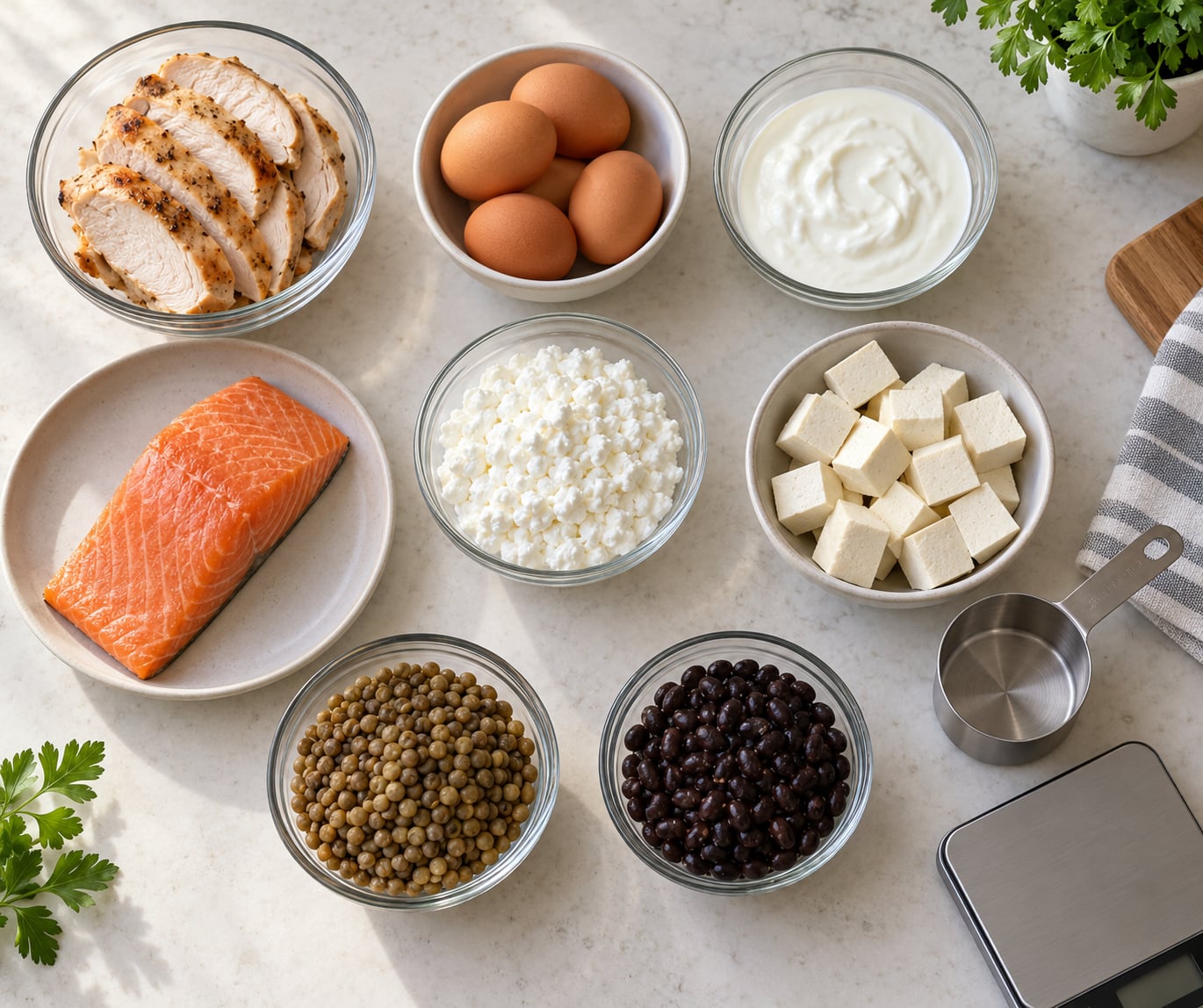
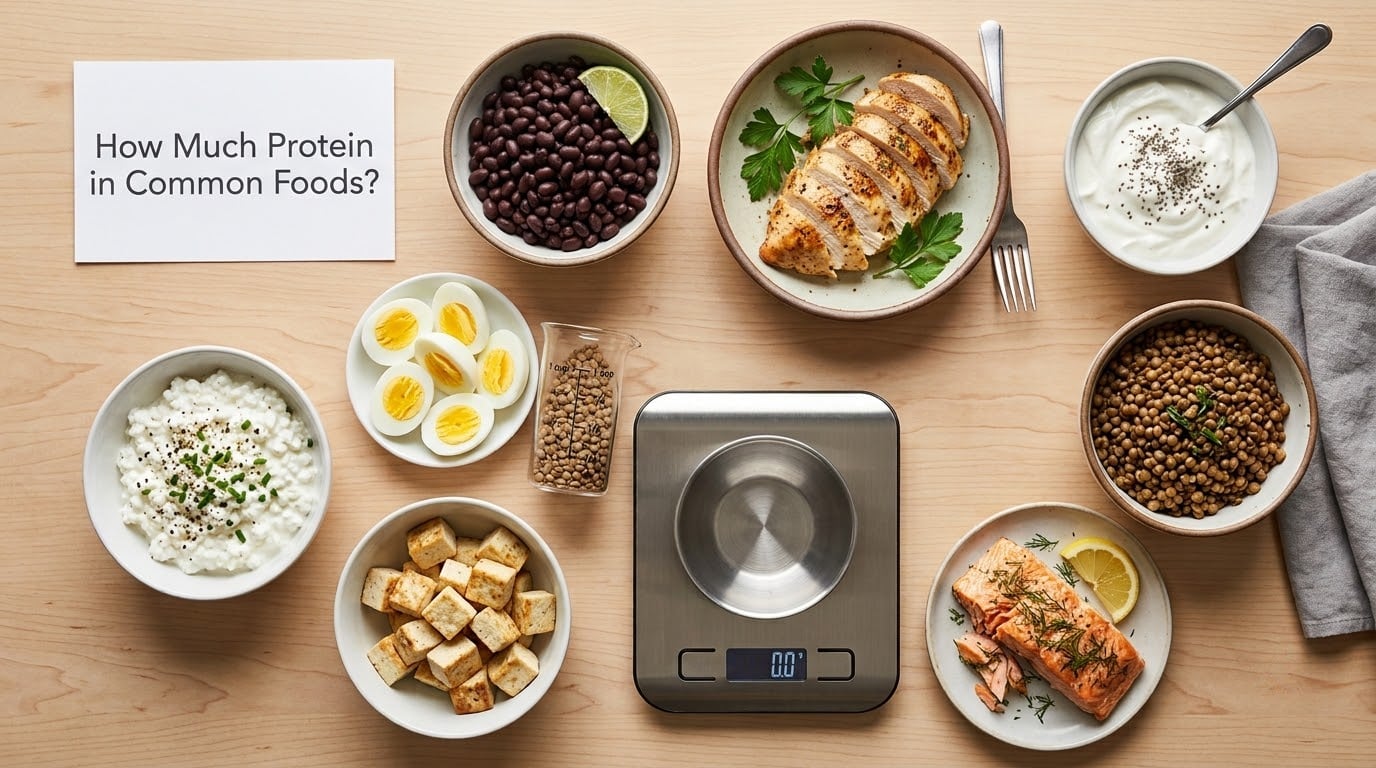
If you are wondering how much protein in common foods is actually in the things you eat, here is the short version: a 3 oz (85 g) cooked serving of chicken breast holds roughly 26 g of protein, a cup of Greek yogurt about 24 g, and a cup of cottage cheese about 28 g. Most people guess these numbers two to three times too high. This chart gives you the real figure for around 50 everyday foods, plus the daily target to aim at.
All gram values below come from USDA FoodData Central reference data. Weights are cooked unless the row says raw, and every number sits next to the serving it was measured against, because a protein number without a serving weight is meaningless.
Table of Contents
- How Much Protein in Common Foods?
- How much protein in common foods at a glance
- What Is a Good Protein Serving?
- How much protein do I need per day?
- Worked example: turning body weight into a target
- Needs change across life stages
- Which Everyday Foods Are Highest in Protein?
- The ten highest-protein everyday servings
- Which foods give you the most protein per 100 calories?
- The budget protein staples
- How Much Protein Is in Eggs, Meat, and Fish?
- Chicken and turkey by cut
- Beef and pork
- Fish and shellfish
- Eggs and egg whites
- How Much Protein Is in Dairy, Nuts, and Seeds?
- Greek yogurt, cottage cheese and regular yogurt
- Milk, cheese and soy milk
- Nuts, seeds and nut butters
- How Much Protein Is in Beans, Grains, and Plant Foods?
- Lentils, beans and peas
- Tofu, tempeh and soy milk
- Quinoa, oats and other grains
- Bread, pasta, rice and potatoes
- Vegetables and fruit
- How Do Portion Size and Cooking Method Change the Amount?
- Scale the number to your portion
- Cooked weight versus raw weight
- What you add changes the total
- Easy Ways to Add More Protein to Your Meals
- Breakfast
- Lunch
- Dinner
- Snacks
- Complete versus incomplete protein
- Building toward bigger daily totals
- Frequently Asked Questions
- How much protein is in a normal serving?
- Which common food has the most protein?
- How much protein should I eat per meal?
- Are eggs or chicken better for protein?
- How can I get more protein without eating meat?
- How do I find the protein content of packaged food?
- Start With One Change
How Much Protein in Common Foods?
How much protein in common foods at a glance
Read the first two columns together. A number only means something once you know how much food it covers, and 3 oz of fish is not the same amount of food as a cup of yogurt.
| Food | Standard serving size | Protein per serving (g) | Protein per 100 g |
|---|---|---|---|
| Chicken breast, roasted | 3 oz (85 g) | 26 g | 31 g |
| Turkey breast, roasted | 3 oz (85 g) | 26 g | 30 g |
| Chicken thigh, roasted | 3 oz (85 g) | 24 g | 28 g |
| Lean beef, 90% ground | 3 oz (85 g) | 22 g | 26 g |
| Pork tenderloin, roasted | 3 oz (85 g) | 22 g | 26 g |
| Salmon, cooked | 3 oz (85 g) | 22 g | 26 g |
| Tuna, canned in water | 3 oz (85 g) | 22 g | 26 g |
| Shrimp, cooked | 3 oz (85 g) | 20 g | 24 g |
| Cod, cooked | 3 oz (85 g) | 17 g | 20 g |
| Canned sardines | 3 oz (85 g) | 22 g | 26 g |
| Large whole egg | 1 egg (50 g) | 6 g | 13 g |
| Large egg white | 1 white (33 g) | 3.6 g | 11 g |
| Greek yogurt, plain nonfat | 1 cup (245 g) | 24 g | 10 g |
| Cottage cheese, low fat | 1 cup (226 g) | 28 g | 12 g |
| Regular yogurt, low fat | 1 cup (245 g) | 12 g | 5 g |
| Cheddar cheese | 1 oz (28 g) | 7 g | 25 g |
| Parmesan cheese | 1 oz (28 g) | 9 g | 33 g |
| Milk, 2% | 1 cup (245 g) | 8 g | 3 g |
| Soy milk, unsweetened | 1 cup (245 g) | 7 g | 3 g |
| Lentils, cooked | 1 cup (198 g) | 18 g | 9 g |
| Chickpeas, cooked | 1 cup (164 g) | 15 g | 9 g |
| Black beans, cooked | 1 cup (172 g) | 15 g | 9 g |
| Edamame, cooked | 1 cup (155 g) | 18 g | 12 g |
| Tofu, firm | 1/2 cup (126 g) | 16 g | 13 g |
| Tempeh | 1/2 cup (84 g) | 20 g | 24 g |
| Peanut butter | 2 tbsp (32 g) | 8 g | 25 g |
| Almonds | 1 oz (28 g) | 6 g | 21 g |
| Walnuts | 1 oz (28 g) | 5 g | 15 g |
| Pumpkin seeds | 1 oz (28 g) | 9 g | 30 g |
| Hemp hearts | 3 tbsp (30 g) | 9 g | 31 g |
| Chia seeds | 1 tbsp (12 g) | 2 g | 17 g |
| Oats, cooked | 1 cup (234 g) | 6 g | 3 g |
| Quinoa, cooked | 1 cup (185 g) | 8 g | 4 g |
| Whole wheat bread | 1 slice (43 g) | 4 g | 13 g |
| Pasta, cooked | 1 cup (140 g) | 5 g | 4 g |
| White rice, cooked | 1 cup (158 g) | 5 g | 3 g |
| Baked potato with skin | 1 medium (173 g) | 5 g | 3 g |
| Protein pasta, dry | 1/2 cup (60 g) | 12 g | 20 g |
| Broccoli, cooked | 1 cup (156 g) | 5 g | 3 g |
| Green peas, cooked | 1 cup (160 g) | 9 g | 6 g |
| Spinach, cooked | 1 cup (180 g) | 5 g | 3 g |
| Mushrooms, raw | 1 cup (70 g) | 2 g | 3 g |
| Apple, medium | 1 apple (182 g) | 1 g | 1 g |
| Banana, medium | 1 banana (118 g) | 1 g | 1 g |
One heuristic covers most of the meat, poultry and fish column: about 7 g of protein per ounce. Three ounces lands you near 21 to 26 g. It is the fastest mental shortcut there is, and it is roughly right across every cut on the chart.
Where a figure varies a lot by brand or cut, treat these as a range rather than a promise. Protein pasta, for example, runs from about 10 g to 14 g per 2 oz dry depending on the blend.
What Is a Good Protein Serving?
A serving of protein is defined by the food, not by a single rule. For meat, fish and cheese it is an ounce or three. For dairy and legumes it is a cup. For nuts, seeds and nut butter it is a small handful or a spoonful.
Per-meal numbers matter more than people expect. Spreading your intake across three or four eating occasions tends to work better than cramming most of it into dinner, which is why a 20 g to 40 g target per meal is the number most dietitians hand out.
How much protein do I need per day?
The recommended dietary allowance is 0.8 g per kilogram of body weight, which works out to about 46 g a day for a 57 kg (125 lb) woman and 56 g for a 70 kg (154 lb) man. Active adults and people who lift weights are usually advised to aim higher, commonly 1.2 to 1.6 g per kilogram.
Worked example: turning body weight into a target
A 75 kg (165 lb) adult working out three or four times a week: 75 multiplied by 1.4 g is 105 g a day. Split across breakfast, lunch, dinner and a snack, that is a target of roughly 25 g per eating occasion. The chart above has more than enough combinations to hit it without a single supplement.
Needs change across life stages
Growing children and teenagers need proportionally more protein per kilogram than adults, and pregnancy raises the target to about 1.1 g per kilogram. Adults over 65 are advised to hold protein steady rather than cut it, because muscle loss accelerates with age and protein is the nutrient that protects it best.
One caution worth stating plainly: if you have kidney disease, liver disease or any condition where protein intake has been restricted, these numbers are general information, not advice for you. Talk to your doctor or a registered dietitian before changing how much you eat.
Which Everyday Foods Are Highest in Protein?
Ranked by a normal serving rather than by weight, cottage cheese, Greek yogurt, chicken breast and turkey breast top the list. A cup of cottage cheese at 28 g beats a 3 oz steak, mostly because dairy packs protein into a smaller, denser volume.
The ten highest-protein everyday servings
| Rank | Food and serving | Protein (g) |
|---|---|---|
| 1 | Cottage cheese, low fat, 1 cup | 28 g |
| 2 | Chicken breast, cooked, 3 oz | 26 g |
| 3 | Turkey breast, cooked, 3 oz | 26 g |
| 4 | Greek yogurt, nonfat, 1 cup | 24 g |
| 5 | Beef, pork or salmon, cooked, 3 oz | 22 g |
| 6 | Tempeh, 1/2 cup | 20 g |
| 7 | Shrimp, cooked, 3 oz | 20 g |
| 8 | Lentils or edamame, cooked, 1 cup | 18 g |
| 9 | Cod, cooked, 3 oz | 17 g |
| 10 | Tofu, firm, 1/2 cup | 16 g |
Which foods give you the most protein per 100 calories?
This is the number that actually matters if you are trying to lose weight and keep muscle. It reframes the whole list, because a 10 g protein snack that costs 300 calories and a 10 g protein snack that costs 90 calories are not remotely equal choices.
| Food | Protein per 100 calories |
|---|---|
| Shrimp, cooked | about 24 g |
| Turkey breast, cooked | about 22 g |
| Tuna, canned in water | about 22 g |
| Egg white | about 21 g |
| Cod, cooked | about 20 g |
| Greek yogurt, nonfat | about 17 g |
| Chicken breast, cooked | about 16 g |
| Cottage cheese, low fat | about 15 g |
| Tofu, firm | about 12 g |
| Salmon, cooked | about 11 g |
| Tempeh | about 11 g |
| Edamame, cooked | about 10 g |
| Whole egg | about 9 g |
| Lentils, cooked | about 8 g |
| Peanut butter | about 4 g |
| Broccoli, cooked | about 3 g |
The gap between the top and bottom of that list is enormous. Lean meat, seafood and egg whites deliver roughly six times more protein per calorie than nut butter, which is why the practical move for weight loss is to build the backbone of the day around the top half of the table and treat the bottom half as extras.
The budget protein staples
Eggs, canned tuna, dried beans and lentils, milk powder and canned sardines are the foods people call poor man’s protein. They are cheap because they last, they are not processed, and per 100 calories they sit near the top of the density list. A pot of lentils cooked at the start of the week does more for a 120 g daily target than most packaged options.
How Much Protein Is in Eggs, Meat, and Fish?
Meat, poultry and fish are the highest-protein-per-calorie foods in the kitchen, and they are all measured against the same 3 oz (85 g) cooked basis so the numbers compare directly. Cooking method barely moves the protein, but it moves the water and fat content a lot.
Chicken and turkey by cut
A roasted chicken breast gives you 26 g per 3 oz, and turkey breast lands in the same place. A chicken thigh sits about 2 g lower, and a wing lower still. Nobody is wrong here; darker cuts just carry a little more fat alongside the protein.
Beef and pork
Lean 90% ground beef and pork tenderloin both deliver around 22 g per 3 oz. Fattier cuts and heavily marbled steaks drop to 18 g or lower for the same weight, which is the clearest case on this page of why protein and fat are a trade-off inside the same food.
Fish and shellfish
Salmon and canned tuna both hit about 22 g per 3 oz, though salmon gets there with roughly double the calories thanks to fat. Cod is leaner at 17 g and 90 calories, shrimp comes in at 20 g, and canned sardines are the sleeper at 22 g for pennies.
Eggs and egg whites
A large egg carries 6 g of protein in a 50 g shell-free weight. Three eggs gives you 18 g, which is roughly a normal serving of protein and roughly a normal breakfast. One white holds 3.6 g, so four whites match a whole egg while leaving most of the fat and cholesterol behind.
How Much Protein Is in Dairy, Nuts, and Seeds?
Dairy is where the biggest single difference between two nearly identical products shows up. Greek yogurt and regular yogurt look alike in the aisle and differ by 12 g of protein per cup. The difference is straining: the whey goes into the Greek version, concentrating what is left.
Greek yogurt, cottage cheese and regular yogurt
Greek yogurt at 24 g and cottage cheese at 28 g are the two strongest dairy options per cup. Regular yogurt sits at 12 g, which is respectable but a different league. Cottage cheese also travels well, which is why it shows up so often as a snack.
Milk, cheese and soy milk
A cup of 2% milk has 8 g and a cup of unsweetened soy milk about 7 g. Cheese is the exception to the low-protein-per-calorie rule: an ounce of cheddar has 7 g in roughly 110 calories, and hard cheeses like parmesan push that ratio higher still.
Nuts, seeds and nut butters
Two tablespoons of peanut butter give you 8 g, and an ounce of almonds about 6 g. Seeds outperform nuts almost every time: pumpkin seeds and hemp hearts carry about 9 g per ounce against almonds’ 6 g. Chia is the outlier at 2 g per tablespoon, but the serving it swells into is large.
How Much Protein Is in Beans, Grains, and Plant Foods?
Lentils, beans and peas
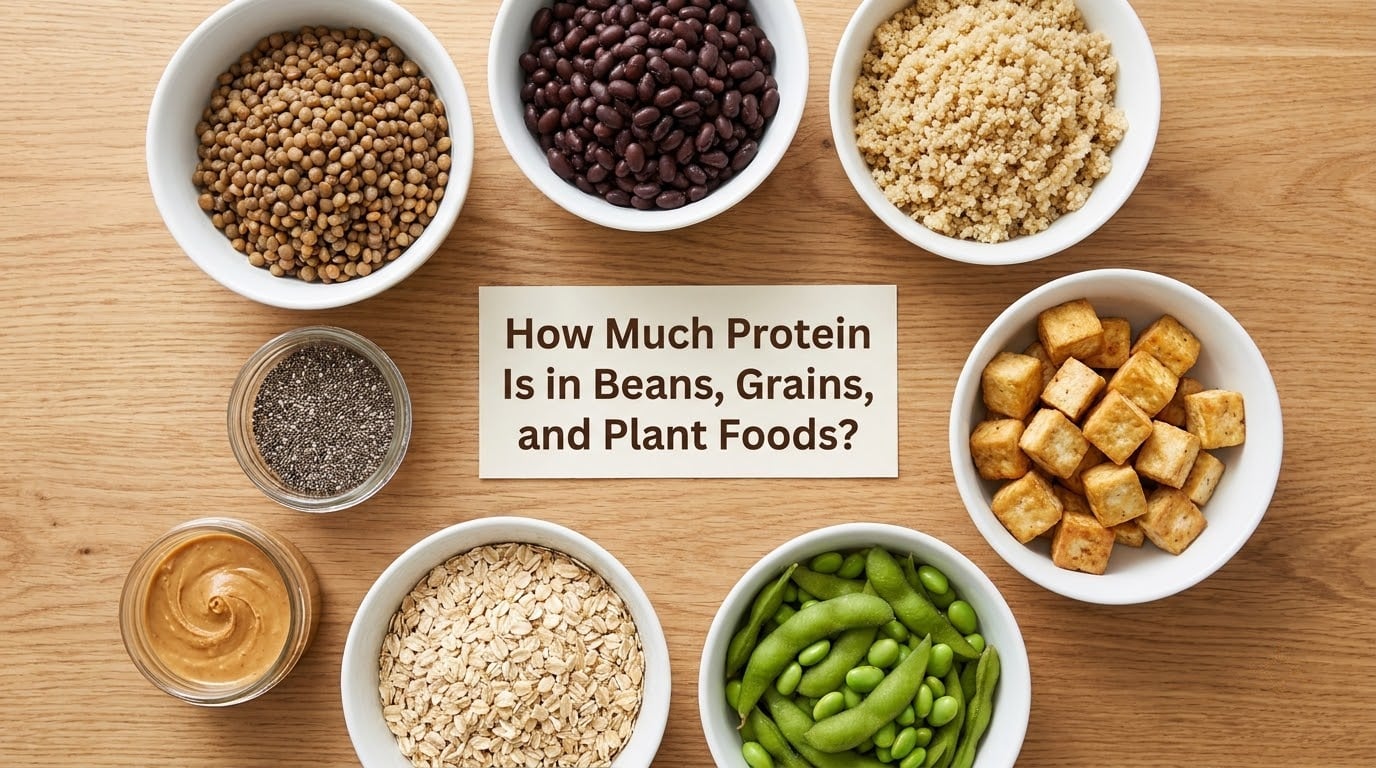
A cup of cooked lentils or edamame gives 18 g, and a cup of chickpeas or black beans about 15 g. These are the quiet workhorses of a plant-heavy week, and they cost a fraction of what meat does.
Tofu, tempeh and soy milk
Half a cup of firm tofu has 16 g, which is close to a 3 oz chicken breast for a serving half the weight. Half a cup of tempeh is higher still at 20 g. Soy is also one of the few plant proteins that is complete on its own, which is why it anchors so many vegetarian plates.
Quinoa, oats and other grains
Cooked grains are modest: a cup of quinoa is 8 g and a cup of cooked oats 6 g. Quinoa and buckwheat are commonly grouped with soy as complete plant proteins because they carry all nine essential amino acids rather than a partial set.
Bread, pasta, rice and potatoes
A slice of whole wheat bread has about 4 g. A cup of cooked pasta or white rice has 5 g, and a medium baked potato 5 g. Protein pasta is the exception in this group, running to about 12 g per 2 oz dry, but that figure swings widely by brand.
Vegetables and fruit
Green peas are the best of the lot at 9 g per cooked cup. Broccoli and spinach both give 5 g, mushrooms 2 g, and a medium apple or banana about 1 g. Nobody needs to count protein in produce, but it explains why a vegetable-heavy plate can leave you short.
How Do Portion Size and Cooking Method Change the Amount?
The chart gives you one serving. Most meals are not one serving, and the arithmetic is simpler than people expect. Every number on this page is just weight multiplied by the protein per 100 g column.
Scale the number to your portion
Six ounces of chicken breast is about 52 g of protein. Half a cup of Greek yogurt is about 12 g. A quarter cup of cottage cheese is 7 g. Double a serving and you double the protein, no other adjustment needed.
Cooked weight versus raw weight
This is where homemade tracking most often goes wrong. Chicken loses roughly 25% of its weight to water during cooking, so 4 oz raw becomes about 3 oz cooked, which is 26 g of protein, not 31 g. Weighing after cooking removes the guesswork entirely.
What you add changes the total
Two tablespoons of peanut butter add 8 g. A scoop of protein powder adds around 20 to 25 g. Shredded cheese on a plate of pasta can add 7 g on its own. Mixing corn and beans, or rice and beans, pulls the total up without changing the food at all.
A final warning about labels: a serving is an arbitrary unit set by the manufacturer. A serving of crackers might be eight pieces, a serving of pasta two cups. Multiply by the number of servings you actually ate, or better, read the per-100 g figure and work from weight.
Easy Ways to Add More Protein to Your Meals
You do not need specialty products. Nearly every boost below uses something already in most kitchens, and the arithmetic comes straight from the chart above.
Breakfast
Three eggs is 18 g. Swap one egg for 4 egg whites and you hold the protein while trimming fat. A cup of Greek yogurt with a spoon of pumpkin seeds takes you past 30 g. Oatmeal cooked in milk instead of water adds about 8 g to a 6 g bowl.
Lunch
A cup of lentil soup carries roughly 18 g. Add a handful of pumpkin seeds and a hard-boiled egg and lunch becomes a 30 g meal. A tuna sandwich on whole wheat bread with mustard comes to about 26 g.
Dinner
Roast a tray of chicken thigh and keep the pan for the week. Cube tofu into a stir-fry with edamame and it beats most meat dinners for protein per calorie. Lentil or beef tacos on corn tortillas land around 25 g depending on the filling.
Snacks
Cottage cheese with a spoon of berries is 28 g. A can of tuna with crackers is 22 g. Greek yogurt with peanut butter drizzled on top is around 28 g. These are the options that fill a gap between meals without undoing a calorie budget.
Complete versus incomplete protein
Animal foods and soy, quinoa and buckwheat supply all nine essential amino acids. Other plant proteins supply them unevenly, which is why pairing a grain with a legume across the day, rice with beans or bread with hummus, covers the gap without any special effort.
Building toward bigger daily totals
To reach 100 g, breakfast needs about 25 g, lunch 25 g, dinner 30 g and a snack 20 g. Reaching 150 g takes a bigger breakfast and a protein source at every meal, which is where tempeh, extra chicken, or a yogurt bowl start earning their place.
Frequently Asked Questions
How much protein is in a normal serving?
A normal serving is about 26 g for a 3 oz cooked piece of chicken breast, 24 g for a cup of Greek yogurt, 28 g for a cup of cottage cheese, and 6 g for one large egg. The most useful shortcut is roughly 7 g of protein per ounce of meat or fish, so three ounces lands near 21 to 26 g depending on the cut. Read every number against its serving weight, because the same gram count covers very different amounts of food.
Which common food has the most protein?
It depends on the measure. By a standard serving, low-fat cottage cheese leads at about 28 g per cup, followed by chicken breast and turkey breast near 26 g per 3 oz. By protein per 100 calories, cooked shrimp comes out top at roughly 24 g, with turkey breast and canned tuna close behind. Per 100 g, hemp hearts and pumpkin seeds climb to about 30 g, though nobody eats 100 g of either in one sitting.
How much protein should I eat per meal?
Roughly 20 g to 40 g per meal is the range most dietitians suggest, which works out to three or four eating occasions across the day. Spreading intake through the day tends to support fullness and muscle protein synthesis better than one large dinner. On a 120 g daily target, that means about 30 g per meal. Needs vary with body weight, activity level, age and health, so treat this as a starting point rather than a prescription.
Are eggs or chicken better for protein?
Chicken wins on protein per serving: about 26 g per 3 oz cooked breast versus 6 g per large egg. Eggs win on protein per calorie and on price per gram, and four whites match a whole egg’s 6 g with most of the fat removed. Three eggs gives you 18 g, which is a legitimate protein serving on its own. Choose based on calories and how you want the rest of the meal to taste.
How can I get more protein without eating meat?
Start with the high performers on the chart: firm tofu at 16 g per half cup, tempeh at 20 g, edamame and lentils at 18 g per cooked cup, and Greek yogurt at 24 g. Tempeh and tofu both cook in minutes and take any flavor you give them. Pairing a grain with a legume across the day, such as rice with beans, covers the amino acids you would otherwise get from meat.
How do I find the protein content of packaged food?
Turn the box over and find the Nutrition Facts panel. Look at the protein line, then note the serving size directly above it, because that serving is a manufacturer choice rather than a standard. Multiply the protein by the number of servings you actually ate, or use the per-100 g figure where available. Claims like high protein are relative and largely unregulated, so the panel beats the front of the package every time.
Start With One Change
Pick one meal, work out its protein from the chart, and decide what it is short against a 25 g target. Adding a second egg, swapping yogurt for Greek, or putting a half cup of lentils into a soup does it faster than any powder ever will.