To build a workout routine for fat loss, train 3 or 4 times a week using compound lifts, do 3 sets of 8 to 12 reps with 60 to 90 seconds of rest, add weight or a rep every week, and keep a moderate calorie deficit. That is the whole method, and this guide walks through how to set it up.
The mistake most beginners make is not training badly. It is jumping into a routine someone else designed, hitting it for two good weeks, then switching to the next new program when progress slows. A routine you can repeat and make harder beats a perfect plan you abandon in a month.
Here is how it actually works. You decide how many days you can train, pick a split, choose one movement per pattern, set your reps and rest periods, then add load over time. Cardio is a supporting player, not the main event, because fat loss is decided by your weekly total and your calorie intake rather than by one session.
Everything below is general information, not medical advice. If you have a heart condition, joint problems, are pregnant or postpartum, are over 40 and returning after years of inactivity, or take medication that affects heart rate, check with a doctor before you start. That conversation takes ten minutes and it is worth it.
Last reviewed for 2026, and we go through it every quarter.
Table of Contents
- What You Need To Build A Workout Routine For Fat Loss
- Equipment: pick the tier you can actually use
- The four things you actually need
- What your finished routine looks like
- Step-by-Step
- 1. Set a realistic starting routine
- 2. Choose exercises that support fat loss
- 3. Build each workout session
- 4. Track activity and recovery
- 5. Increase difficulty gradually
- Common Mistakes
- Frequently Asked Questions
- How many days a week should I train to lose fat?
- Can I lose fat without doing any cardio?
- How quickly should I increase my workouts?
- What do I do after missing a workout session?
- When should I talk to a doctor before starting a routine?
- Can I build a workout routine for fat loss with no equipment?
- Conclusion
What You Need To Build A Workout Routine For Fat Loss
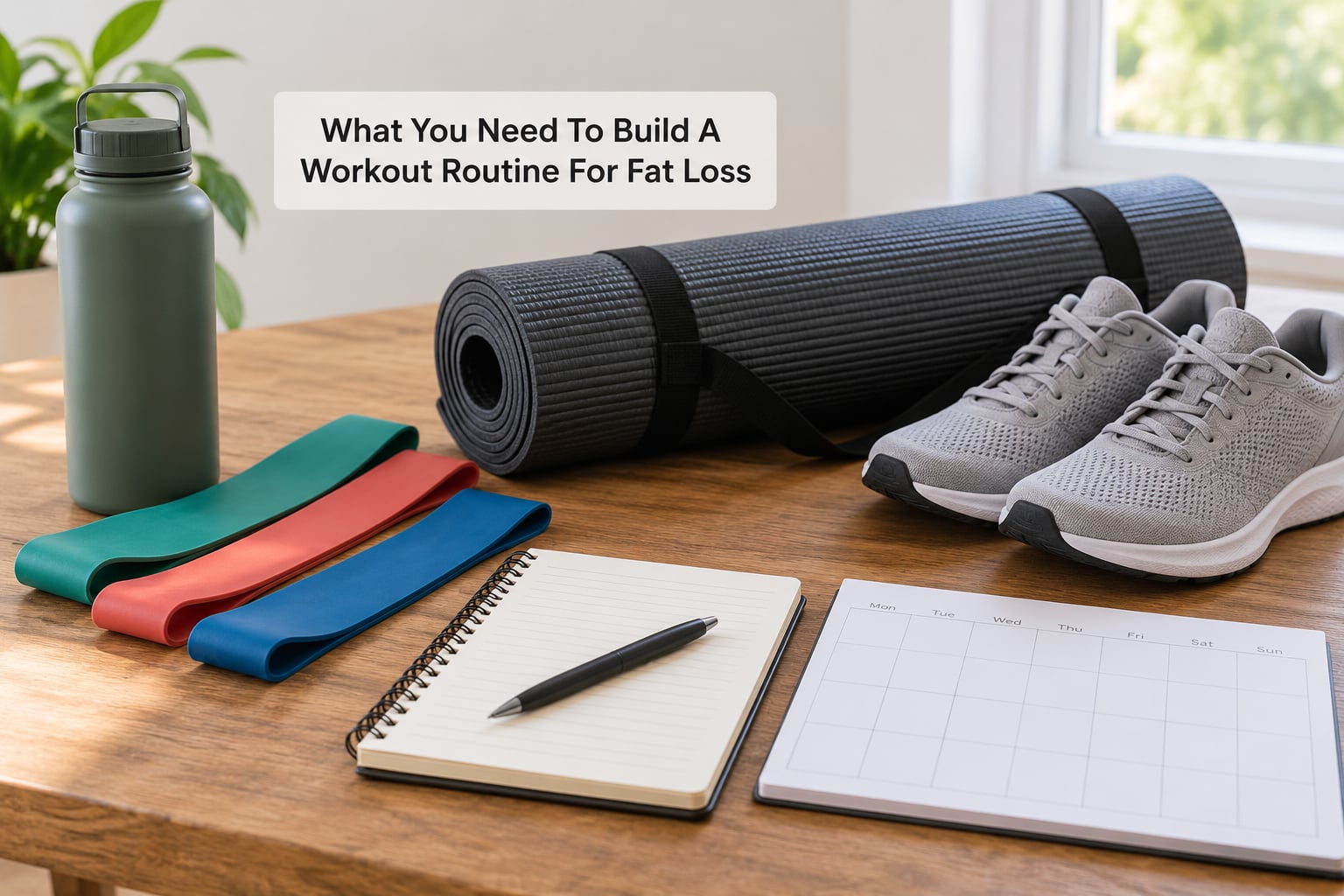
The equipment list is shorter than most gym marketing suggests. What you need is a repeatable weekly schedule, a way to load your muscles, and one tracking method you will actually use. Everything else is optional.
Equipment: pick the tier you can actually use
Three tiers work fine. Choose one and stay on it for your first twelve weeks.
- Full gym. Barbells, dumbbells, a bench, a lat pulldown and a cable station give you room to progress for a long time.
- Home with a pair of dumbbells. Adjustable dumbbells or fixed dumbbells plus a bench cover almost everything a beginner needs. Resistance bands add a few dollars of capability.
- No equipment. A backpack filled with water bottles or bags of sand, a resistance band and a mat will get you through the same session structure. Members of r/WorkoutRoutines describe exactly this setup and it works.
The four things you actually need
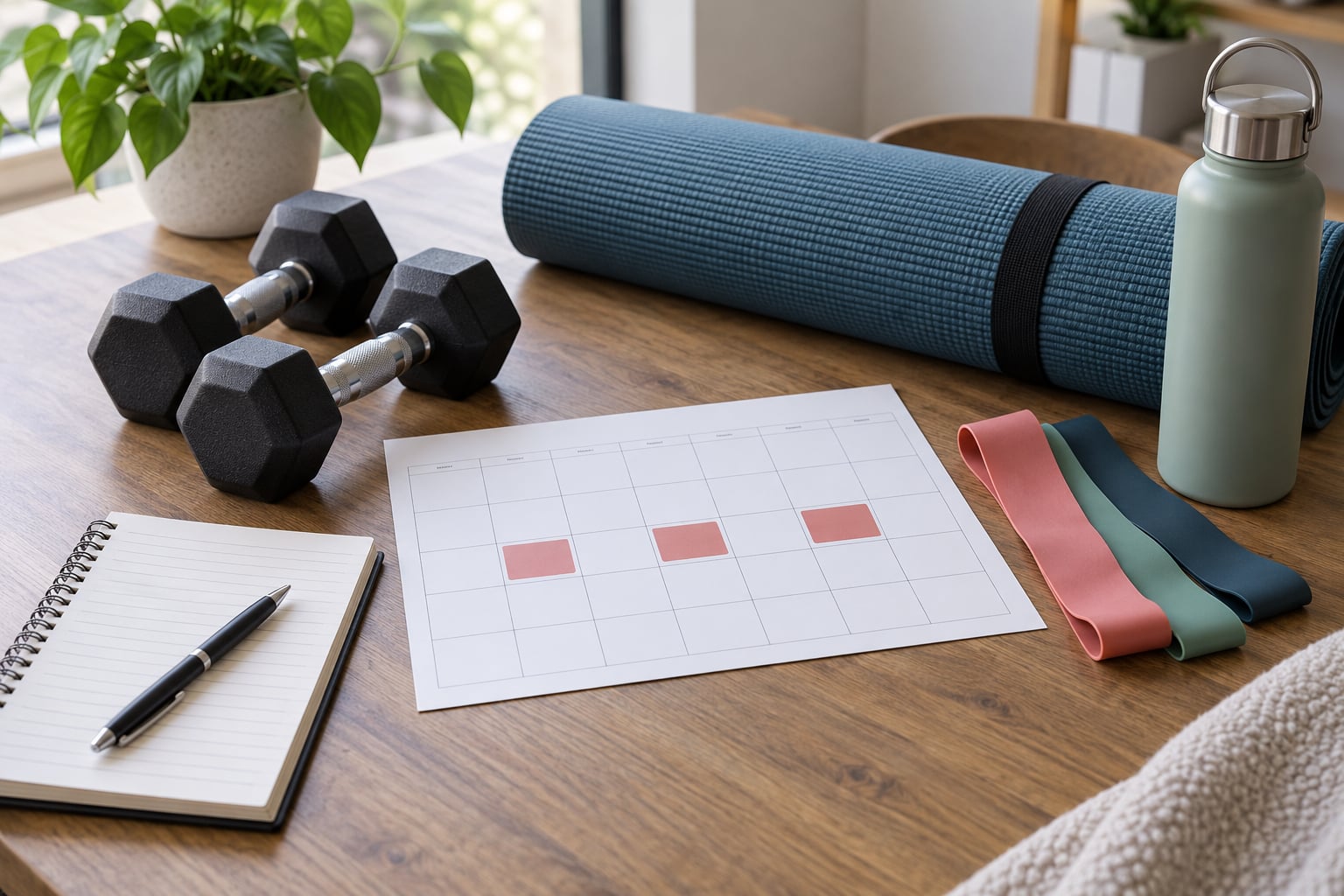
A schedule is the one item people skip and then wonder why nothing changes. Block three or four specific slots in your week, treat them like appointments, and put them on a calendar you see every day.
Clothing matters more than brands. You want shoes you can walk in for 45 minutes and layers you can remove, because a session you dread in bad clothes is a session you cancel.
Water is simple: a bottle within reach and a drink before you start and roughly every 20 minutes during.
Tracking is where most routines quietly fail. A phone note with four fields is enough. I use the same four: sessions completed, average daily steps, hours of sleep, and one number for the main lift. Nothing fancier survives contact with a real week.
What your finished routine looks like
Before the steps, here is the target. Write this down and adjust it as you learn.
| Plan element | Starting target |
|---|---|
| Sessions per week | 3 strength sessions, non-consecutive days |
| Session length | 35 to 45 minutes including warm-up and cool-down |
| Split | Full body, Workout A and Workout B alternated |
| Sets and reps | 3 sets of 8 to 12 reps per movement |
| Rest between sets | 60 to 90 seconds for compound lifts |
| Cardio | 2 sessions of 15 to 20 minutes, on separate days |
| Progression | Add load or a rep every time you hit the top of the range |
| Recovery | 2 full rest days, 7 to 9 hours of sleep |
That snapshot fits on one screen. When a plan needs a spreadsheet to explain itself, beginners abandon it.
Step-by-Step
Five steps get you from a blank page to a repeatable week. Do them in order, and do not skip to step five.
1. Set a realistic starting routine
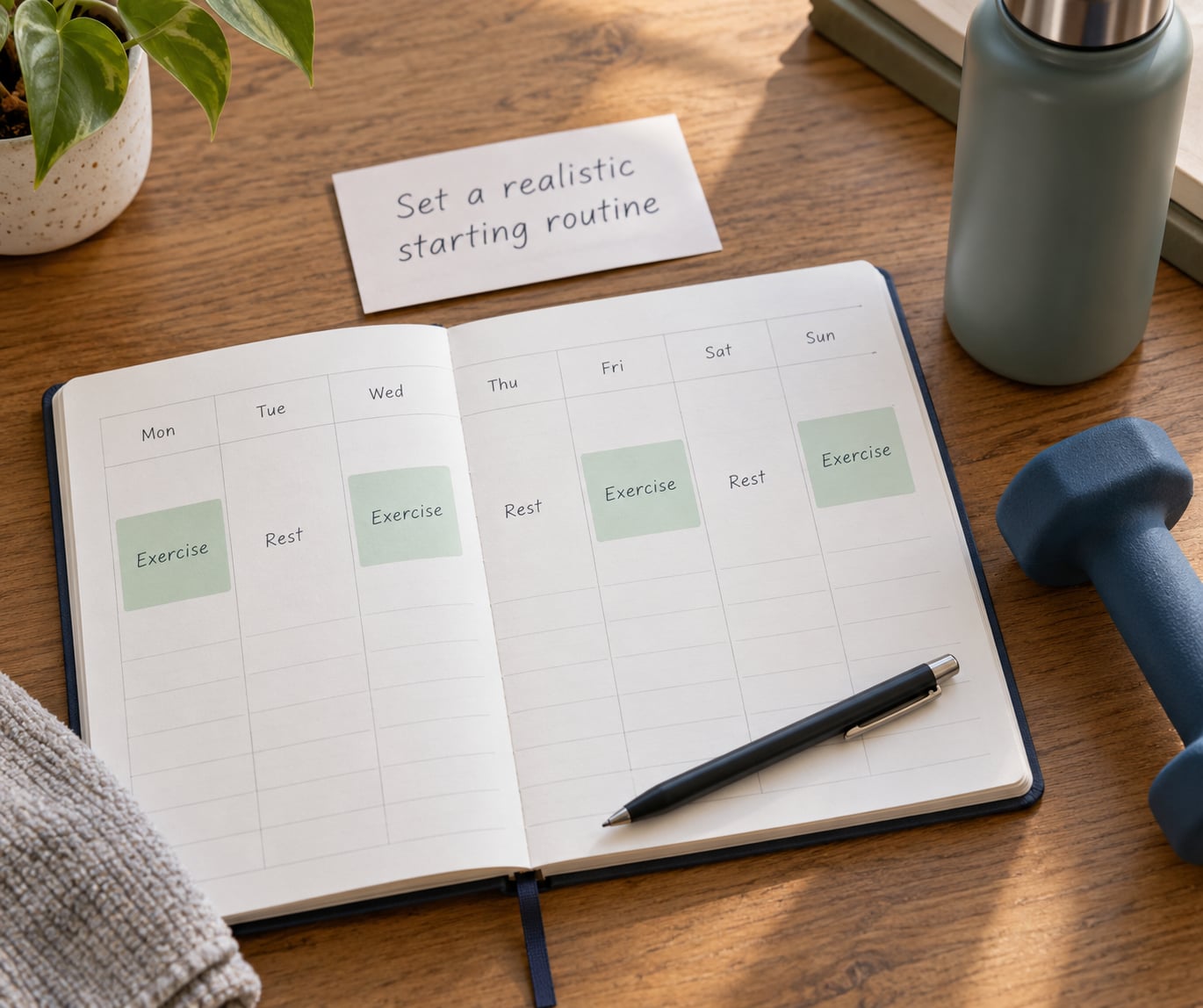
Beginners should train 3 days a week on non-consecutive days, and that is the single most useful number on this page. Monday, Wednesday and Friday is the pattern most beginners on r/beginnerfitness settle on because it gives two full rest days and covers the whole week without daily training.
Set a duration you can repeat on a bad week, not your best week. If 30 minutes is realistic when you are tired, plan 30 minutes. A 45-minute routine you complete eight times beats a 70-minute routine you complete twice.
Set an intensity you can judge without thinking. RPE, short for rate of perceived exertion, is a 1 to 10 scale where 10 is impossible and 1 is a walk. Most working sets belong at RPE 7 or 8, which means the last few reps are hard but your form is still clean. The talk test works too: if you cannot speak a full sentence during a set, it is too heavy for that exercise right now.
| Your situation | Days per week | Session length | Split |
|---|---|---|---|
| True beginner, returning after a break | 3 | 35 to 45 minutes | Full body |
| Consistent for 6 or more weeks | 4 | 40 to 50 minutes | Full body or upper and lower |
| Only 20 to 30 minutes free per session | 4 short sessions | 20 to 30 minutes | Full body, 4 movements only |
| Training around a desk job | 3 | 35 to 45 minutes | Full body, squat and hinge limited |
Write the three days into your calendar now, before you close this page. That single action separates people who train from people who intend to.
2. Choose exercises that support fat loss
Pick five movement patterns and cover each one: squat, hinge, push, pull, and core. These multi-joint movements recruit the most muscle per rep, and muscle is the tissue you want to protect while you are in a deficit, because it keeps your resting metabolic rate from dropping as you lose weight.
A good beginner set is small and boring. Goblet squat or bodyweight squat, Romanian deadlift or hip hinge, push-up or overhead press, row or lat pulldown, and a plank. Keep it there. Isolation work like lateral raises and curls can wait until your first twelve weeks are behind you.
Exercise alone does not decide fat loss. A workout burns a few hundred calories; the deficit comes from your daily intake. What training decides is how much muscle you keep and how much you burn outside the gym, week after week.
That answers the question people ask most: no single exercise burns the most fat. Pick the movements you can perform with good form twice a week for three months, not the movement that looks like the hardest work on the page.
3. Build each workout session
Every session follows the same three-part shape, which is part of why routines survive contact with real life. Warm up, do the strength work, add conditioning if it is on the schedule, cool down.
| Block | Time | What it looks like |
|---|---|---|
| Warm-up | 5 to 7 minutes | Brisk walk or bike, then 10 reps each of band pull-apart, bodyweight squat, hip hinge and push-up |
| Strength work | 20 to 25 minutes | 5 movements, 3 sets of 8 to 12 reps, 60 to 90 seconds rest |
| Conditioning | 0 to 15 minutes | Steady-state walk, cycling, rowing or 8 rounds of 30 seconds hard and 60 seconds easy |
| Cool-down | 3 to 5 minutes | Easy walking plus light stretching for hips, hamstrings and chest |
Alternate two workouts so you never repeat the exact same session, which keeps soreness manageable. Workout A: squat, push, row, plank. Workout B: hinge, overhead press, pulldown or pull-up, side plank. Monday is A, Wednesday is B, Friday is A again.
On how to pick a starting weight: choose one that lets you finish all 12 reps with clean form and about two reps left in reserve. Do five reps with something heavier the week before, find the ceiling, and drop back. Starting too light is the most common beginner stall, and most people never notice for weeks.
4. Track activity and recovery
Record four things per week, no more. Sessions completed, average daily steps, average hours of sleep, and the weight or reps on your main lift. Ninety seconds of logging on Sunday is enough.
Add two checks that tell you how to adjust. Waist circumference, measured at the navel the same time each week, is the most reliable fat-loss signal you have at home. Photos, front and side in the same light and same spot every four weeks, catch changes the mirror and the scale both miss.
Tracking separates progress from noise. Weight moves around daily for reasons that have nothing to do with fat, and people quit in month two because they trusted a number that was never going to be straight.
Watch recovery signals too: soreness that lasts more than 48 hours, dropped performance on lifts you were doing easily, poor sleep, or low energy all mean the week before was too heavy. That is information, not failure.
5. Increase difficulty gradually
Progressive overload means gradually asking your body to do more than it did before, so your routine keeps producing results. Add in this order: one extra rep per set, then a small increase in weight, then an extra set, then shorter rest. One change at a time, and only after you have hit the top of the rep range on every set with good form.
A small weight jump is usually 2.5 to 5 pounds on upper body lifts and 5 to 10 pounds on squats and deadlifts, then drop back to 8 to 10 reps and work up again. Progress comes in waves, and that is normal.
Every fourth week, cut your sets or your load by roughly 40 percent and keep the movements. That deload week lets joints and connective tissue catch up, and it is the cheapest insurance in programming. Your fatigue usually drops within a few days of the first good session.
If a lift stalls for two sessions in a row, check sleep, food and soreness before adding load. Adding weight on top of poor recovery is how routines break.
Common Mistakes
These six mistakes account for most stalled fat-loss routines. Each one has a simple correction.
1. Overtraining from week one. Starting at six days a week because you are motivated right now. Muscle does not grow or fat come off faster because you train daily; recovery is where adaptation happens. Fix: three non-consecutive sessions and two full rest days, and add a fourth session only after six consistent weeks.
2. Doing only cardio. Running or cycling burns calories during the session, but with no resistance work you lose muscle as you lose weight, which lowers your resting metabolic rate and makes the next stage harder. Fix: make strength work the backbone and treat cardio as a two-day supplement.
3. Switching programs every two weeks. A new influencer plan every fortnight feels like progress and delivers none. Nothing changes because you did not stay long enough to progress. Fix: commit to one routine for twelve weeks before you judge it.
4. Chasing extreme deficits. Cutting to 1,000 calories while training five times a week usually works for a few weeks and then stalls hard. It also raises stress hormones, wrecks sleep and makes you lose strength along with fat. Fix: aim for a moderate deficit of roughly 300 to 500 calories a day and hold it long enough to matter.
5. Ignoring sleep and food. Training on five hours of sleep with an aggressive deficit is a recipe for a stalled routine. Most adults need 7 to 9 hours; during a cut, more rather than less is the better bet. Fix: treat recovery as part of the plan, not as leftover time.
6. Treating soreness as the score. DOMS, the delayed muscle soreness you feel in the day or two after a session, measures how new or hard a movement was. It has almost nothing to do with whether the session worked. Fix: track the numbers above, and use soreness only as an early warning that you did too much.
One more worth naming: fear of getting bulky. Lifting does not make you bulky. Muscle gain on an untrained beginner is slow, and a moderate calorie deficit works against gaining significant muscle mass. Beginners often lose fat and gain a little lean body mass at the same time, which is body recomposition.
Frequently Asked Questions
How many days a week should I train to lose fat?
Three days a week on non-consecutive days is the right starting point for most beginners. Monday, Wednesday and Friday gives you two full rest days and lets you hit every major muscle pattern twice, which is the frequency most widely supported in resistance training guidance. Once you have four to six weeks of consistent training and recovery feels normal, move to four days. More is not automatically better: extra sessions on poor recovery cut your progress, not raise it.
Can I lose fat without doing any cardio?
Yes. Cardio is not required for fat loss. What matters is a calorie deficit over time plus resistance training to protect muscle, and a routine that supports daily movement you enjoy, such as walking. Conditioning still earns its place because it burns calories, improves work capacity and gives you options on days you do not want to lift. If you dislike running or cycling, rowing, a jump rope or brisk walking work just as well.
How quickly should I increase my workouts?
Increase one thing at a time, and only after you hit the top of the rep range on every set with good form. Add a rep first, then a small amount of weight, then a set, then shorten rest. Most beginners add load weekly for the first three months, since their lifts improve fast at the start. Plan a lighter week every fourth week. If two sessions in a row stall, check sleep and food before adding anything.
What do I do after missing a workout session?
Skip the guilt and just continue the schedule. If you miss one strength session, do the next one as planned rather than doubling up or adding an extra day to make up for it. If you miss several in a row, drop back to the version of the routine you were managing comfortably before the gap, then rebuild from there. One missed week costs almost nothing in a twelve-week plan; abandoning the plan costs everything.
When should I talk to a doctor before starting a routine?
Talk to a doctor or other qualified clinician first if you have heart disease, high blood pressure, diabetes, a history of chest pain or fainting during exercise, or a current or past joint injury. Pregnancy and the first months postpartum, and perimenopause or menopause with symptoms, also warrant a conversation before you increase training load. Medications that affect heart rate, blood pressure or blood sugar can change what intensity is safe for you.
Can I build a workout routine for fat loss with no equipment?
Yes. Bodyweight training works, and a home version follows the same structure: a full-body session with a squat, hinge, push, pull and core movement, three sets of 8 to 12 reps, plus conditioning. A backpack filled with water bottles or bags of sand, and a resistance band, let you add load once bodyweight gets easy. Progression comes from slower tempo, one-arm variations, extra reps and shorter rest, not from new machines.
Conclusion
Here is how to build a workout routine for fat loss in the next ten minutes. Pick three non-consecutive days and put them in your calendar. Do one full-body session using a squat, hinge, push, pull and core movement, 3 sets of 8 to 12 reps each. Write down what you lifted. Then repeat next week and add a little.
Adjust gradually rather than trying to change everything at once, and if anything about your health or history makes exercise a question, that is a conversation for your doctor, not for me.