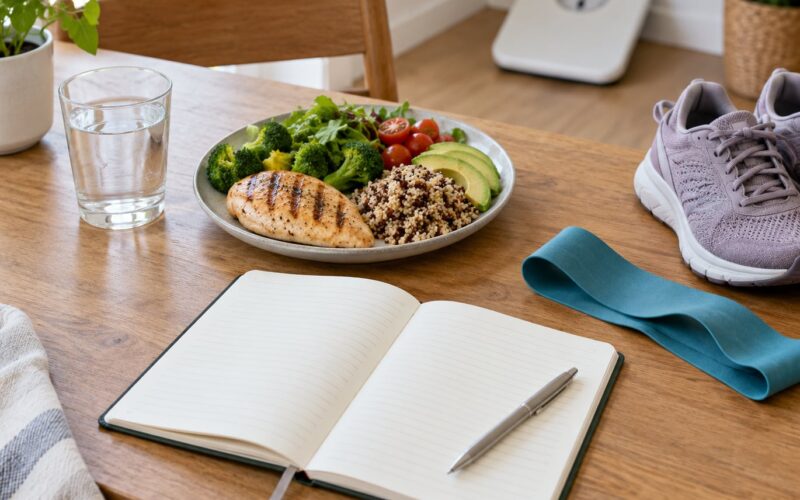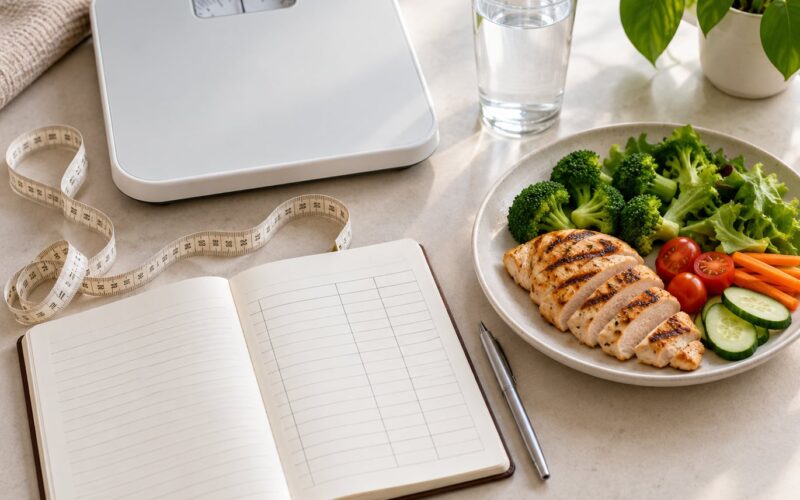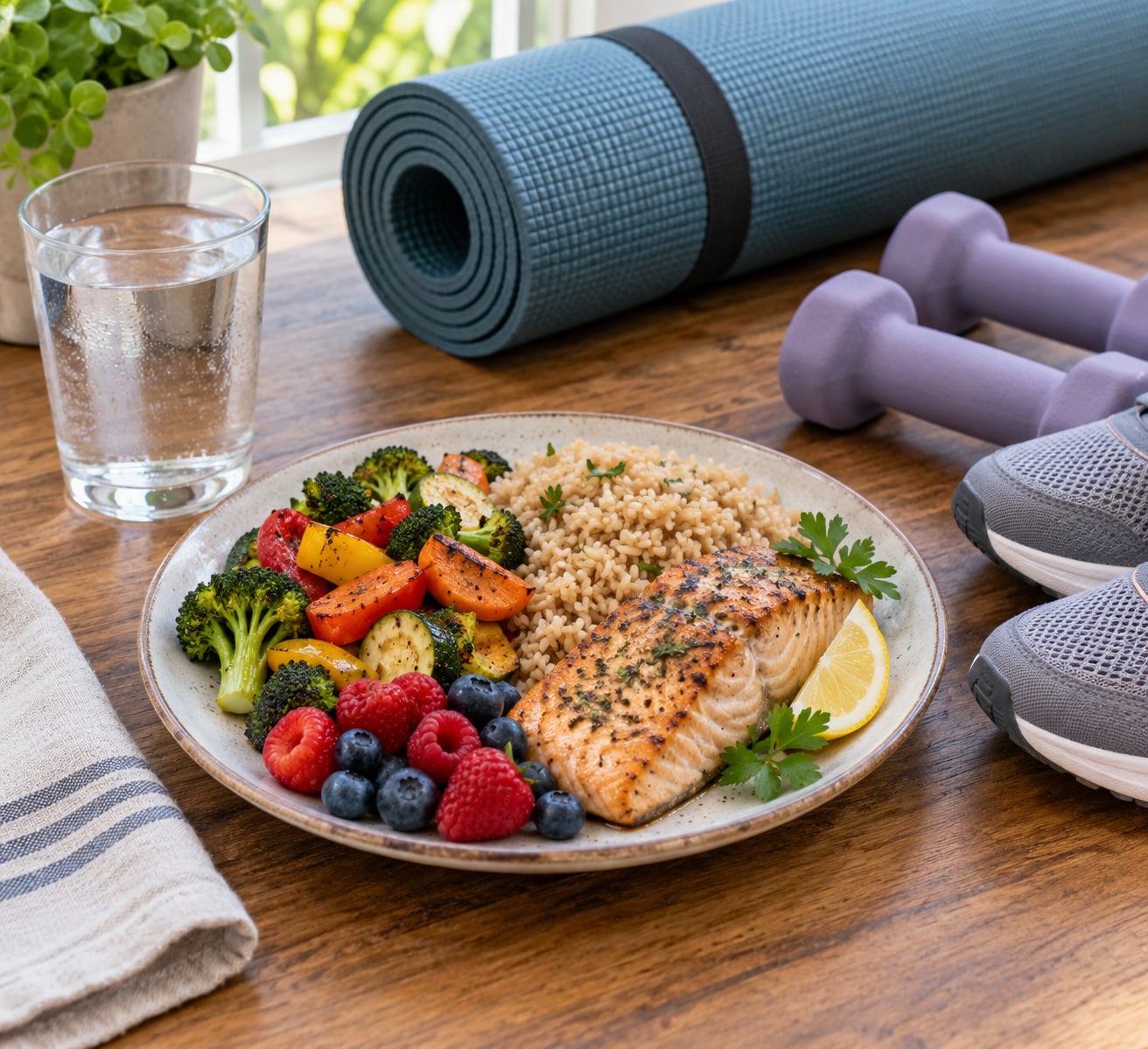
Weight loss after 40 is harder, but not impossible: muscle declines with age, fat shifts toward the abdomen as hormones change, and life gets busier. What still works is a modest calorie deficit, enough protein, strength training twice a week, more daily movement, and real sleep. Most people who do those things steadily lose around 1 to 2 pounds a week, and the ones who stick with it keep the weight off.
This guide is general information for adults over 40, not a treatment plan for any individual. If you have a health condition, take medication, are pregnant, or have symptoms, talk to a doctor or a registered dietitian before you change what you eat or how much you exercise.
Nothing here needs a fancy program or a supplement. You need a way to see what you are currently doing, a couple of repeatable habits, and about twelve weeks of patience.
Table of Contents
- What You Need
- A clinician, when one is relevant
- A simple baseline of food and activity
- Basic equipment
- A tracking method you will not resent
- Step-by-Step: How to Lose Weight After 40 Safely
- How to set a calorie baseline without rigid dieting
- Build meals around protein, fiber, and satisfying carbohydrates
- Reduce frequent eating without skipping meals
- Add strength training two or more times a week
- Use walking and moderate cardio to raise activity
- Prioritize sleep, recovery, and stress
- Track progress over weeks instead of days
- Create a maintenance routine
- Common Mistakes
- Tips for Staying Consistent
- Frequently Asked Questions
- Is losing weight after 40 harder because of metabolism?
- How fast can I safely lose weight after 40?
- Should I do cardio or weights after 40?
- Are weight loss supplements worth taking after 40?
- How do I lose weight during perimenopause and menopause?
- When should I see a doctor about weight loss after 40?
- Conclusion
What You Need
Before you change anything, sort out these four things. None of them are expensive.
A clinician, when one is relevant
Weight changes can come from thyroid problems, untreated sleep apnea, medication side effects, perimenopause, or conditions you may not know you have. Book an appointment if your weight has shifted noticeably without trying, if you feel ravenous or exhausted most days, or if you are starting a new exercise routine after an injury or a long break.
A doctor can also tell you whether a prescription weight management medication or hormone therapy is worth discussing. That is a clinical decision, not a lifestyle shortcut, and it belongs with a prescriber who knows your history.
A simple baseline of food and activity
You do not need an app with a database of 900,000 foods. For seven days, write down roughly what you eat, what you drink, and how much you move. Notes, a phone memo, or a paper notebook all work.
The point is not accuracy. The point is noticing patterns that were invisible before, like an afternoon habit of grazing while working, a large glass of wine most evenings, or a commute that has quietly shrunk to 1,500 steps.
Basic equipment
Supportive walking shoes and, if you are training at home, a set of resistance bands or a pair of light dumbbells will carry you a long way. A sturdy chair for sit-to-stands is enough to start strength work with no equipment at all.
A tracking method you will not resent
Pick something dull: a weekly weight average, a waist measurement at the same time of day, or a weekly note about how your meals and sessions went. That last option matters more than it sounds. People abandon tracking because it feels like paperwork, and a plan you do not resent is the one you will still be following in month three.
Step-by-Step: How to Lose Weight After 40 Safely
The order matters. Fix what you eat and drink before adding training, then add training, then fix recovery. Doing all five at once is how people burn out by week three.
How to set a calorie baseline without rigid dieting
You need an honest picture of portion sizes, drinks, snacking, hunger, and movement across several ordinary days. Look at a full week rather than one good Tuesday, because weekends and evenings are where most of the drift lives.
Then make one adjustment, not five. Current mainstream public health guidance for adults is generally a moderate deficit of roughly 300 to 500 calories a day, which is around a small snack or a couple of glasses of wine, not a whole meal. You can spot that in your notes without counting anything.
You know the routine is working when your clothes fit differently and you are not hungry between meals. If you are ravenous by 4 pm every day, the deficit is too large or the meals are not built well. That is data, not failure.
Build meals around protein, fiber, and satisfying carbohydrates
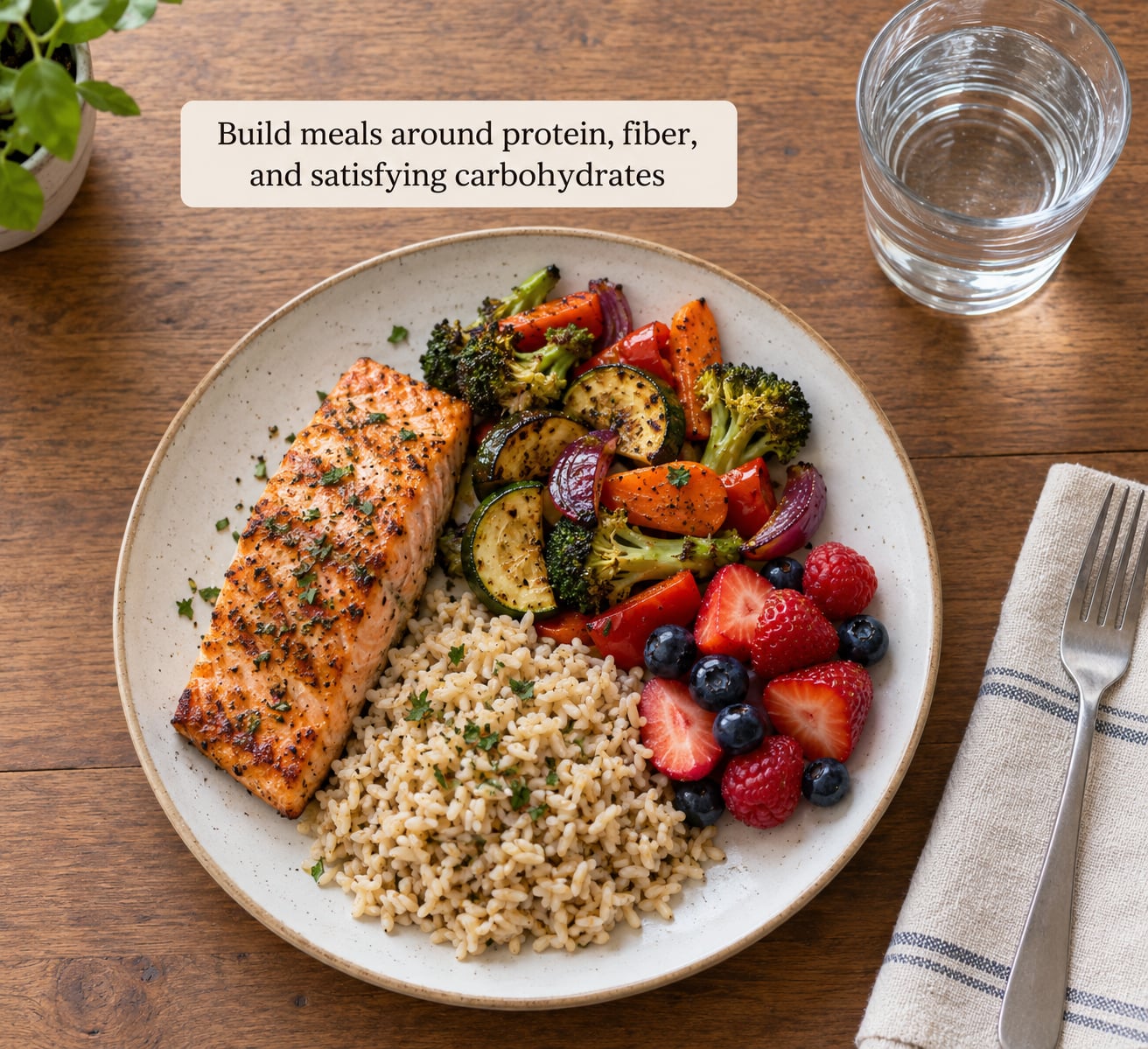
Most adults can get useful amounts of protein from food alone: eggs, fish, chicken, tofu, beans, lentils, Greek yogurt, cottage cheese, or whatever you already eat and like. Aim for a protein source at every meal, plus vegetables or fruit, a carbohydrate you genuinely enjoy, and a small amount of fat.
Fiber does a lot of quiet work here. Roughly 25 to 30 grams a day is a common adult target, and it comes from vegetables, beans, oats, whole grains, whole fruit, and nuts rather than from a powdered supplement.
There are no good and bad foods. Some are simply more calorie-dense per bite, and the practical move is to eat them more deliberately rather than to ban them. A piece of chocolate still fits in a plan that is going to run for a year.
Hydration helps more than people expect. A glass of water before a meal, and instead of a second coffee, takes care of a surprising share of the afternoon snacking that people blame on low willpower.
Two examples. Breakfast: Greek yogurt with berries and a spoon of oats. Lunch: a bowl of beans and greens with olive oil and lemon, plus a piece of fruit. Dinner: salmon, roasted vegetables, and brown rice. Same structure, different ingredients, no weighing required.
Reduce frequent eating without skipping meals
The easiest calories to lose are usually the ones you barely noticed. Liquid calories come first: sweetened coffee, juice, alcohol, and regular soda go into a drink quickly without producing any fullness. Cutting one of those often does more than any food rule.
Mindless eating is the second one. Sitting at a desk with a bag of crackers is grazing, not a snack you planned. Dividing a bag into a small bowl at the start of the afternoon is almost comically effective, and it is effective because it removes the decision.
Third is oversized portions at dinner, especially food that is easy to keep eating. Put a portion on a plate and put the rest away. Eat slowly enough to notice fullness, which takes about 20 minutes, and that is genuinely all it takes.
Do not skip meals to compensate for yesterday. Bouncing between starving and overeating is what makes people feel exhausted and gives up, and it is the pattern that most often ends a weight loss attempt.
Add strength training two or more times a week
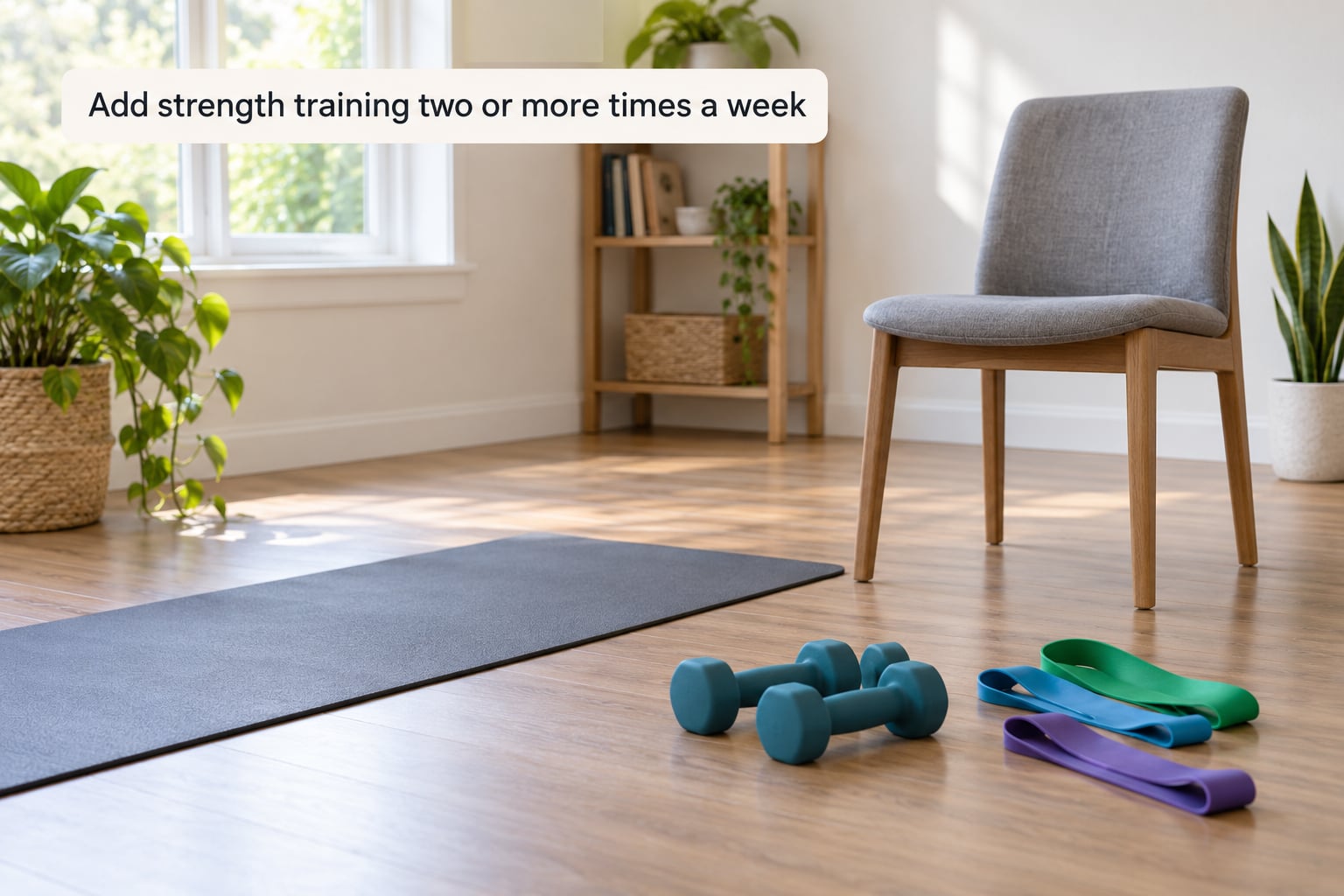
Muscle declines with age, and muscle is what keeps your resting calorie burn from dropping further. Resistance training protects it while you lose fat, which is why the same effort often changes body composition before it changes the scale.
A beginner full body routine needs five movements, not twenty. Sit-to-stands from a chair, a hip hinge holding a weight, an incline push-up on a wall or counter, a resistance band row, and a carry with two weights or a bucket. Two sets of 8 to 12 reps, two or three times a week, is a real program.
Progression is simple: when 12 reps of every set feel easy, add a little weight or one rep. Give yourself two or three weeks between increases. Rushing the jump is how people get hurt and then stop.
Skip the session, not the week, when you are tired. Sleep and rest days are treated as real levers by people who keep their progress, not as wasted days.
Use walking and moderate cardio to raise activity
Everyday movement is where most adults have the most room. Non-exercise activity thermogenesis, the calories burned simply by standing, walking, and fidgeting, can outweigh a formal workout in a sedentary week, and it does not need recovery time.
For adults, the common public health target is at least 150 minutes of moderate aerobic activity a week plus two strength days. Brisk walking counts. Three ten-minute walks after lunch get you to 150 minutes without setting an alarm for a 6 a.m. session.
Pick an intensity where you can still talk in short sentences. That is roughly the middle range people call zone 2, and it is repeatable, gentle on joints, and easy to build up from. Add a few harder intervals later if you want, not in week one.
Prioritize sleep, recovery, and stress
Short sleep and chronic stress do not cause weight loss, but they make it harder: they raise appetite, they make cravings harder to resist, and they push fat storage toward the abdomen. Most adults need 7 to 9 hours, and the wind-down matters as much as the hours.
Keep a consistent wake time, get daylight early in the day, and stop caffeine several hours before bed. A ten-minute walk, a few slow breaths, or a fixed bedtime for screens covers a lot of ground.
Get persistent fatigue, dizziness, chest pain, shortness of breath, or any other warning sign checked by a doctor promptly rather than training through it.
Track progress over weeks instead of days
Weight moves day to day for reasons that have nothing to do with fat. Compare weekly averages, and look at waist measurements, how your clothes fit, how much you can lift, your energy, and your sleep. Those move more reliably than a single morning reading.
Reassess after eight to twelve weeks, not after eight days. If nothing has changed at all and your habits are solid, that is the point to talk to a doctor or dietitian about thyroid function, sleep apnea, medications, or a more specific plan.
Create a maintenance routine
This is where most regain happens, because nobody plans for it. By the time you reach your goal, your food portions, training schedule, and sleep routine are already habits. The work now is keeping them, not adding new effort.
Eat slightly more than during the loss phase, at the same protein level and with the same meal structure. Keep two or three strength sessions a week and your walking baseline, because the muscle you built is what makes maintenance cheaper than dieting was.
Weigh or measure yourself less often than before. Expect a small settle in the first few weeks as the body fills with water, then stay steady. Revisit the plan when your schedule, appetite, or health changes, because maintenance is a maintenance job, not a finish line.
Common Mistakes
Most stalled attempts after 40 come down to a handful of repeatable errors.
Cutting calories too hard. Very low intakes cause hunger, poor sleep, and low energy, and they rarely last past a few weeks. Correction: cut roughly 300 to 500 calories a day and leave the rest of your nutrition alone.
Relying on supplements and fat burners. Fat-burning products, appetite suppressants, and metabolism reset blends are not supported by good evidence, and some interact with prescription medications. Correction: treat any supplement as a question for your pharmacist or doctor, not a shortcut.
Chasing fast results. The fastest plans are rarely the ones people keep. Correction: aim for about 1 to 2 pounds a week, which is steadier and easier to hold.
Skipping strength training. Losing weight without lifting is how people end up smaller but not stronger. Correction: two full body sessions a week is enough to start.
Overtraining and under-recovering. Adding intense intervals to an already busy life leads to soreness, poor sleep, and quitting. Correction: keep most sessions moderate and take real rest days.
Neglecting sleep and evening habits. A week of short nights plus evening drinks will undo a careful plan. Correction: fix the wake time first, then look at the drinks.
Changing five habits at once. It feels motivating for four days and then collapses. Correction: pick one food change and one movement change, and let them run for eight weeks before adding anything.
Believing in spot reduction and viral rules. You cannot choose where fat comes off, and rules like the 3-3-3 or 30-30-30 have no real basis. Ab exercises and crunch variations train muscles; they do not pull fat from the belly.
Tips for Staying Consistent
Start with two changes. One food habit and one movement habit is a realistic first month.
Give each habit eight to twelve weeks before you judge it. Progress in weight loss is not a straight line, and the weeks that look flat are often where the body is quietly recompiling.
Plan meals and movement a little in advance. Ten minutes on a Sunday deciding what you will cook three nights and when you will walk removes most of the daily decisions that defeat people.
Adapt rather than quit. Painful joints, a sick child, a deadline week, a bad night’s sleep: these are reasons to shrink the session, not abandon the plan. A ten-minute walk still counts as a walk.
Ask for help early. A registered dietitian can set protein and portion targets, and a doctor can rule out the medical reasons weight loss stalls. Neither of them is a judgment, and both save months.
If you have eaten in a way that feels out of control, whether once or for years, tell a clinician. Emotional and binge eating are common in midlife and treatable, and weight advice built on shame rarely survives contact with a real life.
Frequently Asked Questions
Is losing weight after 40 harder because of metabolism?
Age-related changes in muscle, activity, sleep, hormones, and health conditions all affect weight patterns, but metabolism is not a switch that turns off at a birthday. Adults can still lose weight in their 40s and beyond by protecting muscle with protein and strength training, keeping a moderate calorie deficit, and moving daily. What changes is how much effort it takes and how much muscle you lose along the way.
How fast can I safely lose weight after 40?
Around 1 to 2 pounds a week is a reasonable pace for most adults, and it is the pace most likely to last. Faster loss usually means cutting more food than you can sustain, and much of what drops is fluid and muscle rather than fat. People training hard may see the scale move slower while waist measurement and strength still improve. Faster than 2 pounds a week for more than a few weeks deserves a conversation with a doctor.
Should I do cardio or weights after 40?
Both, but weights come first because muscle protects your resting calorie burn and helps you look like you lost fat rather than simply getting smaller. Two or three full body strength sessions a week is a good base. Add daily walking and aim for the standard target of about 150 minutes of moderate aerobic activity a week. If you can only do one thing, pick walking you will actually do, then add resistance training.
Are weight loss supplements worth taking after 40?
Most fat burners, appetite suppressants, and metabolism reset products are not supported by good evidence, and some interact with prescription medications. A few, such as protein powder, creatine, magnesium, or vitamin D, may help fill a real gap, but they add little to a diet built from ordinary food. Run any supplement past a pharmacist or doctor first, especially if you take prescription medication regularly.
How do I lose weight during perimenopause and menopause?
Perimenopause and menopause bring changes in sleep, energy, stress response, and where fat is stored, which makes an aggressive plan harder to sustain. Focus on protein at every meal, fiber, and enough food to stay satisfied, keep strength training twice a week, and expect the scale to be a less useful measure than your waist and how you feel. Hormone therapy and prescription weight management medications are options to discuss with a clinician, not lifestyle choices.
When should I see a doctor about weight loss after 40?
Book an appointment if your weight changes noticeably without trying, if weight loss stalls for many weeks despite consistent habits, if you feel constantly exhausted or unusually hungry, or if you snore and wake unrefreshed, which can point to sleep apnea. Thyroid problems and medication side effects are common medical explanations worth ruling out. Get urgent care for chest pain, shortness of breath, dizziness, or fainting rather than trying to train through them.
Conclusion
Sustainable fat loss after 40 does not need a perfect metabolism, a cleanse, or a program you hate by week two. It needs a calorie baseline you can actually read, one repeatable food habit, and a strength or walking routine you would still be doing in December.
So start with the record, not the rules. Write down seven ordinary days of food, drinks, movement, and sleep. Then choose one portion habit to fix and one movement habit to build, give both twelve weeks, and track your waist and your energy rather than a single morning number.
This article is general information and not medical advice. If you have a health condition, take medication, or have symptoms such as persistent fatigue, chest pain, or shortness of breath, talk to a doctor before changing your routine.