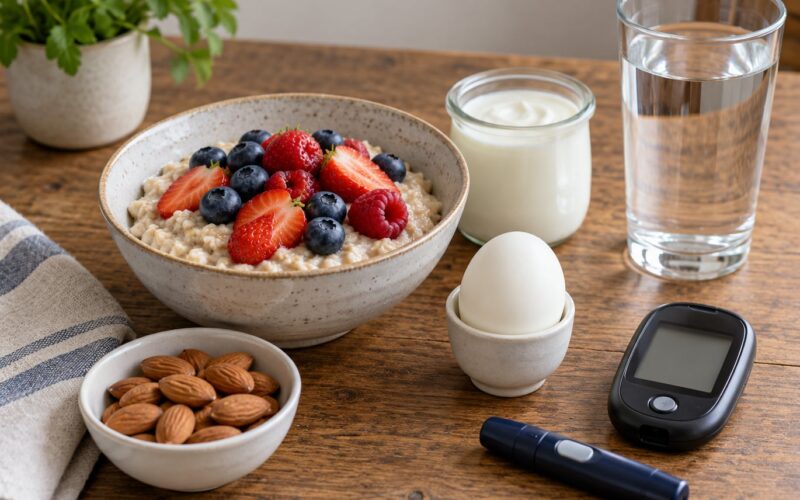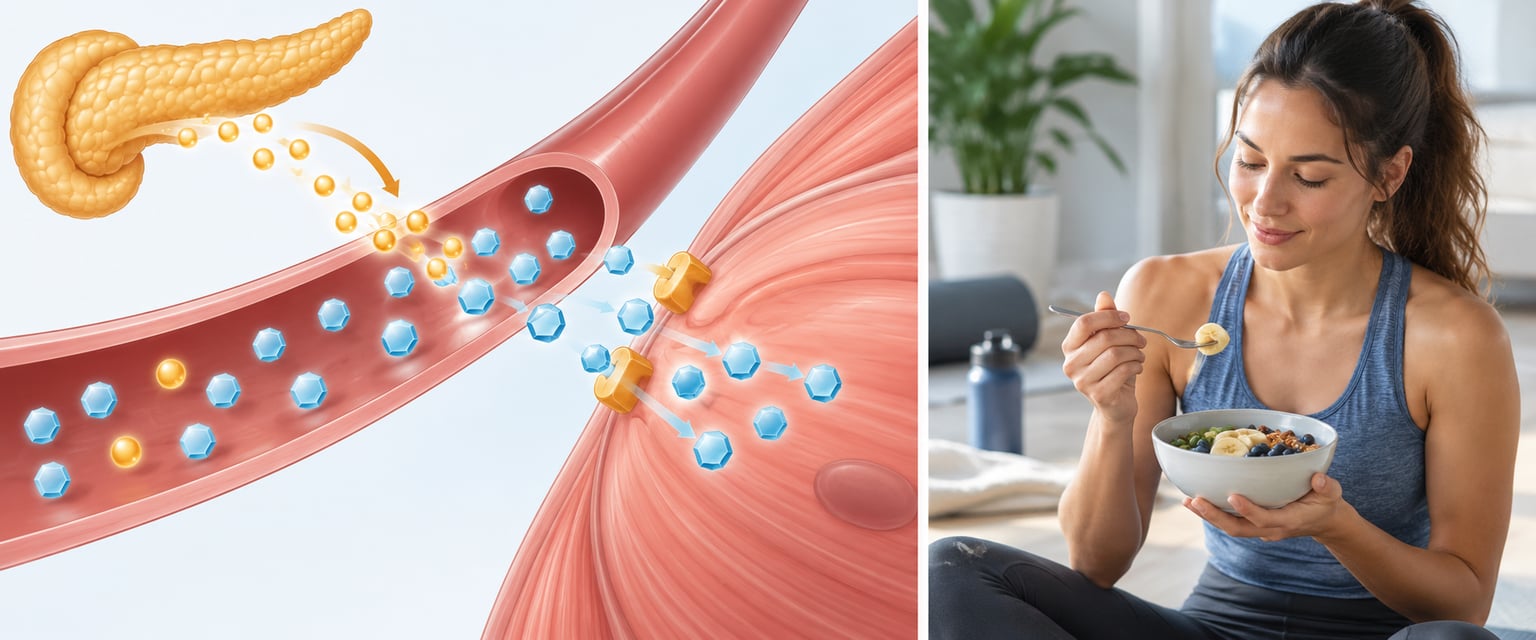
Insulin resistance is a condition where the cells in your muscles, fat and liver stop responding effectively to the hormone insulin, so glucose stays in your bloodstream instead of moving into cells for energy. Understanding what is insulin resistance and how does it affect weight matters because it changes how hungry you feel, how quickly energy arrives, and why weight loss can feel harder than the effort you are putting in. Here is the plain-language version.
Most people meet this topic after a doctor mentions prediabetes, after lab work comes back with a flag they did not expect, or after a few months of effort that produces very little. Some work it out on their own from symptoms. This guide is general information, not a diagnosis, and it is not a treatment plan.
If you want the honest short version before the detail: a calorie deficit still governs fat loss, but insulin resistance shapes how hungry you are, how satisfying each meal feels, and how quickly your energy crashes. Losing weight is also one of the most reliable ways to improve insulin sensitivity, so the two goals support each other rather than compete.
Table of Contents
- What Is Insulin Resistance?
- What Causes Insulin Resistance?
- How Does Insulin Resistance Affect Weight?
- How Does Insulin Resistance Affect Blood Sugar and Energy?
- Can Insulin Resistance Be Improved?
- What Eating and Exercise Habits Support Insulin Sensitivity?
- How Is Insulin Resistance Tested?
- When Should Someone Talk With a Healthcare Professional?
- Frequently Asked Questions
- Is insulin resistance the same as diabetes?
- Can insulin resistance make it harder to lose weight?
- Does insulin resistance always cause weight gain?
- What symptoms can suggest insulin resistance?
- How quickly can insulin sensitivity improve with lifestyle changes?
- Should I take insulin or another medication for weight loss?
- Conclusion: Start With One Manageable Change
What Is Insulin Resistance?
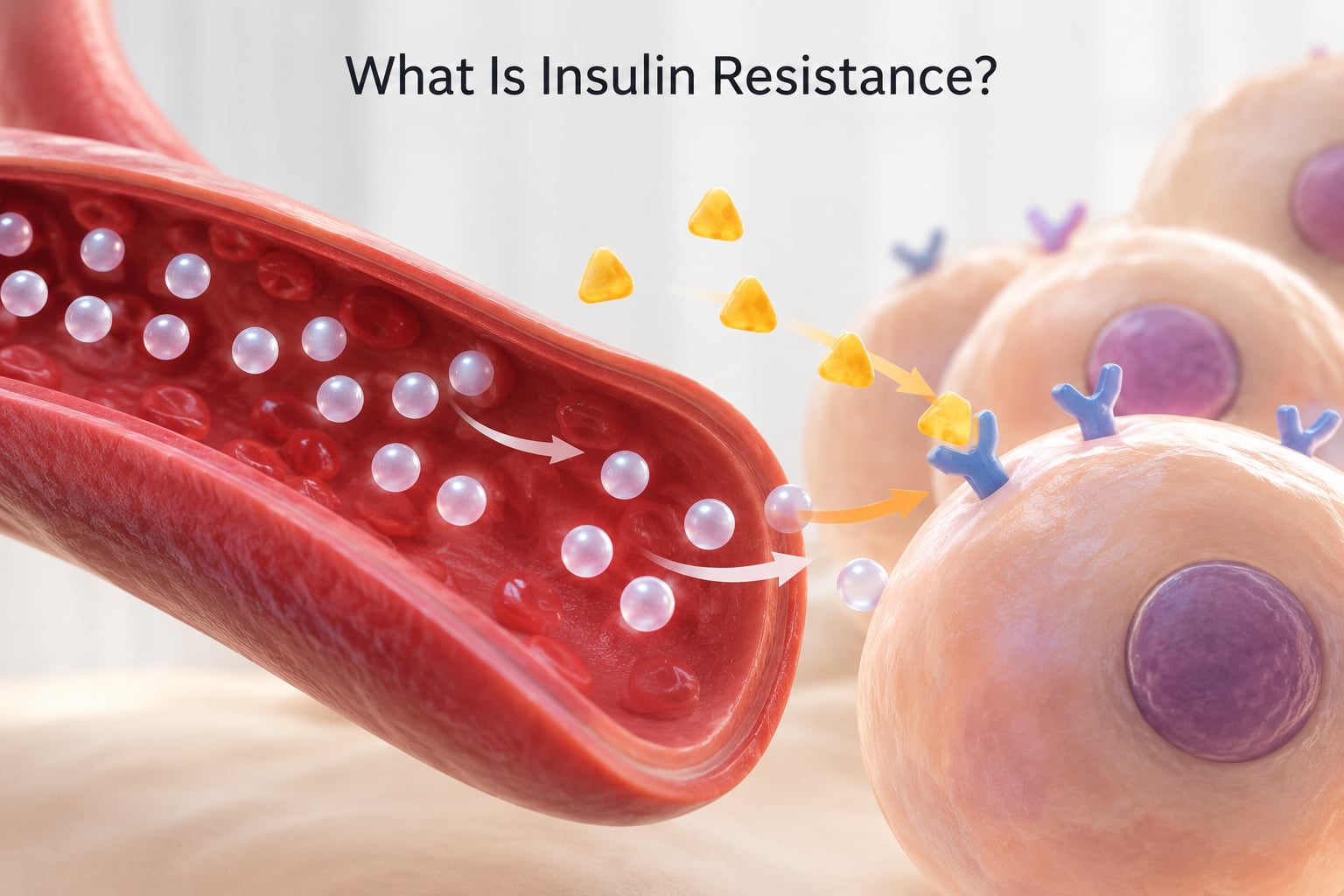
Insulin resistance means your cells respond poorly to insulin. Insulin is a hormone made by the pancreas that helps glucose enter muscle, fat and liver cells, where it can be used for energy or stored.
Think of insulin as a key and your cells as the lock. After a meal, glucose rises in the blood and insulin is released to open the door so that glucose can go in and come down to a safe level. In insulin resistance, the locks get stiff. The pancreas pushes out more insulin, the doors open less efficiently, and glucose lingers in the bloodstream longer than it should.
The NIDDK, part of the NIH, describes insulin resistance as a state in which the body does not respond well to insulin and cannot easily use glucose from the blood for energy, which can lead to high blood sugar and Type 2 diabetes over time. Cleveland Clinic frames it the same way: the cells in muscle, fat and liver do not respond effectively to insulin.
Two things are worth separating here. Normal regulation is a rise after eating and a return to baseline within a couple of hours. Insulin resistance is a sustained pattern where recovery is slower and the pancreas has to work harder to keep up. Hyperinsulinemia, the term for that extra insulin, often shows up in blood tests years before blood sugar itself looks abnormal.
What Causes Insulin Resistance?
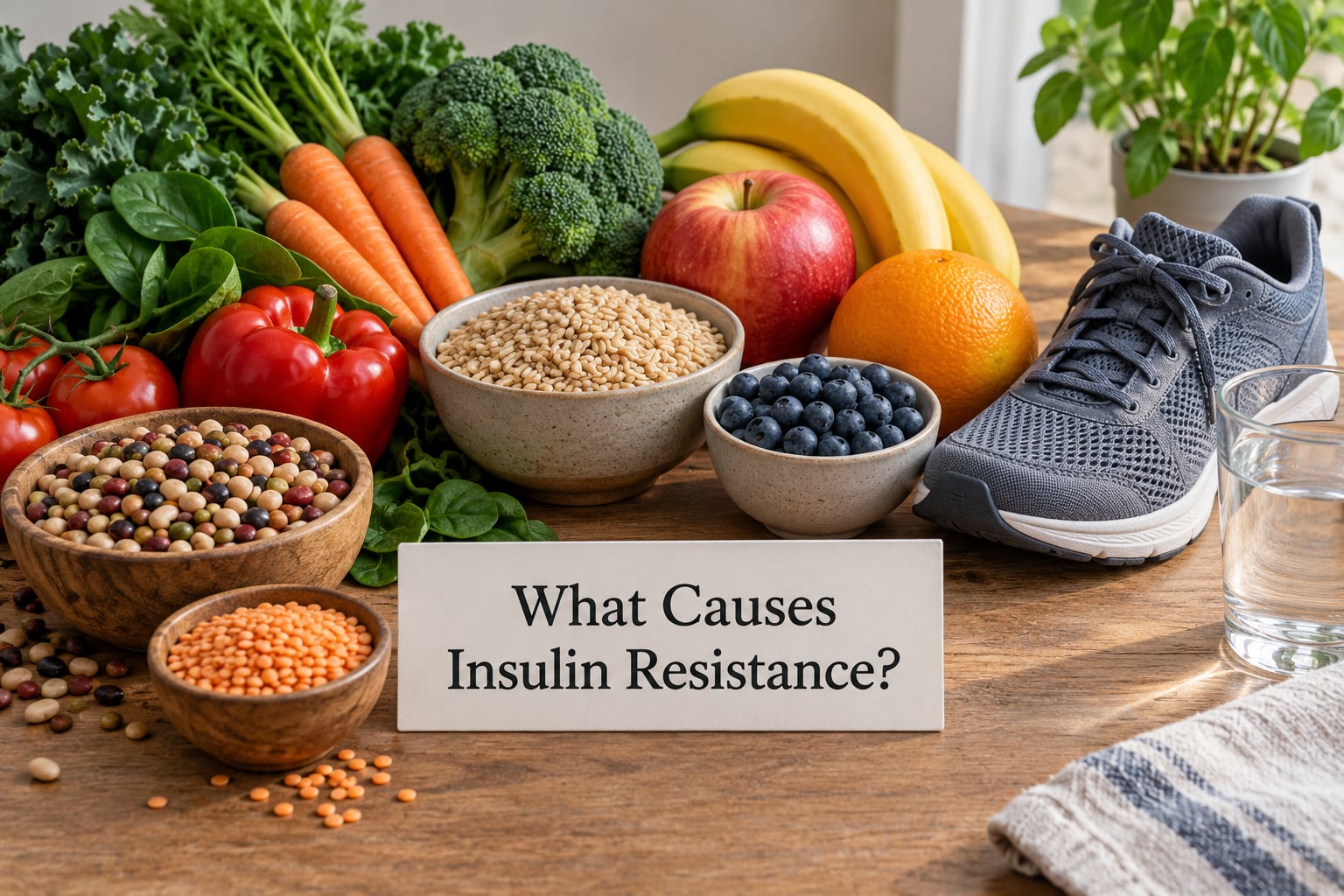
No single cause explains it. For most people it is a mix of what you inherited, how you sleep, how much you move, and where your fat sits in the body.
- Visceral and abdominal fat. Fat around the organs is strongly linked to insulin resistance, which is why waist size often tells a more useful story than weight alone.
- Physical inactivity. Muscle is the most insulin-sensitive tissue in the body, and unused muscle becomes far less efficient at taking up glucose.
- Eating patterns. A diet heavy in refined carbohydrates, added sugars and sugary drinks keeps insulin elevated through much of the day.
- Poor sleep and chronic stress. Sleep deprivation and sustained cortisol both raise blood sugar and blunt insulin signalling, and the two quietly cancel out most of the effort you put into your diet.
- Genetics and family history. A parent or sibling with Type 2 diabetes raises your odds substantially.
- Age. Insulin sensitivity tends to decline with age, and it tends to decline faster when the other factors above are also present.
- Certain health conditions. PCOS is the most common companion we see discussed, and fatty liver, high blood pressure, high triglycerides and low HDL often travel with it.
Causes vary between people. Two people with the same lab result can have completely different underlying drivers, which is one reason a diagnosis needs a clinician rather than a symptom checklist.
How Does Insulin Resistance Affect Weight?
Insulin resistance makes weight loss harder rather than impossible. It does not block fat loss, but it works against you in four places at once: hunger, cravings, fullness signals and the mechanics of storing and releasing energy.
Hunger gets louder. Constantly high insulin means glucose enters and leaves cells quickly, and the drop between meals registers as hunger even when you ate an hour ago. A lot of people describe being hungry shortly after finishing a meal that was large enough for anyone.
Cravings narrow in on fast carbs. A sharp rise and fall in blood glucose is the classic pattern behind wanting something sweet two hours after lunch. Frequently, the craving itself is a symptom rather than a lack of discipline, and treating it as a character flaw is both unfair and unhelpful.
Fullness signals get noisier. In a body that is not managing glucose well, meals high in refined carbohydrate tend to be less satisfying per calorie than meals built around protein, fibre and fat. You eat more across the day without ever deciding to.
Stored fat is harder to release. Insulin’s main job after a meal is to push energy into storage, and that signal tends to be elevated for longer when cells are resistant. The same signal that stores fat also inhibits the release of stored fat, which is the part that shows up as a plateaus that do not respond to effort.
Now the part that gets argued about online, so here is the honest answer. Calories still govern fat loss. Insulin resistance does not override the calorie balance, and telling someone with insulin resistance that their weight is unrelated to how much they eat is simply wrong. What insulin sensitivity actually governs is how easily you sustain a deficit, because it drives the hunger, the cravings and the energy crashes that push you back above it.
The practical consequence is worth stating plainly. The same 500-calorie deficit can feel manageable in a body that handles glucose well and nearly impossible in a body that does not, without either person cheating. Treating the hunger and cravings as a metabolic problem rather than a moral one is usually what makes a deficit survivable.
How Does Insulin Resistance Affect Blood Sugar and Energy?
Reduced insulin sensitivity means blood glucose can stay elevated longer after a meal. While blood sugar is above its usual range, the brain and muscles are running on less immediately available fuel, which is why some people report fatigue, brain fog, thirst or an energy slump in the hour or two after eating.
These are not diagnostic. A bad night’s sleep, a stressful week, anemia, thyroid problems and poor sleep can all produce the same feeling, and only lab results separate them. Track the pattern rather than the moment: if you feel wiped out after most meals and wired at bedtime, that is worth raising with your doctor.
Can Insulin Resistance Be Improved?
Yes. Insulin sensitivity can improve, often substantially, and it can happen well before any diagnosis of Type 2 diabetes. Modest weight loss is one of the strongest levers, alongside regular movement, eating patterns that keep glucose steadier, sleep and stress management.
A realistic timeline matters more than a dramatic promise. Many people report that cravings calm down and post-meal energy improves within the first few weeks of consistent change, because those are the fastest symptom signals to respond. Lab measures such as fasting glucose and A1C move more slowly, and re-testing is usually discussed at your next appointment rather than week to week.
Some people improve dramatically, some improve partially, and some need medication alongside lifestyle changes. Metformin and GLP-1 medications such as semaglutide are prescribed by clinicians for specific indications, and they are not lifestyle substitutes. Nothing on this page should be used to start, stop or change a prescription.
What Eating and Exercise Habits Support Insulin Sensitivity?
Build meals that keep glucose steadier and add movement that asks muscle to take up more glucose. Both matter, and both are unglamorous.
Fibre first. Beans, lentils, oats, vegetables, berries, whole grains and nuts slow digestion and blunt the glucose spike that follows a carbohydrate meal. Most adults fall well short of recommended fibre intake, so this is often the easiest place to start.
Protein with every meal. Protein at the start of a meal flattens the sugar rise that follows the carbs later on. Eggs, Greek yoghurt, fish, tofu, chicken, beans and cottage cheese cover most preferences.
Minimally processed carbohydrates. Whole grains instead of refined grains, whole fruit instead of juice, and a water glass or unsweetened drink instead of a sugary one. You are not banning carbs, you are removing the ones that arrive with nothing attached.
Walk. A ten to fifteen minute walk after a meal is one of the simplest and most reliable habits people report. Walking uses muscle contractions to pull glucose out of the blood independently of insulin, which is why it works even when insulin signalling is poor.
Do resistance work. Muscle is the most insulin-sensitive tissue in the body, and this is the single change most often cited by people who reversed insulin resistance. Two or three sessions a week is a realistic starting point, and a registered dietitian or trainer can help if you are starting from zero.
Protect sleep and recovery. Seven to nine hours. Untreated sleep apnoea and chronic stress quietly undo some of the benefit from everything above, and both are worth raising with a clinician.
Intermittent fasting comes up constantly in this conversation. It can work for some people because it reduces grazing, but it is not required for insulin sensitivity to improve, and it is not better than consistent moderate meals for everyone. If you are eating regularly and controlling portions, you already have a workable plan.
How Is Insulin Resistance Tested?
Testing usually starts with blood work your doctor already has or can order quickly, plus a fasting insulin level that most people with the condition have never had measured.
| Test | What it shows | Standard reference |
|---|---|---|
| Fasting glucose | Blood sugar after an overnight fast | Below 100 mg/dL is normal; 100 to 125 mg/dL is the prediabetes range |
| A1C | Your average blood sugar over roughly three months | Below 5.7 percent is normal; 5.7 to 6.4 percent is prediabetes |
| Fasting insulin | How much insulin your body needs at rest | Most labs list 2 to 19 uIU/mL, though ranges vary widely |
| HOMA-IR | A score derived from fasting insulin and fasting glucose | Often flagged above about 2.0, but cut-offs vary by lab |
| Triglycerides and HDL | Cholesterol markers that often move together with insulin resistance | Triglycerides below 150 mg/dL, HDL above 40 mg/dL for men and 50 mg/dL for women |
These ranges are the standard American Diabetes Association figures and your lab will print its own. A1C alone misses a lot of early insulin resistance because blood sugar can stay within range for years while fasting insulin is already climbing. That is the common experience of people whose A1C is fine but who still feel symptomatic and are told to lose weight without further investigation.
If you want to ask for the panel, this is a reasonable script: I would like fasting insulin alongside fasting glucose and A1C so you can calculate a HOMA-IR, plus triglycerides and HDL. Ask whether an oral glucose tolerance test makes sense in your case, and bring a list of what you have noticed and when.
Where does insulin resistance sit against the other two conditions? The table below covers that. The short version is that insulin resistance can exist without either diagnosis, and prediabetes is what it often becomes if nothing changes.
| Insulin resistance | Prediabetes | Type 2 diabetes | |
|---|---|---|---|
| Blood sugar | Normal or only mildly raised | Above normal, below the diabetes threshold | Consistently at or above the diabetes threshold |
| Fasting insulin | Usually elevated | Usually elevated | May be elevated or may be falling as beta cells strain |
| A1C | Typically normal | 5.7 to 6.4 percent | 6.5 percent or higher |
| Symptoms | Often none, or subtle | Often none | Thirst, frequent urination, fatigue more commonly present |
| Reversible | Often, with change over time | Often, with change over time | Manageable; remission is possible but not guaranteed |
When Should Someone Talk With a Healthcare Professional?
Arrange a conversation if any of this sounds familiar, especially if you have a family history of diabetes or Type 2 diabetes.
- Darkened or thickened skin in body creases, such as the neck or underarms, or small skin tags appearing in new places.
- Persistent hunger, cravings or binge-eating episodes that have become worse over time.
- Fatigue or brain fog that reliably follows meals, or feeling shaky and irritable before eating.
- Unexplained weight gain around the middle, or weight change you cannot account for.
- High triglycerides, low HDL, high blood pressure, fatty liver on an ultrasound, or a diagnosis of prediabetes or PCOS.
- Home readings that stay higher than your target range, or readings that swing widely.
Seek prompt medical care rather than waiting for a routine appointment if you have marked thirst with frequent urination, unexplained weight loss, vomiting, blurred vision, or wounds on your feet that are slow to heal. Those can point to blood sugar that has moved further than insulin resistance.
And talk to your doctor before changing your diet in a major way or starting any medication. Registered dietitians can also help with the food side, and that is a good split if your clinician handles the testing and the medication decisions.
Frequently Asked Questions
Is insulin resistance the same as diabetes?
No, and the difference is usually measured in years. Insulin resistance means your cells respond poorly to insulin, so blood sugar may still be within the normal range. Prediabetes is defined by blood sugar or A1C above normal but below the diabetes threshold, and Type 2 diabetes is defined by blood sugar at or above that threshold. Most people with Type 2 diabetes were insulin resistant for years first, which is why testing and early treatment matter.
Can insulin resistance make it harder to lose weight?
It can make weight loss harder, but it does not stop it. Insulin resistance drives the hunger, cravings and post-meal energy crashes that push people out of a calorie deficit, and it makes stored fat harder to release. A calorie deficit still governs fat loss, so losing weight remains possible, and weight loss itself is one of the most reliable ways to improve insulin sensitivity. Think of the two goals as working in the same direction.
Does insulin resistance always cause weight gain?
No. It is strongly associated with weight gain, especially around the abdomen, but plenty of people have insulin resistance at a normal BMI. Genetics, sleep quality, stress, PCOS and body composition all play a part, and someone who eats well and moves regularly can still have the condition. That is why weight alone is not a useful screening tool and why fasting insulin and A1C are worth asking about.
What symptoms can suggest insulin resistance?
The most commonly reported ones are constant hunger, cravings for sweet food, difficulty feeling satisfied after a meal, and fatigue or brain fog in the hour or two after eating. Darkened skin in body creases, small skin tags, high triglycerides and low HDL are the more physical markers. None of these symptoms confirm the condition, and several overlap with thyroid problems, anemia and poor sleep, so lab work is what actually settles it.
How quickly can insulin sensitivity improve with lifestyle changes?
Faster than most people expect on symptoms, slower on lab numbers. Many people notice cravings and post-meal energy improving within a few weeks of consistent eating and movement changes. Glucose and insulin markers generally take several months of steady work, and your doctor will usually retest rather than judging progress week to week. Consistency matters more than intensity, and sleep and stress changes count just as much as diet and exercise.
Should I take insulin or another medication for weight loss?
Do not start or change a prescription on your own, and do not take insulin for weight loss, because insulin is not a weight-loss medication. Metformin and GLP-1 medications such as semaglutide are prescribed by clinicians for specific indications such as prediabetes, Type 2 diabetes or PCOS, and they are managed alongside lifestyle work. If medication is relevant to you, book an appointment and bring your family history and any recent lab results to that conversation.
Conclusion: Start With One Manageable Change
Insulin resistance is common, usually silent, and worth taking seriously. It affects weight through hunger, cravings, fullness signals and how readily stored fat is released, which is why losing weight can feel harder for the same amount of effort. It is also one of the more responsive metabolic problems, and modest weight loss, regular movement and steadier eating patterns can move it substantially.
Pick one thing and keep it up for a month. For most people it is a fifteen-minute walk after dinner, or adding protein and a vegetable to breakfast so lunch stops being an emergency. Progress from one habit is easier to keep than progress from five.
Whichever you choose, book the appointment and ask for fasting insulin alongside A1C and fasting glucose, so you are working from real numbers rather than symptoms alone.