
If you want to know how to sleep better to lose weight, the short version is this: aim for 7 to 9 hours of consistent, good-quality sleep, keep the same bedtime and wake time every day, and treat the last hour before bed as part of your nutrition plan rather than leftover time. You can start this evening, and most of the setup takes under an hour.
Sleep is not a magic switch that burns fat on its own. What it does is set the hormonal conditions your body runs on during the day, and those conditions decide how hungry you feel, how well you recover from training, and whether you can stick to the plan you set.
Over the next few minutes I’ll walk through seven habits in the order that works best, why each one matters for weight loss, and the small sign that tells you it’s helping. Nothing here requires a membership, a gadget, or a supplement.
Table of Contents
- What You Need
- Step-by-Step: How to Sleep Better to Lose Weight
- 1. Set a Regular Sleep and Wake Schedule
- 2. Create a Dark, Quiet, Comfortable Sleep Environment
- 3. Wind Down Before Bed
- 4. Limit Late Caffeine, Alcohol, and Heavy Meals
- 5. Use Light, Movement, and Meals Strategically During the Day
- 6. Build a Helpful Bedtime and Morning Check-in
- 7. Support Sleep to Lose Weight With a Sustainable Routine
- Common Mistakes
- Frequently Asked Questions
- How much sleep do adults need to support weight loss?
- Will sleeping more help me lose weight?
- What should I do if I had poor sleep after eating late?
- Can I use a sleep app to improve my sleep and manage my weight?
- When should I talk with a doctor about sleep problems?
- Does sleep itself cause weight loss?
- Start Tonight, Not Monday
What You Need
You need four things, and honestly three of them are free. The list is short because the routines people describe as complicated usually come down to a handful of decisions repeated nightly.
- A comfortable sleep environment. A dark, quiet, cool room and a bed you actually look forward to. This is the highest-return change for most people who say they sleep badly.
- A manageable evening schedule. A fixed wake time, and enough room before it for a 30- to 60-minute wind-down. If your evening is packed to 11:45 p.m. every night, the routine has to shrink or start earlier.
- A calm wind-down period. Dim lights, no work, no arguing, no doomscrolling. Something boring enough to be a transition.
- A way to track sleep and daytime energy. A cheap notebook works. A sleep app or wearable is optional and useful, but it is a tool for noticing patterns, not a score to chase.
That is genuinely it. No special pillow, no meal plan, no supplement stack required.
Step-by-Step: How to Sleep Better to Lose Weight
Work through these in order over about two weeks, adding one at a time rather than all seven at once. Doing everything on night one is the most common way people quit by night four.
1. Set a Regular Sleep and Wake Schedule
Pick a wake time and hold it every day, weekends included. That single fixed point does more for your sleep than almost anything else you can control.
A steady schedule keeps your circadian rhythm stable, and that rhythm is what sets your appetite hormones, body temperature, and energy across the day. When your sleep window jumps around by three hours, hunger cues land at odd times and your training schedule drifts with them.
Most people aiming to lose weight do better in a mid-range target: at least 7 hours. People who consistently cut to 5 or 6 hours report more hunger and worse food choices, which matters more than the missing hour itself.
Go to bed when tired, not on a rigid clock, and get up at your fixed time even after a bad night. Sleep efficiency, meaning the share of your time in bed actually spent asleep, tends to improve once the wake time stops moving.
How to tell it is working: you fall asleep within about 15 to 20 minutes most nights, and daytime energy stops dipping hard in the late afternoon.
2. Create a Dark, Quiet, Comfortable Sleep Environment
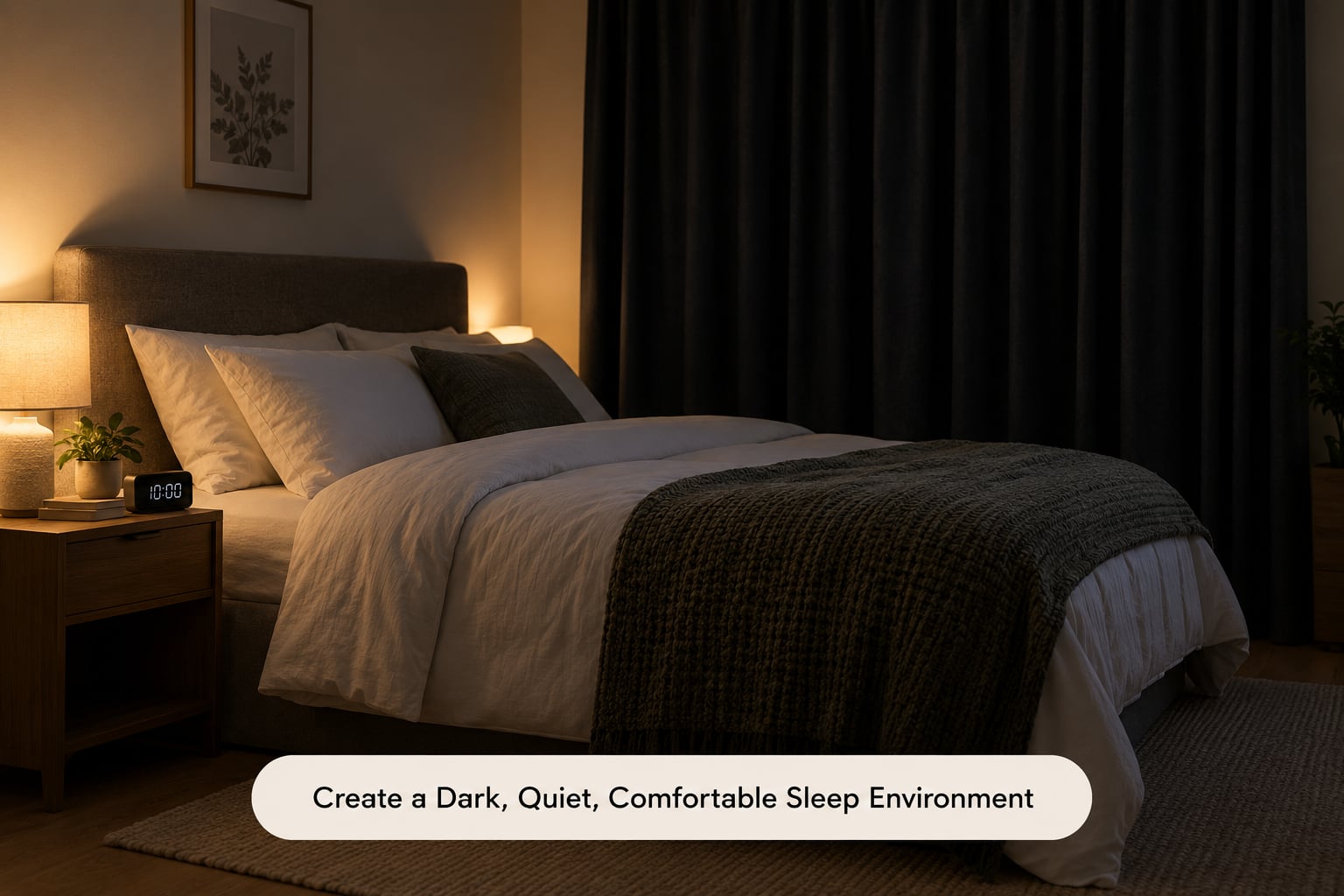
Your bedroom should be dark, quiet, and cool. Those three conditions matter more than the mattress brand you paid for last year.
Light is the biggest lever. Streetlights, standby LEDs, and phone screens all push back melatonin release and delay sleep onset. Blackout curtains are usually the single highest-impact change people make, and they cost less than people expect.
Noise wakes people without them noticing. A fan, a white noise machine, or steady background audio covers sudden sounds like a door slam or a neighbor’s TV.
Temperature follows the same logic. A room that feels cool lets your core temperature drop, which is part of what signals your body it is time to sleep.
Charge your phone across the room, not on the pillow. You may still use it in bed, but you remove the temptation to check it at 2 a.m. and start negotiating with yourself about tomorrow’s plan.
How to tell it is working: you stop waking during the night, and getting out of bed in the morning stops feeling like a decision you have to fight.
3. Wind Down Before Bed
Give yourself 30 to 60 minutes between the end of the day and getting into bed. Dim the overhead lights, put the phone away, and pick one quiet, repeatable thing.
Reading paper, stretching for five minutes, or writing tomorrow’s top three tasks in a notebook all work. The point is that your brain gets a consistent signal that the day is closing.
Do not run your to-do list in bed. Reviewing unfinished work raises cortisol, and elevated cortisol late at night is one of the patterns most consistently linked with disrupted sleep and cravings the following day.
People who write their open loops down tend to stop replaying them in the dark. It takes two minutes and it works far better than lying there rehearsing tomorrow’s arguments.
How to tell it is working: the gap between getting into bed and drifting off gets shorter.
4. Limit Late Caffeine, Alcohol, and Heavy Meals
Caffeine has a half-life of roughly 5 to 6 hours in most adults, so a 4 p.m. coffee can still be doing work at midnight. A 10-hour cutoff is a common rule of thumb for anyone whose sleep is not solid.
Alcohol deserves its own note because it is easy to get wrong. It may help you fall asleep faster, but it suppresses restorative deep sleep and fragments the second half of the night, so you wake less refreshed after more drinks rather than fewer.
Large, heavy meals close to bedtime leave you uncomfortable and can raise reflux. A normal-sized dinner two to three hours before bed is usually a better balance than a big meal right before lights out, or than going to bed starving.
If you are hungry at night, that is a signal to check yesterday’s portions, not to override your hunger every evening. Persistent night hunger is worth raising with a doctor or registered dietitian.
How to tell it is working: fewer night wakings, and less of the 9 p.m. vending machine run.
5. Use Light, Movement, and Meals Strategically During the Day
Sleep quality is built during the hours you are awake. Three levers matter most: daylight, activity, and meal timing.
Get outside in the morning, even for 15 or 20 minutes. Natural light early in the day anchors the clock that governs melatonin later at night, and people who get morning daylight usually report an easier wind-down.
Regular activity makes sleeping easier for most people. Training gives you something to be tired from, and weightlifting in particular tends to improve sleep quality more than steady cardio, partly because of the fatigue it creates and partly because of how it affects mood.
For evening workouts, finish vigorous sessions at least a couple of hours before bed. Light stretching or an easy walk right before bed is usually fine, but a hard session at 9:30 p.m. can leave some people wired.
On meals, many people find that a consistent daytime window works well, often something like 10 to 12 hours. Finishing dinner several hours before bed supports both sleep quality and appetite control the next morning.
If you nap, keep it short. Fifteen to 20 minutes early in the afternoon restores energy without cutting into nighttime sleep.
How to tell it is working: your evening comes to an end at a reasonable hour without a fight, and training feels less like it drains you for two days.
6. Build a Helpful Bedtime and Morning Check-in
Write down five things each morning, and it takes under a minute: roughly when you fell asleep, roughly when you woke up, how many times you woke overnight, your energy level from 1 to 5, and whether you stuck with your eating plan.
This turns how to sleep better to lose weight from a vague intention into something you can actually adjust. Most people find one recurring pattern in a fortnight, usually a specific bedtime or a specific evening habit, rather than a general feeling that “sleep is bad.”
Change one variable at a time. If you move bedtime, add evening light control, and cut caffeine the same week, you will not know which one did it, and you will probably drop all three.
If you use an app or wearable, look at trends over weeks rather than nightly scores. Those devices are useful for spotting a pattern, and they are poor at telling you whether you slept well. Their estimates run on assumptions your phone and watch cannot verify.
How to tell it is working: your check-in sheet shows a change in the same direction two weeks in a row.
7. Support Sleep to Lose Weight With a Sustainable Routine
Improved sleep makes a weight-loss routine easier to follow. It does not replace one. If your eating pattern and activity are off track, better sleep will help you hold the plan, not substitute for having one.
On the nutrition side, aim for balanced meals with protein, fiber, and produce rather than an aggressive cut. Very large calorie deficits are a common cause of middle-of-the-night waking, and waking at 3 a.m. hungry is often hunger, not poor sleep habits.
Set realistic goals. Slow, repeatable progress survives bad weeks, and rushed progress tends to end in rebound weight and more disrupted sleep.
Two situations deserve specific attention. Shift workers often cannot reach 7 to 9 hours on a fixed clock, and many still make steady progress by anchoring sleep where they can, keeping meals consistent, and protecting the sleep block that matters most. During perimenopause and menopause, hormonal changes can disrupt sleep and shift fat distribution at the same time, which is a good reason to talk to a doctor rather than guess.
Supplements come up constantly. Magnesium and melatonin come up most, and both have real cautions and interactions, so discuss them with a doctor or pharmacist before adding them to your routine.
How to tell it is working: weight moves slowly and steadily, and you are not constantly fighting your own bedtime.
Common Mistakes
Chasing a perfect sleep score. Wearables are estimates, and treating the number as a grade turns sleep into another thing you can fail at. Track trends and energy, not a single night.
Spending extra time in bed when you cannot sleep. Lying awake for hours teaches your brain that bed is where you think. If you are up much longer than 20 minutes, get up, do something quiet in dim light, and return when sleepy.
Using sleep as punishment for eating. Staying up late to make up for a meal does not erase calories and reliably wrecks the next day. Fix the meal and go to bed at your normal time.
Grabbing supplements on day one. Melatonin and magnesium products vary widely in dose and quality, and both can interact with medications. Talk to a clinician first, then start with the lowest sensible dose.
Changing seven habits at once. You will not know what worked, and you will burn out. Add one habit per week, keep the ones that work, drop the ones that do not.
Two implementation tips that help most people. Fix the wake time first, because it anchors everything else. And keep a two-minute evening note of what you ate and when, so you can spot the connection between late meals and bad nights instead of guessing.
Frequently Asked Questions
How much sleep do adults need to support weight loss?
Most adults do best with 7 to 9 hours a night, consistently rather than occasionally. Going under 6 hours for extended periods is linked with higher hunger hormones, lower insulin sensitivity, and poorer food choices. If you are a shift worker or a caregiver, the total matters less than whether your sleep block is long enough and reasonably unbroken most nights.
Will sleeping more help me lose weight?
It helps indirectly rather than directly. Better sleep tends to reduce hunger, improve insulin sensitivity, support training recovery, and make your eating plan easier to follow, all of which support fat loss. On its own, extra sleep does not burn a meaningful number of calories. Think of it as removing the obstacle rather than adding the workout.
What should I do if I had poor sleep after eating late?
Go to bed at your usual time rather than staying up or going to bed excessively early to compensate. A single late meal rarely undoes a week of work, and sleep loss usually costs more than the meal did. If the scale jumps the next morning, that is most often water and food volume, not fat, and it usually settles within a day or two.
Can I use a sleep app to improve my sleep and manage my weight?
Yes, with a caveat. Apps and wearables are good at showing patterns across weeks, such as whether you sleep worse after late meals or evening workouts. They are not accurate enough to judge a single night. Use the trends alongside a short written check-in of your energy, hunger, and routine, and ignore the nightly score.
When should I talk with a doctor about sleep problems?
Talk to a doctor if poor sleep persists for a few weeks despite consistent schedule and environment changes, or if you snore loudly, wake gasping, feel sleepy while driving, or struggle to stay awake through the day. Those signs can point to sleep apnea or another treatable condition. Persistent night hunger, night eating, or sleep disruption during perimenopause also deserve a clinical conversation.
Does sleep itself cause weight loss?
No. Sleeping burns fewer calories than most people expect, and the small amount your body uses at night is not enough to shift weight on its own. Weight change comes from a sustained difference between what you eat and what you use. Sleep influences that balance by shaping appetite, stress hormones, and energy, which is why it matters and why it is not a substitute for diet and movement.
Start Tonight, Not Monday
Pick one thing: set your wake time and hold it for seven days. That single anchor usually does more for your sleep than any gadget, and it gives you a base to build the rest of the routine on.
Then add the environment fixes, because they are cheap and immediate. Keep eating well and moving during the day, and remember that better sleep supports weight loss rather than causing it. Most of the work is small and dull, which is exactly why it works.