Coffee helps a little, mostly by substitution. A cup of black coffee has 2 to 5 calories, so swapping it in for a sweetened drink removes calories, and caffeine can nudge metabolic rate up by roughly 3% to 11% for a few hours. It is not a fat-burning shortcut, and an overall calorie deficit still does all the real work.
I have watched people take this simple fact and twist it into something stronger than the evidence supports. Coffee is not a metabolism pill you can drink by the mugful. It is a low-calorie drink that can replace a higher-calorie one, and that is the part worth caring about.
Below is what the research does and does not show, how the cup you order changes the numbers, how much is too much, and how to drink coffee in a way that works with weight loss rather than against it. This is general information, not medical advice, so talk to your doctor if you have a health condition or take medication.
Table of Contents
- Does Drinking Coffee Help You Lose Weight?
- Does drinking coffee help you lose weight on its own?
- How Coffee Could Affect Body Weight
- What Does the Research Say?
- Why the effect seems to fade over time
- How Many Calories Are in Coffee?
- Can Caffeine Increase Fat Burning?
- How to Drink Coffee for Weight Management
- How Much Coffee Is Too Much?
- Coffee Before Exercise: Helpful or Harmful?
- Potential Downsides of Drinking Coffee for Weight Loss
- Frequently Asked Questions
- Does drinking coffee on an empty stomach help you lose weight?
- Is black coffee better than coffee with milk for weight loss?
- Does coffee make you feel less hungry or burn more fat?
- Is drinking coffee in the morning better for weight loss?
- Can replacing sugary drinks with coffee help me lose weight?
- Conclusion
Does Drinking Coffee Help You Lose Weight?
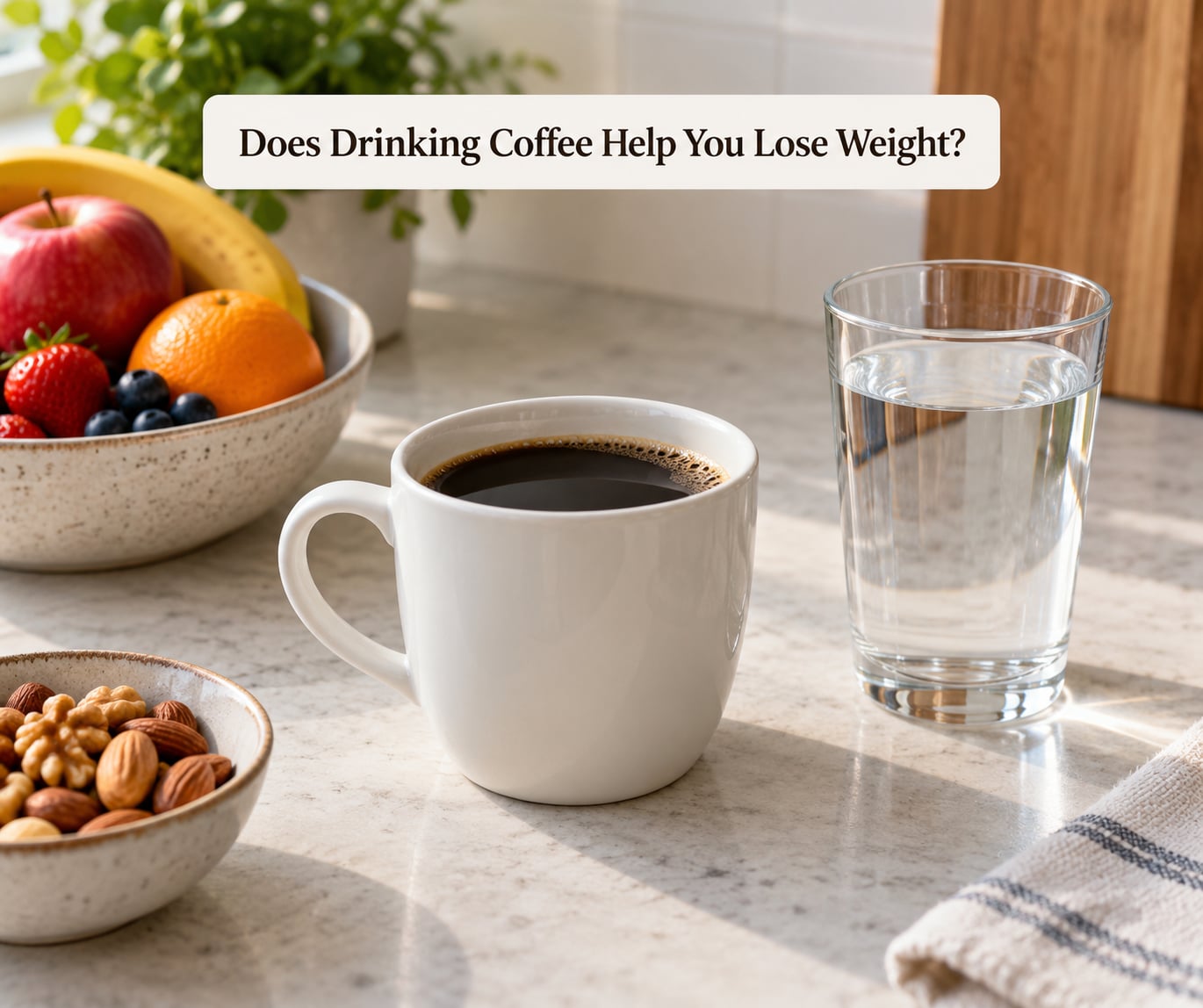
The honest answer is that coffee supports weight loss only on a small scale, and mostly through the choices around it rather than the coffee itself. Unsweetened coffee adds almost nothing to your calorie intake. Caffeine gives some people a short appetite dip and a temporary lift in metabolic activity. Neither effect is large enough on its own to move body fat meaningfully.
The scale change people notice in the first week or two usually comes from a different source. Caffeine is a mild diuretic, and reducing one drink while adding another can shift fluid balance. Water weight is not fat, and it disappears as soon as your intake returns to normal.
Does drinking coffee help you lose weight on its own?
No. Coffee has no fat in it to remove, no meaningful fiber to fill you up, and no protein to keep you full. It cannot create a calorie deficit, because it contributes almost no calories of its own.
Think about the arithmetic differently. If you already drink coffee and you take out the sugar and the cream, you have cut something real. If you add four cups of black coffee on top of an unchanged day, you have changed almost nothing, because those four cups were nearly free to begin with.
Weight loss still comes down to eating fewer calories than you burn, eating enough protein and nutrients to keep functioning, moving regularly, and sleeping. Coffee is a detail inside that, not a substitute for it.
How Coffee Could Affect Body Weight
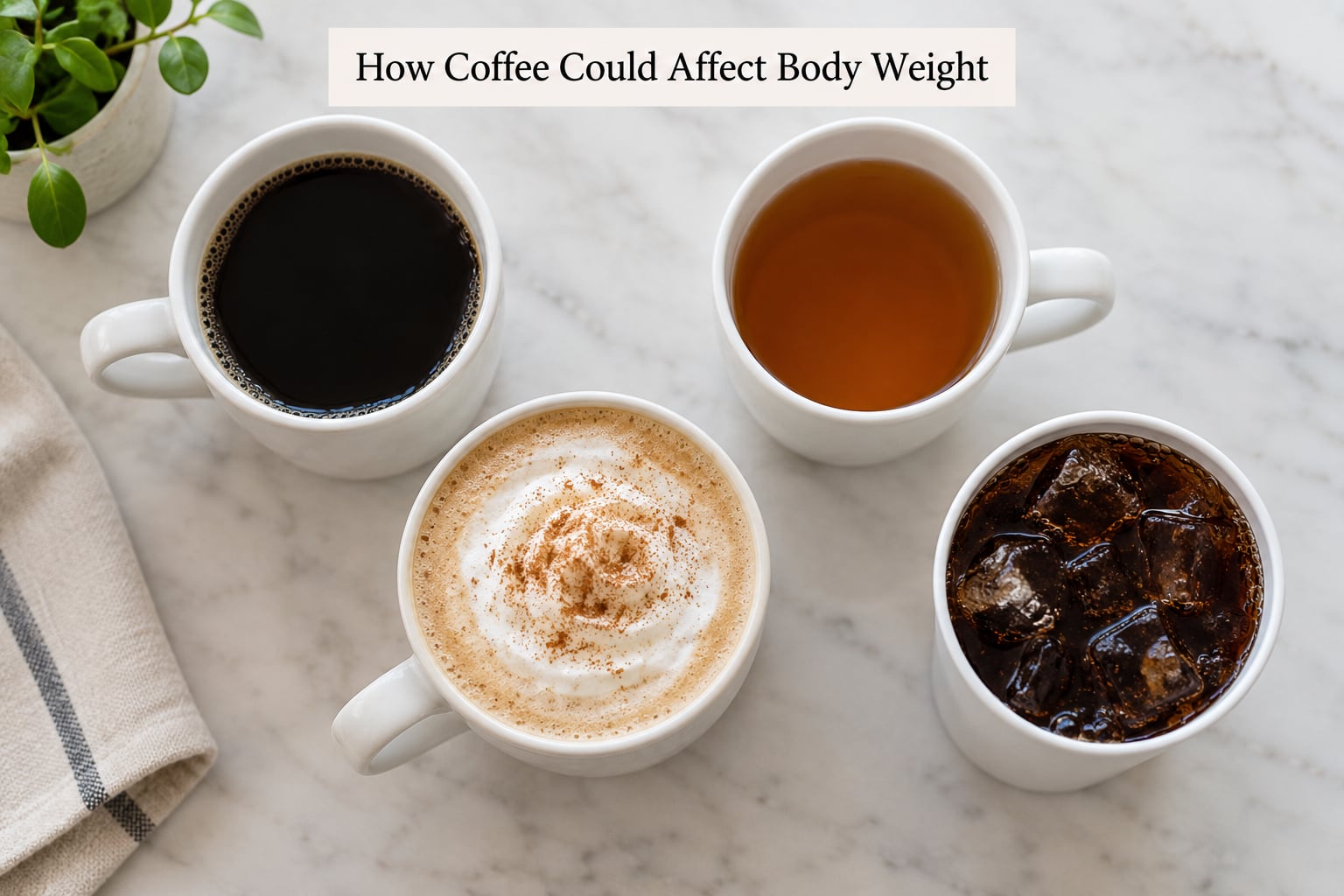
Four mechanisms get blamed for coffee’s effect on weight. Three are real but modest. One is the one people actually feel, and it has nothing to do with caffeine burning fat.
Drink substitution. This is the strongest mechanism and the easiest to verify. Replace a sweetened latte, a soft drink, or an afternoon snack drink with black coffee, and the day has fewer calories in it. Nobody has to feel virtuous about it.
Short-term appetite blunting. Caffeine and chlorogenic acid, a compound coffee is known for, may dampen hunger signals briefly for some people. The effect is real in lab settings and uneven in real life, because a coffee that has syrup in it brings its own calories right back.
Higher alertness and movement. A caffeinated person often paces more, moves more, and is more likely to walk rather than sit. That extra incidental activity is modest but not nothing.
Fluid shifts. Caffeine increases urine output slightly. A pound or two can disappear in a few days, then return. If your progress chart is measuring fat, this is noise.
| Proposed effect | How it could help | How much it matters | How certain the evidence is |
|---|---|---|---|
| Replacing a higher-calorie drink | Removes 100 to 300 calories a day from the total | High, if you actually make the swap | Strong, because it is arithmetic |
| Temporary appetite reduction | Fewer calories eaten in the hour or two after | Low to moderate, and varies by person | Mixed, mostly small trials |
| Short metabolic bump | Burns slightly more energy for a few hours | Low | Consistent but small, and it fades with tolerance |
| More incidental movement | Pacing, walking, staying on your feet | Low | Plausible but poorly measured |
| Diuresis | Sheds water weight briefly | None for fat loss | Well established, and irrelevant to body fat |
Read that table and the pattern is clear. The row with the biggest effect is the one that involves changing a habit, not a molecule.
What Does the Research Say?
Coffee research splits into two kinds of evidence, and they get mixed together constantly.
Observational studies follow large groups of people and look at what correlates with what. Many have found that regular coffee drinkers tend to have slightly lower weight, lower risk of type 2 diabetes, and healthier liver outcomes. Those findings are useful, but correlation is not causation. Coffee drinkers also tend to be more active, to smoke less, and to have more money and education than non-drinkers, and each of those differences moves body weight on its own.
Controlled trials give cleaner but smaller answers. Small studies of caffeine show a short-lived rise in metabolic rate and, in some trials, a small reduction in food intake during the hours after a dose. These are genuine findings. They are also measured over hours rather than months, which is the entire problem when people use them to predict a change on the scale.
One figure circulates constantly: roughly 4% lower body fat among people drinking about four cups a day. It comes from observational work, so it cannot tell you whether the coffee caused the difference or simply marked a set of habits that did. Treat it as a reason to keep drinking coffee if you enjoy it, not as a forecast.
Coffee type, dose, how much you already drink, the rest of your diet, your sleep, and your own genetics all change the response. Someone who drinks two cups a day and sleeps eight hours is not in the same experiment as someone drinking six cups and sleeping five.
Why the effect seems to fade over time
Caffeine tolerance is real. With regular use, the jolt fades and the measurable rise in metabolic rate gets smaller, which is why habitual heavy drinkers often report that coffee no longer wakes them up. You are not imagining it, and it is another reason to keep intake moderate rather than escalating.
There is a named version of this thinking in popular diet blogs: the coffee diet, roughly three cups of black coffee a day alongside a very low calorie target. Some readers report losing weight on it, and it can work in the same way any severe restriction works for a while, by eating very little. The mechanism is the calorie restriction, not the coffee, and the results rarely hold once eating returns to normal.
How Many Calories Are in Coffee?
Black coffee is close to nothing. Everything else is a story about what got poured into the cup. The ranges below are typical US servings, and brands and recipes vary enough that a menu will always be more accurate than a table.
| Preparation | Typical calories | Where the calories come from |
|---|---|---|
| Black coffee, 8 oz | 2 to 5 | Effectively none |
| Coffee with a splash of milk | 25 to 50 | Milk protein and fat |
| Coffee with unsweetened oat or soy milk | 40 to 80 | Plant milk, mostly the added starches |
| Basic latte, 8 to 12 oz | 110 to 190 | A full serving of whole or 2% milk |
| Flavored or syrup-based drink | 180 to 350 | Syrup, flavored shots, extra cream |
| Blended iced or hot coffee drink | 250 to 500 | Cream, sugar, ice, toppings, whipped cream |
The two categories worth scrutinising are syrup and blended drinks. Both are desserts with coffee in them, and both are easy to order repeatedly without noticing. A 300-calorie blended drink twice a week is roughly 2,000 calories a week that most people never log.
Flavored creamers are the quiet version of the same problem. Powdered creamers often contain sugar, milk powder, and thickeners, and a scoop can run from 20 to 100 calories depending on the brand. If you want creaminess, a splash of real milk is cheaper on calories and tastes less artificial.
Can Caffeine Increase Fat Burning?
Yes, slightly and briefly. Caffeine stimulates the central nervous system, which raises adrenaline and nudges the body toward breaking down stored fat for fuel. Metabolic rate can climb by roughly 3% to 11% in the hours after a dose, and the effect is larger for smaller people and for people who are not used to caffeine.
Here is the part that gets left out. That bump lasts a few hours, wears off as the caffeine clears, and shrinks as tolerance builds. It is also a small number relative to what a day of eating looks like. A 5% lift on a 2,000-calorie burn for a couple of hours is a rounding error next to a single slice of pizza, and it disappears completely if the same day contains a large snack.
Caffeine is not thermogenic enough to move body fat on its own, and anyone describing it as a fat burner has oversold a genuinely interesting bit of physiology. It is also worth saying plainly that caffeine does not burn belly fat specifically. There is no evidence that coffee targets abdominal fat, and any claim of spot reduction deserves suspicion.
How to Drink Coffee for Weight Management
If coffee is already part of your day, these adjustments are the ones that actually change the arithmetic.
- Keep the sugar out. Black, or with cinnamon, or with a splash of unsweetened milk. Cutting two sugars in a large coffee is one of the fastest calorie reductions available anywhere in a typical diet.
- Measure the creamer. Half a cup of heavy cream is around 100 calories. Poured freehand, it is easy to double without noticing.
- Skip syrups and flavored creamers. This is where the calories hide in drinks that look innocent.
- Count the blended drinks as dessert. Not as coffee, and not as a beverage you can have freely.
- Use it to replace, not to add. A coffee in place of a soft drink is a win. Two extra coffees on top of an unchanged day is a wash.
- Do not use coffee to skip meals. Caffeine makes hunger quieter, not gone. Pushing through it repeatedly is how people end up eating more at dinner.
- Watch the evening cup. This is the one most people get wrong, and it is covered below.
- Keep it alongside ordinary meals. Coffee with breakfast is fine, and a small amount of unsweetened coffee does not break most intermittent fasting protocols, though anything with calories or significant cream ends a fast.
People who drink coffee regularly should also remember that these benefits only matter while the rest of the pattern holds. A registered dietitian can look at your actual intake and tell you where the calories are actually going, which is usually somewhere other than the morning cup.
How Much Coffee Is Too Much?
For most healthy adults, the FDA cites 400 mg of caffeine per day from all sources as a level not generally associated with dangerous effects. That is roughly four 8 oz cups of brewed coffee, though the real number per cup varies enormously.
| Drink | Approximate caffeine | Percent of the 400 mg daily limit |
|---|---|---|
| Brewed coffee, 8 oz | 80 to 100 mg | About a quarter of the limit |
| Espresso, single shot | 60 to 80 mg | About a fifth of the limit |
| Decaf coffee, 8 oz | 2 to 10 mg | Negligible |
| Green tea, 8 oz | 25 to 35 mg | Under a tenth of the limit |
| Energy drink, 8 oz | 80 to 300 mg | Up to three quarters of the limit in one can |
| Large blended coffee drink | 150 to 350 mg | Often more than an eighth of the limit |
Some people need much less. A low limit applies during pregnancy, where the commonly cited guidance is 200 mg per day, and clinicians generally advise similar caution in adolescence. People with anxiety, panic disorder, reflux, insomnia, certain heart conditions, or a fast heart rate often do better on a lower dose, and several common medications interact with caffeine in ways that change the safe ceiling.
Coffee Before Exercise: Helpful or Harmful?
Caffeine has one clear, well-replicated benefit for exercise: about 3 to 6 mg per kilogram of body weight taken roughly 30 to 60 minutes beforehand can make hard efforts feel easier. That is a performance effect, and it is not a weight-loss effect. Working out harder is worth doing for its own reasons, but a faster mile and a lower body fat number are two separate things.
Coffee is not a pre-workout meal. It contains almost no protein and very little carbohydrate, so it does not fuel a session. Drink it alongside something with carbs if you train fasted or early, and drink water regardless.
The reason to be careful is the after-effects. For a moderate dose, too much jitteriness to lift weights properly is a real complaint. Jitters, nausea, and a racing heart tend to cut sessions short rather than improve them. And caffeine that lands four to six hours before bed, with a half-life of five to six hours, is often still active when you try to sleep, and poor sleep raises hunger hormones and makes weight loss noticeably harder.
A simple rule that works for most people: one moderate cup before training, nothing new on days you test, and finish all caffeine at least eight hours before bed.
Potential Downsides of Drinking Coffee for Weight Loss
The habit is mild for most people and genuinely difficult for others, and the problems are worth knowing before you lean on it.
Sleep disruption is the big one. Poor sleep increases hunger and cravings the following day, so a late coffee can quietly work against the weight loss you are trying for. Caffeine half-life is five to six hours on average, which means an afternoon cup is often half-active at midnight.
Withdrawal shows up as headache, fatigue, and irritability within a day or two of cutting back. Taper gradually rather than stopping cold.
Jitters, anxiety, and reflux affect people with sensitive stomachs or anxious dispositions, and both are reasons to reduce rather than push through.
Added-calorie beverages quietly undo the point, as covered above.
Using coffee as punishment or compensation. Treating a cup as a way to morally cancel out food tends to backfire, and it is worth asking what the drink is actually doing for you.
Impatience. People who expect visible fat loss in a week give up early. This is the most common reason a coffee-based plan quietly fails, and it is not a coffee problem.
Seek medical care rather than adjusting your intake yourself if you experience persistent palpitations, severe headaches, fainting, chest pain, or changes in breathing. Anyone with a medical condition, who is pregnant, or who takes prescription medication should get personal guidance from a doctor or pharmacist before changing how much they drink.
Frequently Asked Questions
Does drinking coffee on an empty stomach help you lose weight?
Coffee has almost no calories, so an empty-stomach cup does not add them. Some people find caffeine blunts hunger briefly, but the effect is mild and often fades within an hour or two. Coffee before breakfast can also bother the stomach or trigger reflux in susceptible people. If it sits well for you, there is no strong reason to avoid it on weight-loss grounds.
Is black coffee better than coffee with milk for weight loss?
Black coffee is the lowest-calorie option, usually 2 to 5 calories per 8 oz cup. A splash of milk adds roughly 25 to 50 calories, which is still modest, and unsweetened oat or soy milk runs a little higher. The drinks that undo the habit are syrups, flavored creamers, and blended coffee-shop drinks, which can reach the hundreds. Cream for taste is fine if the rest of your day still fits.
Does coffee make you feel less hungry or burn more fat?
Caffeine can raise metabolic rate by roughly 3% to 11% for a few hours after a cup, mostly through the nervous system and adrenaline. That is a real but small and short-lived bump that shrinks as your body builds tolerance. Appetite suppression varies a lot between people. Over weeks and months, the acute effect is far too small to produce noticeable fat loss by itself.
Is drinking coffee in the morning better for weight loss?
Morning is popular for practical reasons: most people get the appetite and energy benefit before the day’s food decisions, and an early finish protects sleep. There is no good evidence that a morning cup burns more fat than an afternoon one. What matters more is stopping at least eight hours before bed, since caffeine’s half-life of five to six hours leaves an afternoon cup partly active at midnight.
Can replacing sugary drinks with coffee help me lose weight?
This is the most reliable way coffee affects weight. A sweetened coffee or soft drink can carry 100 to 300 calories a day that most people never log. Swapping it for black coffee or coffee with a splash of unsweetened milk removes most of that. So does drinking coffee help you lose weight? In that sense yes, because it replaced something, not because caffeine did anything special.
Conclusion
Unsweetened coffee fits comfortably in a weight-conscious diet, and it is genuinely useful when it replaces a sugary drink or an afternoon snack. It does not cause meaningful weight loss on its own, and anyone promising otherwise is selling something.
Start with the cup rather than the cup count: remove the sugar, use a measured splash of milk, and treat blended coffee-shop drinks as dessert. Keep your last cup at least eight hours before bed, watch how much caffeine you are actually consuming across the day, and make one change to food or activity at a time so you can tell what worked. If weight is a real concern for you, a registered dietitian can look at your actual patterns and give you guidance that fits your health history.