A heart rate zone is a range of beats per minute that tells you how hard you are working, usually expressed as a percentage of your maximum heart rate. Knowing your zones turns a single number on a watch into a real decision: push here, ease off there, recover in between.
Most people meet the idea sideways. A fitness tracker flashes a color, an app tells them they spent forty minutes in Zone 3, and they have no idea whether that was good or terrible. This guide fills that gap with the numbers, the feel, and the common mistakes.
Table of Contents
- What Is a Heart Rate Zone?
- Why Do Heart Rate Zones Matter for Exercise?
- What Are the Five Heart Rate Zones?
- How to read a heart rate zone chart
- How Do You Calculate Your Target Heart Rate?
- Why the 220 minus age formula is only a starting point
- How Do You Find Your Heart Rate Zone During a Workout?
- Can You Use Heart Rate Zones for Walking and Weight Loss?
- What Common Heart Rate Zone Mistakes Should You Avoid?
- Frequently Asked Questions
- How do I find my maximum heart rate?
- What heart rate zone should I use for walking?
- Does my age determine my heart rate zones?
- Are chest-strap monitors more accurate than wrist sensors?
- Can medications or health conditions change my safe exercise zone?
- Should I stay in one heart rate zone to lose weight?
- Conclusion
What Is a Heart Rate Zone?
A heart rate zone is a band of exercise intensity defined as a percentage of your maximum heart rate. Zone 2, for example, usually covers 60 to 70 percent of your maximum heart rate and corresponds to comfortable, conversational effort you could hold for an hour.
That definition has three important caveats. Zones are calculated, not measured, so the boundaries depend on the formula your app uses. They differ by activity, because cycling and running produce the same heart rate at genuinely different efforts. And they shift as you get fitter, which is why a zone chart printed on a poster is wrong within a few months.
Different brands draw the lines differently. One watch might call 70 percent of your maximum Zone 2 while another calls it Zone 3. Neither is broken; they are using different models, and we cover that further down.
Why Do Heart Rate Zones Matter for Exercise?
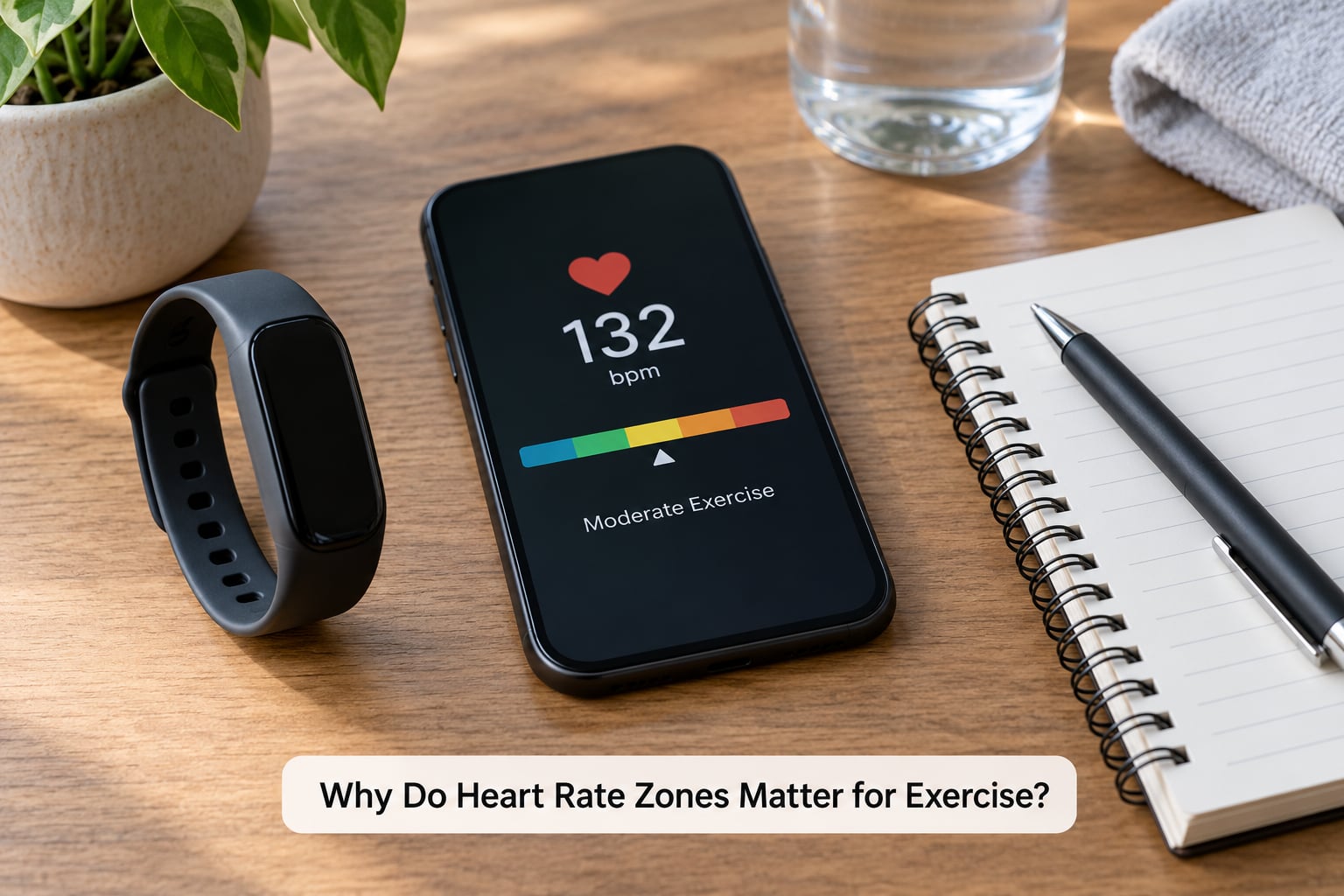
Zones matter because effort and heart rate are not the same thing. Without a zone, 140 beats per minute could mean a good morning walk for one person and a near-max effort for another. A zone turns that number into a shared language for how hard a session actually was.
Five practical reasons keep coming up. Pacing gets easier, because you can slow down before you blow past the effort you planned. The aerobic base gets built in the lower zones, where most of the work belongs. The top zones stay meaningful when they are rare, because sessions above 90 percent of your maximum are hard to recover from. Progress becomes visible, since a lower resting heart rate and a faster pace at the same heart rate both show up over months. And recovery days stop feeling wasted, because Zone 1 has a job too.
For anyone losing weight, zones settle a common argument. Total weekly minutes of movement matters more than how brutal any single session was. Beginners who think they must sweat to see results tend to overdo the high zones, then feel wrecked and stop.
What Are the Five Heart Rate Zones?
The table below uses the standard five-zone model and the common example of a 40-year-old with an estimated maximum heart rate of 180 bpm.
| Zone | Percent of max heart rate | Example bpm (max 180) | How it feels | What it is for |
|---|---|---|---|---|
| Zone 1 | 50 to 60 percent | 90 to 108 | Very easy, barely out of breath | Warm-ups, cool-downs, active recovery |
| Zone 2 | 60 to 70 percent | 108 to 126 | Comfortable, full sentences, steady | Aerobic base, most of your weekly minutes |
| Zone 3 | 70 to 80 percent | 126 to 144 | Moderate, short sentences only | Endurance, sustainable weight loss cardio |
| Zone 4 | 80 to 90 percent | 144 to 162 | Hard, a few words at a time | Tempo efforts, threshold work |
| Zone 5 | 90 to 100 percent | 162 to 180 | Very hard or all-out, cannot speak | Short intervals, maximum fitness testing |
How to read a heart rate zone chart
Read it bottom to top, not top to bottom. Zone 1 is the least intense and Zone 5 the most, and most people picture the chart upside down because the top of a chart looks like the finish line.
Then check the percentage column rather than the color. Colors are arbitrary and change between apps, while the percentage bands are what every zone model shares. If your watch shows a color you do not recognize, look for the number underneath.
How Do You Calculate Your Target Heart Rate?
Most calculations start with an estimate of your maximum heart rate. The classic formula is 220 minus your age, and a slightly more accurate alternative from Tanaka and colleagues is 208 minus 0.7 times your age.
For a 40-year-old, 220 minus 40 gives 180 bpm, and 208 minus 28 also gives 180. Multiply that maximum by each band to get your ranges: 50 percent is 90 bpm, 60 percent is 108, 70 percent is 126, 80 percent is 144, 90 percent is 162, and 100 percent is 180.
Why the 220 minus age formula is only a starting point
The catch is error. Individual maximum heart rates vary by roughly 10 to 20 beats per minute around the prediction for the same age, and the formula leans on the high end. Runners who mention it on forums often say a fit person’s Zone 2 feels like it forces them to crawl. That is not a discipline failure; it is a bad starting number.
A better approach uses heart rate reserve, sometimes called the Karvonen method. Subtract your resting heart rate from your estimated maximum to get your reserve, then work out each zone as a percentage of that reserve and add your resting rate back on.
Take the same 40-year-old with a resting rate of 62 bpm. The reserve is 118. Sixty percent of that is about 71, so Zone 2 runs from 133 to 145 bpm rather than 108 to 126. On a treadmill, that reads far more naturally for someone who runs regularly.
If you can, find your real numbers instead of estimating. A graded treadmill test at a clinic or a careful field test on a familiar hill both work. Take your maximum from a hard effort, not a sprint you have never tried before.
How Do You Find Your Heart Rate Zone During a Workout?
Start slow on purpose. Heart rate lags behind effort by a minute or two, so a workout that begins too fast registers as easy for the first few minutes and then jumps three zones at once. Most mislabeled sessions start with a sprint.
Then read the monitor and ask two questions. Is the number inside the range I want, and does it match how hard this feels? When the two disagree, trust the feel over the number and adjust pace until they agree.
The talk test is the fastest check and needs no device. Zone 1 to Zone 2 means you can speak a full sentence without pausing for breath. Zone 3 means short sentences only. Zone 4 and above means a few words at a time, if that.
Make three or four workouts your calibration period. Notice where the talk test and the monitor line up, then move the zone boundaries in your settings to match. Recalculate every four to eight weeks, or whenever your pace improves noticeably for the same heart rate.
Can You Use Heart Rate Zones for Walking and Weight Loss?
Yes, and walking is where zones are most misunderstood. Brisk walking often sits in Zone 2, which looks disappointing on a watch but is exactly where most of your weekly minutes belong.
The same applies to cycling, swimming on a steady pace, and home workouts built from repeated movements. What matters is that the effort is steady enough to count and frequent enough to repeat. A forty-five minute walk you actually take beats a hard session you skip twice a month.
Fat loss is not gated by zone. Higher zones burn more calories per minute, but the difference over a week is smaller than the difference between doing the work and not doing it. Zone 2 also holds together longer, which is why it dominates most week-long plans.
One rough distribution for a beginner: about a fifth of weekly minutes in Zone 1, most of the rest in Zone 2, a slice in Zone 3, and very little above that. Nobody gets fat loss wrong by doing too much easy work.
What Common Heart Rate Zone Mistakes Should You Avoid?
Using one generic chart forever is the first mistake. Fitness changes, so a chart that fit you eight weeks ago may now put your easy run into Zone 4. Update the numbers.
The second is trusting a wrist sensor during anything with heavy arm movement. Optical wrist sensors read high while running because every arm swing confuses the light signal. Chest straps are more accurate on running, rowing and intervals. This is the single most common reason people conclude their zones are wrong.
The third is treating the reading as biology when it is partly context. Caffeine, heat, dehydration, stress and poor sleep all push heart rate up at the same effort. On a hot day your Zone 3 run may genuinely sit at a Zone 3 number, but that number describes the conditions, not your fitness.
The fourth is starting every session at full pace, which lands you in Zone 4 before you are warmed up. The fifth is chasing high zones for weight loss. Short, hard efforts have a place, but they work best after a base of steady aerobic minutes, and they need real recovery.
One safety point, and it matters more than any of the above. Chest pain, fainting, unusual breathlessness, or a resting heart rate that stays higher than your normal for days means stop and talk to a doctor or a qualified clinician. Nothing in this guide is medical advice, and anyone with a heart condition, high blood pressure or a history of chest pain should get exercise clearance before using heart rate targets.
Frequently Asked Questions
How do I find my maximum heart rate?
The 220 minus age formula is the usual starting point, and 208 minus 0.7 times your age is slightly more accurate. Both are estimates with an error of 10 to 20 beats per minute. A graded treadmill test at a clinic or a careful field test on familiar ground gives you a real number. Recalculate every four to eight weeks as fitness improves.
What heart rate zone should I use for walking?
Most brisk walking sits in Zone 2, roughly 60 to 70 percent of your maximum heart rate. It should feel like you can hold a full conversation without pausing for breath. If a gentle walk pushes you into Zone 3, your estimated maximum is probably too low, so update it rather than slowing down further.
Does my age determine my heart rate zones?
Age only sets the rough starting estimate for your maximum heart rate. Fitness level, medication, stress levels and illness all shift your real numbers. Two people of the same age can differ by 20 beats per minute or more at maximum. Treat the age formula as a first guess, then adjust using effort and, where possible, a measured test.
Are chest-strap monitors more accurate than wrist sensors?
For running, rowing, cycling with handlebars and any interval work, yes. Wrist optical sensors use light through the skin and can read high when your arm swings, while chest straps track the electrical signal directly and stay accurate during movement. For steady walking or sleeping, wrist sensors are usually fine. If a number looks wrong, check it with the talk test.
Can medications or health conditions change my safe exercise zone?
They can, and this is where you need a clinician rather than a calculator. Beta blockers and some blood pressure medicines lower heart rate at a given effort, which can push you into a higher zone than the effort deserves. Heart conditions, thyroid problems and medications that affect heart rate all change what is safe. Ask your doctor before setting targets.
Should I stay in one heart rate zone to lose weight?
No, and it does not matter as much as most people think. Higher zones burn more calories per minute, but over a week the difference is smaller than the gap between training and not training. For most people aiming to lose weight, most weekly minutes in Zone 2 with some Zone 3 is the most sustainable plan, plus resistance work and eating habits.
Conclusion
Understanding what a heart rate zone is and why it matters comes down to one habit: use the number to make a decision, not as a score. Most of your weekly minutes belong in the easy zones, the hard ones stay occasional, and the talk test settles any argument with the watch.
Your first step is small. Estimate a range using 220 minus your age, then do a short easy session, check whether the zone matches how it felt, and adjust the boundaries by hand until they agree. Do that for three or four workouts and you will have something far more useful than any calculator you started with.