You can lose weight without a gym membership by creating a calorie deficit through what you eat and raising daily movement through walking, stairs and bodyweight training. Walking is the workout most people skip, and it is the one that moves the scale. Here is the plan, step by step.
That is the honest version of the answer, and it is worth sitting with for a second. Most people searching this phrase assume they need machines, mirrors and a motivational coach. The reality is that the deficit does the fat loss, and a gym is one way to widen it rather than the only way.
On the other end of the same argument, beginners on fitness forums tend to land somewhere closer to the truth: exercise builds fitness and physique, while long-term eating change does the fat loss. Both can be true at once, and this guide is built on that.
What follows is a plan you can start on Monday with shoes you already own, a floor, and about 30 minutes twice a week. Nothing here requires a membership, a supplement, or an app subscription.
Table of Contents
- What You Need
- Step-by-Step
- How to set a realistic starting point
- How to build meals that support weight loss
- How to move every day without a gym
- How to strength train at home
- How to track progress without obsessing over the scale
- Common Mistakes
- Frequently Asked Questions
- Can I lose weight without going to the gym?
- How much walking do I need to do to lose weight?
- What can I do for exercise at home with no equipment?
- How often should I strength train if I am a beginner?
- How long will it take to see results without a gym membership?
- What happens after one week of not going to the gym?
- Conclusion
What You Need
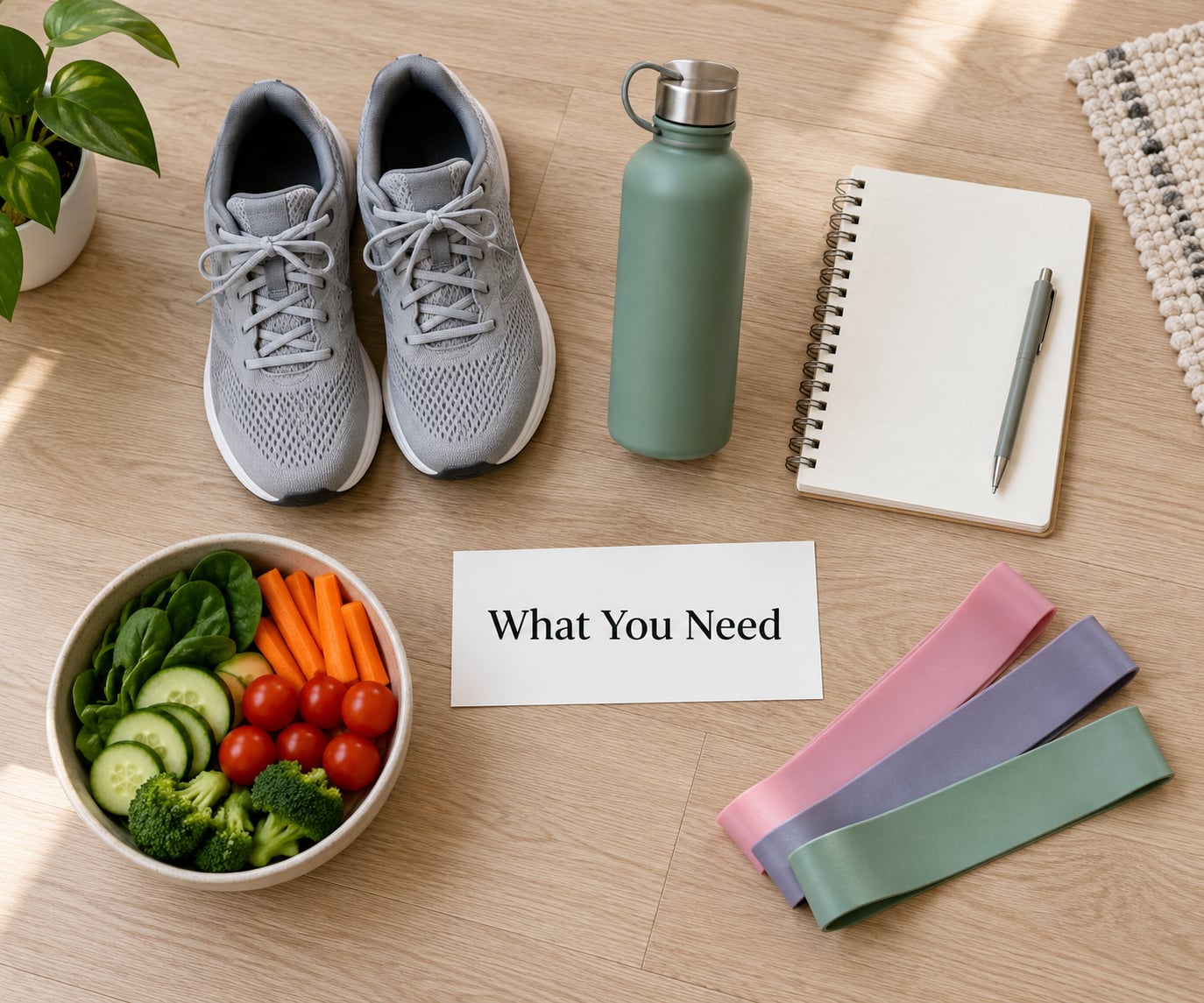
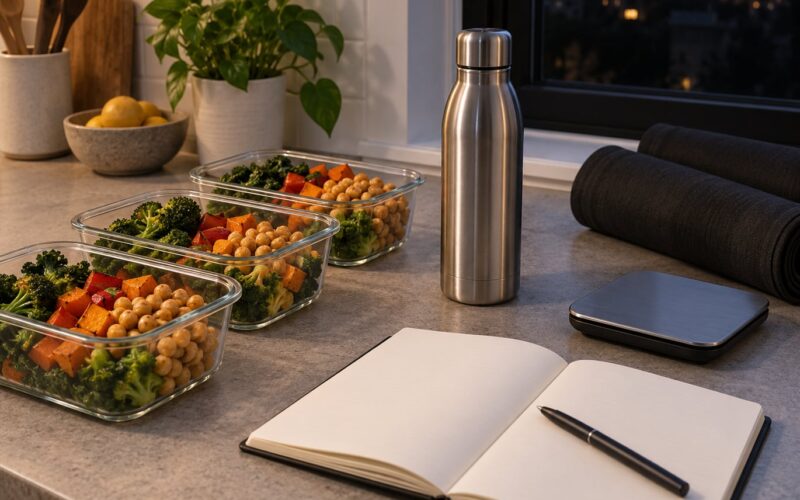
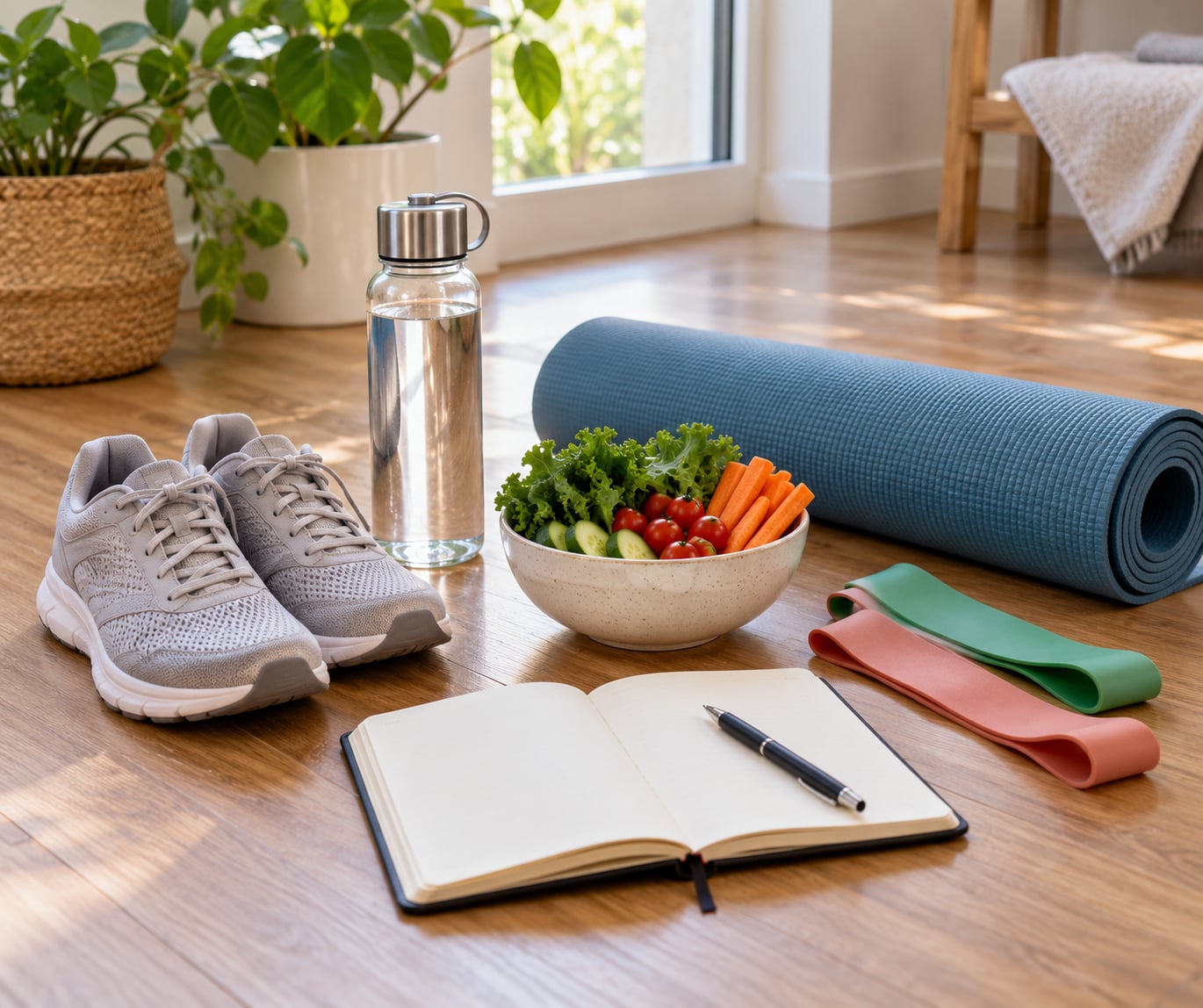
The equipment list for this plan is short enough to fit in one paragraph. Start with supportive walking shoes, because walking is where you will spend most of your training time and bad shoes end sessions early. A water bottle matters less for weight loss than people think, but it matters for whether you drink anything other than coffee by mid-afternoon.
You also need a way to eat. That does not mean a meal prep system or a specific diet. It means deciding in advance what a normal plate looks like, because a plan decided at 7pm on an empty stomach is not a plan. Pick two or three breakfasts you will actually eat, two lunches, and a dinner rotation you like.
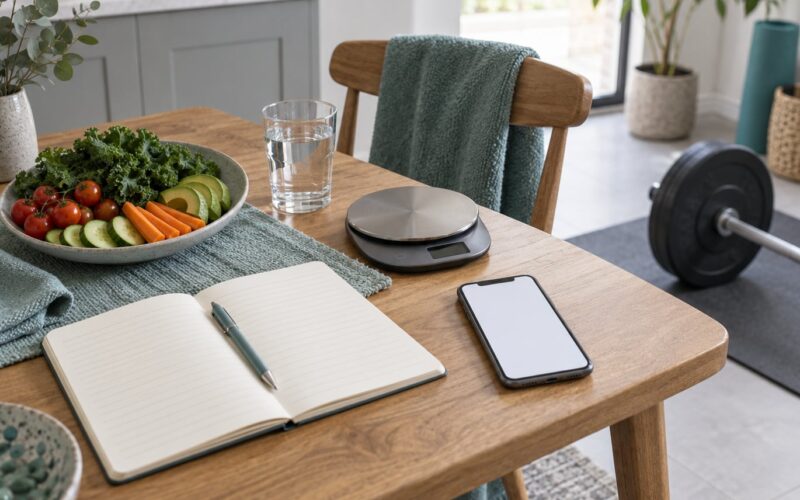
Third, a tracking method. A paper notebook works as well as anything, and a free phone step counter covers the movement side. What you are logging matters more than the tool: calories or portion sizes, plus the weekly average weight.
Fourth, floor space roughly the length of two body lengths. A yoga mat is nice, a carpet is fine, and a towel works on hard floors. That is the whole equipment budget for weeks one through four.
What you do not need is the one thing the internet pushes hardest. Skip fat burners, metabolism boosters, detox teas and meal replacement plans. If a product requires you to believe it works in a way that ordinary food does not, the product is the point and you are the marketing.
If you have joint pain, are returning from an injury, or have been diagnosed with a condition that affects exercise, talk to a doctor before starting anything here. A physiotherapist is the better call for movement programming after an injury.
Step-by-Step
How to set a realistic starting point
Set the baseline before you change anything. Weigh yourself first thing in the morning, three days in a row, and average those three numbers. A single morning reading tells you almost nothing, because your weight swings by several pounds across a day from water, salt and bowel movements.
Then write down your current week honestly. How many steps does your phone average? How many servings of vegetables did you eat on a normal weekday? When did you last do anything that made you out of breath?
Most beginners try to change six things on the same day, last three weeks, and conclude that the plan failed. Change two things instead. For almost everyone those two are how much they walk and how they build a plate.
On the deficit, start moderate. A 15 to 20 percent reduction below what you currently eat is the range regulars recommend and the one I would start at. Bigger deficits produce faster early scale drops and then flatten out, because an aggressive cut and high training volume together is exactly how people end up tired, hungry and stalled.
How to build meals that support weight loss
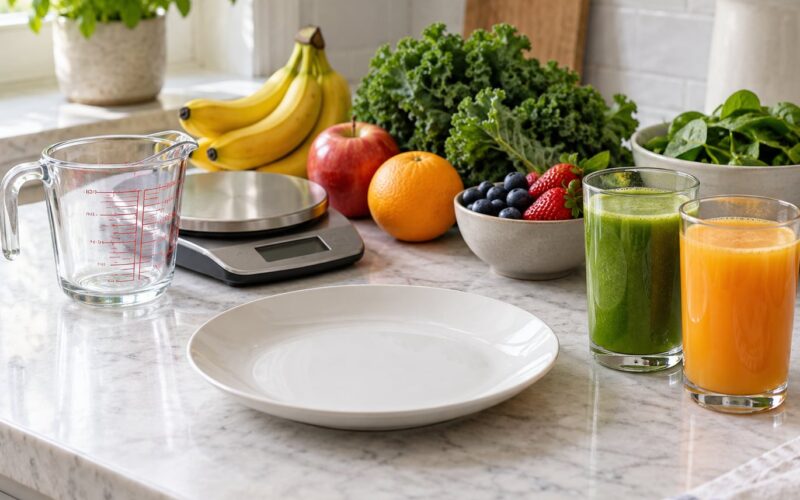
A plate method beats calorie counting for most beginners because it survives a busy week. Fill half the plate with vegetables, a quarter with protein, and a quarter with a fiber-rich carbohydrate such as beans, brown rice, oats or whole-grain bread. Add a small amount of fat and drink water or an unsweetened drink.
Vegetables are the cheapest lever here. They add volume and fiber for very few calories, which is what lets you eat until satisfied rather than counting every gram. Frozen vegetables count, canned vegetables count, and the frozen bag is usually cheaper and less wasted than the fresh one.
Protein keeps you full and helps you keep muscle while you are in a deficit. A workable range for adults is roughly 1.2 to 1.6 grams per kilogram of body weight per day, spread across meals rather than loaded at dinner. Eggs, Greek yogurt, chicken, fish, tofu, beans and cottage cheese all fit the bill.
Watch the drinks. Liquid calories do not fill you up, so a daily sweetened coffee, soda or juice can quietly add a week’s worth of deficit in a few days without changing how full you feel. Cutting those first is usually easier than cutting solid food.
Do not drop carbohydrates. Beans, oats, potatoes, fruit and whole grains are what make the plan workable, and people who cut them report feeling flat and hungry within days. Cut portions and refined extras first.
A day that fits this method: breakfast is oatmeal with berries and a spoon of peanut butter, lunch is a large salad with grilled chicken and beans on the side, dinner is salmon, a baked potato and broccoli. Snacks are fruit and yogurt. That is a normal day, not a special one.
If you cook meat, poultry and fish at home, food safety is not optional. USDA guidance puts poultry at 165F (74C), ground meats at 160F (71C), and whole cuts of meat and fish at 145F (63C). Use a thermometer rather than guessing, and refrigerate leftovers within two hours.
How to move every day without a gym
Walking is the most underrated part of this whole topic. It is joint-friendly, it requires nothing, it can be done in shoes you own, and it burns more calories across a day than any 20-minute session because the effect accumulates. Set a step number rather than a workout time.
Start from where you actually are, then build. If your current average is 5,000 steps, go to 7,000 for two weeks and hold there. Then push to 8,500 or 9,000. A common and honest ceiling for many adults sits somewhere around 10,000 steps, and the jump from your baseline matters far more than hitting a round number.
Pick one reliable way to add steps instead of five unreliable ones. Park farther from the store entrance, take a 10-minute call standing up, walk one extra loop of the neighborhood after dinner, or use stairs instead of the elevator. Desk workers get real mileage from one-minute movement breaks every hour: wall push-ups, ten squats at the desk, or a lap of the floor.
That last category has a name. NEAT stands for non-exercise activity thermogenesis, which is the calories you burn through everything that is not deliberate training, like walking, cooking, cleaning and fidgeting. It is a large share of a normal person’s daily burn, and it is the part a gym membership cannot touch.
Add intervals once your walking is comfortable. Fast walking for 30 to 60 seconds, then easy again, repeated 8 to 10 times, does more for fitness than a long slow stroll and takes 15 minutes. Go hard enough that you could not comfortably talk, not harder than that.
How to strength train at home
Strength work is what keeps you looking like yourself as you lose weight. Without resistance training, a portion of what you lose is lean muscle, and your resting metabolic rate comes down with it. You do not need weights to do this. Bodyweight exercises for beginners work fine at first.
A complete no-equipment routine for beginners is five movements, two or three times a week, 25 to 30 minutes. Squats for the legs, push-ups for the chest and arms, reverse lunges or a step-up for the hips, a plank or dead bug for the core, and a glute bridge for the hips and lower back.
Here are the numbers to start with. Do 3 sets of 8 to 12 reps on the squats, lunges and bridges. Do 3 sets of as many good push-ups as you can with two reps left in reserve, which for a lot of beginners means 4 to 8. Do the plank for 20 to 30 seconds per set. Rest 60 to 90 seconds between sets.
Progression is the whole game, and it does not require buying anything. First you add reps. Then you add a slow 3-second lowering phase. Then you add a set. Only after all three stop being hard do you add load, which at home means a backpack with books in it or a jug of water in each hand.
Do not skip the carry and hinge pattern. Hip hinge work at home with a backpack, or a single-leg balance hold, covers ground that push-ups and squats miss. Those two patterns plus squat and push are the core of any sensible home program.
Know when to stop. Sharp joint pain, chest pain, dizziness or unusual shortness of breath means stop and see a clinician. Muscle fatigue in the working muscles is expected. Soreness the next day is normal. Pain in a joint is not, and no weight is worth training through it.
Skip the burpees, jump squats and anything high impact for the first two weeks if you are overweight, have knee or ankle issues, or have been sedentary. Walking, bodyweight strength work and low-impact intervals will get you further than an injury.
How to track progress without obsessing over the scale
Use three measures instead of one. The weekly average weight tells you whether the plan is working. Strength and endurance in your home routine tell you whether your body is adapting. Energy, sleep and mood tell you whether you can sustain it.
Look at the trend line, never the daily number. Weigh three mornings a week, average them, and compare this week’s average to last week’s. A pound a week is a good result. Half a pound is fine. Unchanged for three weeks is a signal to adjust something, not to panic.
What to adjust depends on what changed. If your weight is flat and you feel fine, cut slightly or add steps. If it is flat and you feel exhausted, eat more and move less, because you have cut too hard. Never respond to a plateau by doing both at once.
Sleep and stress are weight variables, not background decoration. Most adults do better on seven or more hours, and short sleep makes hunger harder to control. Community weight loss reports point the same way: the people who make progress without a gym usually changed how much they ate, not how hard they trained. One poster in a weight loss community described losing 10 pounds in a month through meal timing and total intake rather than exercise. Unglamorous, and repeatable.
Budget two weeks before you judge anything. Most people who quit a plan in week three did not fail at weight loss. They failed at boredom, and boredom is a scheduling problem more than a motivation problem.
Common Mistakes
Cutting food far too hard while training hard. The classic trap, and the reason experienced lifters call it the slim look. An aggressive deficit combined with high volume leaves you under-recovered, hungry and metabolically adapted. The fix is the 15 to 20 percent starting deficit and a slower ramp on training volume.
Treating exercise as the fat loss plan. A 45 minute session can outrun a 2,000 calorie day, and most days it does not. Fix it by deciding that eating is the primary lever and movement is what makes the plan livable and preserves muscle.
Doing everything in week one. Twenty thousand steps on day one and a full circuit will injure a beginner or make them quit. Add one new element per week. The plan in this article ramps over four weeks for that reason.
Skipping strength work entirely. Walking is excellent and sufficient for fat loss on its own, but it leaves muscle unprotected. Twenty-five minutes twice a week is a low bar that keeps the shape of you.
Buying equipment before earning it. The most common complaint from beginners is gear that gathers dust. Use your body weight for the first month. Add a resistance band or a pair of adjustable dumbbells only when a movement has stopped being hard.
Chasing a fast drop and quitting at week three. When 20 pounds comes off in a month and then stops, most people read it as failure and start a harsher plan. That is the rebound cycle. A slower rate that you can maintain is worth more than a fast one you cannot hold, and keeping the weight off is the actual goal.
Two smaller habits close the list. Eat sitting down, slowly, most of the time. And do not keep a membership you are afraid to use out of guilt; a cancelled membership with the money going into better groceries beats a frozen one.
Frequently Asked Questions
Can I lose weight without going to the gym?
Yes. Weight loss follows energy balance, and a gym is only one way to spend more calories. A moderate calorie deficit plus daily walking and twice-weekly bodyweight strength work is enough for most adults to lose fat steadily. Community weight loss reports tend to show the same pattern: the biggest changes come from everyday eating and daily walking, with home strength work added to protect muscle.
How much walking do I need to do to lose weight?
More than most people assume, and spread across the day rather than in one block. Start from your current daily average and add 1,500 to 2,000 steps, holding the new number for two weeks before raising it again. Many adults settle around 8,000 to 10,000 steps daily. Brisk walking counts more than slow walking, and pace matters as much as total steps.
What can I do for exercise at home with no equipment?
Five movements cover a full beginner week: squats, push-ups, reverse lunges or step-ups, a plank or dead bug, and a glute bridge. Do 3 sets of 8 to 12 reps, two or three times weekly, resting 60 to 90 seconds between sets. Progress by adding reps, then a slow lowering phase, then a set, and only then consider a backpack or water jugs for load.
How often should I strength train if I am a beginner?
Two or three sessions a week on non-consecutive days is the standard starting point, and three short sessions usually beat two long ones. Give your first two weeks to learning the movements with light or no load before adding resistance. Muscles recover while you sleep, and most beginners underestimate how much rest day contributes to progress.
How long will it take to see results without a gym membership?
Expect two to four weeks for the first changes in strength, energy and waist measurement, and four to eight weeks for a clear scale trend. A rate of roughly 0.5 to 1 percent of body weight per week is realistic and sustainable. Faster early drops often include water and glycogen changes rather than pure fat, which is why steady outpaces dramatic.
What happens after one week of not going to the gym?
Very little, physically. You lose some conditioning and your resting calorie burn dips slightly, and both return within a week or two of resuming normal activity. If your fat loss was built on a calorie deficit, that deficit keeps working because it depends on your eating rather than on where you trained. The real risk of stopping is the loss of routine, not lost muscle in one week.
Conclusion
Three things to do this week. Pick one eating change and make it automatic, usually half your plate as vegetables and a protein source at every meal. Schedule your walking by putting a step number on a calendar block you already protect. Then start a 25-minute home strength routine twice, on two non-consecutive days.
If a monthly membership is what kept you on the fence, that is the short version of how to lose weight without a gym membership: eat in a pattern you can hold for months, walk most days, and train twice a week on your own floor. Do those three things for four weeks before you buy anything, download anything, or change anything else. If you want individual help with your numbers, a registered dietitian or your doctor can take your history into account in a way a general guide cannot.
Updated for October 2026. General information only, not medical advice. Stop exercising and seek care for chest pain, dizziness, or sharp joint pain.