How to meal prep for shift work comes down to three jobs: cook on your longest rest day, portion everything into containers you can grab in under a minute, and eat on a fixed rhythm of something every three to five hours while you are awake. That is the whole system, and a first session takes about two hours.
The reason it works is that hunger at 3am is not a planning failure, it is a supply problem. If there is food in the bag, you eat something decent. If there is not, the vending machine decides for you. Prep removes the decision, which is the only part you cannot control at 4am on a Tuesday.
Most shift workers I talk to lose the thread on nights, not on days. Day prep is easy because your kitchen and your appetite agree with each other. Nights are harder, and that is what the plan below is built around.
Table of Contents
- What You Need
- Containers that hold together
- Keeping food cold
- Planning supplies
- The nutrition basics
- How to Meal Prep for Shift Work: Step-by-Step
- 1. Match Your Meal Plan to Your Shift Pattern
- 2. Build a Balanced Menu Before You Shop
- 3. Prep Foods That Travel and Hold Well
- 4. Cook and Portion for Your Workweek
- 5. Store, Chill, and Transport Meals Safely
- 6. Create a Backup Meal for Busy or Changing Shifts
- Common Mistakes
- Preparing the same meal for every shift
- Packing foods that leak or go soggy
- Skipping protein or fibre
- Packing food without ice packs
- Ignoring that nights change hunger and thirst
- Letting hydration slide
- Frequently Asked Questions
- How do you meal prep for night shifts?
- What foods are best for overnight shifts?
- How long can I keep a packed lunch at work?
- Can I meal prep for a rotating work schedule?
- What should I eat if my shift does not allow a break?
- Conclusion
What You Need
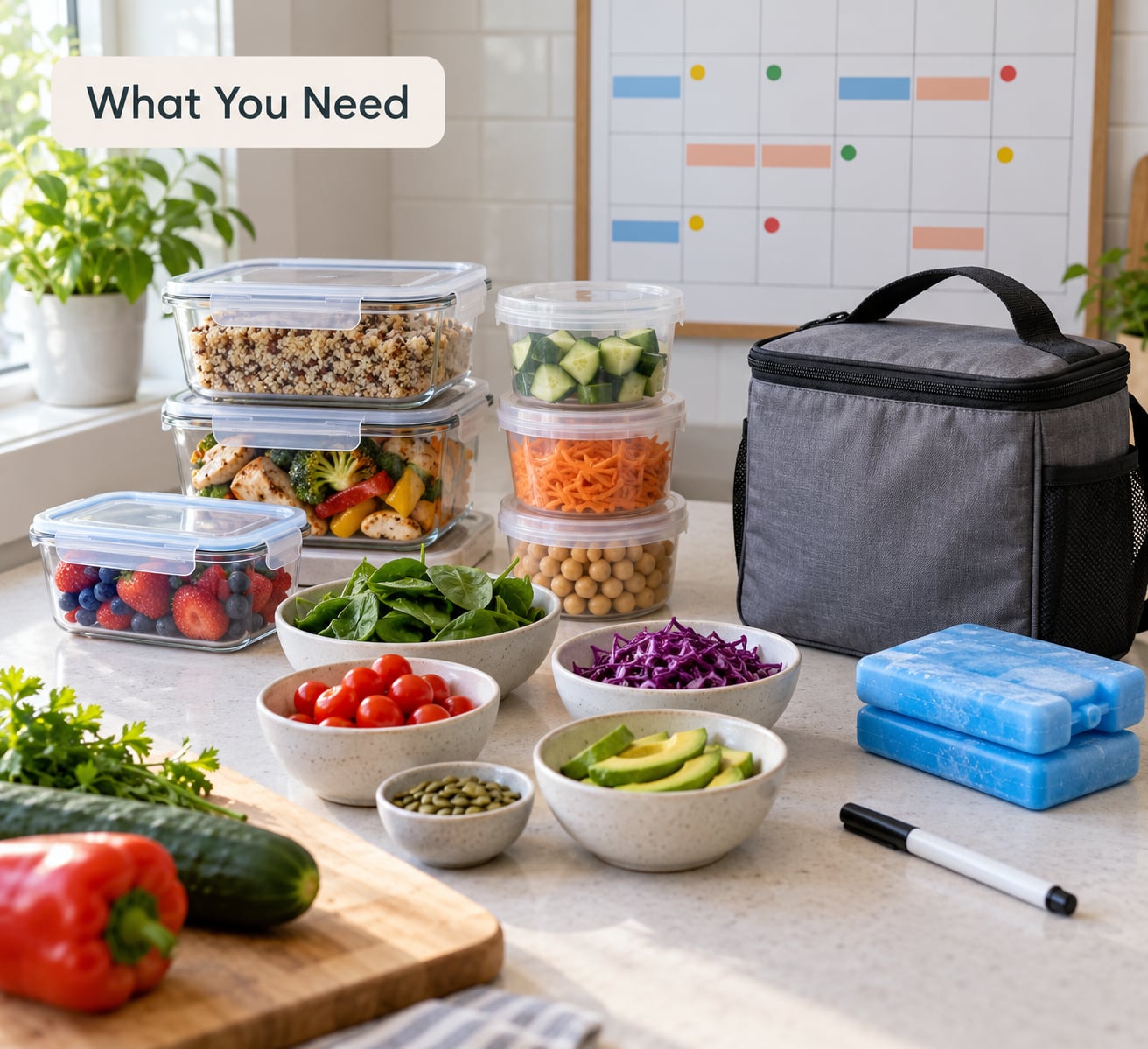
You need very little, and most of it you can buy once and keep for months. The list below is grouped by what it does, so you can skip anything that does not apply to your shift.
Containers that hold together
- Leak-resistant containers with clip or snap lids. A dressing in a bag that tips at 4am ruins the meal underneath it. Test the seal over the sink before you trust it with soup.
- Portion-controlled containers in one or two sizes. Buying a set of matching boxes means every portion looks the same, which makes it far easier to eat consistently across a run of nights.
- Mason jars for layered salads and overnight oats. Put dressing in the bottom, protein in the middle, greens on top, and it stays correct until you shake it.
- Freezer bags laid flat for flat-lying portions that stack neatly in a cooler.
Glass survives the trip better and does not absorb odors, but it is heavier and breaks. For a twelve-hour shift with a drive or a walk to the bus, plastic usually wins on practicality.
Keeping food cold
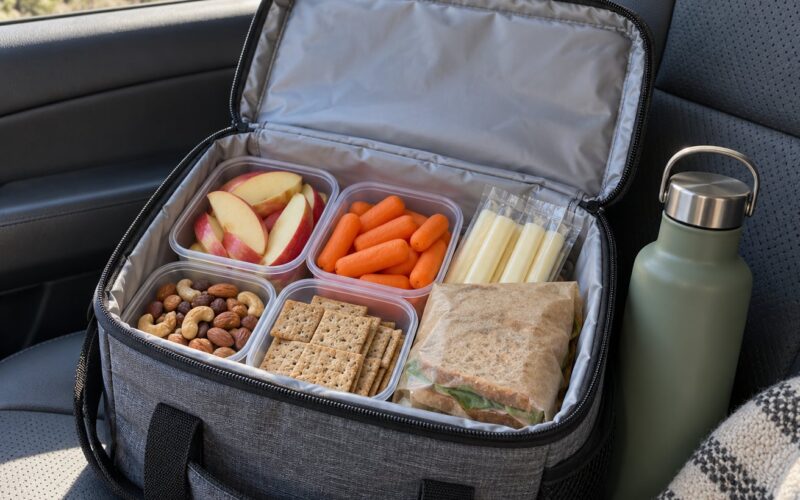
- An insulated lunch bag or soft cooler with a shoulder strap. A plain tote holds cold food for maybe an hour in summer.
- Two or three frozen ice packs, rotated the night before. Gel packs are reusable; a bag of frozen veg works in a pinch.
- A small thermometer if your workplace has no fridge. It tells you whether the bag is doing its job instead of guessing.
Planning supplies
A calendar or the roster app you already use, a marker pen, and a bag or crate that lives by the door and holds packed meals. The crate matters more than it sounds: meals that sit in the fridge get eaten, meals that sit on the counter do not.
The nutrition basics
Every shift meal you build needs four parts: a protein, a high-fibre carbohydrate, vegetables or fruit, and a healthy fat or sauce. You do not need to weigh anything or count macros. You need to glance at the container and see all four.
Not every meal has to be reheated either. About half of a well-planned shift should be edible cold, because reheating opportunities come and go depending on how busy the floor gets.
How to Meal Prep for Shift Work: Step-by-Step
1. Match Your Meal Plan to Your Shift Pattern
Start by writing down your exact hours for the next seven days, because a plan built for the wrong pattern fails before it starts. Night shifters eat by clock, not by meal name, so name the meals after the time they happen.
| Shift type | First meal | Mid-shift | Last meal | After shift |
|---|---|---|---|---|
| Day shift (7am to 3pm) | 6:00am | 11:00am | 2:00pm snack | 4:30pm dinner |
| Evening shift (2pm to 10pm) | 12:30pm | 5:00pm | 8:30pm | 10:30pm light meal |
| Night shift (7pm to 7am) | 5:30pm | 11:00pm | 3:30am | 8:00am, then sleep |
| 12-hour night (6pm to 8am) | 5:00pm | 11:00pm | 2:00am and 5:00am | 8:30am |
| Rotating roster | Follow the clock time of the shift you are on | Every 3 to 5 hours awake | Last 2 hours before finish | Small meal, then rest |
Three rules follow from the table. Perishable food goes into an insulated bag with ice packs when you cannot reach a fridge within a couple of hours. Grains, nuts, whole fruit, unopened nut butter and shelf-stable milk do not need cooling. And on a rotating roster you build one set of foods and rearrange the timing, rather than cooking a new menu every time the roster changes.
2. Build a Balanced Menu Before You Shop
Write the seven-day menu first and shop second, because shopping without a list is how shift prep fails quietly. Use the same four-part formula every day and change only one or two components.
The combinations that survive a shift bag best are the ones already built from shelf-stable parts:
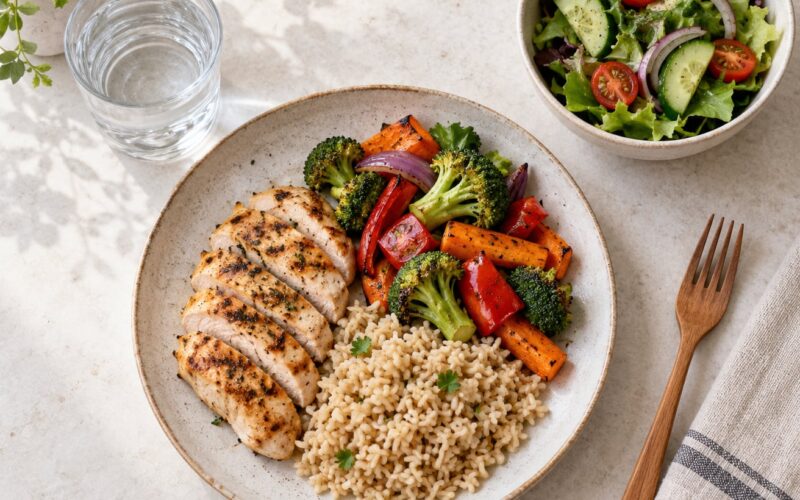
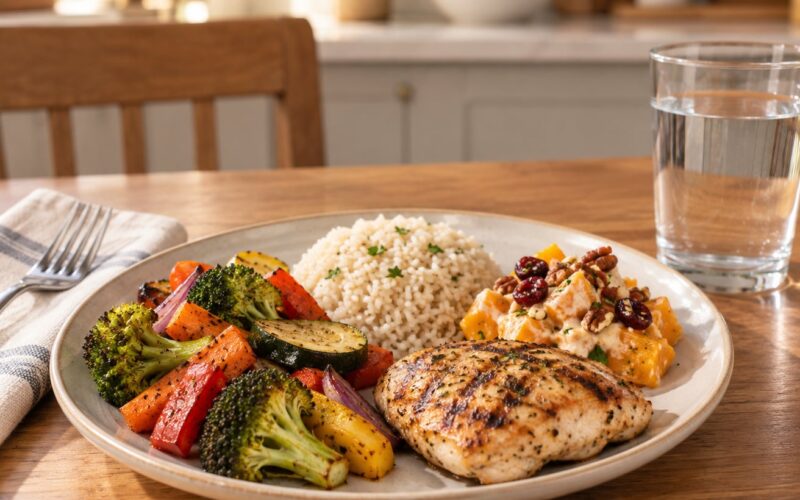
- Chicken, rice, roasted vegetables with a lemon-herb sauce, eaten cold or reheated.
- Tuna and white bean salad with olive oil and lemon, in a mason jar. No heating, no leak, holds four hours happily.
- Egg salad on whole-grain bread with a yogurt-based dressing instead of mayo.
- Lentil soup portioned into a wide-mouth jar so you can drink it straight from the container.
- Greek yogurt with fruit, nuts and oats, which needs a spoon and nothing else.
- Black bean and vegetable wraps, packed flat in a tortilla and eaten within a few hours of assembly.
One rule keeps this from getting boring: change the sauce or seasoning every day, not just the protein. Same chicken, three sauces, feels like three different meals.
3. Prep Foods That Travel and Hold Well
Some foods survive a container better than others, and choosing the right ones removes most of the bad shift meals people complain about.
Cooked grains such as rice, quinoa and couscous hold their texture well, especially when slightly underdone at prep time. Beans and lentils improve overnight. Roasted vegetables stay firm, while steamed or boiled ones turn soft and watery by hour six. Cooked chicken and eggs travel well if you cool them before you seal the lid.
Yogurt-based snacks and fruit are the easiest items of the week to pack. They also fill the gap between meals when you only get one proper break.
For readers who cannot eat a particular food, the swaps are straightforward. If yogurt is out, use a low-fat cottage cheese or a small handful of nuts. If dairy is out entirely, soy yogurt works in the same bowls and overnight oats jars. If a texture bothers you at 3am, choose dishes that are soft and warm rather than anything crisp.
4. Cook and Portion for Your Workweek
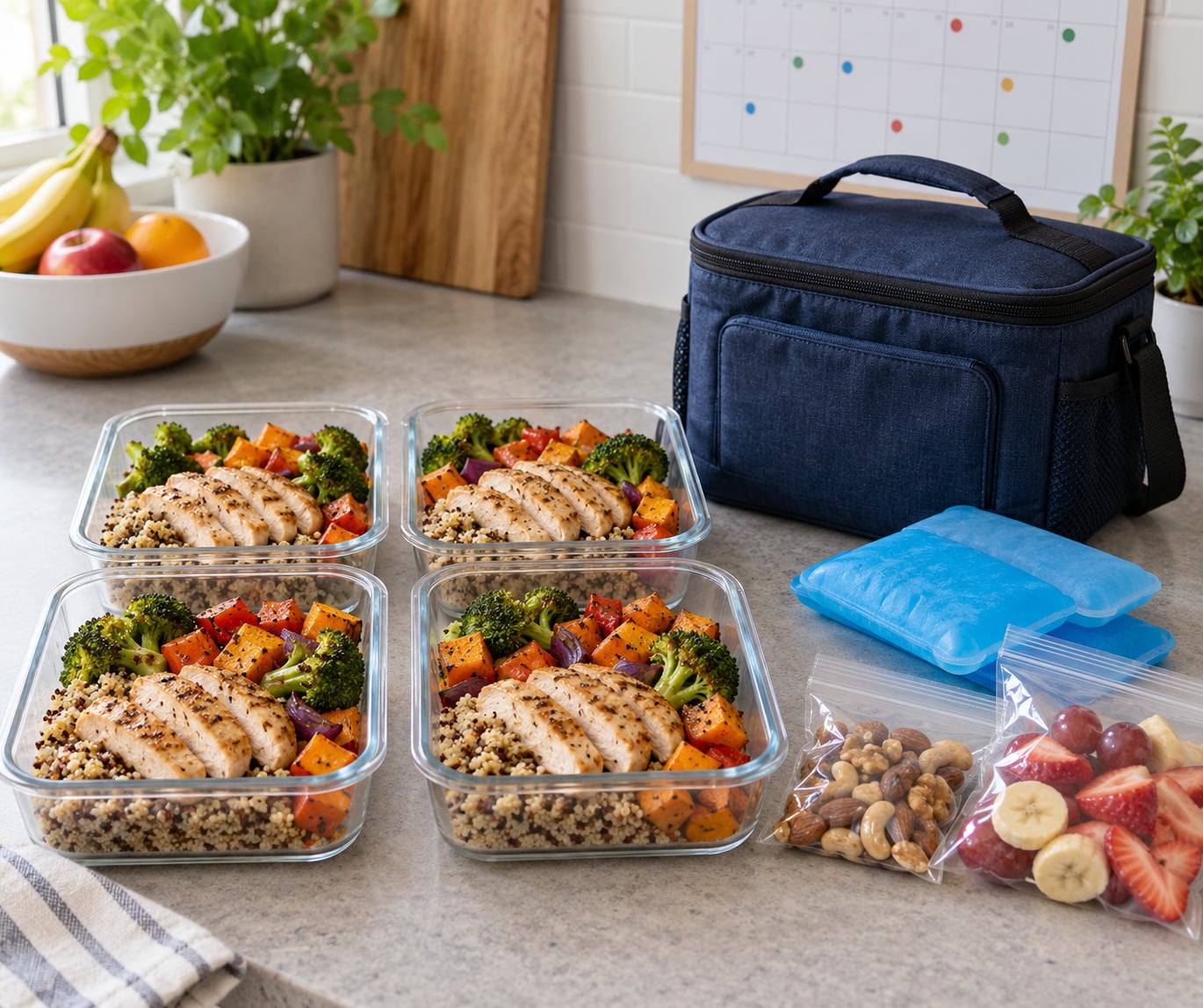
A two-hour session on your longest rest day covers a five-shift run. Do it in this order and it runs without stopping.
- Minute 0 to 10: put a pot of rice or quinoa on, preheat the oven, and pull out one container per shift.
- Minute 10 to 25: chop two trays of vegetables, oil and salt them, and get them into the oven so they start cooking while you handle protein.
- Minute 25 to 55: cook or roast one large batch of protein. If you want a second protein, start it now. Cook poultry to 165F (74C), ground meat to 160F (71C), and whole cuts and fish to 145F (63C).
- Minute 55 to 70: while the protein rests, portion grains and vegetables into containers and add the sauce for that day.
- Minute 70 to 90: slice or shred the protein, add it to the containers, and divide into three or four snack bags from the spare food.
- Minute 90 to 120: cool everything uncovered, label with the day and the use-by date, then split between the fridge and the freezer.
Cooling uncovered matters. Piling hot food straight into a sealed box traps steam, and the middle stays warm long enough for bacteria to be comfortable.
Here is what that session produces for one week of twelve-hour nights:
| Day | Meal 1 | Meal 2 | Snack |
|---|---|---|---|
| Sunday nights | Chicken, rice, roasted vegetables, lemon sauce | Tuna and white bean salad in a jar | Yogurt with berries and nuts |
| Monday nights | Lentil soup and whole-grain bread | Egg salad wrap with yogurt dressing | Apple with peanut butter |
| Tuesday nights | Bean and vegetable bowl with salsa | Leftover soup with crackers | Cheese cubes and apple slices |
| Wednesday nights | Sheet-pan chicken with potatoes and peppers | Yogurt, oats and fruit jar | Roasted chickpeas |
| Thursday nights | Black bean wraps, two per shift | Olive oil tuna salad | Trail mix portion |
Anything you will not eat within three or four days of being cooked goes in the freezer instead. Thaw overnight in the fridge and pack it cold the next morning. This is the simple version of the 3-3-3 rule people ask about: about three days of storage in the fridge, and roughly three months in the freezer.
5. Store, Chill, and Transport Meals Safely
Food safety is the one part of shift prep where the rules are fixed and worth knowing by heart, because you cannot smell or taste most of what makes you ill.
USDA guidance is straightforward. Refrigerate perishable food within two hours, or one hour if the temperature is above 90F (32C). Keep cold food at or below 40F (4C), and keep hot food above 140F (60C) in a thermos with a preheated container. Cooked food keeps about three to four days in the fridge, and two to three months in the freezer.
An insulated bag with a couple of ice packs frozen solid will hold food safely for roughly four hours. With no ice at all, eat the perishable item early in the shift rather than saving it for the end. Anything with meat, fish, eggs, dairy or cut fruit is the item that has to stay cold.
For a twelve-hour shift, split the perishable meals across the day instead of eating everything in one sitting. If your break room has a fridge, label your box with your name and shift date, and put it on a high shelf. If it does not, treat the insulated bag as a working cooler and check it.
Food sitting at room temperature is the most common way shift workers get unwell, because a meal eaten over three hours of a break gets forgotten. If a container has been out for more than two hours, throw it out rather than judging by smell.
If you want a personal plan that accounts for medication, digestion or a specific condition, a registered dietitian is the right person to build it with. The general framework here works for most people.
6. Create a Backup Meal for Busy or Changing Shifts
Keep two or three no-cook options that need no fridge, no heat and no preparation beyond opening a bag, because there will be shifts where the plan gets ignored.
The usual triggers are overtime, a missed break, a schedule change that lands you on nights with nothing prepared, or an early departure that leaves a full container behind. In each case you need something that lives in a drawer or a locker.
- Tuna and bean wraps, made the night before and kept cold, or shelf-stable pouches straight from the cupboard.
- Greek yogurt with fruit and nuts, or the shelf-stable kind if there is no fridge on site.
- Whole-grain crackers with cheese, or nut butter packets with apple slices.
- Shelf-stable nut butter with fruit, which is the most reliable option in the building because nothing about it goes off.
- Protein bars and roasted chickpeas for the shift that runs three hours longer than planned.
Park a crate of these where you will actually see it, and restock it every week. Shift workers report the same pattern from every forum thread I have read: prep before a block of shifts, grocery shop on the days off, and always keep grab-and-go food at work. That simple rhythm removes most of the weekly stress.
Common Mistakes
Most bad shift weeks trace back to the same handful of mistakes, and each one has a simple fix.
Preparing the same meal for every shift
Four identical meals in a row is why people give up by Wednesday. Fix it by preparing three or four base components and combining them differently each day, changing the sauce or seasoning rather than the whole dish.
Packing foods that leak or go soggy
Soup in a container without a clip, or crisp vegetables under a hot lid, will not survive a twelve-hour shift. Fix it by keeping wet foods in wide-mouth jars or clip-lid boxes, and packing crunchy things separately from hot food.
Skipping protein or fibre
A box of plain carbs and fruit feels fine at hour two and collapses at hour six. Fix it by making sure every container has a protein source and a high-fibre carbohydrate, and by adding a protein snack for shifts longer than eight hours.
Packing food without ice packs
This is the mistake that ends in illness, and it is usually made once in a rush. Keep two frozen gel packs by the door with the packed meals, and refill them the night before a block of shifts rather than on the morning of.
Ignoring that nights change hunger and thirst
After a run of nights you often lose the ability to tell hunger from tiredness or boredom, which is why the 3am crash feels sudden. Fix it by eating on a timer, every three to five hours, whether or not you feel hungry. Hunger signals on nights are unreliable; the clock is not.
Letting hydration slide
Thirst on a night shift often arrives late because cool air and low activity mask it. Keep a full bottle in view and refill it at every break. If you want caffeine, front-load it in the first half of the shift and stop well before you drive home, rather than drinking a large coffee an hour before finishing.
Last, do not let one missed prep session end the week. Prep two components on a short rest day, keep the backup foods in your desk, and carry on.
Frequently Asked Questions
How do you meal prep for night shifts?
Cook on your longest rest day, before a block of shifts, rather than on the day itself. Batch one protein, one grain and one tray of vegetables, then portion them into containers for the whole run. Label each one with the date and keep the meals you will not eat within three days in the freezer. Eat something every three to five hours while you are awake, starting about ninety minutes before you leave.
What foods are best for overnight shifts?
Choose foods that eat well cold and do not need reheating: tuna and bean salad in a mason jar, yogurt with fruit and nuts, whole-grain wraps, lentil soup in a wide-mouth jar, and overnight oats. Add something warm when you can, because a hot meal early in a night shift tends to settle better than one at 3am. Keep a protein in every meal so blood sugar stays steady.
How long can I keep a packed lunch at work?
In an insulated bag with two frozen ice packs, perishable food stays safely cold for roughly four hours, at or below 40F (4C). Without ice packs, eat it earlier in the shift rather than saving it. Perishable food left at room temperature for more than two hours should be discarded. Grains, nuts, unopened nut butter, whole fruit and shelf-stable items do not need cooling at all.
Can I meal prep for a rotating work schedule?
Yes, and it is easier than cooking a new menu each week. Prep the same set of base components on your longest rest day, then rearrange the timing based on the shift you are actually working. Someone on a 7pm to 7am start treats the same container as a 5:30pm dinner, an 11pm meal and a 3:30am snack, while a day-shift start uses it as breakfast. Keep the food list constant and change only the clock.
What should I eat if my shift does not allow a break?
Eat something every three to five hours in small amounts rather than waiting for a single break. Pack foods that need no preparation and no fridge: nut butter packets with fruit, whole-grain crackers with cheese, protein bars, roasted chickpeas and shelf-stable yogurt. Put the backup food where you will see it, such as in a locker or a desk drawer, so grazing requires no more effort than standing up.
Conclusion
Start with three things this week, in this order. Write down your shift hours for the next seven days, build a menu from one protein, one grain, one tray of vegetables and one sauce per day, then run a single two-hour prep session on your longest rest day.
Adjust portions and timing to match your roster rather than the plan. Once you have learned how to meal prep for shift work on your own schedule, the rest is just keeping the crate by the door restocked and choosing the backup meal instead of the vending machine.
For weight loss rather than simply eating well on shift, adjust portions and total energy intake with a registered dietitian who understands your schedule. Shift patterns vary widely by job, so check your own roster against the timing table before you commit to any plan.