You can lose weight on nights. The approach that works is a modest 300 to 500 calorie deficit, your main meal before the shift instead of during it, and sleep you actually protect. Most night-shift weight gain is biology pushing against a chaotic routine, not a character flaw.
That is worth saying plainly, because the common experience is confusing. People on a graveyard shift often report eating less than they did on days and still gaining. Their total daily calorie burn runs roughly 50 calories lower at night, and shortened sleep independently adds somewhere around 250 to 500 calories of daily intake. Fix the meal timing and the sleep block and the gap usually closes.
This guide covers the plan step by step: what to prep, how to time meals around an overnight schedule, how to sleep during the day, where to fit exercise, and what to do when the scale stalls. Expect slower progress than day-shift weight loss. Most people see a first real change at four to six weeks, and a new shift pattern can take closer to three months to feel normal.
This is general information, not medical advice. If you have diabetes, are pregnant, take medication that interacts with meals, or have a history of disordered eating, talk to your doctor or a registered dietitian before changing how or when you eat.
Table of Contents
- What You Need
- Step-by-Step: How to Lose Weight When You Work Night Shifts
- Step 1: Plan Your Meals Around Your Shift
- Step 2: Keep Meal Timing Consistent
- Step 3: Protect Sleep and Limit Late-Night Eating Triggers
- Step 4: Fit Exercise Into Short, Regular Blocks
- Step 5: Control Portions Without Going Extreme
- Step 6: Track Trends Instead of Perfect Days
- Common Mistakes
- Frequently Asked Questions
- Is it harder to lose weight while working night shift?
- What time should I eat on a night shift?
- Why am I not losing weight on night shift even in a deficit?
- Is intermittent fasting good for night shift workers?
- What burns fat while you sleep at night?
- What is the 3-3-3 rule, and does it work on night shift?
- The Bottom Line
What You Need

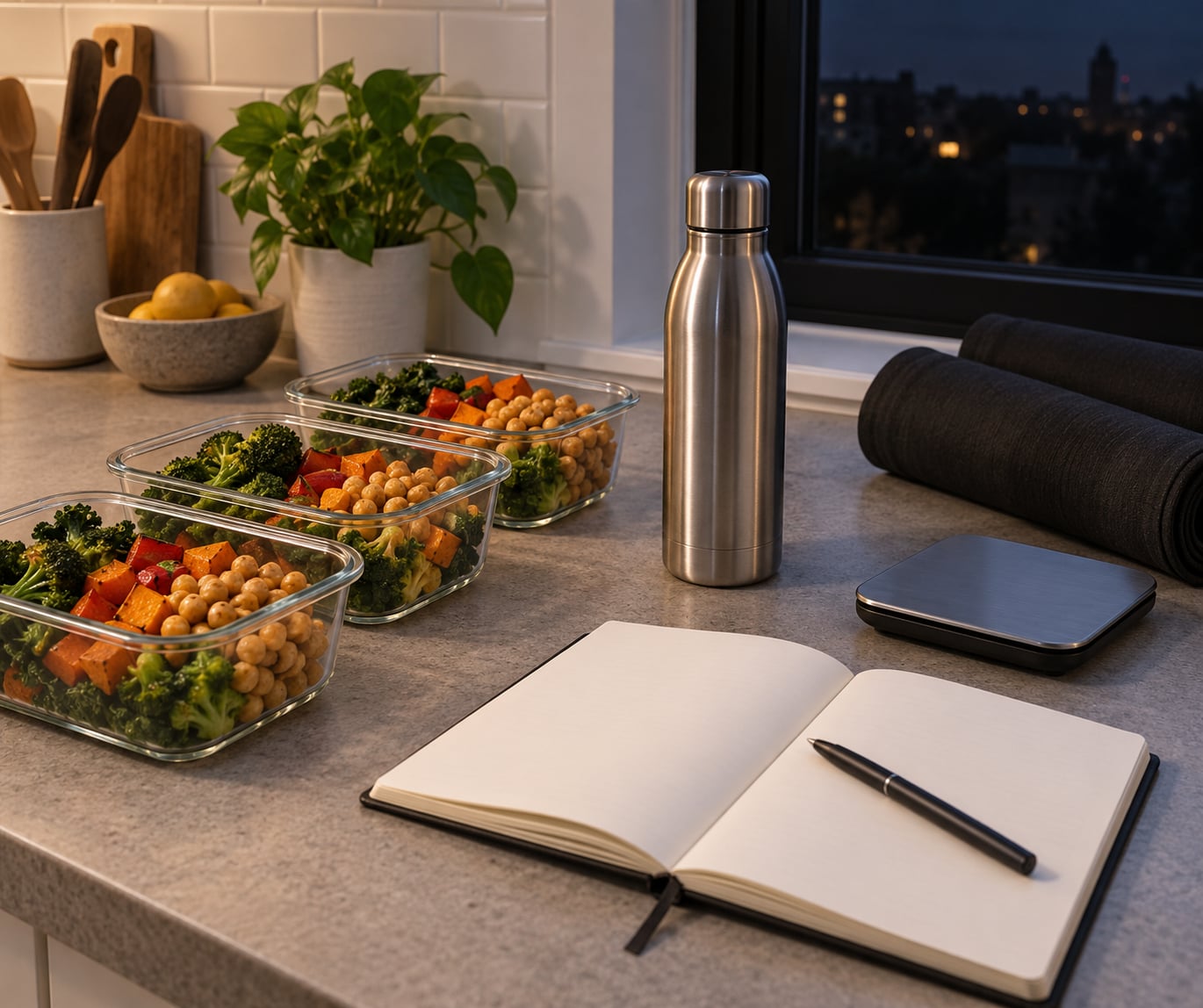
None of this is expensive or complicated. The gear exists to solve the three things that break night-shift diets: no routine, no food at 3 a.m., and no way to tell whether last week worked.
- Two or three leakproof containers so your shift food does not depend on a break room or a vending machine that is closed.
- An insulated lunch bag with a frozen pack if anything you packed needs refrigeration. Perishable food should stay under 40 degrees Fahrenheit.
- A 1-liter water bottle with a timer, so hydration is a thing you do rather than something you remember.
- A notebook or a simple app for shift notes: what you ate, when you slept, how much you moved.
- A bathroom scale, used under one set of conditions only.
- A sleep setup: blackout curtains, an eye mask, earplugs, and a phone that does not buzz at 2 p.m.
Keep the notebook next to whatever you use as a coffee maker. You will fill in two lines a day, and two lines is low enough that you will actually do it at 4 a.m.
Step-by-Step: How to Lose Weight When You Work Night Shifts
Step 1: Plan Your Meals Around Your Shift
Batch cook on your day off and treat yourself like a short-order cook with a one-item menu. Success signal: everything you intend to eat on shift is already assembled before you leave home.
Most night-shift diets fail at 2 a.m. because that decision happens in an empty break room. Take the decision away from yourself. Cook two or three complete plates, portion them into containers, and eat the same food for the same two or three shifts before you try something new.
Build each meal around protein, a fiber-rich carbohydrate, and a vegetable or fruit. Protein is the anchor that keeps you full through the small hours. Beans, lentils, eggs, plain Greek yogurt, chicken, tuna, tofu, and cottage cheese all travel well and cost little per serving.
For the carbohydrate, choose one that is not refined: beans, oats, brown rice, sweet potato, whole-grain bread, or a whole-wheat tortilla. Skip the sugary drink as your default and go with water, sparkling water, or unsweetened tea.
Keep a shelf-stable backup bag in your locker or your work bag. Good options that survive eight hours without a fridge include nuts, nut butter packets, jerky, roasted chickpeas, tuna pouches, whole-grain crackers, dried fruit, popcorn, and protein bars with real fiber in them. Fresh fruit holds up fine. A banana is not a problem.
Skip anything that needs a microwave you cannot count on, and skip the gas station at 4 a.m. unless you have genuinely no other choice.
Step 2: Keep Meal Timing Consistent
Anchor your meals to clock times, not to hunger. Success signal: you eat at roughly the same hours every shift, and you are not grazing from one end of the shift to the other.
This is the single biggest lever, and it is the one the AI-generated answers and the top-ranking guides all lead with. Eat your main meal before you leave, around 7 to 8 p.m. for a midnight start. That meal should be the biggest and most balanced of the day.
Then eat lightly. Have your next real meal around 11 p.m. to midnight, and keep what you eat from 1 a.m. to roughly 6 a.m. small. That early-morning window is when your body is at its lowest metabolic output, insulin sensitivity is at its worst, and cravings for starch and sugar peak. Occupational health guidance from CDC and NIOSH recommends keeping that window light for exactly this reason.
Three eating patterns work for most people. Pick one and stay with it for three weeks before judging it.
- Three meals, anchored: 7:30 p.m., midnight, and a small 6 a.m. meal before sleep.
- Two meals plus snacks: a large pre-shift meal, a small 2 a.m. snack, and a small meal when you get home.
- A compressed eating window: from roughly 5 p.m. to 1 p.m. the next day, so you fast through the biological night. This one suits people who do well with less eating, and it suits some people badly. Skip it if you have diabetes or prediabetes, are pregnant, or have a history of disordered eating, and get advice from a clinician first.
Whichever pattern you choose, the failure mode to avoid is the all-day graze. Small bites every ninety minutes add up quietly and switch off the satiety signal you need to stop.
Step 3: Protect Sleep and Limit Late-Night Eating Triggers
Protect seven to nine hours, because sleep is the fat-loss window, not a reward for finishing your work. Success signal: you fall asleep within about 30 minutes of lying down, most nights.
Make the bedroom do the work. Keep it cool, roughly 65 to 68 degrees Fahrenheit, fully dark, and quiet. Blackout curtains and an eye mask are not luxury items here; they are what makes the difference between sleeping and lying there for eight hours.
Keep your wake time as fixed as your schedule allows, even on your day off, because your sleep drive builds on rhythm. Stay off screens for the 30 to 60 minutes before you sleep, and if you wear glasses, use blue-light blocking lenses on the drive home if morning light hits you.
Then name your eating triggers, because the 3 a.m. snack is almost always triggered rather than hungry. Common ones: boredom on a quiet stretch, stress after a difficult call, the smell of someone else’s food, a hard stop in energy around 3 a.m., and caffeine wearing off.
Pre-decide what you do with each trigger. Boredom gets a ten-minute walk. Stress gets water and two minutes of slow breathing. The 3 a.m. dip gets the snack you packed, not whatever is in the machine. Cravings at 3 a.m. are real, and they are also predictable, which means they can be handled.
Step 4: Fit Exercise Into Short, Regular Blocks
Train before your shift, not after. Success signal: three sessions a week, each one short enough that you do it on your worst days.
Coming home at 6:30 a.m. with nothing left is why most night workers quit training. Move the workout earlier, ideally ending within an hour or two of your main pre-shift meal.
Keep it simple: a 20 to 30 minute brisk walk on three days, plus two short resistance sessions a week using bodyweight or dumbbells. Resistance work matters here because muscle is what keeps your resting metabolic rate up while your total daily burn is already lower. Add mobility or mobility and balance work if your job is sedentary and your body complains.
Start where you are. If you currently do nothing, two weeks of daily walking counts as real progress. Add the resistance work in a second block rather than on day one.
Step 5: Control Portions Without Going Extreme
Build meals that fill you, then measure the few things that quietly add up. Success signal: you are eating from planned portions, not from the container.
Calorie control on nights is mostly portion control plus the extras. Measure oil, butter, nut butter, cheese, and dressings for a few weeks until you can eyeball them reliably. Those five items cause most of the surprise calories in an otherwise sensible meal.
Drink water or unsweetened drinks almost all day, and aim for roughly 2 to 3 liters across a shift. Dehydration reads as hunger to a lot of people, and it also shows up as the 4 a.m. headache that sends you to the vending machine.
Cut caffeine six to eight hours before your sleep block, and pay attention to half-life. Caffeine at 4 p.m. is still working on you at midnight. Set a hard cutoff time and stick to it, even on the hard night.
Drop sugary drinks and minimize alcohol. Alcohol disrupts sleep and blood sugar control, and a nightcap is a poor trade for weight loss. None of this means a perfect day. It means small, repeatable corrections.
Step 6: Track Trends Instead of Perfect Days
Watch the multi-week trend, not the daily number. Success signal: you can point to a downward trend across eight weeks even when the scale bounces around.
Weigh yourself under one condition only: first thing after waking, after using the bathroom, before eating. On a rotating roster, weigh on your last morning of sleep, so the comparison is apples to apples. Day to day swings of several pounds are normal, and a night worker who gained several pounds overnight has almost certainly shifted water and glycogen, not fat.
Track four other things in the same notebook, because they move before the scale does. Sleep hours. Energy during the shift. Hunger between 1 and 4 a.m. And how many planned meals you actually followed. Those four tell you which step needs work long before a number changes.
If the scale stalls for two to three weeks, work through this order. First, check whether your tracking is honest; shift-day eating is the easiest to misremember. Second, look for portion creep in oils, nut butter, and drinks. Third, check sleep hours and caffeine timing. Fourth, look at the deficit itself. Cutting harder is the last option, not the first.
Common Mistakes
Almost every stalled night-shift weight loss plan contains at least two of these. Fixing one habit at a time beats changing everything on a Monday.
Eating the main meal at 3 a.m. Your body is at its lowest metabolic output in that window and its worst at handling a large carb-heavy meal. Move the big meal to before the shift and keep the small hours light.
Skipping meals, then overeating. The 4 a.m. crash feels like needing food, but it usually reads as hunger. It leads to a large 7 a.m. meal, and that meal is where most of the damage happens. Eat small and planned instead.
Living on the vending machine. Most night vending is chips, chocolate, and sugary drinks, which deliver a fast blood sugar rise followed by a drop that triggers the next craving. Pack your own and keep the backup bag stocked.
Using caffeine and sugar as the coping mechanism. Both mask the tiredness that sleep should fix, and both push blood sugar up when insulin response is already impaired. Set a cutoff and take a short walk instead.
Trying to work out after the shift. You are exhausted and heading to bed. Move it before the shift, where it fits and where you will repeat it.
Going too fast. Crash diets fail on nights faster than anywhere else, because the pattern is already fragile. Change about 300 to 500 calories and hold it for weeks.
Quitting when the scale goes up in week one. Early gain is normal on a new pattern. Most people who quit in that window quit just before it starts to work.
Two maintenance notes. Once the weight is off, keep the meal timing and the sleep block, because both are load-bearing. And treat new warning signs seriously: chest pain, fainting, repeated blood sugar swings, or feeling unable to sleep at all are reasons to see a doctor rather than adjust your diet harder.
Frequently Asked Questions
Is it harder to lose weight while working night shift?
Yes, mainly for biological reasons. Night work lowers total daily calorie burn by roughly 50 calories, and it disrupts the fullness and hunger hormones that normally regulate how much you eat. Shortened sleep then adds around 250 to 500 calories of intake on its own. That combination adds up to a real advantage for day workers, but it is manageable with fixed meal timing and protected sleep.
What time should I eat on a night shift?
Eat your largest meal before the shift, around 7 to 8 p.m. for a midnight start. Have a smaller meal around 11 p.m. to midnight, then keep what you eat from 1 a.m. to about 6 a.m. small. That early-morning window is when your metabolic output is lowest and your blood sugar control is weakest. Most night shift weight loss advice, including CDC and NIOSH guidance, points to that same window.
Why am I not losing weight on night shift even in a deficit?
Start with tracking accuracy. Shift-day intake is the least reliable number most people keep, and portion creep in oil, nut butter, and drinks is easy to miss. Then check sleep hours and caffeine timing, because short sleep raises hunger on its own. Only after those three come back clean should you cut calories further. Many people are not in a deficit at all, they are in a noisy one.
Is intermittent fasting good for night shift workers?
It can be, and a window from about 1 a.m. to noon suits people who eat well with less food. But it is not a good fit for everyone. Skip it or get medical advice first if you have diabetes or prediabetes, take medication that needs food, are pregnant, or have a history of disordered eating. On nights, an unplanned fast usually turns into a large late meal, which defeats the point.
What burns fat while you sleep at night?
Sleep itself, more than anything you do or eat in the dark. Fat oxidation rises during deep sleep, and short or fragmented sleep disrupts it while also raising ghrelin, the hunger hormone, and lowering leptin, the fullness signal. That is why protecting seven to nine hours matters more than any supplement. When your daytime sleep is short, your appetite rises no matter how disciplined the rest of your day is.
What is the 3-3-3 rule, and does it work on night shift?
The 3-3-3 rule is a general eating pattern: eat within three hours of waking, finish three meals across three hours, and stop eating at least three hours before bed. It was built around a normal daytime schedule, so the evening part does not transfer cleanly to nights. On nights, apply the same logic to your own clock: three anchored meals, and stop eating a few hours before your sleep block begins.
The Bottom Line
Night shift weight loss comes down to four levers: a 300 to 500 calorie deficit, the main meal before the shift, a sleep block you protect like an appointment, and movement short enough that you keep doing it. Start tomorrow with the meals. Cook two plates, put them in containers, and take them with you.