A weekly check-in is a short, scheduled 15 to 20 minute review, usually on the same day each week, where you record your weight, waist measurement and a few non-scale markers, compare them with last week, and make at most one small change to your plan. That is the whole process. Fifteen focused minutes, once a week, tells you more than a month of guessing.
Most people get the check-in wrong in one of two directions. They skip it entirely, then wonder why a six-pound regain feels like it happened overnight. Or they do it daily, react to every wobble, and quit inside a month. The version that works sits in the middle, and it is not complicated.
Below is the process I would hand to someone starting out, including the numbers worth knowing and a copyable template. This is general information, not medical advice. If you have a health condition, take medication, are pregnant, or have a history of disordered eating, talk with your doctor or a registered dietitian before changing how you track your weight. Last reviewed in 2026.
Table of Contents
- What You Need for a Weekly Check-In
- How to Do a Weekly Check In for Weight Loss, Step by Step
- 1. Pick a consistent day and time to weigh in
- 2. Record measurements and the context of the week
- 3. Look at the trend instead of one number
- 4. Review what helped and what got in the way
- 5. Choose one small adjustment for the next week
- 6. Close the check-in with a short reflection
- Common Mistakes to Stop Making
- Frequently Asked Questions
- When should I do a weekly weight-loss check in?
- How often should I weigh myself while losing weight?
- What if my weight changes a lot from one week to the next?
- Should I use waist measurements along with weight?
- What if I miss my weekly check in?
- When should I talk with a doctor or registered dietitian about my weight-loss routine?
- Start With One Number on One Day
What You Need for a Weekly Check-In
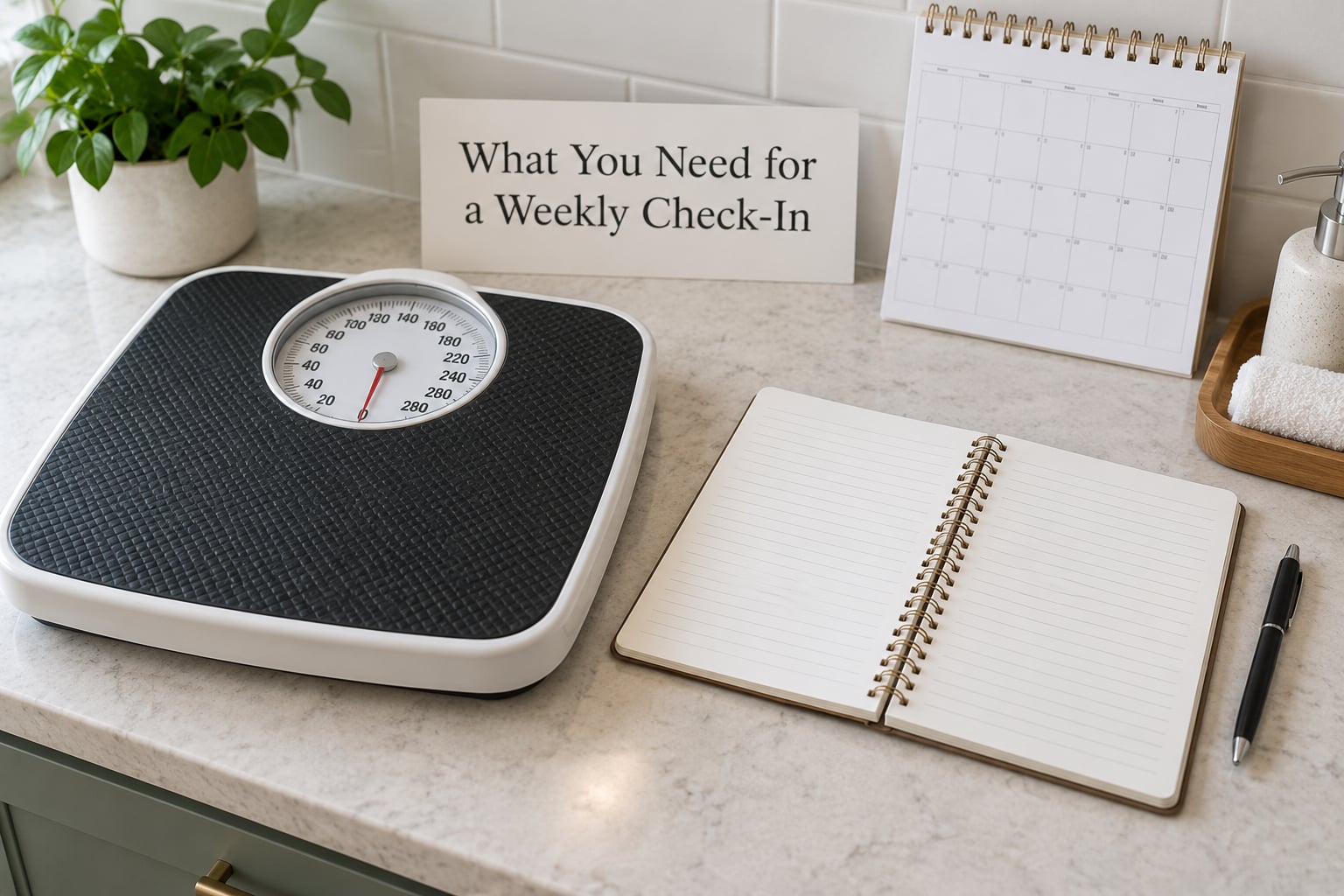
None of this is expensive. You need a way to measure, a place to write, and about ten minutes of honest note-taking. Here is the full kit.
- A scale, or another measurement method. A digital scale is the easiest option, but waist circumference and a once-a-month progress photo work too. Some people stop weighing entirely and rely on measurements and how clothes fit. Any consistent measure beats an inconsistent one.
- A notebook or a single app. Paper works well because you can see the whole trend on one page. An app is better if your scale or phone syncs automatically. Pick one, not five.
- A calendar or habit tracker. This is what turns a check-in into something that actually happens. Put the 20-minute block in your calendar the same way you would a dentist appointment.
- A soft measuring tape for waist, and optionally hips and chest. Measure at the same spot each time, usually just above the hip bone, and keep the tape snug but not tight.
- A rough log of the week. You do not need a perfect food diary. A sentence about meals, a step total, hours of sleep, stress level and energy is enough to explain most of what the scale did.
If you would rather not count calories at all, the check-in still works. Swap the nutrition log for hunger, satisfaction and how often you ate out. Consistency in what you record matters far more than how much you record.
How to Do a Weekly Check In for Weight Loss, Step by Step
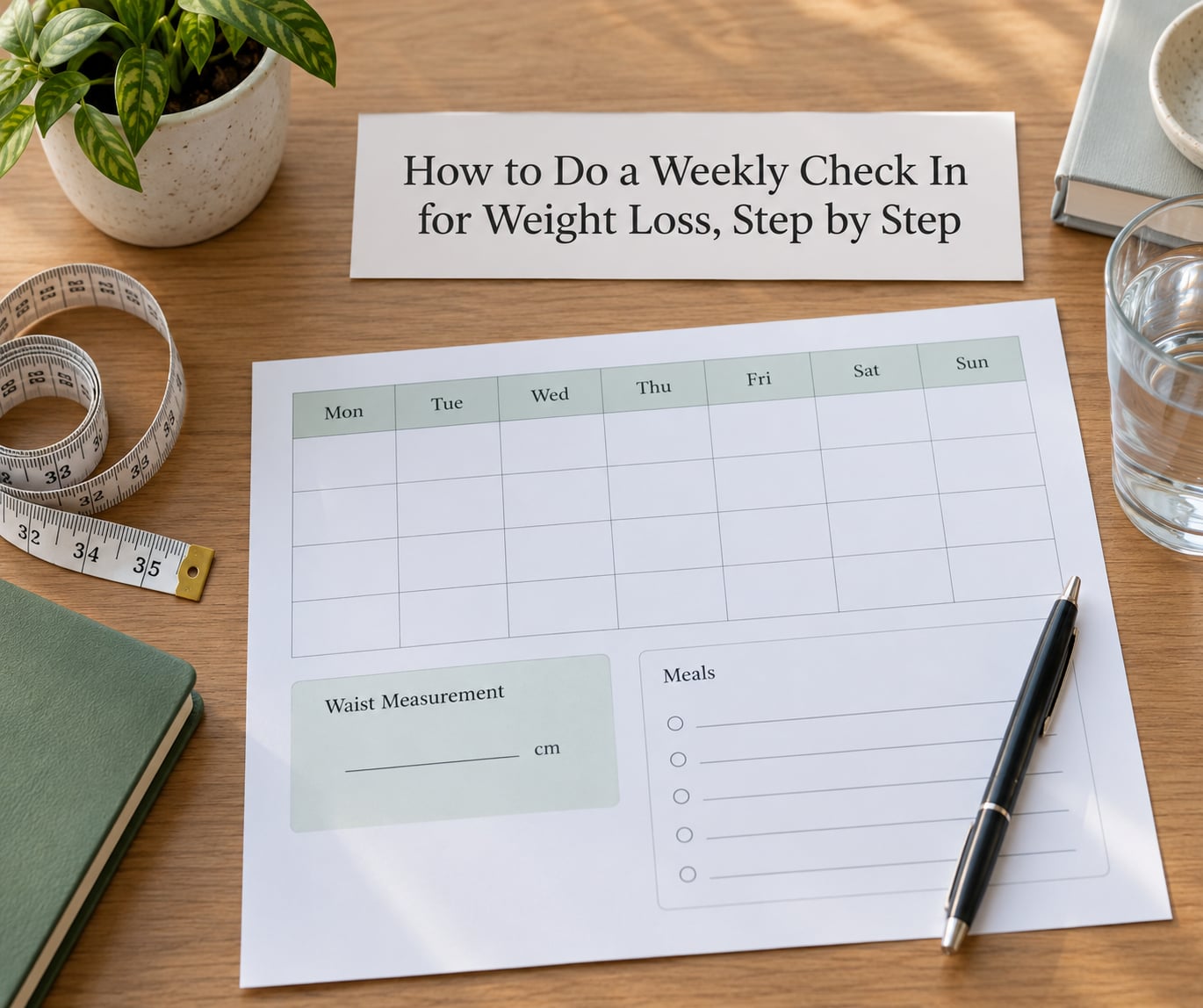
Set a 20-minute timer when you start. The agenda below fits inside it, and going over means you are sliding into self-criticism rather than review.
1. Pick a consistent day and time to weigh in
Choose one weekday and one rough time, then protect it. The standard conditions are first thing in the morning, after using the bathroom and before eating or drinking anything, in the same clothes or no clothes, on the same hard floor. If mornings are chaotic, an evening slot works as long as it is always the same one.
Why the fuss? A liter of water weighs about a pound, so the scale is really a balance of everything in and out of your body over the past 12 hours. Same conditions mean the leftovers from yesterday still show up in both numbers.
2. Record measurements and the context of the week
Write down the number, then write down why the week looked the way it did. Weight alone is a noisy signal. Waist measurement, step count, sleep, meals and energy turn it into something you can act on.
Keep the note short. Three or four lines: average weight for the week, waist, whether you hit your nutrition and movement targets, and one sentence about the week. If you lifted weights, note whether the gym numbers went up, because a heavier scale reading with stronger lifts is a different week from a heavier reading with nothing gained.
3. Look at the trend instead of one number
Compare this week’s weight with last week’s, then with the three and four weeks before it. A four-week moving average smooths out water retention better than anything else you can do at home, and it takes one subtraction per week.
Here is the calculation most people use:
- Add up the weigh-ins for the week.
- Divide by the number of weigh-ins, for example seven daily readings or one weekly reading.
- Subtract last week’s average from this week’s average.
- Look at four weeks of those averages in a row, not at this week’s line alone.
Everyday context matters. A salty takeaway, a day of extra carbs, a long flight, a new medication or a stressful week can move the scale two to four pounds without a single ounce of fat changing. People on weight-loss forums describe waking up to a jump like that more often than any other complaint, and it is nearly always water and gut content.
4. Review what helped and what got in the way
Now go through the habits, not the number. What did you repeat that worked? Two lunches packed at home and a walk after dinner is a real pattern, and it deserves to be protected next week. What got in the way, and was it the plan or the circumstances?
That distinction matters. A birthday party, a work trip and a sick kid are events. Skipping breakfast four days because you disliked your meal prep is a decision, and the fix is a different plan rather than more willpower. Phrase it as a pattern you want to change, not a failure you committed.
If you track calories, a rough adherence percentage is more useful than a precise count. Six out of seven days on target with a trending weight down is a working plan, not a broken one.
5. Choose one small adjustment for the next week
One change. Not four. The table below covers the three situations you will actually face.
| What the trend shows | Likely explanation | What to do next week |
|---|---|---|
| Down 0.5 to 1 percent of body weight | Plan is working | Change nothing. Hold the same targets and let the trend keep running. |
| Down a little more than that | Possible deficit too large, or a fluid week | Keep going two more weeks before adjusting. Add food back slowly if energy is poor. |
| Flat, or within half a pound of last week | Normal week-to-week noise, or portions drifting up | Audit the last seven days honestly. Fix one thing, such as a snack habit or a weekend meal. |
| Up 1 to 2 percent | Water, salt, travel, a heavy lifting week, poor sleep | Fix nothing this week. Drink normally, sleep, and re-check next Sunday. |
| Up 3 percent or more for two weeks running | Real intake increase, or a calorie target that is now too low | Recalculate your target. Maintenance and reverse dieting beat a harsher cut, and never go below widely cited floors of about 1200 calories for women or 1500 for men without medical supervision. |
Most long plateaus are not mysterious. Portions creep, weekends get longer, and the same target quietly stops working as you get lighter. Some people also stop logging at all, which makes the drift invisible until it is 10 pounds. When your bodyweight drops by 10 to 15 percent, your energy needs drop with it, so recalculating every few months is normal maintenance, not failure.
6. Close the check-in with a short reflection
Finish with three lines you can read in six months: what progress you are happy with, the question you are carrying, and the single action for next week. This is the part people skip, and it is the part that turns one good week into a habit that lasts.
Here is the template to copy into a notebook or a note. One row per metric, one column per week.
| Metric | This week | Last week | Change |
|---|---|---|---|
| Average weight | |||
| Waist measurement | |||
| Average daily steps | |||
| Nutrition target hit | of 7 days | of 7 days | |
| Average sleep | hours | hours | |
| Energy, 1 to 5 | |||
| One non-scale win | |||
| One adjustment for next week |
Non-scale wins deserve their own line because they are the ones that hold when the scale stalls. Stairs that used to wind you now do not. Jeans fit differently at the waist. A lift you could not do two months ago moved. Photos from the same spot and lighting show things the scale never will.
Common Mistakes to Stop Making
Weighing too often is the first one, and it is the most common. Daily readings are useful data, but only if you average them and then stop looking. Weighing in the morning and reacting before breakfast is how people turn a normal fluctuation into a bad day.
Reacting emotionally to a single number is the second. One number is a snapshot of fluids, food and timing, and it says almost nothing about fat. Judge the trend over four weeks, and treat a bad reading as information rather than a verdict.
Tracking only weight is the third. If the number stalls but your waist dropped an inch and your lifts went up, you are losing fat and gaining lean mass, which the scale cannot see. Add at least two non-scale markers to every check-in.
Setting targets that are too aggressive causes the fourth. Losing 1 to 2 pounds a week, or roughly 1 percent of body weight, is the pace most people in weight-loss communities describe as the fastest that stays sustainable. A 500-calorie daily deficit averages out to about a pound a week. Promising more than that is how plans end in restriction and regain.
Changing everything at once is the fifth. When the scale is disappointing, the instinct is to cut carbs, add two hours of exercise and stop eating after six. You will lose some water, feel miserable, and learn nothing about which change worked. One adjustment, held for two weeks.
Using shame is the sixth, and it is the one that ends check-ins permanently. A check-in is a measurement, not a grade. Write what the data says, then write one supportive sentence about what you are doing about it.
Believing internet rules will not help either. You will see viral rules like the 3-3-3 method, which has no clinical basis and no connection to any mainstream nutrition guidance. Judge a plan by whether it is safe, sustainable and something you can still be doing in three months.
Two habits fix most of the above. Protect the calendar slot like a meeting, and pair the check-in with something you enjoy, a short walk or a coffee, so it stays attached to a good feeling. And add one monthly review on top of the weekly one, where you look at the whole quarter and ask whether your plan still matches your life.
Frequently Asked Questions
When should I do a weekly weight-loss check in?
Pick one fixed weekday and time, usually a Sunday morning or a Monday morning before breakfast. Same day, same time and same conditions each week make the numbers comparable. A Sunday morning slot also gives you a full day to plan meals and movement before the week starts, which turns the review into preparation instead of just looking at a number.
How often should I weigh myself while losing weight?
Once a week is enough for most people, and that is the number most weight-loss communities land on. If you use a smart scale that syncs automatically, step on it daily but only look at the weekly average, never a single day. Daily numbers are useful raw data and poor decisions. If weighing makes you anxious, weigh monthly and lean on waist measurements and photos instead.
What if my weight changes a lot from one week to the next?
Look at the direction of the trend over three to four weeks, not the size of the jump. Salt, extra carbohydrates, travel, constipation, a new medication, heavier strength training and poor sleep can all move the scale several pounds without changing body fat. If the jump came with no pattern in your habits, change nothing this week and simply re-check next Sunday.
Should I use waist measurements along with weight?
Yes, and it is the single most useful addition to a check-in. Measure at the same point each time, just above the hip bone, with the tape snug but not tight, and once a week is plenty. Waist circumference often shows a change before the scale does, particularly when you are strength training, because muscle gain and fat loss can cancel out on the scale while the waist keeps shrinking.
What if I miss my weekly check in?
Do not backfill a full week of effort to make up for it. Just check in the next scheduled day and mark the gap. Two missed weeks in a row is the point to look at what changed, usually portions, weekend habits or sleep. If a hard month makes tracking feel like punishment, drop to a monthly check-in rather than abandoning the habit altogether.
When should I talk with a doctor or registered dietitian about my weight-loss routine?
Speak with a professional before starting if you are pregnant or breastfeeding, under 18, managing diabetes, heart or kidney conditions, or taking medication that affects appetite or weight. Also reach out if you feel ravenous, dizzy or unusually tired, if your eating has become rigid, or if food thoughts are affecting your daily life. A registered dietitian can also recalculate your targets as you get lighter.
Start With One Number on One Day
Do this first: put a recurring 20-minute block in your calendar for the same day each week, write down your weight and waist tomorrow morning before breakfast, and leave everything else alone. After four weeks you will have a trend instead of a series of anxious mornings, and the decision you make each Sunday will finally be based on something.