The short answer to how to handle holidays while losing weight is simple: protect the routine you already have rather than white-knuckling a perfect diet. Keep your meal times, eat protein and vegetables first, drink water before you drink anything else, and move through ordinary daily life instead of the gym. Most people gain 1 to 5 pounds between Thanksgiving and New Year’s, and most never take it off, so the real win in December is holding steady rather than chasing another pound.
The shift that makes this easier is deciding in advance what the season is for. If you are mid-loss and have 20 pounds to go, December is a maintenance month. You keep the deficit running through October and November, then hold steady for six weeks, then restart in January with a plan you already believe in.
That approach takes about fifteen minutes of setup in early December, and it removes the two things that derail most people: surprise decisions made at four in the afternoon, and the belief that one big meal has ruined everything.
Table of Contents
- What You Need to Handle Holidays While Losing Weight
- A short written list of your maintenance calories
- Three meal times that do not move
- A small food scale and a reusable container
- A water bottle you carry with you
- Comfortable shoes and a walking plan
- One or two people who know your plan
- Step-by-Step
- Plan your holiday meals before the event
- Choose satisfying portions instead of avoiding all holiday foods
- Navigate buffets, dinners, and potlucks with a simple strategy
- Keep movement simple and enjoyable
- Protect your progress after a big meal or missed day
- Common Mistakes
- Frequently Asked Questions
- Can I lose weight during the holidays without skipping my favorite foods?
- What is the best way to handle a holiday buffet?
- Should I avoid alcohol while trying to lose weight?
- How do I control my weight when eating at restaurants or traveling?
- What should I do the day after eating too much during the holidays?
- How can I handle relatives who pressure me to eat or drink?
- The One Thing to Do First in December
What You Need to Handle Holidays While Losing Weight
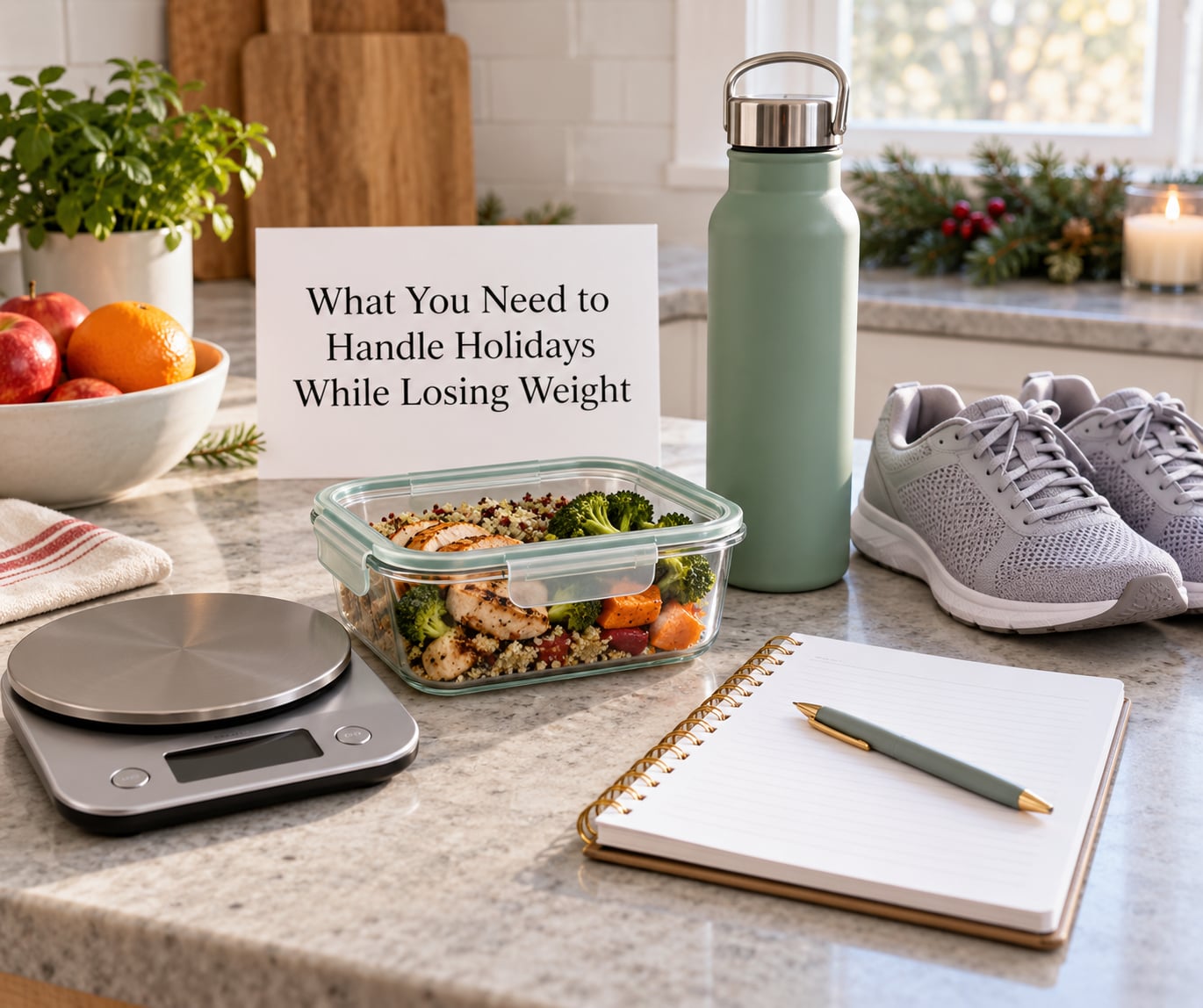
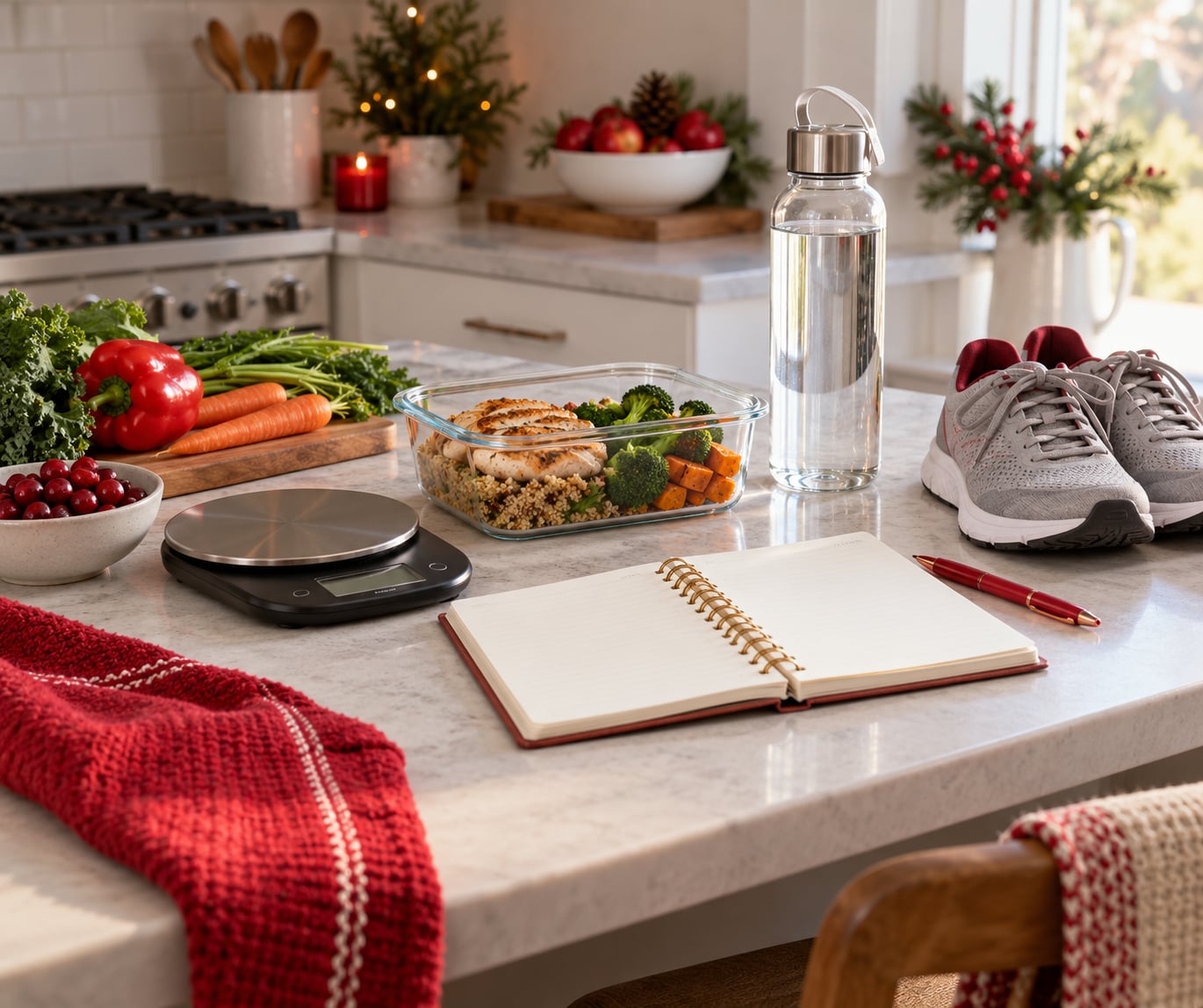
Almost nothing on this list costs money, and none of it needs a membership. What it needs is a decision made now, while you are calm, instead of later when your cousin is asking for seconds. Most of how to handle holidays while losing weight is settled in that calm moment rather than in the moment itself.
A short written list of your maintenance calories
Pick one number and write it where you will see it. If you have been tracking calories, you already know roughly what your maintenance level looks like. If you have never tracked, a rough estimate is still more useful than guessing mid-party, because it gives your plate a size to aim at.
Three meal times that do not move
Pick breakfast, lunch, and one other meal, and defend those. Even on the worst day of the season, those three meals happen at roughly the same hours. Everything else at a gathering is an addition, not a replacement, and that one distinction prevents the majority of holiday damage.
A small food scale and a reusable container
The scale removes the guessing. If you want a slice of the dessert you love, weigh it, log it, and keep going. The container is for the opposite problem: the buffet leftovers you did not mean to take home.
A water bottle you carry with you
Alcohol calories are easy to rack up and impossible to feel. Most of the season’s drinks are either high-calorie or served in a large glass, and neither shows up on a plate. Having water in hand gives you something to drink between the toasts without making a decision every twenty minutes.
Comfortable shoes and a walking plan
Sightseeing, shopping, and walking to a relative’s house will get you somewhere in the 8,000 to 10,000 step range on a busy day without any effort on your part. That is the movement that counts in December. No doubles, no punishing sessions, no making up for a meal with a punishing session.
One or two people who know your plan
Tell one person. Not the whole table, not your aunt, not your coworker. One person who will text you a day before the party and ask what you are eating. Doing this alone is the part most people find hardest, and it costs nothing.
Step-by-Step
Plan your holiday meals before the event
Write down the three or four holiday foods you genuinely look forward to, not the twelve you feel obligated to try. Those get a place in the plan. Everything else is bonus.
Then decide in advance what you eat before and after the gathering. A normal breakfast with protein, and a normal lunch an hour or two before you leave, means you arrive at a party able to enjoy choices instead of arriving starving and eating whatever is nearest.
One Thanksgiving-style dinner can land somewhere around 3,000 to 4,500 calories. Nobody needs that number on a plate, but it explains why the plate before and after the event matters more than the one at the center of it.
Choose satisfying portions instead of avoiding all holiday foods
All-or-nothing rules fail predictably. A person who bans pie for six weeks does not eat no pie. They eat pie, plus the thing they skipped earlier because it was “not allowed,” plus guilt.
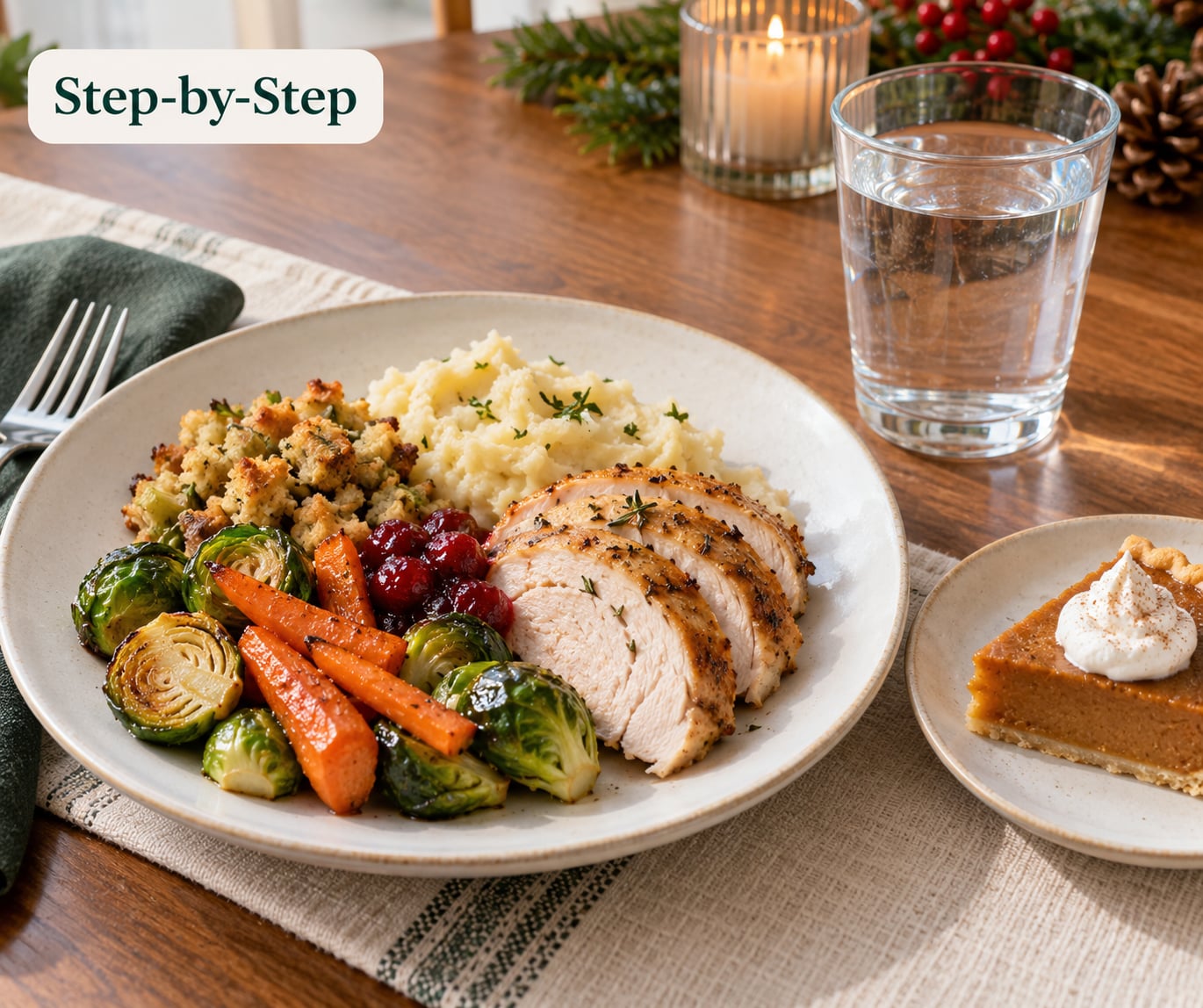
Use the plate method instead. Half the plate vegetables or salad, a quarter protein, a quarter the starch or the pie. Serve yourself a smaller portion than the one you would take at home. Put a real protein source on the plate first, and drink a glass of water before you go back to the table.
Sitting down for ten minutes with the food changes more than most people expect. It takes about twenty minutes for the body to register fullness, and a holiday table is engineered to interrupt that clock.
Navigate buffets, dinners, and potlucks with a simple strategy
Scan the whole table before you pick up anything. That one habit separates a plate from a pile.
Then build one plate: protein, a vegetable, and the one holiday item you most want. Sit down with it. If you want seconds later, seconds are a decision you make at the table, not a reflex you discover at 8pm.
The buffet line works the same way: cold vegetables and protein first, hot dishes second, the starch or dessert last. Walking the line once, slowly, beats three trips.
For pressure at a family table, the shortest answers work best. “This is incredible, I’m having a little” buys you a plate without a speech. “I’m full, honestly” ends the second offer. A long justification invites negotiation, and you do not want a debate at Thanksgiving dinner.
Keep movement simple and enjoyable
A ten to fifteen minute walk after dinner is the single easiest habit in this article. You do not need to change clothes, you do not need a workout video, and it happens at the exact moment your blood sugar is highest and your willpower is lowest.
Other movement that survives the season: dancing at a party because the music is good, taking the long way around a market, standing up during the boring parts of a football game, or doing a short bodyweight circuit in a hotel room.
Drop the double sessions. Training hard and then eating a huge dinner leaves a lot of people feeling worse, not better, and it makes January harder to get back into. December movement is about keeping a habit alive, not earning back calories.
Protect your progress after a big meal or missed day
Nothing on the scale in December is a straight reading. Salt makes you hold water. Carbohydrates do the same thing. Alcohol, travel, constipation, and heat all add noise. A two-pound jump on December 28 is usually fluid, not fat.
So here is the recovery protocol, and it is deliberately boring: return to your usual meal at your usual time, drink water, go for a walk, and get a normal night’s sleep. No compensatory fasting. No punishing workouts. No skipping meals to “cancel it out.”
Restricting after overeating starts the guilt cycle, and forum posts from people dreading the holiday season describe that cycle as the worst part, not the number on the scale. One big meal in a six-week stretch is a rounding error.
If you want a number to aim at, most people reverse a few pounds of seasonal gain within about a week or two of going back to normal eating. The scale often settles before you feel like you have earned it, which is another reason not to check it daily for a week.
Common Mistakes
Skipping meals before a party so you can save calories for it. You arrive starving, and the first four things you eat come from the plate closest to you. Fix: eat normally, then enjoy the gathering.
Saving the whole day for one enormous meal. A 3,000 to 4,500 calorie dinner on an empty stomach is the worst-case version of this. Fix: protein and vegetables at three of your four meals.
Treating alcohol as a side note. Drinks add up fast and they lower the quality of your food choices around them. Fix: a glass of water between drinks, and decide the limit before you walk in, not at the second round.
Sitting all day. Between the meal and the couch, a holiday weekend can be almost entirely sedentary. Fix: a walk after dinner, and take the stairs.
Abandoning the plan after one indulgence. This is the mistake that turns a five-pound season into a twenty-pound one. Fix: the next meal is the plan again. Not Monday, not January, the next meal.
Weighing yourself daily during the season. The noise creates stress, and stress creates more eating. Fix: check weekly at most, and judge progress by how the clothes fit in February.
Frequently Asked Questions
Can I lose weight during the holidays without skipping my favorite foods?
Yes, and you are less likely to lose weight if you try to skip them. The people who hold their weight through December are usually the ones who ate the holiday foods they love, in a portion they chose, and went straight back to their normal meals the next morning. Skipping food for weeks to save room for one meal tends to end with eating more than you planned, plus the guilt afterwards.
What is the best way to handle a holiday buffet?
Walk the entire line once before you take anything, so you know what is available. Then build a single plate: vegetables and protein first, the hot dishes second, and the one holiday item you most want last. Sit down with it rather than standing at the table, drink a glass of water before you go back up, and take one trip instead of three.
Should I avoid alcohol while trying to lose weight?
You do not have to, but be deliberate about it. Alcohol carries calories with no fiber and no protein, and most holiday drinks are poured in generous glasses. It also lowers inhibition, which is what turns a planned plate into a second and third helping. A glass of water between drinks and a limit you set before you walk in handles most of it.
How do I control my weight when eating at restaurants or traveling?
Keep two of your three anchored meals normal, usually breakfast and lunch, so the day still has structure. At a restaurant, order protein and a vegetable first, choose a side rather than a combo, and eat slowly. When travelling, self-catering from a place with a kitchen is the single biggest lever people report, and a walk through wherever you land does the movement without a gym.
What should I do the day after eating too much during the holidays?
Go back to your normal meal at your normal time. Drink water, get some movement, and sleep. Do not fast, do not double up on workouts, and do not skip food to cancel out the day. Salt and carbohydrates make you hold water for a day or two, so a scale jump is usually fluid rather than fat, and it settles quickly once you are eating normally.
How can I handle relatives who pressure me to eat or drink?
Keep the answer short, warm, and non-negotiable. Complimenting the food and moving on works better than explaining, because an explanation turns into a conversation you have to win. Saying yes to the first offer and no to the second is much easier than refusing twice. Tell one person outside the table what you are doing so you are not defending it all night.
The One Thing to Do First in December
Write your maintenance number on a card and pick your three fixed meal times. That is the whole setup, and it takes five minutes.
Everything else in this guide is a detail inside those two decisions. Eat the holiday foods you actually love, in portions you chose, sitting down, with a walk afterwards. Then go back to your normal meals the next morning without a single apology.
Holding 1 to 5 pounds is a good December. Losing weight during the holidays is possible, but for most people holding steady is the smarter goal, and it leaves January free to get started again.