A 16:8 fasting schedule means you eat all of your food inside an eight-hour window and go without food for the other sixteen hours each day, usually overnight while you sleep. That is the whole rule. The window can start at 7am, at noon, or at 2pm, and the sixteen hours run from the moment you finish eating to the moment you start again.
People ask about the “how it works” part because the answer is less dramatic than the marketing suggests. Fasting compresses your eating into fewer hours, which usually means fewer unplanned snacks and less time grazing. Whether that alone produces weight loss depends far more on what you eat inside the window than on the window itself.
This guide walks through the daily rhythm, four realistic eating windows, what to eat and drink, and how to start without white-knuckling it. It is general information, not medical advice. If you take medication, are pregnant, or have a history of disordered eating, talk to a doctor or registered dietitian before you start.
Table of Contents
- What Is a 16 8 Fasting Schedule?
- How Does a 16 8 Fasting Schedule Work?
- A Simple 16 8 Fasting Schedule
- 16 8 Fasting Schedule Examples
- What Should You Eat During the 8-Hour Window?
- How Do You Stay Hydrated While Fasting?
- Can You Exercise During a 16 8 Fast?
- Is a 16 8 Fasting Schedule Safe for Beginners?
- How to Start a 16 8 Fasting Schedule
- Frequently Asked Questions
- How long does it take to see results on a 16:8 fast?
- What can I drink during a 16-hour fast?
- What is the best schedule for 16:8 intermittent fasting?
- What should my first meal be after intermittent fasting?
- Can I do a 16:8 fast every day?
- Does 16:8 fasting burn belly fat?
- Conclusion
What Is a 16 8 Fasting Schedule?
16:8 is a form of time-restricted eating. You choose one eight-hour period in the day, eat your meals inside it, and fast for the remaining sixteen hours. The sixteen hours include your sleeping hours, so for most people the fast runs from the end of dinner to breakfast the next morning.
It is not a calorie-free diet and it is not a detox. It also has nothing to do with fasting as religious practice, though the two share a name and, honestly, a similar rhythm of an early meal followed by a long stretch of nothing.
Here is how it differs from the other things people mix it up with:
- Water fasting means going long stretches with no food at all, sometimes 24 hours or more. 16:8 is far milder, and you eat every single day.
- Alternate-day fasting means eating on one day and fasting almost entirely on the next. That is a different pattern with a different research base.
- 5:2 or OMAD restrict you to fewer eating days or a single meal per day. 16:8 keeps three meals a day, just closer together.
- Medical or therapeutic fasting happens under clinical supervision for a diagnosed condition. That is not what anyone is doing at home with a timer app.
There are no food rules built into the method itself. Nothing is banned, nothing is required. The structure is purely about time.
How Does a 16 8 Fasting Schedule Work?
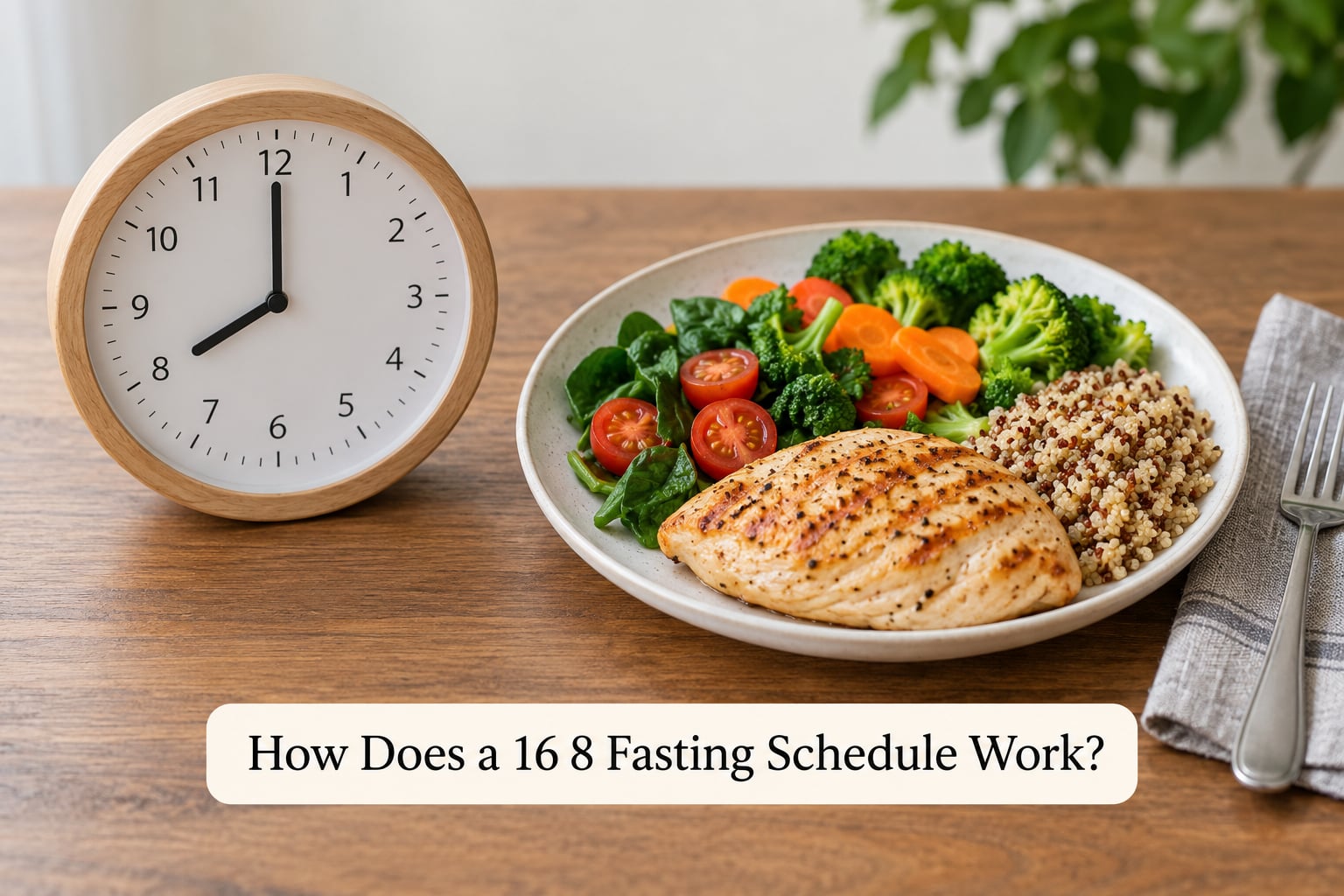
Mechanically it is simple: you stop eating at a set time, you start again at a set time sixteen hours later, and you repeat. What happens inside your body is where the interest sits.
After a meal, insulin rises so glucose can move out of the blood and into cells for energy or storage. Once insulin comes back down and some hours pass with no food, the body starts drawing more heavily on stored fat for fuel. Nutrition researchers call this shift metabolic switching. It is a normal response to not eating, not a special state reserved for people who skip breakfast.
You will also hear autophagy mentioned constantly. Cells do break down and recycle worn-out components during fasting periods, and early research suggests this process ramps up somewhere in the 16 to 24 hour range. What that means for how you feel, how you look, and how you age is still very much an open research question, so treat anyone promising dramatic results from autophagy as overselling.
Hunger arrives in waves rather than as a slow ramp. Most people notice a strong wave around the usual meal time, then another one in the evening, and those pass after 20 minutes or so. That pattern is why the first fortnight feels harder than the rest: your body is conditioned to expect food at those hours, and you have not yet trained it otherwise.
Here is the part most guides get wrong. Restricting your hours does not automatically mean fewer calories. If you eat the same volume packed into eight hours instead of spread across fourteen, nothing much changes. The National Institute on Aging and other groups reviewing the evidence have repeatedly found that time-restricted eating produces roughly the same weight loss as ordinary daily calorie restriction, with no clear edge for either approach.
A Simple 16 8 Fasting Schedule
Pick your first meal, then count sixteen hours backwards from the moment you finish it. That is your fasting start time. The easiest version for most beginners puts the fast across sleep, because waking up does not mean dealing with hunger.
Here is the arithmetic, using a 7am start:
- Last bite at 11pm. That is day one.
- Sixteen hours later is 3pm the next day. That is when the fast ends and the window opens.
- The window runs 3pm to 11pm, which is exactly eight hours.
- Repeat daily.
The clock starts and stops on your last mouthful, not on the middle of the meal. A 9pm finish means your fast is over at 1pm, not at 5pm, which surprises people who count from the start of dinner.
To shift your window, move the whole thing by an hour or two rather than by a day. Moving an hour every few days keeps the sixteen-hour fast intact while your body adjusts. Shifting at once from a 12pm start to a 7am start is a jarring change, and there is no virtue in making it.
16 8 Fasting Schedule Examples
Four windows cover almost everyone. The right one is the one that fits your work, your training, and your social life without constant negotiation.
| Eating window | Fasting hours | Eating hours | Suits | The catch |
|---|---|---|---|---|
| 7am to 3pm | 3pm to 7am | Breakfast, lunch, early dinner | Early risers, people who feel hungry at night | Hard if you eat dinner with family at 7pm |
| 9am to 5pm | 5pm to 9am | Brunch, lunch, afternoon snack | Standard office hours, no social dinners | Three meals compressed into a workday |
| 12pm to 8pm | 8pm to 12pm | Lunch, afternoon snack, dinner | Most beginners and shift workers | Eating close to bedtime for some people |
| 2pm to 10pm | 10pm to 2pm | Afternoon meal, dinner, late snack | Late sleepers, night-shift workers | Can push bedtime and disrupt sleep |
Beginners on the r/intermittentfasting and r/fasting communities tend to land on 12pm to 8pm or 1pm to 9pm, and for an obvious reason: it is the window with the least social friction. Breakfast and lunch happen normally, dinner stays at a civilised hour, and nothing has to be explained at family meals.
Skipping breakfast is usually easier than skipping dinner, though it is not universal. If you train in the morning, a later window fits better. If you are a night nurse, shift your window with the rotation rather than fighting it.
Weekends are where most people lose the thread. Two loose days a week are not a disaster, but two unstructured ones can undo a strict week. Pick a plan before the weekend, not during it.
What Should You Eat During the 8-Hour Window?
Three meals across eight hours works well for most people: one when the window opens, one in the middle, one to close it. Some people prefer two larger meals, which is fine.
Build each one around four things:
- Protein. Aim for a palm-sized portion at each meal. Eggs, fish, chicken, beans, tofu, Greek yoghurt, cottage cheese.
- Fibre-rich carbohydrates. Oats, beans, brown rice, whole-grain bread, potatoes with the skin on. These keep you full through the gaps.
- Vegetables. Aim for two handfuls across the day. Volume matters, especially when your meal volume drops.
- Unsaturated fats. Olive oil, nuts, seeds, avocado, fatty fish. They make the meal satisfying rather than merely filling.
What you leave out matters as much. Ultra-processed snacks eaten inside the window still count, and a window filled with crackers and sweets will leave you hungrier than three proper meals spread over fourteen hours.
For your first meal after a long fast, keep it moderate. Something like eggs with vegetables and a piece of fruit, or yoghurt with berries and a spoon of nuts, sits well. A large greasy meal after sixteen hours is the classic recipe for bloating and stomach discomfort. Ramp up over a couple of weeks if you want to eat more.
Plateaus are normal and they are not a failure of the method. Adjust portion sizes or window placement, not your entire personality.
How Do You Stay Hydrated While Fasting?
Water is the default. Most people need a bit more than usual during a fasting window, not less, especially if the window sits in the afternoon and summer heat.
These drinks are generally fine during the fast:
- Water, sparkling water, and unsweetened mineral water
- Black coffee and black tea
- Unsweetened herbal tea, including plain green tea
- Electrolyte drinks or powders without sugar or calories
These end the fast or add calories you did not intend to eat:
- Coffee with milk, cream, or sugar
- Tea with any added sweetener
- Juice, soda including diet soda, sports drinks
- Bone broth and most fasting teas
- Gum, mints, and anything with sugar or artificial sweetener
That last group is the grey zone people argue about most. The honest answer is that few long studies have tested artificial sweeteners in a fasting state, and the mechanism is plausible rather than proven. If your goal is clean data on how you respond, leave them out. If the gum is what gets you through the afternoon, that is a different conversation, and a dietitian can help you think it through.
Headaches in the first week are usually sodium and fluid, not hunger. A pinch of salt in your water and a steady intake of plain water fixes most of them.
Can You Exercise During a 16 8 Fast?
Yes, and whether you should depends on the session. Lifting, intervals, and sport generally need fuel and perform better with food in you. A walk, some mobility work, and light yoga are fine fasted.
Most people land on a simple split: train shortly before your first meal or during the middle of the eating window, so you have eaten a few hours beforehand. If you prefer fasted cardio, keep it short and easy, and put it in the morning where the day still has time to refuel.
Watch for two things: dizziness during the session, and a hard session immediately before your window closes. Training tired and under-fueled is how people end up overeating at their last meal. If performance drops for two or three sessions in a row, move the workout rather than pushing through.
Is a 16 8 Fasting Schedule Safe for Beginners?
For most healthy adults it is a mild pattern, and research on time-restricted eating has not turned up serious safety signals in short trials. Common early effects are hunger in the mornings, irritability, trouble concentrating, light-headedness, and disrupted sleep if your window runs late into the evening.
Stop and speak to a doctor or pharmacist if you feel faint, get repeated headaches, cannot sleep, feel unusually weak during workouts, or find yourself bingeing at the end of each window. That last one is a signal about the plan, not about your willpower.
Talk to a healthcare professional before starting if any of these apply:
- You take medication that needs to be taken with food, especially diabetes medication or blood pressure tablets.
- You have type 1 or type 2 diabetes.
- You are pregnant or breastfeeding.
- You are under 18 or over 65.
- You have a history of disordered eating, or you are trying to lose a lot of weight quickly.
- You are preparing for or recovering from surgery.
How to Start a 16 8 Fasting Schedule
Do not go from twelve hours straight to sixteen on day one. A gradual ramp costs you nothing and saves you a bad first week.
- Week one: 12:12. Eat a normal breakfast and a normal dinner eight to ten hours apart. No changes to what you eat.
- Week two: 14:10. Pull breakfast forward by an hour or push dinner back by an hour, so fourteen hours pass between meals.
- Week three: 15:9. Same approach, one more hour. Expect hunger, particularly right around where breakfast used to sit.
- Week four: 16:8. Close the window to eight hours and hold it there for two to three weeks before worrying about anything else.
Pick the window before week three, not during it. 12pm to 8pm is the least disruptive place to start for most people.
Track more than the scale. A weekly note on sleep quality, hunger between meals, energy at your workout, and one waist measurement tells you far more than weight alone, which moves around by a kilo for reasons that have nothing to do with fat.
And keep it ordinary. Coffee with a friend is fine if it is black. Dinner out is fine if it sits inside the window. The people who last tend to be the ones who stopped treating it as a test.
Frequently Asked Questions
How long does it take to see results on a 16:8 fast?
Most people notice changes in how they feel within one to two weeks, such as fewer afternoon snacks and more stable energy. Changes on the scale usually take longer, often four to eight weeks, and much of the early drop is water rather than fat. Reviews of the evidence by groups such as the National Institute on Aging suggest time-restricted eating works about as well as ordinary calorie restriction, so judge progress on energy, sleep, and measurements too.
What can I drink during a 16-hour fast?
Water, sparkling water, black coffee, and unsweetened tea are the usual choices during the fasting period. Electrolyte drinks without sugar or calories are also fine and help with headaches. Anything with calories ends the fast, including coffee with milk, juice, diet soda, and sweetened tea. Gum and mints are in a grey area: the evidence on artificial sweeteners during fasting is thin, so leave them out if you want clean results.
What is the best schedule for 16:8 intermittent fasting?
There is no single best schedule, only the one you can hold onto. For most beginners, 12pm to 8pm works well because breakfast and lunch stay normal and dinner stays at a civilised hour. Early risers often prefer 7am to 3pm, and night workers often do well with 2pm to 10pm. Keep the sixteen hours consistent and shift the window by an hour or two at a time rather than jumping it across the day.
What should my first meal be after intermittent fasting?
Keep the first meal small and easy to digest. Eggs with vegetables and fruit, Greek yoghurt with berries and nuts, or a modest bowl of soup with beans all work well. The rule is protein plus fibre plus a little fat, in a portion you would comfortably eat at a normal mealtime. Avoid doubling your usual portions, because a large rich meal after sixteen hours commonly causes bloating and reflux.
Can I do a 16:8 fast every day?
Yes, daily repetition is the standard version of 16:8 and what most research has studied. It means eating every single day, just inside a shorter window. Some people prefer five or six days a week and eat normally on weekends, which works too and fits social life better. If you are exhausted, dizzy, or struggling with intense hunger, take a rest day rather than pushing through.
Does 16:8 fasting burn belly fat?
Fat loss is generally proportional to overall fat loss rather than spot specific, so no schedule targets belly fat on its own. Time-restricted eating can make the calorie deficit easier to achieve because it removes long periods of unplanned snacking, but that is an indirect effect. If you want to lose belly fat, treat the fasting window as a structure that helps you eat less overall, and keep resistance training and sleep in the plan too.
Conclusion
A 16:8 fasting schedule is a timing tool, not a magic switch. Choose an eight-hour window you can live with, keep the sixteen-hour fast running overnight where you can, and spend your attention on the food inside the window rather than on the hours outside it.
Start small. Two weeks at 12:12, then 14:10, then 15:9, and only then the full sixteen. If your energy, sleep, or hunger levels tell a different story than the plan does, change the plan. And check with a doctor or registered dietitian first if you take medication, are pregnant, or have a history of disordered eating.