Most adults need roughly 1,600 to 3,000 calories a day to hold their weight steady, with common averages near 2,000 calories for women and 2,500 for men. Your own number is decided by body weight, age, sex and how much you move, and any calculator will be wrong by about 10 to 20 percent. Treat the number as a starting point you test, not a fact.
This is general nutrition information, not medical advice. If you are pregnant or breastfeeding, under 18, managing diabetes, kidney disease, an eating disorder history, or taking medication that affects appetite, get your number from a doctor or a registered dietitian instead of a formula.
Table of Contents
- What Does Maintaining Weight Mean?
- How Many Calories Do You Need to Maintain Weight?
- Which activity multiplier should you use?
- Which BMR formula should you use?
- Which Factors Affect Your Maintenance Calories?
- How to Estimate Your Personal Calorie Needs
- Two worked examples
- Can You Eat More and Still Maintain Your Weight?
- Reverse dieting: stepping back up to maintenance
- Maintenance, weight loss and bulking are three different targets
- How to Know Whether Your Maintenance Target Is Right
- Frequently Asked Questions
- Is 1,500 calories enough to maintain weight?
- Is 1,200 calories enough to maintain weight?
- Do maintenance calories differ a lot by body size?
- Can I calculate maintenance calories without tracking exercise?
- Do maintenance calories change as I lose weight or age?
- Can reverse dieting break a weight loss plateau?
- Your First Step This Week
What Does Maintaining Weight Mean?
Maintenance is not a single day where calories in equal calories out. It is an average over two to four weeks, which is why one high day tells you nothing and one low morning on the scale tells you nothing either.
Three numbers describe the same system, and mixing them up causes most of the confusion I see in calorie-tracking threads:
- Basal metabolic rate (BMR) is what your body burns lying still and awake, breathing and keeping organs running. It is the floor, not your food target.
- Total daily energy expenditure (TDEE) is BMR plus movement plus the thermic effect of food. This is the figure that equals your maintenance calories.
- NEAT, non-exercise activity thermogenesis, is the unplanned movement: walking to the car, fidgeting, housework, standing while cooking. It is where two people of identical weight burn very different amounts.
Nobody has a fixed number printed on their body. It moves with the season, with training, with how well you slept, with stress at work, and with your weight itself. Anyone selling you a precise figure is guessing with extra confidence.
How Many Calories Do You Need to Maintain Weight?
The table below estimates maintenance calories for an average-build adult, using typical heights of 5 foot 5 for women and 5 foot 10 for men, and ages of 35 for women and 40 for men. Treat each figure as the middle of a range, not a target you must hit.
| Body weight | Sedentary (1.2) | Lightly active (1.375) | Moderately active (1.55) | Very active (1.725) | Extremely active (1.9) |
|---|---|---|---|---|---|
| 120 lb, woman | 1,490 | 1,700 | 1,920 | 2,140 | 2,350 |
| 140 lb, woman | 1,600 | 1,830 | 2,060 | 2,290 | 2,530 |
| 160 lb, woman | 1,700 | 1,950 | 2,200 | 2,450 | 2,700 |
| 180 lb, woman | 1,810 | 2,080 | 2,340 | 2,610 | 2,870 |
| 140 lb, man | 1,860 | 2,130 | 2,410 | 2,680 | 2,950 |
| 160 lb, man | 1,970 | 2,260 | 2,550 | 2,840 | 3,120 |
| 180 lb, man | 2,080 | 2,380 | 2,690 | 2,990 | 3,290 |
| 200 lb, man | 2,190 | 2,510 | 2,830 | 3,150 | 3,470 |
| 220 lb, man | 2,300 | 2,630 | 2,970 | 3,300 | 3,640 |
Pick the cell that matches your weight and your honest activity level, then subtract 10 percent. That gives you a deliberately conservative starting number, because most people underestimate how much they eat long before they overestimate how much they burn.
Which activity multiplier should you use?
The multiplier is where most calculators go wrong. Choose by what a normal week looks like, not by what a good week could look like.
| Multiplier | Label | What your week actually looks like |
|---|---|---|
| 1.2 | Sedentary | Desk job, little deliberate exercise, under 5,000 steps a day |
| 1.375 | Lightly active | Light exercise one or two days a week, around 7,000 to 8,000 steps |
| 1.55 | Moderately active | Training three to five days a week, around 10,000 steps |
| 1.725 | Very active | Hard training six or seven days, physical job or long daily walks |
| 1.9 | Extremely active | Two-a-days, competitive sport, or a manual job on top of training |
Which BMR formula should you use?
Three formulas get recycled endlessly. They are close enough that the multiplier matters more than the choice, but the newer one is the better starting point.
| Formula | Best for | Watch out for |
|---|---|---|
| Mifflin-St Jeor | Most adults; the current default | Uses body weight, so it drifts as your weight changes |
| Revised Harris-Benedict | Older references; fine as a cross-check | The 1918 original overestimates by roughly 10 percent |
| Katch-McArdle | People who know their body fat percentage | Useless without an accurate body fat reading |
Which Factors Affect Your Maintenance Calories?
Here is the short list of things that actually move the number, with a plain example of each.
Body weight. Heavier bodies burn more at rest and in motion. A 200-pound man and a 130-pound woman with identical habits do not share a maintenance figure.
Lean mass. Muscle is more metabolically active than fat. Two people at the same weight can differ by several hundred calories a day depending on how much of that weight is muscle. This is the strongest argument for strength training being a metabolic tool, small as the daily effect is.
Age. Maintenance drifts down with age, mostly because activity falls rather than because metabolism collapses. Men over 50 often see their real number drop after retirement or a desk move, which is a NEAT change, not a broken engine.
Sex. On average, men carry more lean mass and burn more. The gap narrows once you account for body composition, which is why a formula using weight alone penalises tall, lean women and flatters shorter, stockier men.
Daily movement. This is the big one. A person who works a desk job and never walks may burn 400 fewer calories on a Saturday than a colleague who walks 8,000 steps without setting foot in a gym. Step count is usually a better activity input than workout frequency.
NEAT variation. Some people fidget, pace and stand more than others at the same job. Genetic differences here are meaningful and impossible to guess from the outside. This is the main reason one formula cannot give everyone an accurate answer.
Sleep. Short sleep raises appetite and cravings, which usually shows up as a higher intake rather than a higher burn. The metabolic effect is real but smaller than the appetite effect.
Stress. Cortisol shifts fluid and drives comfort eating. Again, the visible effect is mostly intake.
Hormones and health status. Thyroid function, PCOS, menopause and perimenopause all shift energy use. Medications such as GLP-1 agonists reduce appetite substantially, which changes the intake side of the equation far more than the expenditure side.
How to Estimate Your Personal Calorie Needs
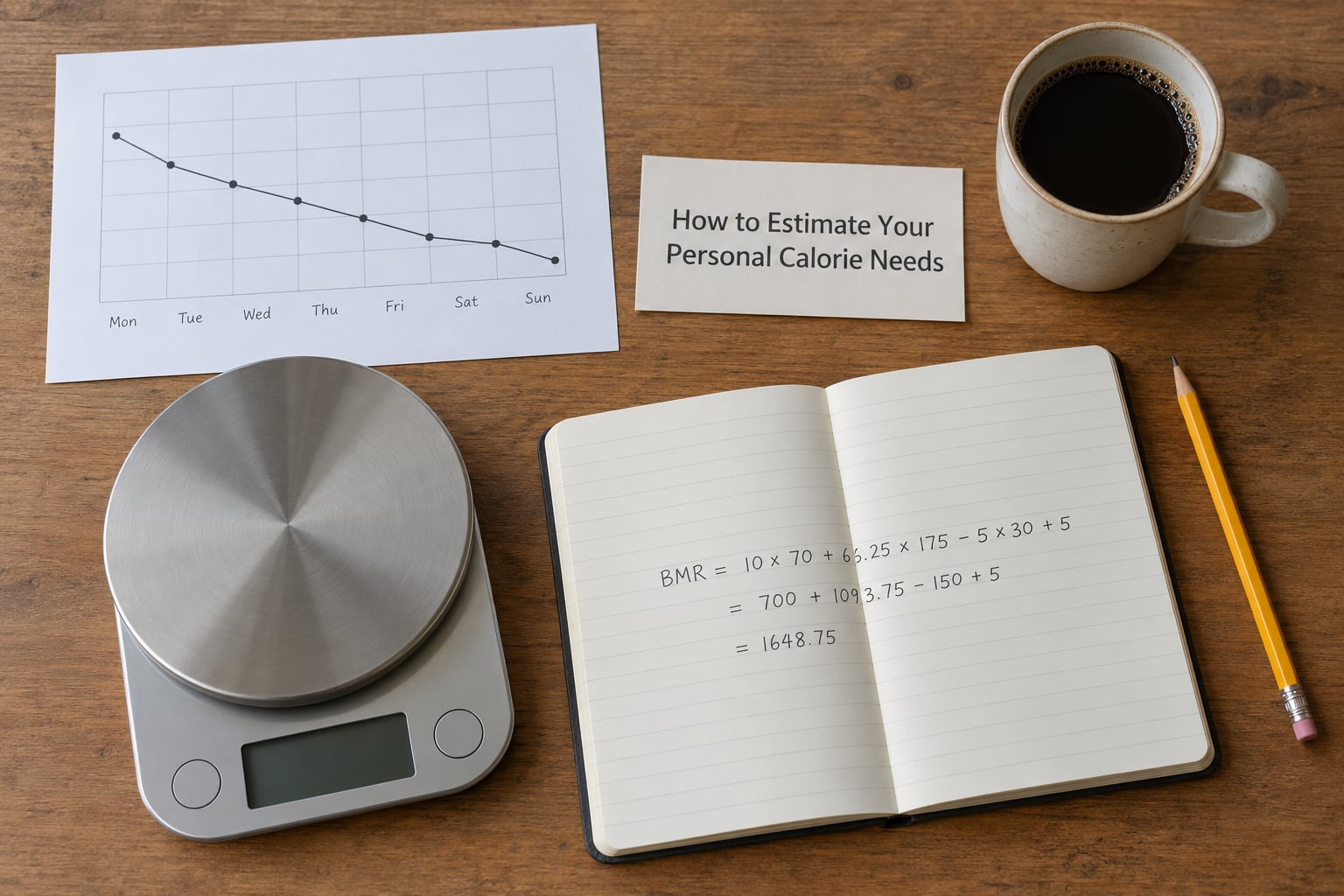
Five steps. The first three get you a number in two minutes. The last two are what turn that number into yours.
Step 1: Start from the table above. Find your weight and activity level. Subtract 10 percent to absorb the inevitable error. Do not skip this; most people never bother, and it costs you nothing.
Step 2: Run Mifflin-St Jeor as a cross-check. For men: (10 × weight in kg) + (6.25 × height in cm) − (5 × age) + 5. For women, subtract 161 instead of adding 5. If your table number and your formula number are more than 400 calories apart, you probably misjudged your activity level, not your weight.
Step 3: Multiply by your activity factor. Then you have a starting intake.
Step 4: Run the three-week calibration. This is the part no calculator does for you, and it is what people on forums keep asking for.
- Eat your starting number every day for three weeks. Log it, including oil, sauces and drinks.
- Weigh yourself every morning, first thing, after using the bathroom, before eating. Ignore each number; the point is the trend, not the reading.
- Average each week, then compare those weekly averages, not daily readings. Water weight from salt, carbs or a new training block moves the scale 2 to 5 pounds and means nothing.
- After three weeks of weekly averages: drop 0.5 percent or more per week across three consecutive weeks and you are eating below maintenance, so add 200 calories. Gaining 0.5 percent or more per week on the same three-week read and you are above it, so cut 200.
- Repeat the three-week cycle. Two cycles usually land you close.
Adjustments of 100 to 200 calories are deliberate. Bigger jumps tell you less and are harder to eat.
Step 5: Recalculate as your weight moves. Maintenance drifts down roughly 10 to 20 calories for every pound you lose, and up by the same order for every pound you gain. That is why a number that worked at 220 pounds drifts low at 180. Recalculate every 10 to 20 pounds of change.
Two worked examples
A 34-year-old woman, 5 foot 5, 150 pounds, walks about 8,000 steps on workdays and lifts twice a week. Mifflin-St Jeor gives (10 × 68) + (6.25 × 165) − (5 × 34) − 161 = 680 + 1031 − 170 − 161 = 1,380 calories BMR. At 1.375 that is about 1,900 calories. Ten percent off gives her a starting target of 1,700. After three weeks her weekly averages climb half a pound a week, so she moves to 1,900 and the average settles. That is her maintenance.
A 52-year-old man, 5 foot 10, 200 pounds, desk job, three lifting sessions a week, average step count near 6,000. Mifflin-St Jeor gives (10 × 91) + (6.25 × 178) − (5 × 52) + 5 = 910 + 1113 − 260 + 5 = 1,768 calories BMR. He is not really moderately active, so he uses 1.375 rather than 1.55: about 2,430 calories. Ten percent off gives 2,190 as his start. He is honest about the weekend portions in his log, and by week four the trend is flat.
Can You Eat More and Still Maintain Your Weight?
Yes, and most people who ask this have either just lost weight, just started training harder, or both. Needs rise and fall; a number set six months ago is a historical document.
Four situations where your number moves upward: you added strength or endurance training, you gained lean mass, you are pregnant or breastfeeding, or you are coming off a restrictive phase. Two where it moves downward: you lost a lot of weight, or you took a sedentary job. Menopause typically shifts things through poor sleep and reduced NEAT rather than through a dramatic metabolic drop.
One situation is genuinely different. GLP-1 medications reduce appetite, so the practical problem is not that you burn fewer calories, it is that eating your maintenance target feels hard. People on these medications often need smaller, more protein-dense meals and more deliberate tracking, and the maintenance number itself does not change much.
Reverse dieting: stepping back up to maintenance
Reverse dieting means raising intake in small weekly steps as you leave a deficit rather than jumping straight to a maintenance estimate. Physiologically you do not have to do it, and calling it necessary overstates it. Practically, it reduces hunger, sleep disruption and the fast regain that follows a big jump, and a four-week schedule is enough.
| Week | Daily intake | Example from a 1,500-calorie deficit target |
|---|---|---|
| 1 | Current intake plus 100 | 1,600 |
| 2 | Plus 100 more | 1,700 |
| 3 | Plus 100 more | 1,800 |
| 4 | Plus 100 more | 1,900 |
| 5 and beyond | Hold until the trend is flat for three weeks | About 1,900 maintenance |
If your trend is still dropping at week five, you have not reached maintenance yet. Keep stepping up.
Maintenance, weight loss and bulking are three different targets
| Goal | Where the number sits | What you are watching |
|---|---|---|
| Maintain | Equal to TDEE | Weekly average flat for three weeks |
| Lose fat | 300 to 500 below maintenance | About 0.5 to 1 lb per week |
| Build muscle | 150 to 300 above maintenance | Weight up slowly, waist steady, lifts climbing |
How to Know Whether Your Maintenance Target Is Right
Four signals tell you the number is working, and none of them is a single weigh-in.
- Weekly averages flat. Three consecutive weekly averages within about half a pound of each other. That is the primary signal and the only one you truly need.
- Waist measurement steady. Worth checking monthly if you care about composition. Sometimes weight holds while fat shifts.
- Hunger and energy normal. Constant hunger, cold hands, poor sleep and dropping gym performance all point to eating below maintenance, even if the scale is quiet.
- Training performance steady. If your weights in the gym climb while body weight sits still, the plan is working.
When something is off, change one thing at a time. Confirm you are actually at a plateau with three or more weeks of weekly averages before doing anything, then check underreporting in your log before blaming your metabolism. A missed tablespoon of oil on three meals a week is roughly 300 calories, which is larger than any adjustment most people make.
Then move 100 to 200 calories and hold for three more weeks. Crash diets almost never hold, and the weight they regain usually comes back within a year.
Two honest expectations. Maintenance calories are not identical across a population, and any estimate can be off by 10 to 20 percent, so treat the first number as a hypothesis. And they drift over time: a target that held last year is unlikely to be right now.
Frequently Asked Questions
Is 1,500 calories enough to maintain weight?
For a small, sedentary woman, often yes. For most men, anyone who trains regularly, or anyone above roughly 160 pounds, 1,500 sits below maintenance and you will lose weight slowly. The number that matters is your own TDEE, not a round figure. Start from your weight and activity level, subtract 10 percent, and test it against three weeks of weekly averages before deciding whether 1,500 holds you steady.
Is 1,200 calories enough to maintain weight?
For most adults, no. 1,200 sits below the resting energy needs of many adults, and the National Academies set 1,200 calories a day as the lowest intake suitable for adult women. A small sedentary woman may hold steady there, but for anyone else it is a deficit, and sustained intakes that low are hard to meet nutrient needs from. If a number below 1,200 feels necessary, talk to a doctor or registered dietitian first.
Do maintenance calories differ a lot by body size?
Yes, considerably. A 200-pound man typically burns several hundred calories more a day than a 130-pound woman, and lean mass accounts for part of that gap. At identical weights, a person with more muscle burns more than one with more fat. This is why body-weight-based formulas get the wrong answer for very lean and very lean-plus people, and why formulas using body fat percentage are more accurate when you know that number.
Can I calculate maintenance calories without tracking exercise?
You can get an estimate, but you will guess. Pick your activity multiplier from the average of a normal week rather than your best week, use a conservative one if you are unsure, and let daily step count stand in for training since unplanned movement usually matters more than workouts. Start 10 percent below the estimate and let three weeks of weight trend data correct it. That method needs a scale and a food log, not a fitness tracker.
Do maintenance calories change as I lose weight or age?
Yes, and usually downward. Losing weight means less tissue to support, so maintenance falls by roughly 10 to 20 calories for every pound lost, which is why a target that held at 220 pounds will drift low at 180. With age, the main driver is usually a drop in daily movement rather than a collapse in resting metabolism, so an activity audit often fixes the drift faster than any change to the formula. Recalculate every 10 to 20 pounds of change.
Can reverse dieting break a weight loss plateau?
It can help, but not in the way people expect. Reverse dieting raises intake in small weekly steps back toward true maintenance, which restores appetite, sleep and training performance. It does not directly melt fat, and it is not physiologically required. The useful move is still to confirm a real plateau with three or more weeks of weekly averages, rule out underreporting, and then step up in 100-calorie increments until the trend flattens.
Your First Step This Week
Stop searching for the exact number. Pick the cell in the weight and activity table that describes you, drop 10 percent, eat there for three weeks while tracking weekly averages, then adjust by 200 calories and repeat. That loop will teach you more about your own maintenance calories than any calculator, and it keeps working as your weight changes.