Most beginner injuries at the gym trace back to three things: adding weight too quickly, warming up too briefly, and grinding through pain that should have ended the set. How to avoid injury as a beginner lifter comes down to a handful of habits you repeat every session — learn the movement before you load it, increase work in small steps, and treat sharp or radiating pain as a stop signal. The lifters who train for years tend to be the ones who moved the least and repeated the most.
None of this takes months to learn. An hour of preparation before your first session and ten focused minutes before each workout covers most of it. This guide walks through what you actually need, the order to do things in, the mistakes that cause most beginner injuries, and how to tell fatigue apart from damage.
Table of Contents
- How to Avoid Injury as a Beginner Lifter: What You Need
- Step-by-Step
- How to avoid injury as a beginner lifter by learning the movement first
- Use a warm-up that prepares you for lifting
- Prioritize repeatable technique over weight
- Increase training load gradually
- A simple three-day beginner week
- Build rest and recovery into every workout
- A five-minute daily mobility routine
- Treat pain, instability and unusual fatigue as stop signals
- Common Mistakes
- Frequently Asked Questions
- How long does it take a beginner lifter to get stronger?
- Should beginner lifters train when they are sore?
- How much weight should a beginner lifter use?
- Are dumbbells safer than barbells for beginners?
- Is lifting at the gym safe with no experience?
- When should a beginner stop lifting because of pain?
- Start Small and Progress Safely
How to Avoid Injury as a Beginner Lifter: What You Need
You need much less than most gym marketing implies. Flat, stable shoes, clothing that lets you move, a written plan, water, and a working knowledge of your own warning signs cover the whole list. Supplements, lifting belts, braces, and fancy attachments can wait months.
Here is the readiness check I would run before any first session:
- Flat, stable shoes. Lifting shoes with a hard, flat sole are useful; running shoes are not, because their cushioning lets your foot roll and your ankle wobble under load. Wear the same footwear you train in.
- Clothing that lets you see and move. Anything that restricts a deep squat, a full overhead reach, or a neutral spine is a problem. Test the movement in it before you load it.
- A written plan for the day. Even a photo of five exercises with set and rep counts. Deciding mid-session what to lift is how warm-ups get skipped.
- Water. A bottle within reach and small sips between sets, especially in a warm room or on a cardio finish.
- Ten quiet minutes. Enough to arrive early, check equipment, and do a real warm-up instead of rushing from a changeover straight into a heavy set.
- A stop signal in advance. Decide now what pain sends you home, so you are not negotiating with yourself mid-set.
Shoes and a plan are the only two items most beginners need in week one. A belt is worth adding once you are bracing properly on heavy compound lifts, not before. Supplements are optional at every stage, and no powder replaces sleep, food, and sessions you actually show up for.
Step-by-Step
Eight steps take a beginner from a cold start to consistent, safe progress. They work in order because each one makes the next one safer, and skipping ahead is what causes most early injuries.
How to avoid injury as a beginner lifter by learning the movement first
Learn the movement with an empty bar or no weight at all before you add a single plate. A barbell with no plates weighs roughly 20 kg, which is plenty for a first session, and a set of dumbbells lets you work one side at a time without any balance demand.
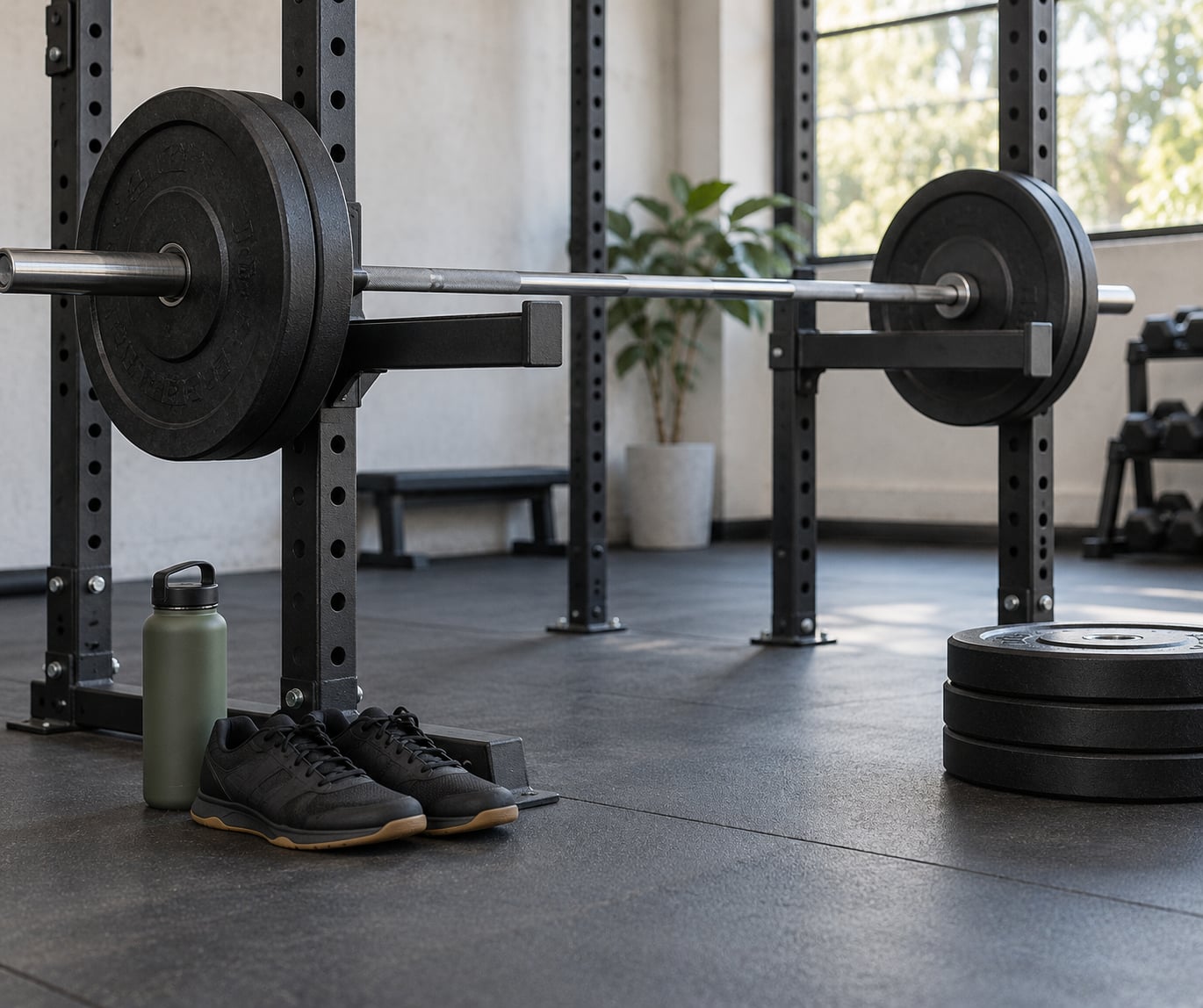
Start by inspecting the equipment before you load anything. On a rack, set the safety bars just below the lowest position the bar could travel, so a missed rep lands on metal instead of on you. Check that collars are tight, that bench pads are secure, and that cables and attachments are not frayed.
Then watch a demonstration from a qualified source, rehearse the motion without weight, and rehearse it again the next session. Community lifters on r/bodyweightfitness consistently describe the same pattern: master the basics, do real warm-up work, and treat skill work as the priority before adding strength work.
Ask a qualified trainer for a few sessions when you are unsure. One or two hours with someone who watches your setup often resolves questions that a month of videos leaves open. People who hired a coach for two or three sessions consistently report better confidence and fewer problems than people who trained entirely from recordings.
You know the setup is ready when you can describe it out loud: bar position, grip, foot placement, where the knees travel, where the ribs go when you brace. If you cannot describe it, you have not learned it yet.
Use a warm-up that prepares you for lifting
Spend 5 to 10 minutes before your first working set, and treat it as part of training rather than as a delay. The goal is raised body temperature, better available range of motion, and a few rehearsals of the exact movement you are about to load.
A protocol that fits in ten minutes and works for most beginners:
- Two minutes of easy movement. Brisk walking, cycling, or rowing. You want to feel warm, not tired.
- Ten reps each of two mobility drills. Cat-cow for the spine, band pull-aparts or wall slides for the shoulders.
- Ten reps each of three activation movements. Glute bridges, bodyweight squats, and light scapular retraction work.
- Specific rehearsal. Twenty-five percent of your planned working weight for 10 reps, then 50 percent for 5 reps.
- A final ramp set. About 80 percent of your planned top set for 3 reps, then rest two to three minutes.
A general warm-up is not the same as a heavy warm-up set. Loading close to your maximum before your technique is stable trains bad patterns under fatigue, and it is a common way beginners hurt themselves on a movement they thought they knew.
Static stretching of cold muscles before lifting is a separate question and not part of this protocol. Hold your warm-up short, move well, and get to your first working set while you still feel alert.
Prioritize repeatable technique over weight
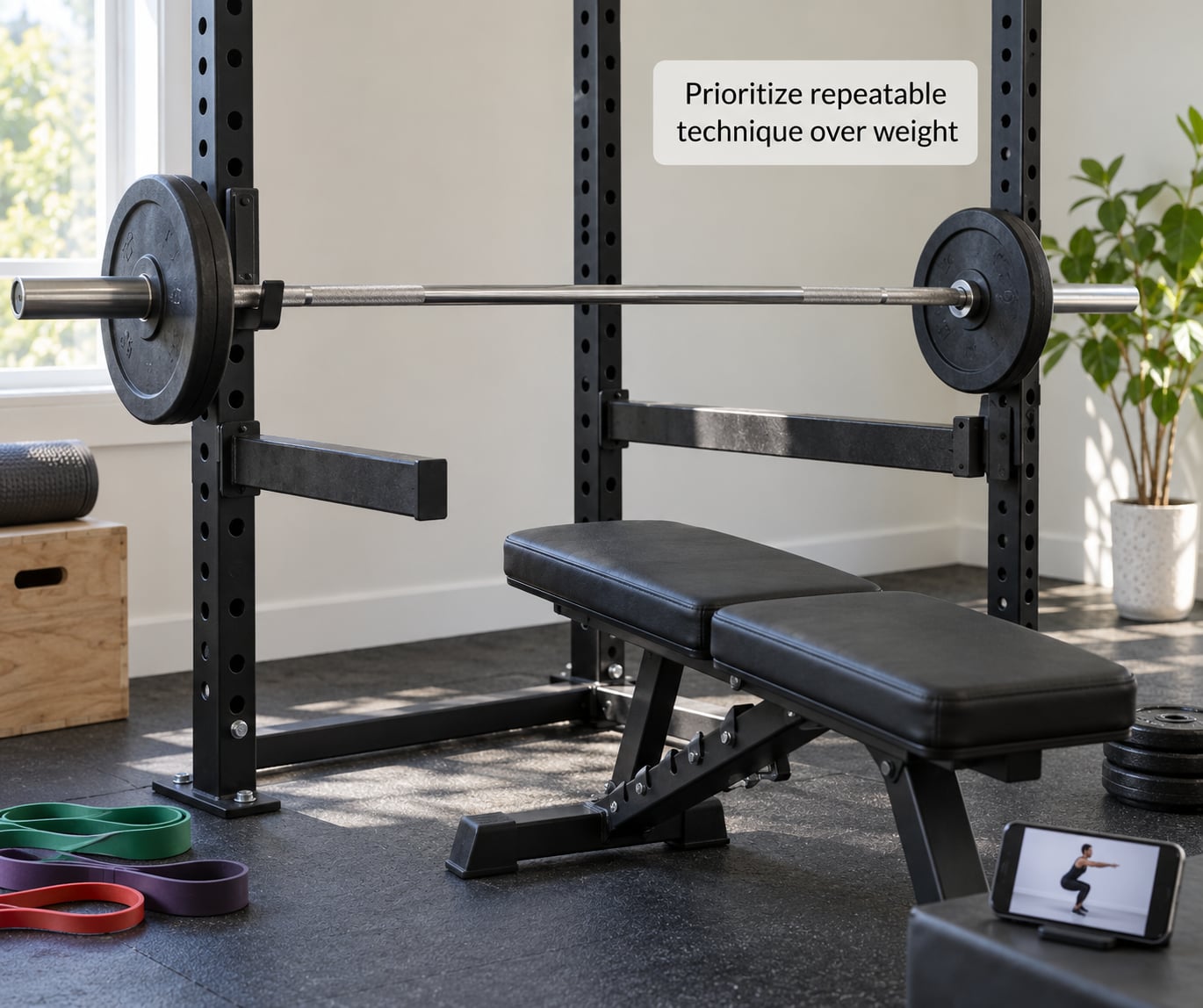
Weight is the least important variable for the first few months. A load you can repeat with the same shape session after session builds strength; a load you can only manage once builds frustration and bad habits.
Five things matter more than the number on the bar:
- Neutral spine. Keep your ribs stacked over your pelvis and avoid rounding through the middle of your back under load, especially on deadlifts and overhead work.
- Control. Lower under tension rather than dropping. If you cannot control the weight on the way down, it is too heavy regardless of how the reps looked on the way up.
- A comfortable range of motion. Depth that keeps your heels down and your back in position. Depth that requires twisting to finish is not depth worth chasing.
- Breathing. Take a breath, brace, and hold during the effort on heavy compound lifts. Never hold your breath through an entire set of lighter work, and never breathe out on the hardest portion of a heavy rep.
- Repeatability. Every rep in a set should look like the first one. If rep three looks different from rep one, the set is over.
When technique starts to slip, the fix is almost never more effort. Drop the load, slow the tempo down, shorten the range slightly, or ask for a spotter. Film the set with your phone and review it; filming every set is one of the habits injury-free beginners report most often.
Increase training load gradually
Progressive overload means gradually asking your body to do more than it did before — more weight, more reps, or better control — so that it adapts instead of breaking. The word that matters is gradually. An overload your tissues cannot absorb is just a bigger injury risk.
For a beginner, a simple objective rule works better than intuition. Pick a target like 3 sets of 8 reps, and add a small amount of weight only when you hit all reps on all sets with identical form, twice in a row. That is the popular 2-for-2 rule, and it removes the guesswork of deciding whether you are ready.
Small means small in the first months: 1 to 2.5 kg per side on a barbell, or the smallest increment your dumbbells offer. If increases stop feeling tiny, take a deload week — a lighter week where you keep the movements and cut the load by roughly a third to half. Lifters on forums commonly run a deload every four to six weeks, and most beginners can do the same from the start.
Back the load off immediately when performance drops across sessions, when form changes, or when soreness and fatigue climb week after week. Stopping progression for one week costs almost nothing; pushing through a bad week is how a month of work turns into three months off.
A simple three-day beginner week
You need a plan more than you need variety. A workable first month looks like this, with the same session repeated on Monday, Wednesday and Friday so you can practise the same movements until they are boring:
- Session A. Goblet squat or leg press, machine chest press or push-ups on an incline, seated or supported row, deadlift on a Romanian or trap-bar deadlift, plus a carry or core hold.
- Session B. The same five movements in a different order, with slightly different rep counts. Same movements, not new ones.
- Session C. Session A again. If a lift stalls across two sessions, keep the weight the same and add a rep instead.
Choose machines or dumbbells for the first few weeks if that makes the movement easier to learn, then move to free weights once the setup is automatic. Stop each set with two or three reps left in reserve rather than grinding to failure, and only move toward failure once the movement has been clean for weeks.
Build rest and recovery into every workout
Your body adapts during the days after training, not during the session. Training is the stimulus; recovery is where the adaptation happens, which makes rest a part of injury prevention rather than a break from it.
The basics that matter most for a beginner:
- Sleep. Most adults need 7 to 9 hours. Short sleep shows up as poor bracing, slower reactions, and a bad mood in the rack, which is where technique falls apart.
- Meals. Regular meals with enough protein and carbohydrate to fuel sessions and rebuild tissue. A session run on no food is a session with poor control.
- Hydration. Water through the session, more if you train hot or finish with cardio.
- Space between muscle groups. Give a challenging group roughly 48 hours before hitting it hard again, so the tissue recovers before you reload it.
- Planned rest days. Two full rest days a week is plenty for a beginner, and it is not too much. Rest days are when you come back stronger, not wasted days.
Most beginners also benefit from three short full-body sessions a week rather than five or six days split across the body. Frequency you can recover from beats frequency you cannot, and for a first six months it produces nearly the same strength gains with much less wear.
A five-minute daily mobility routine
Mobility work is maintenance, not a cure, and it takes five minutes. Most lifters wish they had started it earlier, because prehab is easier than rehab. Do these on days you are not training, or before a session if you have the time:
- Cat-cow, 10 slow reps. Move the spine through its full range while your shoulders stay quiet.
- 90/90 hip switches, 8 per side. Seeded, both knees rotate to each side without forcing the end range.
- Wall slides, 10 reps. Keep your ribs down as your arms travel overhead.
- Band pull-aparts, 15 reps. Shoulders stay quiet while the band opens.
- Cossack squat hold, 30 seconds per side. Sit straight down into one side, hold, then switch.
If something in that list feels sharp rather than tight, skip it and get it looked at. The routine is for maintaining comfortable range, not for forcing it.
Treat pain, instability and unusual fatigue as stop signals
Some discomfort is normal and some is a warning. The distinction matters more than any single cue, so use a simple traffic light and decide before the session what each colour means for you.
- Green — keep training. General muscle fatigue or soreness, similar in both sides, appearing gradually and easing with rest. Progress as planned.
- Yellow — modify the session. One-sided soreness, tightness that limits a range of motion, or unusual stiffness that lasts into the next day. Lower the load, swap the exercise, or shorten the session, and reassess tomorrow.
- Red — stop and get it checked. Sharp or sudden pain, pain in a joint rather than a muscle, pain that radiates down a limb, numbness, tingling, or a feeling that a joint is unstable or about to give way. End the set, and end the session.
Normal muscle soreness from unfamiliar work usually peaks within a day or two of the session and settles. Pain that appears only under load and disappears at rest still deserves a professional opinion, especially if it returns at the same weight every time.
See a doctor or qualified physiotherapist for pain that persists beyond about a week, pain that wakes you at night, swelling, or any loss of strength or range of motion. Getting a professional involved early is cheaper than working around an issue for six months.
Common Mistakes
Almost every beginner injury I see traces to one of these seven errors, and all of them are fixable this week.
Skipping the warm-up. The most common one by a distance. Ten minutes of easy movement plus rehearsal sets prevents more problems than any technique cue. Fix: schedule the warm-up as the first item on your plan, not as something left over if there is time.
Adding weight to prove something. Ego lifting in the first month is the single clearest predictor of early injury. Fix: use the 2-for-2 rule so the plan decides when weight goes on, not how you felt at the moment.
Bracing badly or holding your breath. Breath-holding without tension, or slack bracing, moves load to the spine. Fix: inhale, brace hard like you are bracing for a cough, and hold only during the effort on heavy compound lifts.
Choosing exercises at random. Twenty exercises in one session means twenty opportunities to practise bad form and no time for the ones that matter. Fix: three to five compound movements you can repeat for months, then add accessories only once those are solid.
Training through pain. Fatigue is part of training. Sharp, joint-level, or radiating pain is not. Fix: use the traffic light above and treat red as an automatic stop.
Changing the program every two weeks. A new routine every month means you never progress far enough to see why it works. Fix: commit to one plan for eight to twelve weeks before judging it, which is also long enough to see real progress.
Ignoring recovery. Training hard on short sleep, skipped meals, and no rest days, then wondering why form falls apart. Fix: protect the 48 hours around each challenging group and keep two rest days in the week.
A few practical habits for the gym itself: set the safety bars every time rather than only for heavy sets, avoid training alone when attempting anything close to your maximum, ask for a spotter instead of trying to impress someone waiting for the rack, and leave the platform as you found it so nobody trips over a plate you abandoned.
For home sessions, the same rules apply with one addition: check your equipment for looseness, wear, and floor condition before every session, because there is nobody else to mention it to you.
Frequently Asked Questions
How long does it take a beginner lifter to get stronger?
Most beginners can add weight to their squat, bench and row every session or every other session for the first several months, and measurable strength gains usually show up within four to six weeks. Visible body changes take longer, often six to twelve months of consistent training. If you are progressing at all after eight weeks, your program is working.
Should beginner lifters train when they are sore?
Mild muscle soreness does not require a rest day. You can train a different body part, or keep the session lighter and skip anything that pulls hard on the sore area. Sharp, joint-level, or lingering pain is different from muscle soreness, and training through that tends to make it worse rather than clearing it up.
How much weight should a beginner lifter use?
Use a load you can control through a comfortable range of motion with about two to three reps left in reserve. If you cannot finish your planned reps with the same shape on the last set, the weight is too heavy, no matter how small the plates look. Start lighter than feels necessary for the first two weeks.
Are dumbbells safer than barbells for beginners?
They remove several failure points at once: no balance demand, no barbell rolling down your back, and you can simply drop the weight to stop a set. That makes them a reasonable first choice, and they let you train each side independently. They also cap how far you can progress, so most programs bring the barbell in later.
Is lifting at the gym safe with no experience?
For most healthy adults, yes, and starting with structured resistance training is safer than training nothing. Set the safety bars, choose a load well below what you think you need, and learn four or five movements before adding variety. A few sessions with a qualified trainer are the cheapest safety equipment you can buy.
When should a beginner stop lifting because of pain?
Stop the set immediately for sharp, sudden, radiating, or joint-centred pain, numbness, tingling, or a feeling of instability. Pain that appears only under load and vanishes at rest still deserves a professional look if it repeats. See a doctor or physiotherapist for anything that persists beyond about a week.
Start Small and Progress Safely
Three things to do before anything else. Learn one basic movement and be able to describe its setup out loud. Begin with a load you could lift five times more than you plan to lift. And write down how the session felt — the weights, the reps, and anything that hurt — before you try to add anything.
Keep doing that for eight weeks. Consistency at a modest load is what builds the tissue tolerance that lets you go heavier later, and it is the cheapest injury prevention available to a beginner lifter in 2026.