Habit stacking works by attaching one new, small healthy action to something you already do without thinking, such as the coffee you make each morning or the moment you brush your teeth at night. That existing habit becomes the cue your brain uses to start the new one, so you add seconds to a day you already keep instead of rebuilding your schedule from scratch. That is the whole method: one reliable anchor, one tiny action, repeated at the same time each day.
Most healthy routines don’t fail because the goal was wrong. They fail because the starting point was too heavy and too abstract, and life got busy. Stacking fixes the starting point. In the steps below I’ll walk through how to use habit stacking for healthy routines, including how to pick an anchor, how small to start, and what to do when a week goes sideways.
Table of Contents
- What You Need
- Step-by-Step: How to Use Habit Stacking for Healthy Routines
- 1. Choose One Reliable Anchor Habit
- 2. Define One Small Healthy Behavior
- 3. Link the New Behavior to the Anchor
- 4. Start With the Minimum Version
- 5. Practice the Stack at the Same Time
- 6. Track Completion, Not Perfection
- 7. Gradually Add the Next Healthy Action
- Common Mistakes and How to Fix Them
- Frequently Asked Questions
- How long does habit stacking take to work?
- What makes a good anchor habit?
- Can you stack more than two habits at once?
- What should I do after missing a day?
- Can habit stacking work for weight loss, exercise and nutrition goals?
- Conclusion
What You Need
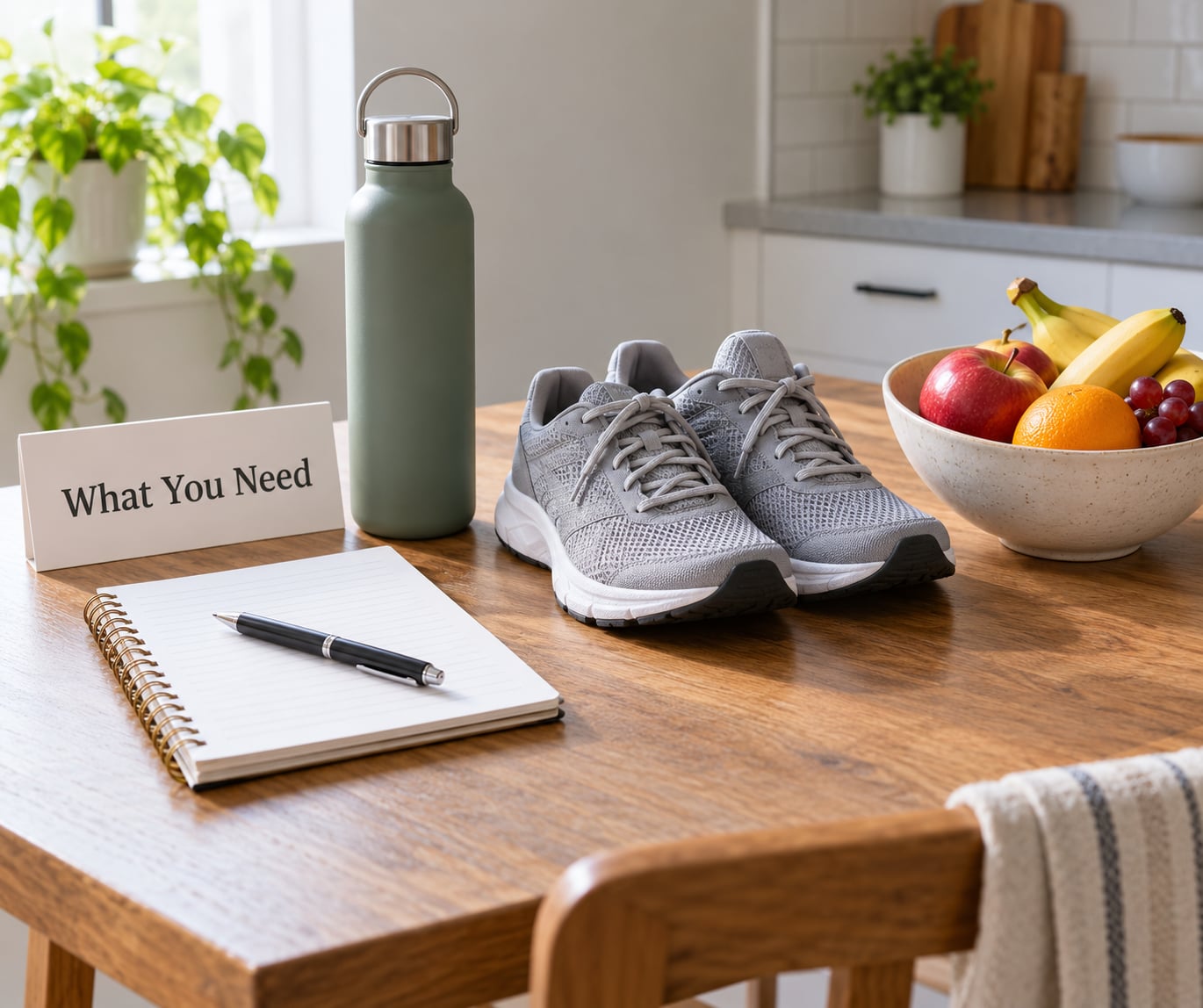
You need five things to build a habit stack, and none of them cost money or require a special app.
- One reliable anchor habit. Something you already do nearly every day at a predictable time and place.
- One small new behavior. A specific action you can finish in two minutes or less on a bad day.
- A consistent trigger. The exact moment after the anchor that starts the new action.
- A realistic minimum version. The bare-minimum fallback for the days you have nothing left.
- A simple way to track repetitions. A paper checklist, a note on your phone, or a calendar with a mark in a square.
The anchor habit is the piece people get wrong most often, so it gets the closest look in step one. If you have no obvious anchor yet, don’t force one. Start with something physical and already daily, like brushing your teeth, making a hot drink, or taking a vitamin, and build from there.
A note on scope: this is general information about routine building, not medical or nutrition advice. If you’re managing a health condition, taking medication, or changing your diet significantly, talk with your doctor or a registered dietitian before you change what you’re doing daily.
Step-by-Step: How to Use Habit Stacking for Healthy Routines
1. Choose One Reliable Anchor Habit
Pick an anchor habit that happens every single day, in the same place, at roughly the same time. Coffee-making is the most popular choice in community discussions for a simple reason: it survives weekends, travel, and bad moods.
Write down three candidate anchors, then score each one out of three questions: Does it happen daily? Does it happen at a predictable time? Does it happen even on your worst day? Anything scoring a three on all three is your anchor. If your morning is genuinely chaotic, an evening anchor like brushing your teeth or taking your vitamins is a better starting point than an ambitious wake-up routine.
Don’t build a new habit just to have something to stack onto. The anchor should already exist and be close to automatic.
2. Define One Small Healthy Behavior
Turn your healthy goal into one concrete action that takes two minutes or less. “Eat more vegetables” becomes “add a handful of spinach to my eggs at breakfast.” “Move more” becomes “put on my shoes and walk for five minutes.” “Drink more water” becomes “fill one bottle before I leave the sink.”
The test is whether you could describe it to someone else in a single sentence, with a verb and an object. If the sentence needs an “and,” cut it in half. One behavior per stack is the rule, at least until the first one holds steady.
3. Link the New Behavior to the Anchor
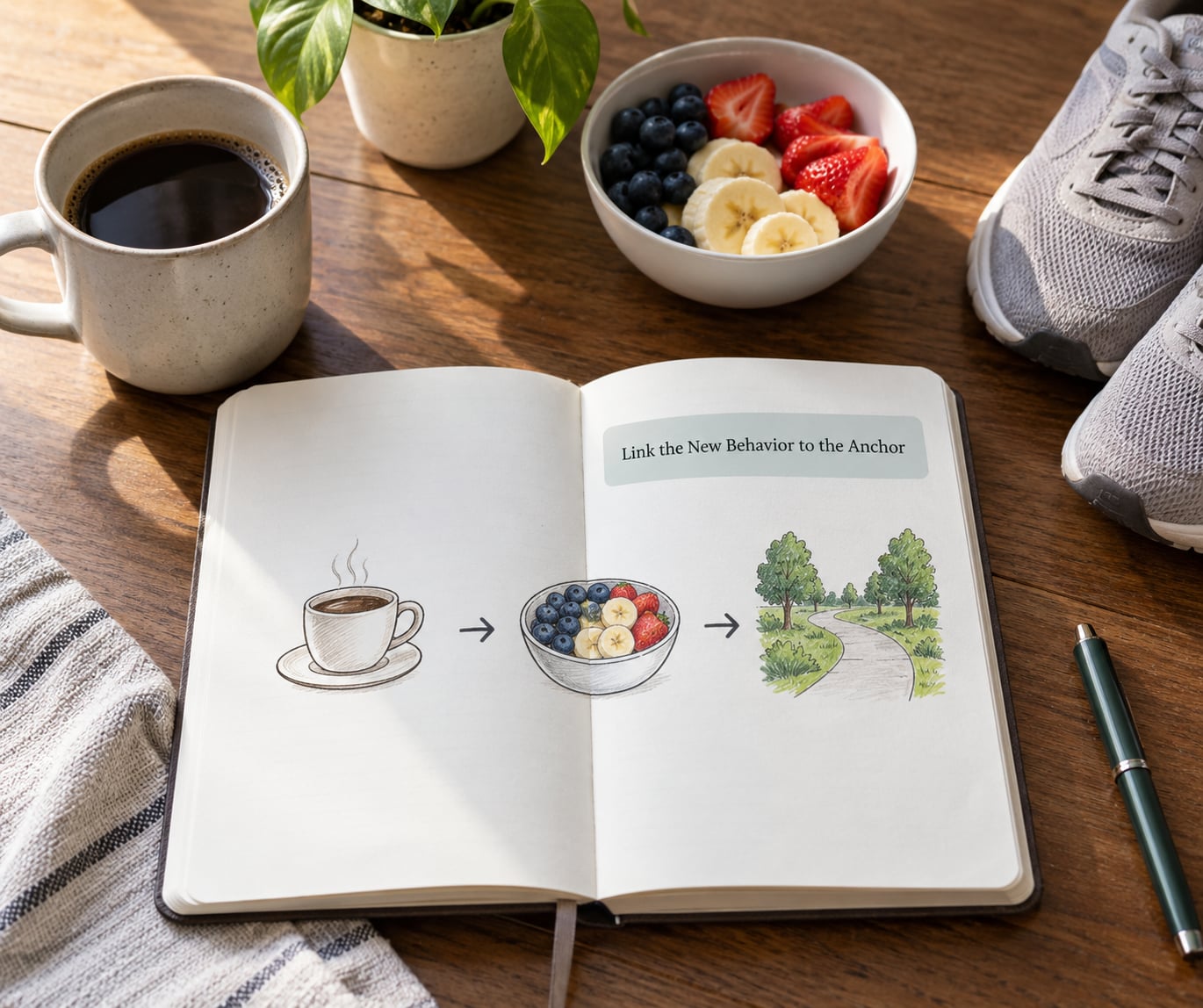
Write the plan as a single if-then sentence: After I [existing habit], I will [new habit]. Researchers call this an implementation intention, and a large body of evidence links stating that kind of plan to actually following through. The sentence takes fifteen seconds to write and does most of the work later.
Use a clear trigger rather than something vague. “After I drink my coffee, I will eat a piece of fruit before I leave the table” works. “Sometime in the morning I will try to eat better” does not, because it gives your brain no specific moment to act on. Put the written plan where you’ll see it that morning, or set one phone reminder for the first week until the pair starts running on its own.
4. Start With the Minimum Version
On day one, do the smallest possible version of the new behavior and nothing more. Ten seconds is fine. Putting the shoes on is fine. Filling the water bottle and stopping there is fine.
This is the part people skip, and skipping it is why most stacks collapse in week three. The minimum version is not a watered-down goal, it’s the floor you build on. On a good day you do more; on a tired day you hit the floor and the streak survives. People who report lasting habits online almost always describe small ones, and the ones that don’t survive are usually the ambitious versions.
5. Practice the Stack at the Same Time
Repeat the anchor and the new behavior at the same time each day. Repeating a cue-action pair strengthens the association, so eventually the thought of coffee itself starts pulling up the fruit and the walk.
Life will shift the timing. A meeting moves the anchor by an hour, kids change the bedtime, a work trip kills the routine. Treat those as normal data, not failure. Shift the trigger rather than abandoning it: if coffee happens at 8:30 instead of 7:00, do the stacked action at 8:30. Reattaching the new habit to a moved anchor for a few days is what keeps the stack from resetting to zero.
6. Track Completion, Not Perfection
Mark the day when the stack happened, and don’t count how much you did. A tally of completed days tells you something useful; a calorie or step count just tells you whether today was a good day for other reasons.
Weekly, look at the misses and ask one question: what got in the way? Most of the time the answer is something physical, like the shoes being in a closet, the fruit being in the fridge instead of on the counter, or the reminder firing while you were in a meeting. Fix the friction rather than your willpower. If you miss a day, mark it and move on. A missed day is a data point, not a verdict.
7. Gradually Add the Next Healthy Action
Only when the first stack feels close to automatic, usually after several consistent weeks, attach a second new behavior. Stack it to the same anchor rather than creating a chain of six steps to remember. Two linked actions are easy to hold; six become a project you’ll abandon.
A workable order is movement first, then nutrition and hydration, then recovery habits like a wind-down routine or breathing exercise. Each new one starts again at the minimum version. Most people can hold two or three stacked habits at once, and the honest answer for most beginners is one.
Common Mistakes and How to Fix Them
Five mistakes account for most failed habit stacks, and each one has a straightforward fix.
1. Stacking too many actions at once. Adding three new behaviors in the same week feels productive and finishes none of them. Fix: one stack, one minimum version, two to three consistent weeks before you touch anything else.
2. Picking an anchor that isn’t reliable. “After my morning workout” fails on the days you skip the workout, and the new behavior goes with it. Fix: use an anchor that happens on your laziest day, not your best one.
3. Setting the goal too large. A 45-minute session after a 6 a.m. alarm is not a habit, it’s an event. Fix: cut the behavior until it’s under two minutes, then let repetition grow it. This is where the biggest difference shows up between people who stick with it and people who quit quietly.
4. Relying on motivation instead of design. Motivation is what you feel on the first three days. Fix: reduce friction before the cue fires. Shoes by the door, fruit on the counter, the water bottle filled the night before. When the action starts costing nothing, it stops needing a mood.
5. Treating one missed day as failure. The all-or-nothing reading is the single biggest reason stacks get abandoned. Fix: never miss twice. Miss once, do the minimum version the next time, and keep counting. Chain-breaking is a normal event in a routine, not evidence that the routine is wrong.
A few habits-building tips worth keeping: start the new action while you’re still standing at the anchor location, write stacks on paper where you’ll see them daily, and pair stack review with an existing weekly routine such as your Sunday meal prep. Reviewing five minutes on a set day beats checking constantly.
Frequently Asked Questions
How long does habit stacking take to work?
Most stacks need several weeks of consistent repetition before they feel automatic, and the honest range is longer than the popular 21-day claim. Research by Phillippa Lally and colleagues in 2010 tracked people forming a daily habit and found the median time to reach automaticity was about 66 days, with a range stretching from 18 to more than 250 days. Simple behaviors like drinking a glass of water formed fastest. Treat 21 days as the point where it starts to feel easy, not the point where it is finished.
What makes a good anchor habit?
A good anchor habit happens every day, at a predictable time, in a predictable place, and survives your worst days. Making coffee, brushing your teeth, taking vitamins, and eating lunch at your desk all qualify because they are already close to automatic. Avoid anchors that depend on good intentions, such as your workout or an early wake-up call. If nothing on your day scores high on all three questions, pick an evening habit instead and build from there.
Can you stack more than two habits at once?
You can, but most people do better with one new behavior at a time. Two linked actions are easy to hold in working memory; six become a project, and the most common failure in community discussions is stacking several new behaviors in the same week and dropping all of them. Add a second action only after the first stack has felt close to automatic for several weeks, and attach it to the same anchor rather than building a long chain.
What should I do after missing a day?
Mark the day, do the minimum version the next time, and keep going. One missed day does not erase the repetition you have banked, and reading a missed day as total failure is a leading reason people quit routines entirely. Use the miss as information instead: if you keep skipping on busy mornings, move the stack to a steadier anchor or shorten the behavior further. The rule that works well is never miss twice.
Can habit stacking work for weight loss, exercise and nutrition goals?
Yes, because the method is about consistency rather than intensity. Stacking a five-minute walk after your morning coffee, or fruit with breakfast, gives you repeatable actions that fit an existing day. The habits themselves are general wellbeing practices, not weight loss treatments, and results depend on overall diet, activity, sleep, and your own body. If you are managing diabetes, a medical condition, or taking medication, check with your doctor or a registered dietitian before changing your routine.
Conclusion
Habit stacking for healthy routines is simple to describe and genuinely hard to do well: choose one anchor that already happens every day, attach one new action to it in an if-then sentence, and start with the smallest version that still counts. Write it down, mark the days you do it, and expect a missed one along the way. After a week, review what got in the way and make the next version easier rather than adding more. Most people who succeed with this method are not more disciplined than anyone else; they just picked a trigger that never moved.