How to build habits that stick comes down to three things: start smaller than feels necessary, attach the habit to a reliable cue you already repeat every day, and design a recovery plan for the days you miss. Small steps, clear cues, and automatic routines replace the willpower that most people burn out in about three weeks.
Most people don’t fail because they lack discipline. They fail because they pick a goal that is far too large for a normal Tuesday, attach it to nothing specific, then treat the first missed day as a verdict on themselves. Restarting on the first of the month feels productive, but it costs you the accumulated practice every single time.
The good news is that willpower was never the mechanism. A habit is a cue-action-reward loop that the brain eventually runs on its own. Your job is to build that loop in a way that survives a busy week, a holiday, or a sore knee, and to make coming back after a slip so easy that skipping twice is rare.
What follows is a six-step process for weight loss, nutrition, movement and sleep habits. It is general information, not medical or nutrition advice — talk to a doctor or registered dietitian about anything specific to your health or weight-management plan.
Table of Contents
- What You Need
- Step-by-Step: How to Build Habits That Stick
- Start with one small cue: how to build habits that stick
- Make the healthy choice easier
- Track the action, not just the outcome
- Use the two-minute version on difficult days
- Review and adjust every week
- Make progress feel rewarding
- Common Mistakes
- Frequently Asked Questions
- How long does it take to build a habit that sticks?
- What is the best way to restart a healthy habit after missing several days?
- Do I need to track my habits to make them stick?
- How can I build healthy eating habits without going on a strict diet?
- How do I know if my habits are helping my weight-loss goals?
- Should I change all my habits at once?
- Conclusion
What You Need
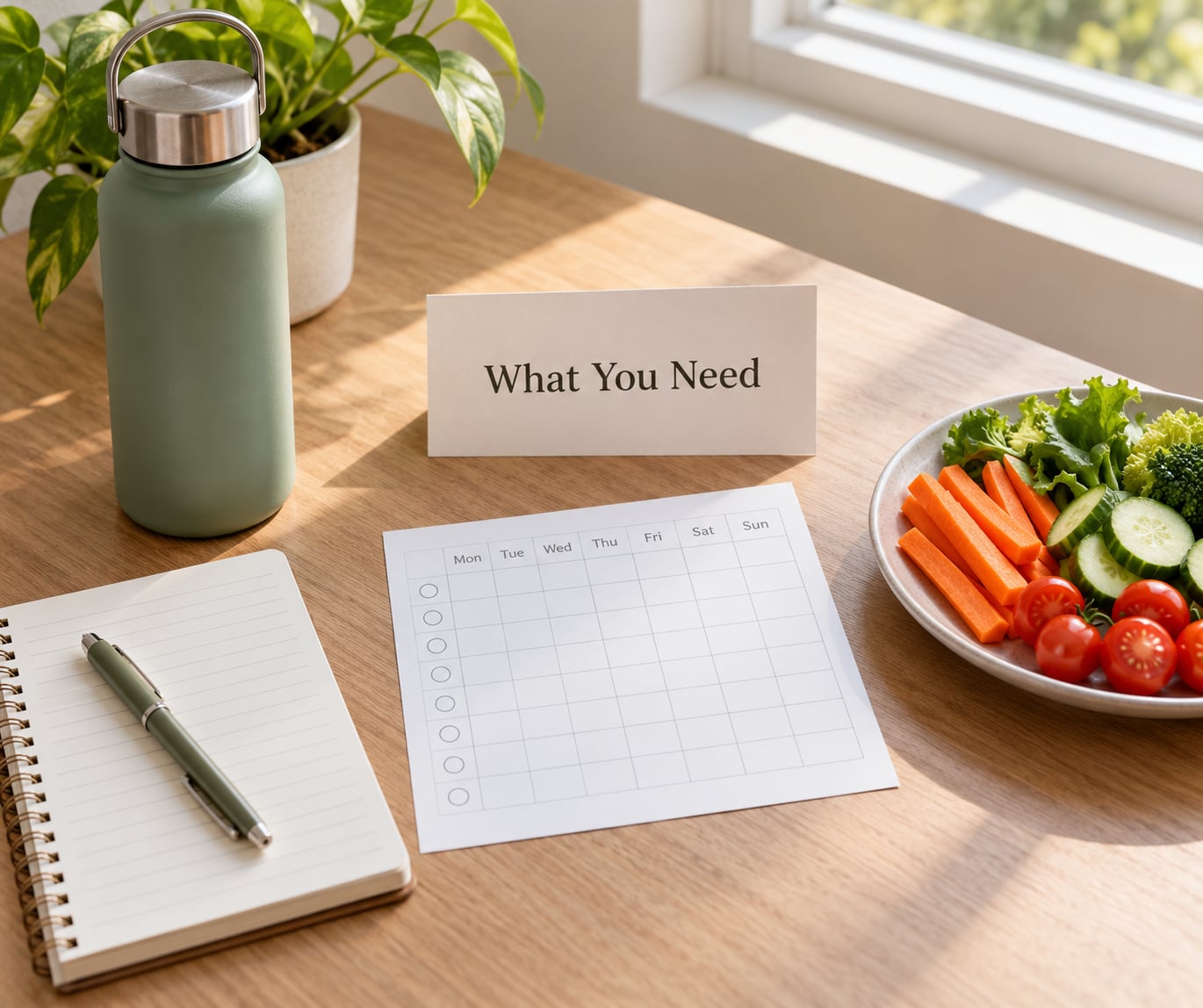
You need very little. Five things, and all of them are free or already in your house.
- One specific behaviour
- “Get healthier” is a wish, not a behaviour. “Walk for ten minutes after dinner” is a behaviour you can do or fail to do. If you cannot picture the action, it is too vague to build.
- One reliable cue
- A cue is the prompt that starts the behaviour: a time, a place, or an existing routine. Anchor habits work because they are specific — after the coffee machine finishes brewing, after I hang up my work keys, after I brush my teeth at night.
- A minimum version
- Your baseline is the smallest version you will still do on your worst day. Two minutes of walking. One glass of water. Three minutes of mobility work. Most people aim at 100% and treat the 10% version as failure, so the baseline keeps the chain intact.
- A way to track it
- A paper calendar, a bullet in a notebook, or an app. The format matters less than the fact that marking it off happens within a minute of doing the thing.
- Support that fits real life
- An accountability partner, a scheduled class, or simply a lower-effort version you have decided on in advance. Forum contributors on r/getdisciplined and r/Habits describe the same pattern: advice that ignores an unpredictable schedule does not survive contact with a real week.
Notice that none of this involves food you are forbidden to eat, a rigid meal plan, or an hour of exercise you dread. Routines built on deprivation tend to collapse the first time life gets busy.
Step-by-Step: How to Build Habits That Stick
Start with one small cue: how to build habits that stick
Pick the behaviour, then attach it to something you already do without thinking. While the coffee brews, do ten squats. After the first sip of coffee, take a two-minute walk. While lunch cooks, put vegetables on the plate.
This is habit stacking, and it works because the anchor habit already has a strong cue attached to it. You are not creating a new trigger from scratch — you are borrowing one that fires reliably, often at the same time and place. Repeating that pairing enough times is what turns the pair into one automatic sequence.
How do you tell it’s working? After two or three weeks, the new action should start happening without you negotiating with yourself first. If you are still deciding every time, the anchor cue is probably too vague — make it more specific in time, place or sequence.
Make the healthy choice easier
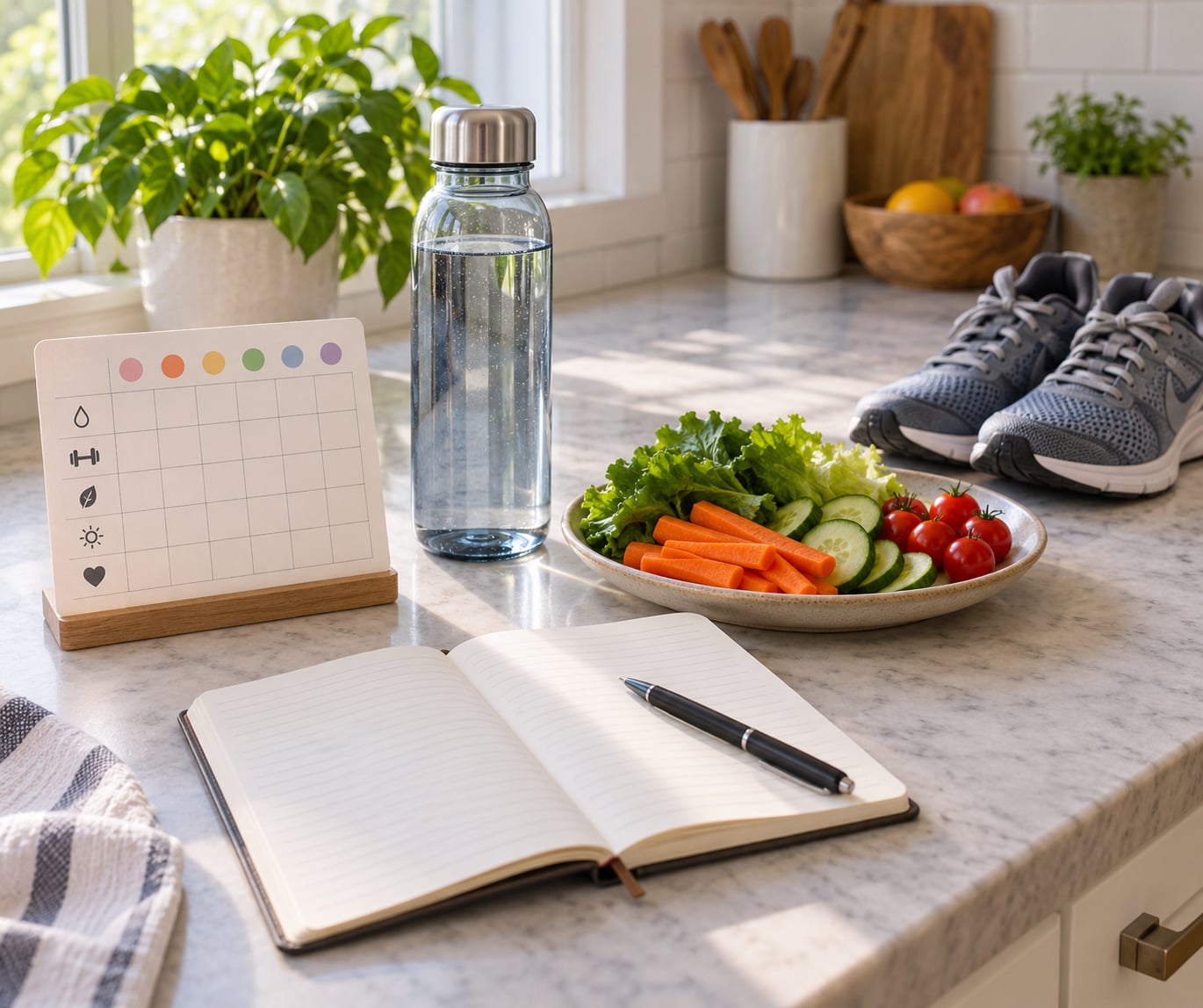
Behaviour follows friction. Put the water bottle where you will see it, keep fruit and ready-to-eat vegetables at the front of the fridge, leave walking shoes by the door, and put your kit out the night before. Move the things you reach for mindlessly further away — phone charger out of the bedroom, snacks on a high shelf rather than in the cupboard at eye level.
Nothing is forbidden here. The goal is not a ban list; it is that the thing you want more often requires fewer steps than the thing you want less often. Environmental design beats willpower because it never gets tired.
Check this by asking one question tonight: what would I have to do differently tomorrow to make the right choice the path of least resistance? Make that change, then wait.
Track the action, not just the outcome
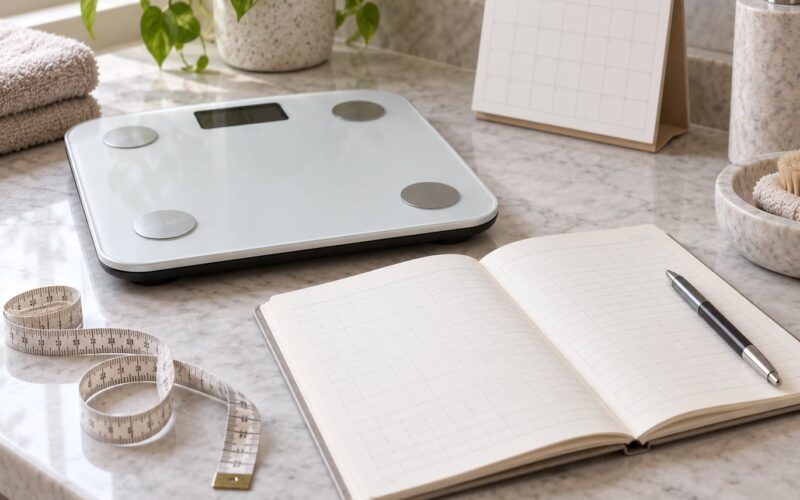
Most people measure habits by results, and results are a lagging indicator that lags by weeks. A bathroom scale after two weeks of walking tells you very little, because water weight, sodium, sleep and constipation all move that number in either direction.
Track the behaviour instead: days completed, minutes walked, meals prepared, glasses of water. These move the same week you act, which is exactly what motivation needs in the early stretch. Track one behaviour-level measure and one outcome measure, then let the outcome one stay quiet for a month before you draw any conclusion from it.
A word of caution on streak apps: several people in habit forums describe abandoning a tracker because a broken streak felt like a verdict. If your tracker punishes a missed day, it works against you. A paper tick that stays filled from earlier weeks does not have that problem.
Use the two-minute version on difficult days
Give every habit a two-minute form. Two minutes of walking. One healthy component of the meal prepared instead of the full meal. Two minutes of movement instead of a full session. It feels almost insultingly small, which is the point.
Imperfect repetitions build the pathway; skipped repetitions do not. Someone writing about a decade-plus meditation practice started at two minutes a day and grew it slowly, which is a far better return than starting at twenty minutes, burning out in a month, and starting over at twenty again.
The minimum version is not a watered-down life. It is insurance for the weeks when work is heavy, someone is ill, or the gym is closed.
Review and adjust every week
Set seven minutes aside on a fixed day — Sunday evening works for most people — and answer three questions: which habit went smoothly, which one created resistance, and which one needs a smaller or earlier cue.
Adjust the design, not your character. If the walk keeps failing at 9pm because dinner runs late, move it to a different anchor. If breakfast preparation only works on weekends, accept that and stack something else onto the weekend version. A weekly review is also the natural place to add exactly one new habit, not three.
Also use this review to notice boredom. A habit that works but has become dull usually needs a new cue, a new location, or company — not more discipline.
Make progress feel rewarding
Reinforcement works best when it arrives immediately. Weight change is slow and delayed; a tick on the tracker is instant. Enjoyable movement counts as its own reward too, which is why people who walk with a friend stick longer than people who walk alone staring at a distance goal.
Be careful not to celebrate the wrong things. Reinforcing restriction, punishing missed meals, or treating a fast weight drop as pure victory sets up a harsher pattern than the one you were trying to escape. Reward the behaviour, not the number.
For weight-related habits, pair the effort with something genuinely pleasant: a podcast only during the walk, a proper coffee after the gym, music in the kitchen while preparing food.
Common Mistakes
Starting five habits on the same Monday. Five new routines means five cues to learn and five opportunities to feel like you failed. Fix: run one habit for three weeks of consistent behaviour before adding a second, and keep the rest on a list, not in your calendar.
Treating motivation as the input. Motivation is a feeling that arrives and leaves; nobody can schedule it. Fix: build the cue and the minimum version so the habit still happens on a low-energy day, when motivation is genuinely not there.
Making the habit too complicated. A 45-minute circuit, six days a week, with a strict warm-up, is a plan, not a starting point. Fix: shrink the first version until it feels almost too easy, then let it grow for two to three weeks before adding anything.
Reacting emotionally to a missed day. All-or-nothing thinking turns one skipped Tuesday into “I have failed”, and failure reading is what restarts the cycle. Fix: run the two-minute version the very next day. One missed day is a lapse; two in a row is the habit of not missing — the recovery rule most people never write down.
Measuring success only by the scale. Weight moves for reasons that have nothing to do with your effort, so it makes a poor weekly scoreboard. Fix: track consistency and preparation alongside weight, and review body weight on a longer cycle.
Adding rules instead of removing friction. Strict rules, forbidden foods and self-imposed penalties all require a fresh supply of willpower every single day. Fix: change the environment once, then let the new default do the work.
None of this needs more determination than you already have. It needs a smaller first step and a plan for the day you miss.
Frequently Asked Questions
How long does it take to build a habit that sticks?
Most behaviours take between 18 and 254 days to become automatic, with an average of about 66 days, according to Lally and colleagues’ 2010 study. The 21-day rule is folklore. Simple behaviours like drinking a glass of water form faster than complex ones like a daily workout, and missing a single day does not reset the count.
What is the best way to restart a healthy habit after missing several days?
Do not restart from zero or wait for Monday. Run the two-minute minimum version today, at the same cue as always, and let that count as the day. The pathway is still there. Then return to your normal size on the next repetition rather than doubling your effort to compensate.
Do I need to track my habits to make them stick?
Some kind of record helps, because seeing a run of ticks makes a behaviour more satisfying to repeat and easier to restart. It does not have to be an app. A paper calendar, a notebook line or a weekly tally works, and a tracker that punishes you for a missed day tends to cause more abandonment than it prevents.
How can I build healthy eating habits without going on a strict diet?
Start with one preparation behaviour rather than a set of rules. Add a vegetable at lunch, eat protein at breakfast, or keep fruit visible at eye level in the kitchen. Preparation behaviours repeat easily, while restriction needs constant willpower. For individual nutrition or weight-management advice, a registered dietitian can help you set targets that suit your health.
How do I know if my habits are helping my weight-loss goals?
Look at consistency, not the scale. Days completed, meals prepared, steps taken and minutes of movement change in the same week you act, while body weight responds slowly and moves for many unrelated reasons. If your habits are consistent and your weight has not moved after several months, that is worth raising with a doctor or registered dietitian rather than adjusting by guesswork.
Should I change all my habits at once?
No. One habit at a time, run for roughly three weeks of steady repetition, gives the cue time to become automatic before you add another. Changing several at once makes it impossible to tell which change caused a result, and it multiplies the chances of a week where everything fails together.
Conclusion
Small steps, clear cues, automatic routines — that is the whole method, and it works because it takes the decision out of the moment. Start with one behaviour you can finish in two minutes, attach it to something you already do every day, and write down what happens when you miss.
Today, pick one habit, shrink it until it feels too easy, and decide now what you will do the first time you skip it. Then start.