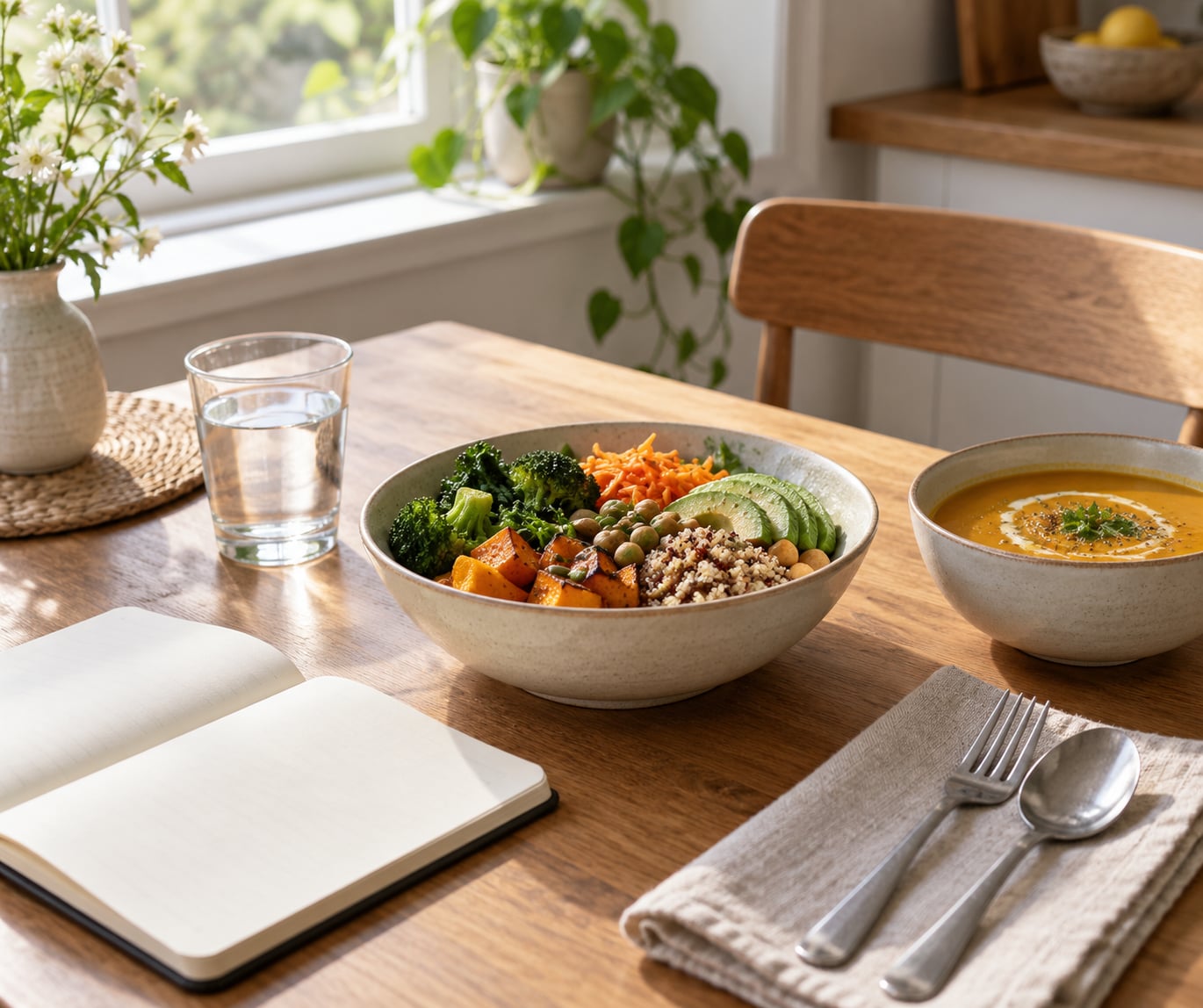
To practice mindful eating, slow down one meal a day and pay close attention to three things: what the food tastes and feels like, what your body is telling you, and what is happening around you. That is the whole method, and it takes no special equipment, no app and no food rules. Most people need two or three weeks before eating one meal this way starts to feel normal instead of awkward.
The reason it works is straightforward. Most overeating happens when attention is somewhere else entirely, on a screen, a drive, an argument or the end of a long day. Mindful eating puts attention back on the meal, and a meal you actually taste usually turns out to be enough.
What follows is a seven-step practice you can repeat at the same meal every day until it becomes automatic. It is a skill, not a diet, and nothing in it asks you to give up a food you love.
Table of Contents
- What You Need
- Step-by-Step: How to Practice Mindful Eating
- Pause Before You Eat
- Check Your Hunger and Cues
- Engage All Five Senses
- How to Practice Mindful Eating Slowly and Without Distraction
- Notice Satisfaction and Fullness
- Reflect Without Judgment
- Make Mindful Eating Repeatable
- Common Mistakes
- Frequently Asked Questions
- How long should a mindful eating practice last?
- Can I practice mindful eating with snacks and takeout food?
- What if I do not notice hunger or fullness cues?
- Does mindful eating help with weight loss?
- How can I practice mindful eating when eating with family or at work?
- Is mindful eating the same as eating slowly?
- Start With One Meal
What You Need
Nothing. That is the part most people find surprising, because mindful eating gets marketed alongside gadgets and programs. What it actually needs is a little attention and somewhere to sit.
A comfortable, ordinary setting helps. It does not need to be a dining room or a silent house. The kitchen table at 7pm with the kids shouting is a perfectly good place to start.
Pick one meal or snack to practise with. Dinner is easiest because it is already a habit, but lunch at your desk works too if that is when you tend to eat on autopilot.
A few minutes of attention is the real requirement. Five slow minutes of an ordinary meal is a complete practice, even on a busy weeknight.
Two optional tools are worth having. A hunger scale from 1 to 10 gives you language for what your body is saying, and a small notebook records meals, times and how you felt, which is where patterns tend to show up after a couple of weeks. People who keep a simple food journal without counting anything in it usually get more out of this than people trying to track macros at the same time.
Step-by-Step: How to Practice Mindful Eating
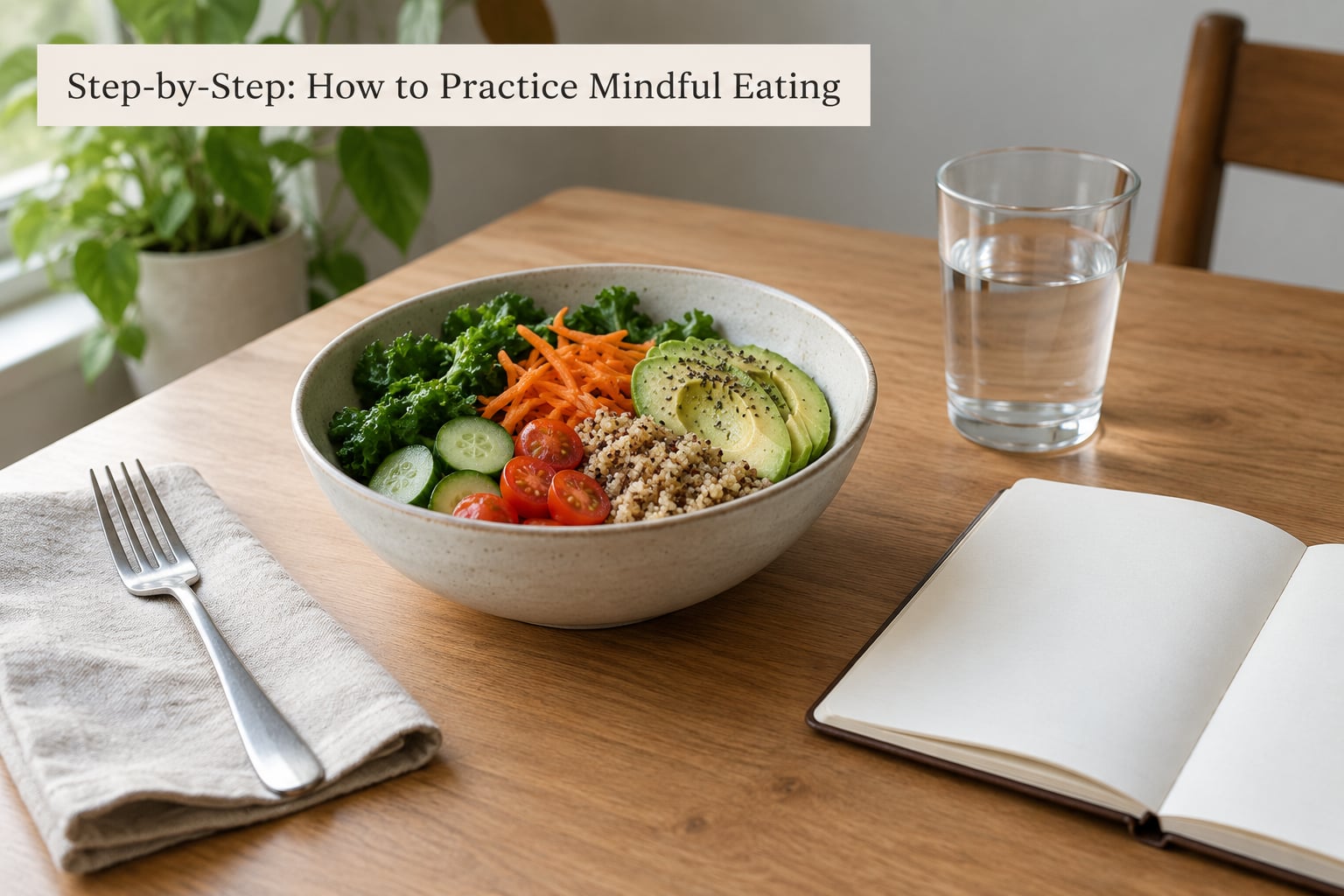
Seven steps, in the order they happen around a meal. Each one is a repeatable skill rather than a rule you can fail, so missing a step just means you pick it up again at the next bite.
Pause Before You Eat
Stop for thirty seconds before the first bite. Take a few slow breaths, notice where you are sitting and who is around you, and say to yourself why you are about to eat.
That last part is where most distracted eating shows itself. You arrive home at 6:30, tired and hungry, open the fridge, and eat standing up while reading email, and twenty minutes later you have no memory of what was on the plate. Naming the reason is not judging it. It is just noticing, and usually the honest reason is something like I am exhausted rather than I am hungry.
Check Your Hunger and Cues
Before eating, rate your hunger from 1 to 10. One means no hunger at all, ten means so hungry you would eat almost anything. Most people eat well somewhere around four or five.
Below three you are usually eating for something other than hunger, such as boredom, tiredness, a habit or the fact that the food is sitting there. Above seven you are likely to eat too fast and feel uncomfortable afterwards, so it is worth waiting ten minutes, drinking a glass of water or eating something small first.
Watch the difference between thirst, fatigue and real hunger. A dry mouth and a headache are thirst. Irritability and poor concentration are often hunger or tiredness, and it is hard to tell which in the moment.
Engage All Five Senses
Look at the food before you touch it. Notice the colour, the steam, the gloss on the surface and the contrast on the plate. Then smell it, which is the sense people skip most often and the one that adds the most.
While you eat, notice texture and temperature as much as flavour. A bowl of soup changes across a single mouthful: hot and thick at the start, thinner as it cools. Fruit has a sequence too, from crisp to soft. A sandwich has order, and the last bite is usually different from the first because it has absorbed the filling.
How to Practice Mindful Eating Slowly and Without Distraction
Put the phone in another room, not just face down. A screen within reach is a decision you make several dozen times a meal, and face down is still a decision.
Take smaller bites and chew until the food is close to liquid before swallowing. Digestion starts in the mouth, and slower work there means less rushing later, which matters if you get reflux or bloating.
Put the fork or spoon down between bites. Your mind will wander, usually within about a minute, and that is not a failure. Notice where it went and bring it back to the taste in your mouth. Doing that gently a dozen times a meal is the exercise itself.
Turn the television off if you can. If someone else in the house controls it, sit facing away from the screen or choose one meal a day where you eat somewhere else entirely.
Notice Satisfaction and Fullness
Satisfaction and fullness are not the same signal, and learning to tell them apart changes how much you eat. Satisfaction is the pleasant, settled feeling that the meal is complete. Fullness is the physical pressure that comes later, and by then you have eaten past what you needed.
Common fullness cues include a slowing pace, a full heavy feeling in the stomach, looser clothing around the waist, and a slight decline in interest in the food. Many people report a tired feeling about twenty minutes after eating, which is usually a sign that they ate a little too much rather than too little.
Stop at comfortable satisfaction. Eating until you are stuffed every meal is not the goal, and forcing a stop mid-meal is not either. Leaving a little food on the plate is normal.
Reflect Without Judgment
After the meal, spend a minute on what actually happened rather than how you think you did. Did you sit down? Were you distracted? Did you notice fullness too late?
The point of non-judgment is that it keeps you coming back. A neutral note about a rushed lunch is useful. A guilty note about a slice of cake is not, and guilt tends to turn into restriction followed by overeating later.
Then pick one small adjustment for the next meal. Not three. One change at a time is what actually sticks.
Make Mindful Eating Repeatable
Start with one meal a day, at the same time and in the same place, for two weeks. Consistency is what turns this into a habit rather than a good day.
Then widen it slowly, a second meal, then a snack, then meals eaten out. Flexibility is built in from the start, because a practice that only works at home on a quiet Tuesday is not a practice you will keep.
Allow some meals to be ordinary. Birthday dinners, holidays, eating with friends and rushed lunches are part of life, not failure. The aim is a meal you pay attention to most days, not every meal forever.
Common Mistakes
Turning it into another strict diet. The moment mindful eating becomes a set of forbidden foods, it is dieting with extra steps, and it does not last. The fix is to keep every food in the picture and change nothing except your attention. One supportive thought: if you feel anxious about a meal before it happens, the practice has been turned into a rule, and that is worth noticing.
Only practising at home. Home meals are the easy case. The interesting work happens at your desk, in the car, in a restaurant and at a family dinner where somebody else turned the television on. The fix is to pick one recurring outside-the-home meal, lunch at work, for instance, and apply the same three things: no screen, smaller bites, a pause at the start.
Confusing it with eating slowly. Slowing down is one tool, not the practice. You can chew very slowly while watching a whole episode of something and still be doing mindless eating. The difference is where your attention is, not how fast the fork moves.
Judging food as good or bad. If a practice makes you feel worse about the meal you just had, it is working against you. Call food neutral instead: nourishing, not virtuous; heavy, not a failure. A supportive habit here is noticing that the food itself did not change and only your interpretation of it did.
Skipping meals to compensate. Some people use mindful eating as permission to eat less, or skip breakfast after an overeating dinner. That reliably leads to stronger hunger later and more distraction at the next meal. Eat regular meals, and keep a light snack available.
Expecting your body to change immediately. People often report noticing how much they were overeating only after months of paying attention. Awareness comes first and any change in weight comes later, if it comes at all. Judge the practice on whether you eat fewer meals without thinking about food, which is a better signal than the scale.
Only managing emotional eating. Mindfulness helps, but during intense emotional eating it is rarely enough on its own. If eating is tied to stress, anxiety, low mood or feeling out of control, that is worth raising with a doctor or a registered dietitian, along with any support they think would help.
Frequently Asked Questions
How long should a mindful eating practice last?
Aim for about 20 minutes of unhurried eating rather than a stopwatch target. Most ordinary meals take 15 to 25 minutes when you eat without a screen, chew thoroughly and put the fork down between bites. What matters is that you are present for most of the meal, not that you hit a number.
Can I practice mindful eating with snacks and takeout food?
Yes, and takeout is where the practice is often most useful, because the food arrives already in front of you with no preparation ritual to slow you down. Open the container, put it on a plate if you can, sit down and eat the first few bites without any screen. Snacks work the same way.
What if I do not notice hunger or fullness cues?
Many people do not, especially if they eat on a schedule or have eaten that way for years. That is more common than the confident tone of most mindful eating articles suggests. Rate your hunger on a scale of 1 to 10 anyway, and eat to a comfortable middle rather than to a clear stop signal.
Does mindful eating help with weight loss?
It can help, because eating without distraction usually reduces how much you eat at a sitting, but it is not a weight loss method on its own and results vary widely. Research on mindful eating programs generally shows modest changes in eating behaviour. If weight loss is your goal, pair it with a registered dietitian rather than relying on attention alone.
How can I practice mindful eating when eating with family or at work?
You do not need silence or solitude. At family meals, put your phone away, take the first three bites slowly and let conversation fill the rest. At work, use lunch away from your screen and eat the first few bites without headphones. Attention on your own food is what counts, not the room you are in.
Is mindful eating the same as eating slowly?
No. Eating slowly is one part of it. Mindful eating means paying attention to taste, texture, hunger and fullness, without judging what you are eating. You can eat very slowly while watching television and be entirely distracted. The attention is the practice, the pace is a side effect.
Start With One Meal
Pick tomorrow’s lunch or dinner, phone in another room, thirty seconds of breathing before the first bite, and one minute afterwards asking what you noticed. That is enough for day one, and it is a better start than waiting for a free evening to arrange everything perfectly.
If you want support with hunger and fullness signals, or with eating that is tied to stress or low mood, a doctor or registered dietitian can help you work through what is going on. General mindful eating practice is a skill you can build at your own pace, and the version that sticks is the one that still feels possible on a hard day.