
To start over after quitting a diet, you reset first: eat at a stable level for four to eight weeks, rebuild a normal meal rhythm, and add movement back gradually. Launching straight into another strict plan is what most people get wrong, and it is why the same weight keeps coming back. This is general information, not medical advice.
The instinct after quitting is to punish yourself for stopping. That usually leads to a cleanse, a very low intake, an intense gym schedule, and a hard crash three weeks later. A gentler route takes longer and holds better, and you are not starting from zero. Everything you learned about feeding yourself while dieting still applies to you right now.
One thing worth knowing first: people in this spot describe the same handful of problems over and over. In weight-loss communities, the recurring themes are wanting to know what to do on day one, still using the old diet’s calorie target, and being so afraid of quitting again that they overcorrect into something harsher.
Table of Contents
- What You Need Before You Start
- A flexible meal rhythm
- Ordinary foods you already like
- One movement option that is not punishing
- Comfortable clothes and a scale you use sparingly
- A way to track without obsessing
- Step-by-Step: The Restart Plan
- Step 1: Stop treating the restart as another diet
- Step 2: Build a regular eating routine
- Step 3: Focus on nourishment, hunger and satisfaction
- Step 4: Return to enjoyable movement
- Step 5: Set small, measurable habits
- Step 6: Handle setbacks without abandoning the plan
- Common mistakes to skip this time
- Frequently Asked Questions
- Should I start another diet or just eat normally after quitting one?
- How long should I wait after quitting a diet before starting again?
- How do you reset your metabolism after years of dieting?
- What should I do the first week after quitting a diet?
- How do I get back into exercise after stopping?
- When should I talk to a doctor or dietitian instead of doing this alone?
- A Gentle First Step Forward
What You Need Before You Start

You need much less than a new program. Here is the short list of what actually helps.
A flexible meal rhythm
Three meals a day with a couple of snacks, or fewer meals if that fits your life. The point is a rhythm you can keep on a bad week, not an optimal schedule.
Ordinary foods you already like
Nothing needs to be bought as part of this. People do best when the list of allowed foods is wide, because a narrow list is what they get tired of and quit over.
One movement option that is not punishing
A walk counts. It has to be something you would still do on a low-energy Tuesday, because low-energy Tuesdays are the majority.
Comfortable clothes and a scale you use sparingly
Clothes that fit now tell you more about how you feel than a daily number does. If you own a scale, keep it in a cupboard and use it once a month, not once a morning.
A way to track without obsessing
A notebook, a notes app, or a simple weekly check-in. Whatever you pick, it should take under five minutes a week.
Step-by-Step: The Restart Plan
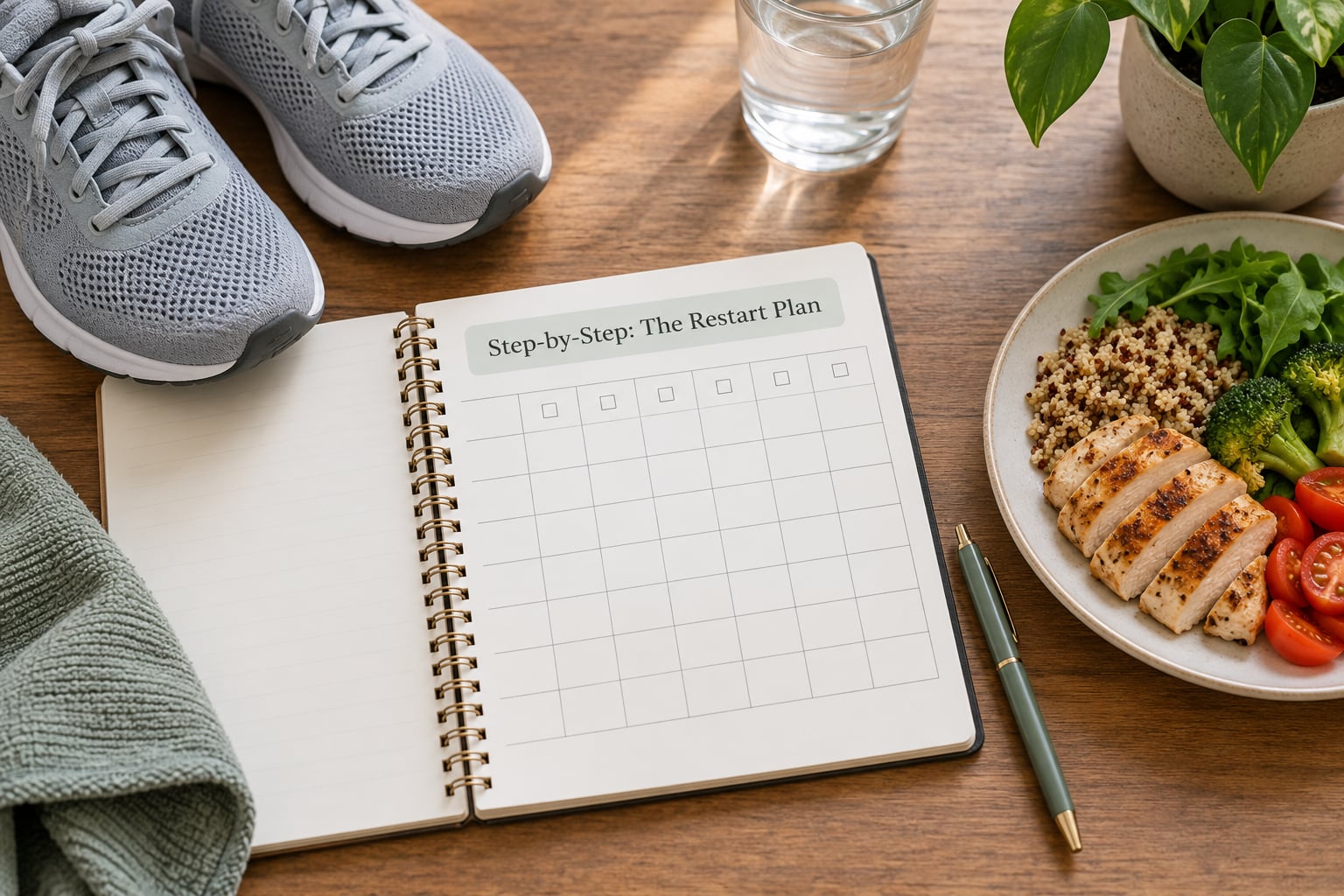
Step 1: Stop treating the restart as another diet
The first step is a change of framing, and it is the one most people skip. Quitting a plan that was hurting you is information, not a character flaw.
Write down the three specific things that made the old plan unworkable. No calories, no scale, just conditions: late-night hunger, food guilt, no time to cook, workouts that felt like punishment. That list is more useful than any new plan, because it tells you what your next one has to fix.
Then replace the promise. Instead of a deadline and a number, use a neutral decision: I will eat regular meals and move a bit, for as long as it feels reasonable. That sounds modest. It is also the version people actually repeat.
Step 2: Build a regular eating routine
Eat at a stable level for four to eight weeks before trying to change anything. Stable means the weight holds roughly steady for a few weeks, which is what you get when intake matches what your body is using at your current weight.
Why bother? Because the weight you are at now is not the weight your old plan was built for. Researchers who followed dieters long-term found that resting metabolic rate stayed reduced for up to about two years after weight was lost, and hunger hormones stayed shifted for much of that period. Sumithran and colleagues reported this in 2011 in a small group of contestants from a weight-loss reality show, and Fothergill’s group found similar persistent changes in a larger 2016 study. Your old calorie number is no longer a useful guide.
So how do you find the new one? Use a reputable calculator with your current weight and current activity level, treat the result as a starting guess, then adjust by watching the scale monthly. If the number drifts steadily in one direction for three to four weeks, change one thing at a time.
Step 3: Focus on nourishment, hunger and satisfaction
Most people restart by counting again. Counting works for some, and for others it is the exact thing that made eating stressful the first time.
A middle path that many people find easier: build each meal around a protein source, something with fibre, and something satisfying to eat, then let portions be flexible. Protein and fibre are the two components that blunt hunger most reliably, which is the main job of a meal.
Practise noticing hunger before you eat rather than after. Most people run low-energy for years and stop registering the signal, then overeat at dinner and wonder why. Ten minutes of noticing, some protein, and the edge usually comes down.
This is general guidance rather than a meal plan. If you want numbers specific to your health, your history and your medications, that is a conversation for a registered dietitian or your doctor.
Step 4: Return to enjoyable movement
Re-entry should be graded. If you have been inactive for a while, walking is the right starting point because it is easy to scale and hard to injure.
Start with ten to fifteen minutes, most days. Add five minutes a week until a walk is an ordinary part of your day. Only then add anything harder.
Strength work is worth adding once walking feels normal. It tends to make eating easier rather than harder, which matters more than the number on any scale. People in weight-loss forums frequently report the same thing: once they started lifting, they could eat more and still move down.
Skip anything that punishes you. If a workout leaves you feeling worse for hours afterwards, it is too much for right now.
Step 5: Set small, measurable habits
Pick two habits small enough that a bad day cannot stop you, and repeat them until they are boring.
Useful examples: planning one meal the night before, a ten-minute walk after lunch, or a protein source at every meal. Each one takes under five minutes, which is the point.
On timing, expect slower than most ads suggest. Lally and colleagues’ habit study, published in 2010, found automatic actions took about 66 days on average to feel automatic, with a wide range across participants. Three weeks is a marketing number, not a research one.
Set your own check-in for three months out rather than three weeks. That single change removes the most common reason people stop.
Step 6: Handle setbacks without abandoning the plan
You will have a week where you eat at 11pm twice and skip the walk for four days. The rule is simple: the next planned action counts, the missed ones do not.
Do not compensate. No fast, no punishing session at the gym, no cutting back to compensate for a bad meal. Compensating is how a slip turns into a pattern.
Ask yourself one question after a bad week: was this a planned break or a loss of structure? A planned break is fine. A loss of structure means your routine needs to be smaller, not stricter.
Common mistakes to skip this time
These come up constantly in restart threads, and each one has a plain fix.
Trying to erase the past. Your old progress is still experience. Fix: keep the cooking skills, the portion awareness, and the walking habit. Discard the rules that made you miserable.
Reusing old calorie targets. They were built for a different body. Fix: recalculate from your current weight, then adjust slowly.
Starting with an intense workout. Injury and exhaustion end plans early. Fix: two weeks at gentle volume before anything demanding.
Weighing daily. It adds noise, not information, and the noise drives the mood swings that end the attempt. Fix: monthly, ideally in the morning.
Relying on supplements, detoxes or cleanses. They address symptoms of the old approach rather than the approach itself. Fix: put that effort into the meal rhythm instead.
Setting a short timeline. Two-week deadlines create two-week quitting. Fix: use a three-month first checkpoint and adjust once, not daily.
Restarting immediately after a break. Going straight back into a deficit from a stressed state is the pattern that produces weight cycling. Fix: four to eight weeks of steady eating first.
One more safety note. If the urge to restrict has returned as something you cannot control, or you are fasting or compensating for weight gained, that is not a plan to work through alone. Stop and talk to a doctor, a registered dietitian, or an eating-disorder helpline such as the ANAD helpline in the US. Steady appetite and a steady relationship with food are the foundation of everything above.
Frequently Asked Questions
Should I start another diet or just eat normally after quitting one?
Eat normally for four to eight weeks first. That period is a stabilising phase, not a permanent change: regular meals at roughly maintenance, regular movement, no aggressive targets. Once your weight and appetite have settled, you can decide whether you want a small change at all. Many people find the steadier routine is enough.
How long should I wait after quitting a diet before starting again?
About four to eight weeks of steady eating is a reasonable pause, and the reason is practical rather than moral. Going straight from a stressed, restricted state back into a deficit tends to repeat the same loop. Use those weeks to rebuild a meal rhythm and sleep, and recalculate your calorie baseline from your current weight before you change anything.
How do you reset your metabolism after years of dieting?
There is no switch to flip, and nothing resets in a weekend. Studies following dieters for years found resting metabolic rate stayed lower and hunger hormones stayed elevated for up to about a year or two. Eating steadily at your current maintenance for four to eight weeks, adding activity gradually, and sleeping properly is what helps those signals return.
What should I do the first week after quitting a diet?
Write down the three conditions that made the old plan unworkable, then set a regular meal rhythm with three meals and a couple of snacks using foods you already like. Take a ten-minute walk once a day. Put the scale away. Do not start counting calories, fasting, or planning a timeline in week one. Structure first, numbers later.
How do I get back into exercise after stopping?
Walk first, and start smaller than feels silly. Ten to fifteen minutes most days, adding about five minutes a week, is enough to rebuild tolerance without injury. Once walking is ordinary, add two strength sessions a week. Skip anything that leaves you feeling worse for hours, and build up over weeks rather than restarting at your old intensity.
When should I talk to a doctor or dietitian instead of doing this alone?
Talk to a professional if you have a medical condition, take medication that affects appetite or blood sugar, are pregnant or breastfeeding, or are under 18. Also worth raising if the urge to restrict or compensate for weight has become hard to control, or if eating regularly feels frightening. A registered dietitian can also calculate a starting level specific to you.
A Gentle First Step Forward
If you do one thing today, choose one regular meal you can repeat, one short walk, and one way to check in that is not the scale. That is the whole starting point.
Then give it three months instead of three weeks. You are not starting from zero after quitting a diet. You are keeping the skills, dropping the rules that hurt you, and building a rhythm that can survive an ordinary week. If the weight moves, that comes later. The habit is the part that lasts.