You can estimate calories when eating out by working through four tiers of accuracy, in order: the restaurant’s own nutrition information, a comparable chain dish, a component-by-component breakdown using hand portions, and finally a realistic range when nothing at all is published. In practice most meals take about two minutes. Find the number, size the plate, add the invisible oil and sauce, and write down a range instead of hunting for one exact figure.
The reason this matters is boring but true: restaurant meals are the least predictable part of any calorie budget, and people routinely undercount them. There is no label, the oil is invisible, and a restaurant portion is often two or three times a home portion. A rough estimate you actually log is worth far more than a precise number you never write down, because it is your weekly average that moves the scale, not one dinner.
This is general nutrition information, not personalised medical advice. If you have a condition affected by diet, are pregnant, or have a history of disordered eating, talk to a doctor or a registered dietitian before tracking calories.
Table of Contents
- What You Need
- Step-by-Step: How to Estimate Calories When Eating Out
- 1. Check for Posted Nutrition Information
- 2. Break the Dish Into Main Components
- 3. Estimate the Portion You Will Eat
- 4. Add Sauces, Dressings, and High-Calorie Extras
- 5. Use a Range When the Estimate Is Uncertain
- 6. Save the Estimate for Later
- Common Mistakes and Helpful Tips
- Frequently Asked Questions
- How do I estimate calories at a restaurant with no nutrition information?
- How accurate are restaurant calorie counts?
- Should I round up my restaurant calorie estimate?
- What is the 30/30/30 rule for restaurants?
- Can I lose weight while eating out two or three times a week?
- When should I stop estimating and talk to a professional?
- Conclusion
What You Need
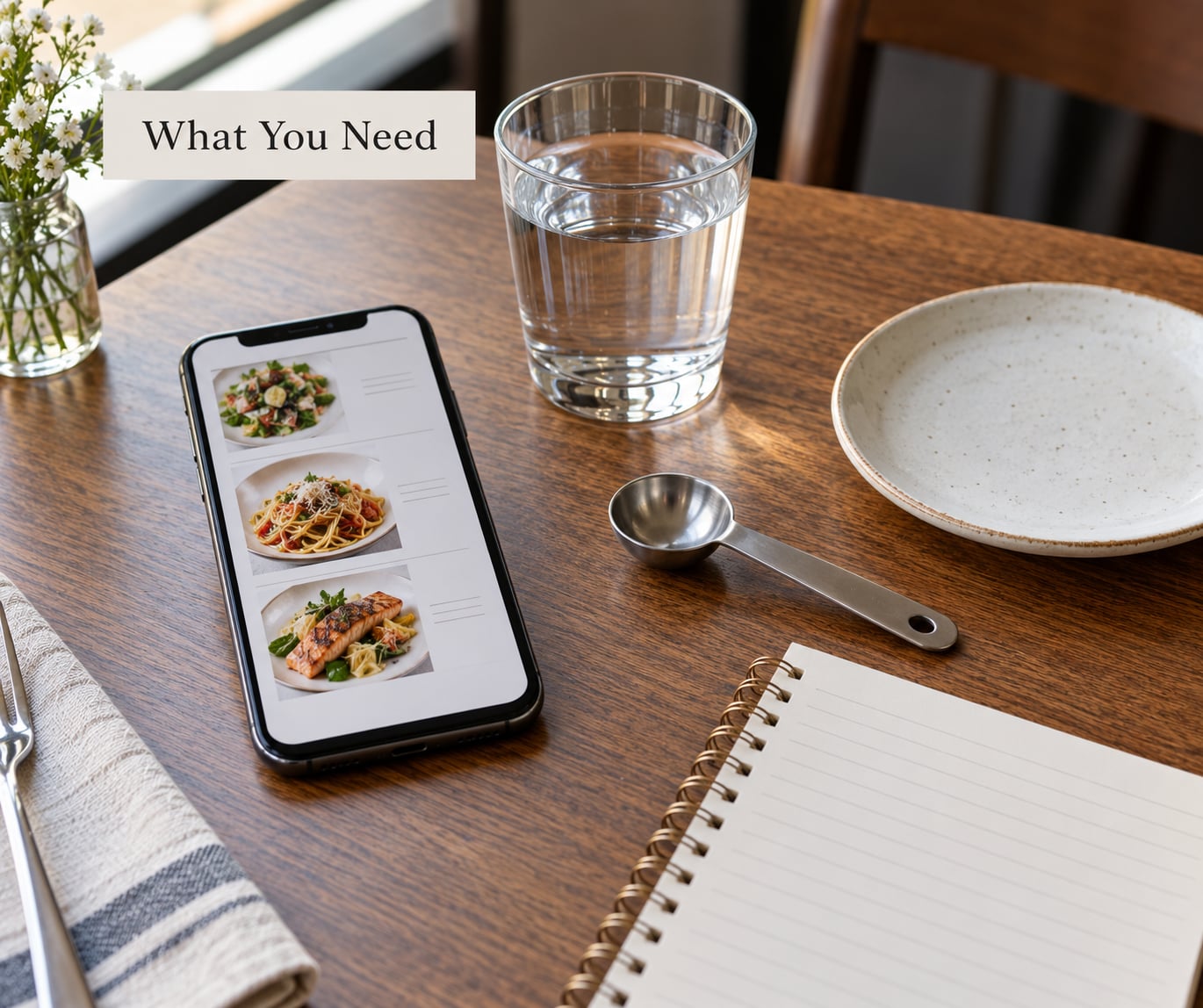
Four things. That is the whole kit, and three of them are free.
The first is access to the menu and any nutrition information. Almost every chain restaurant in the US publishes calories on its website or in-store, and many publish full macros. Independent restaurants often publish nothing, which is fine, because the next three tiers cover that case.
The second is a phone or a small notebook. The phone gives you a nutrition database, a calculator and a camera. The notebook works just as well and has one advantage: nothing gets auto-suggested, so you write down the estimate you actually reasoned out.
The third is a set of portion references you already own. Your hand, a deck of cards, a baseball, a shot glass, a postage stamp and a teaspoon. You do not need a food scale, and honestly you are better off without one at a restaurant, because weighing food in front of your table is a fast way to make eating out feel like work.
The fourth is optional: a food logging app with a large database. The useful ones let you build a custom food from components, which matters because most restaurant dishes have no single searchable entry. If your app only accepts packaged foods, keep a plain note template instead and type the components in later.
Step-by-Step: How to Estimate Calories When Eating Out
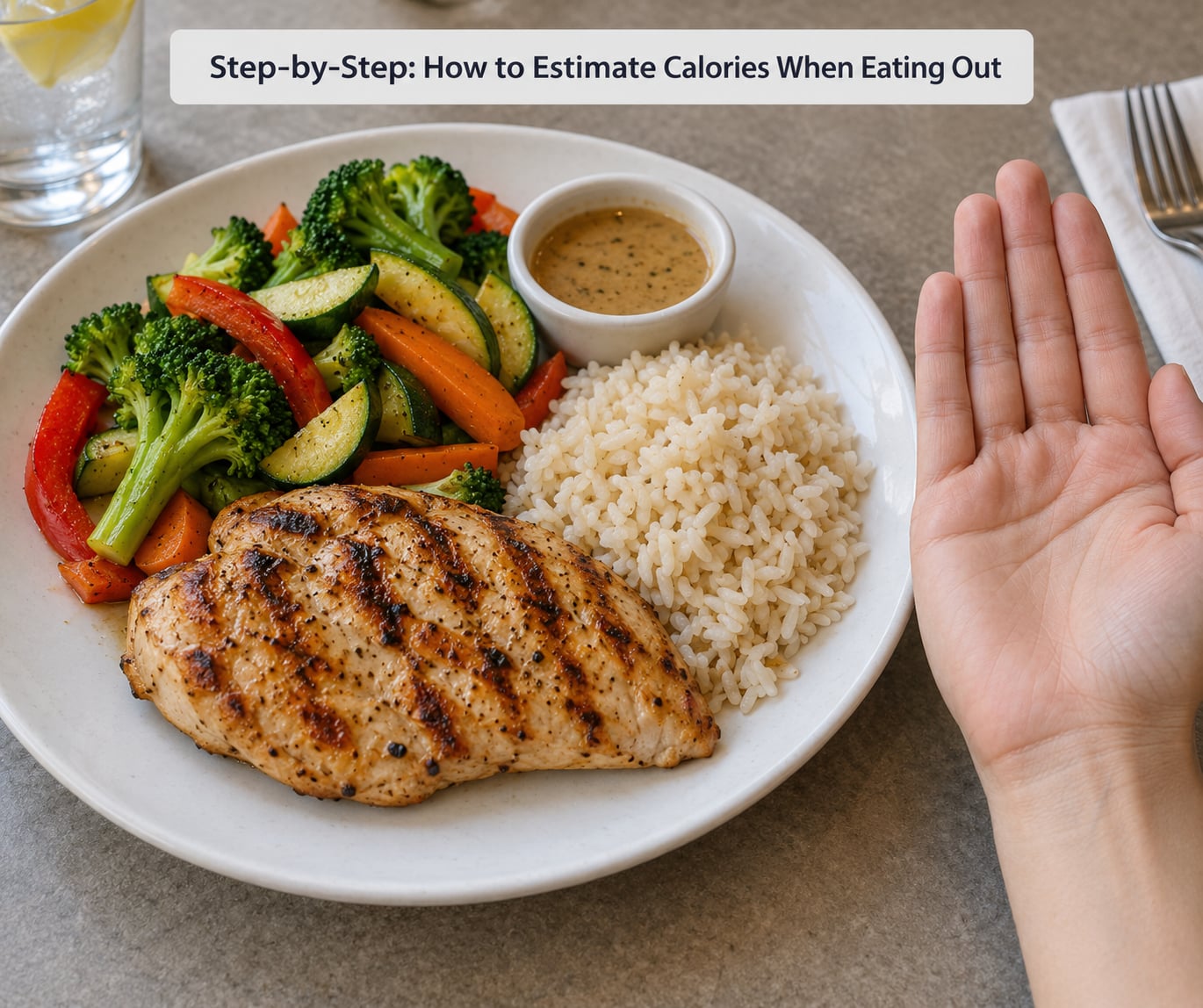
Run these six steps in order. Each one is more accurate than guessing the whole plate at once, and the later steps are what most people skip.
1. Check for Posted Nutrition Information
Start with the official number because it beats everything else you could produce yourself. Calories appear on menus, on counters, on table tents, on delivery apps and on the restaurant’s website, and US rules require calorie labelling for restaurants with 20 or more locations, with a full nutrition breakdown available in writing on request. People in the r/nutrition threads are often surprised that asking is legal and simple: you can request the written nutrition information for any covered chain item.
Then match it properly, because this is where the error creeps in. Pick the exact item you are ordering, not the nearest headline dish. Pick the size you will actually order, since a small and a large can differ by 200 to 300 calories. Match the location where you can, since nutrition is calculated per recipe and recipes change between regions and over time.
If only chain data exists for what you want, treat it as a starting point rather than an answer. Independent restaurants usually serve larger portions and cook with more oil than a fast food chain, so pick the moderate-to-high option from two or three comparable dishes and treat the average of them as your baseline. If nothing is published anywhere, move to step 2.
2. Break the Dish Into Main Components
A mixed dish is not an unknown quantity. It is a sum of parts you can see, and separating the parts is the single biggest accuracy win available.
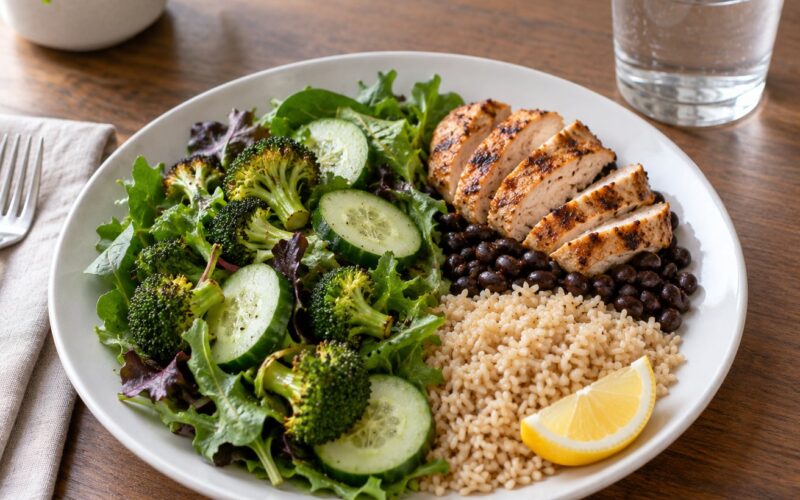
Break the plate into protein, starch, vegetables, visible fat, sauce or dressing, and extras like cheese, nuts, syrup or bacon. Estimate each one on its own, using the reference list below. The advantage is that your uncertainty gets distributed: a portion of rice is easy to size against a fist, while a whole bowl of curry is not.
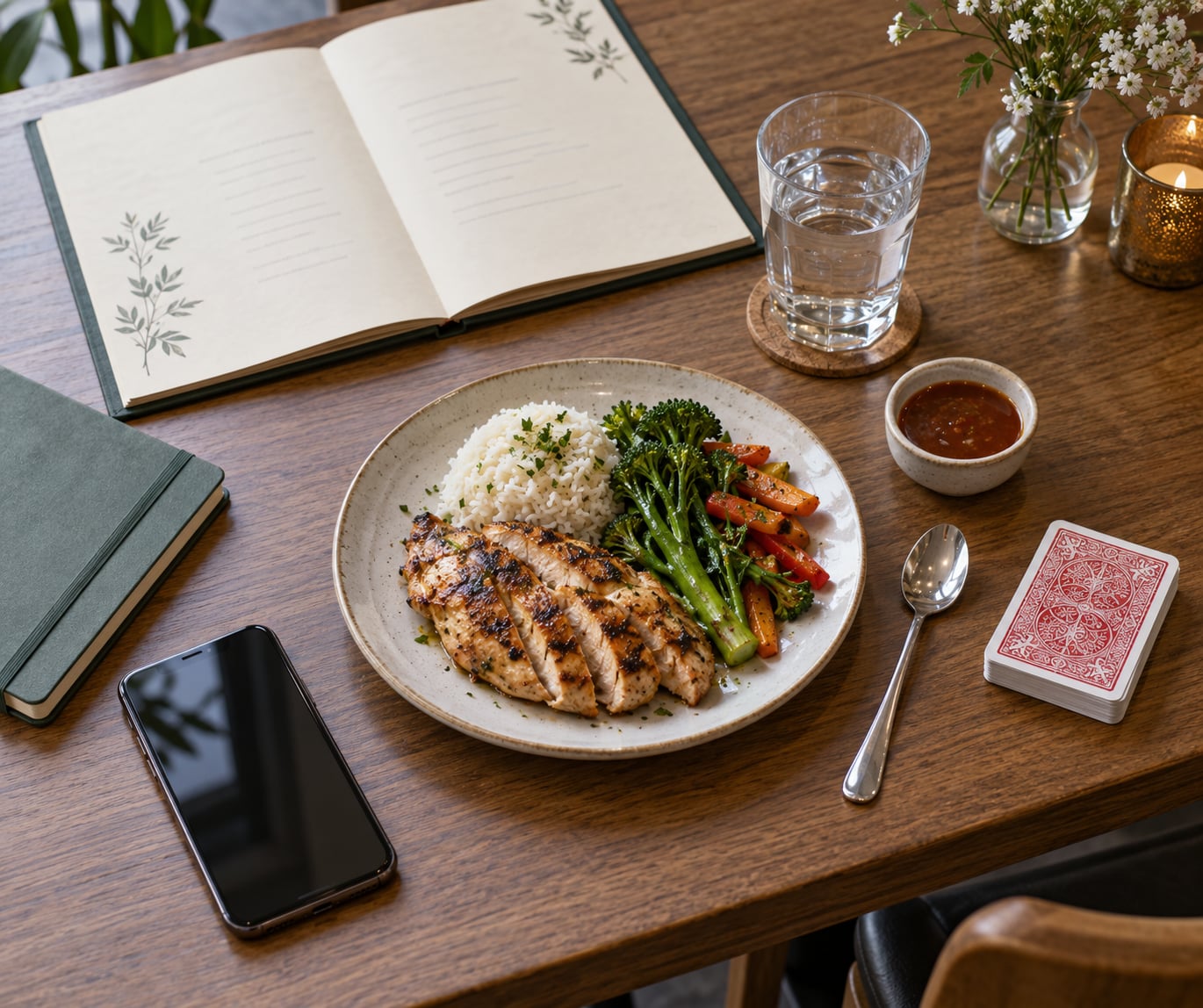
Here is a worked example, because numbers make the method obvious. Someone orders grilled chicken with rice and vegetables at a restaurant with no published data, plus a sauce cup on the side.
- Chicken breast, one palm plus a bit, roughly 5 to 6 oz cooked: about 300 to 350 kcal
- Rice, about one and a half cups: about 300 to 330 kcal
- Mixed vegetables, two fists, little or no oil: about 100 to 150 kcal
- Sauce cup, about 2 tbsp poured: about 80 to 120 kcal
- Cooking oil and butter on the chicken, estimated generously: about 100 to 150 kcal
That lands the plate between roughly 880 and 1,100 kcal before drinks. If the person eats three-quarters of the rice and half the chicken, the logged number drops by about 120 kcal. A 1,000-calorie estimate on a plate that looked far lighter than a week’s worth of home cooking is the honest number, not a failure of the method.
3. Estimate the Portion You Will Eat
Restaurant menus describe a serving size. You are eating a portion. Those are different things, and the gap between them is often 200 to 400 calories.
Use hand and visual references as the yardstick:
- Palm, no fingers — cooked meat or fish, about 3 to 4 oz
- Closed fist — rice, pasta, potatoes or salad, about 1 cup
- Cupped handful — starches and carbs, about 1 cup
- Deck of cards — any meat, about 3 oz
- Half a baseball — rice or pasta, about 1 cup
- Shot glass — dressing or oil, about 2 tbsp
- Postage stamp — butter, about 1 tsp
- Thumb tip — cheese or nut butter, about 1 tbsp
- Fingertip — butter or oil, about 1 tsp
Then adjust. If the plate holds three fists of pasta and you would comfortably eat two, log two. If a listed chain item comes as a single serving and the kitchen sends out double, multiply. One exception to the usual advice: a restaurant bowl of rice or noodles is routinely one and a half to three times a home portion, so treat a full takeout container of fried rice or pad thai as two or three portions unless you are weighing it.
For the leftovers question that comes up constantly on r/CICO: log what you actually ate, not what arrived. If you box a third of the dish, that is two-thirds of the estimate. If you would rather not carry packaging home, take the container before the first bite, not after, because the decision is much harder once the plate is nearly empty.
4. Add Sauces, Dressings, and High-Calorie Extras
Invisible calories are where estimates go wrong. Fat carries roughly 9 kcal per gram, so a single tablespoon of oil really is about 120 kcal, and restaurant cooking uses tablespoons, not teaspoons.
- Oil or butter, 1 tsp: about 40 kcal
- Oil or butter, 1 tbsp: about 120 kcal
- Salad dressing, 2 tbsp: about 120 to 180 kcal
- Ranch or blue cheese, 3 tbsp: about 200 to 250 kcal
- Mayonnaise, 1 tbsp: about 90 kcal
- Grated cheese, 1 oz: about 100 kcal
- Parmesan on pasta, 2 tbsp: about 80 kcal
- Syrup, one pump (about 20 g): about 60 kcal
- Heavy cream splash, 2 tbsp: about 100 kcal
- Bacon, two strips (about 16 g): about 90 kcal
- Olive oil on a salad, 1 tbsp: about 120 kcal
Three habits bound the error. Ask for sauce on the side and use only part of it, which is often the difference between 120 and 400 calories. Ask the server whether the dish is grilled, baked, steamed, sauteed or deep fried, since the method tells you more than the ingredients do. And if a dish is Asian-style with no visible cream or butter, lean on weight instead: a restaurant portion of pad thai, fried rice or stir fry typically weighs 400 to 700 g and runs roughly 700 to 1,100 kcal depending on oil and protein.
Curries with coconut milk or ghee, creamy pasta dishes and loaded fries are the common high-range cases. A curry with rice often lands between 750 and 1,050 kcal, and a rich pasta dish between 900 and 1,200 kcal. Write down the range, not the midpoint.
5. Use a Range When the Estimate Is Uncertain
If you remember one rule from this guide, make it this one: a range is a legitimate answer. False precision costs you credibility and tells you nothing you can act on.
Pick a low bound and a high bound from your component work, then add a buffer of 100 to 300 calories, or roughly 20 percent, for oil and sauce you could not see. Searchers reading the research summaries on this topic land in the same place, and the forums reach it from the other direction: users on r/1500isplenty report assuming restaurant nutrition runs about 100 calories low, so they add to it anyway. Both habits point the same way.
When you are unsure, round up to the nearest 50 or 100 rather than to a specific-looking 847. When the server tells you a dish is deep fried, or the plate arrives swimming in oil, widen the range rather than picking the low end. If you take one number into your log, take the midpoint of a range you actually believe, not the top.
6. Save the Estimate for Later
Write it down while the details are fresh: restaurant, dish, components, the range, what you assumed, and roughly what fraction you ate. Five lines is enough.
A useful note looks like this: Tuesday, independent Thai place, chicken with rice and greens, no posted data. Estimated 950-1,150, logged 1,050. Ate about three-quarters. Assumed 2 tbsp oil, sauce on side used half.
Keeping the assumptions matters more than the total. When you review a few weeks of notes, the pattern is obvious: the restaurant you visit most is consistently 300 calories over your estimate, and the same two extras keep showing up. That is a problem you can fix, and it is invisible if you only logged totals.
Photographing the plate before you start is worth it too, especially for family-style meals. Users on r/CICO weigh leftovers at home and back-calculate from the stated serving weight on the packaging: a 56 g serving of pasta at 210 kcal multiplied by roughly 3.78 servings is how that plate lands near 800 kcal. You do not need to do that at the table, but knowing a reference serving weight makes the arithmetic at home far more reliable.
Common Mistakes and Helpful Tips
Treating all restaurant food as hopeless. Plenty of restaurant meals are perfectly workable: grilled meat, steamed vegetables, a clear soup, a salad with dressing on the side. One user in r/WeightLossAdvice put it plainly, that plain protein plus steamed vegetables is the only situation where a count is genuinely accurate, and everything else is an estimate. That is true, and it does not mean the rest of the menu is off limits.
Ignoring the cooking method. Grilled and steamed food and deep-fried food share ingredients and have nothing in common calorie-wise. Ask before you order. When the answer is fried, the visible part of the meal is the smaller half of the estimate.
Confusing serving size with the portion eaten. Menu descriptions tell you what a recipe yields, not what lands on your plate or what you finish. Adjust in both directions: bigger plate, smaller appetite.
Logging every single ingredient separately. Nobody needs twenty entries for one dinner. Log the components as four or five line items, or as one entry with the breakdown in the notes.
Assuming the posted number is exact. Published figures come from calculated recipes, not weighed plates, and independent research on restaurant meals found discrepancies around 15 to 20 percent, with underestimation growing as the meal gets larger. Meals with variable oil are the least reliable of all. Add your buffer and move on.
Compensating hard afterwards. This is the mistake that turns one dinner into a bad week. If a meal estimate goes high, the response is to return to your normal routine, not to skip meals or restrict heavily. A single oversized estimate has almost no effect on a weekly total; a punishment cycle does.
Some low-effort habits that pay off: pre-log before you leave the house when you already know where you are eating, ask for sauces and dressings on the side, take the leftovers container before the first bite, keep a short personal database of the places you visit often, and photograph the plate. And put alcohol in the log, because at about 7 kcal per gram it adds up faster than the food: a single pint of beer is roughly 170 kcal, a large glass of wine around 125, and a piña colada is often 300 to 400 before the meal.
For buffets and family-style dinners, the workable approach is to pick three or four things, estimate each portion you took, and skip tracking the ones you barely tasted. There is no version of a buffet log that is both accurate and enjoyable.
Frequently Asked Questions
How do I estimate calories at a restaurant with no nutrition information?
Break the plate into components and size each one with hand references. Estimate the protein by palm, the starch by closed fist or cupped handful, vegetables by two fists, and add measured amounts for sauce, dressing and cooking oil. Then add a buffer of 100 to 300 calories, or about 20 percent, and record the result as a range rather than a single number.
How accurate are restaurant calorie counts?
Treat published figures as a starting point, not a verdict. Independent studies have found reported and actual restaurant calories differing by roughly 15 to 20 percent, with underestimation increasing as the meal gets larger. Dishes with variable amounts of cooking oil are the least reliable, which is why adding a modest buffer works better than trusting the printed number exactly.
Should I round up my restaurant calorie estimate?
Yes, when you are genuinely unsure. Round to the nearest 50 or 100 rather than inventing precision, and widen the range if the dish is fried or heavy in oil. Many trackers add 100 to 300 calories on top of a chain figure for exactly this reason. Your weekly average matters far more than whether one estimate was 50 calories off.
What is the 30/30/30 rule for restaurants?
The 30/30/30 rule is a quick meal-planning shortcut rather than an official nutrition standard. The idea is that roughly 30 percent of the plate is protein, 30 percent is vegetables or salad, and 30 percent is a starch such as rice or bread, leaving the balance for sauces and extras. It is useful at a restaurant because it forces you to notice portions, though it says nothing about hidden oil.
Can I lose weight while eating out two or three times a week?
Yes, most people can, as long as the restaurant meals are estimated and logged instead of skipped. What usually breaks progress is not the meal itself but untracked extras such as drinks, sauces and side dishes. Keep a personal database of the places you visit most, and treat your weekly total rather than any single dinner as the thing that decides whether you are in a deficit.
When should I stop estimating and talk to a professional?
See a registered dietitian if you need a plan built around a medical condition, if you are pregnant, or if tracking food is starting to feel anxious or compulsive rather than useful. A doctor is the right first stop for anything clinical. A dietitian can also help you calibrate portion estimates for your own body and meals, which no generic chart can do.
Conclusion
If you do only one thing, check the menu or your tracking app before you order and look for the closest chain equivalent, choosing the moderate-to-high option. Then size the portion with your hand rather than the plate, add what the invisible oil and sauce are likely worth, and write down a range. That is the whole method. Reviewing your notes every week or two is what makes it work, because a rough estimate you keep is far more useful than a precise one you do not.
Updated for 2026.