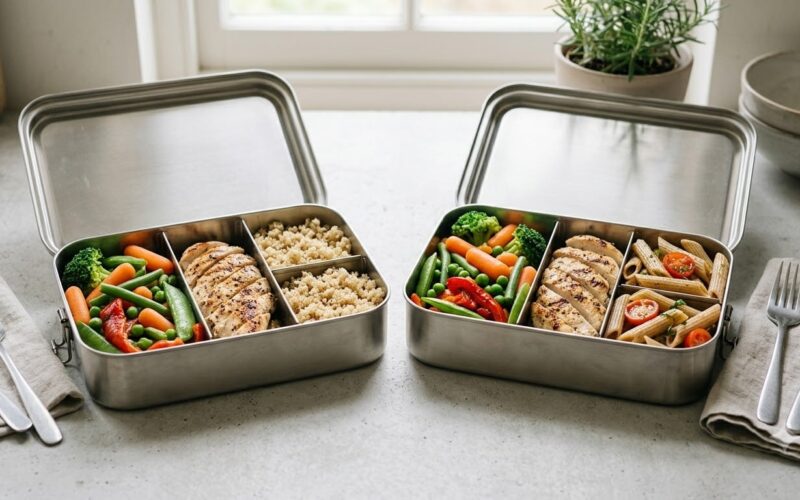
A refeed day is a planned, structured day where you deliberately eat more, mostly from carbohydrates, instead of your usual deficit. Most people do not need one on a fixed schedule, and whether what is a refeed day and do you need one is even a good question for you depends on how long you have been dieting, how lean you are, and how you feel on it.
The short version: a refeed is a dietary flexibility tool. It can help with hunger, training output and the mental strain of a long cut. It does not restart your metabolism, and it will not by itself break a plateau.
Below is a practical look at how refeeds work, what the research actually shows, and how to plan one without turning it into an excuse.
Table of Contents
- What Is a Refeed Day and How Does It Work?
- What Is a Refeed Day, and How Is It Different From a Cheat Day?
- Why Might Someone Consider a Refeed Day?
- Do You Need a Refeed Day to Lose Weight?
- How to Plan a Refeed Day Without Overeating
- Start from your maintenance estimate
- Pick foods you already know
- Keep protein steady
- Plan the day after
- How Much Should You Eat on a Refeed Day?
- What Should You Eat on a Refeed Day?
- How Often Should You Do a Refeed Day?
- How to Tell Whether a Refeed Helped
- Who Should Ask a Doctor or Dietitian First?
- Frequently Asked Questions
- Is a refeed day a cheat day?
- Will a cheat day break a plateau?
- Is 1200 calories too little for one day?
- What is a diet break?
- Does a refeed day reset leptin?
- Will a refeed day make me gain weight?
- What to Do First
What Is a Refeed Day and How Does It Work?

A refeed day is one deliberate day of higher intake during a calorie deficit, with most of the extra energy coming from carbohydrate. You eat at roughly your maintenance calories rather than your deficit target, keep protein steady, and often cut fat a little to make room for the carbs. It is planned in advance, not decided in the moment at a buffet.
Why carbohydrate in particular? Two reasons show up repeatedly. Carbs drive insulin up, and insulin stimulates leptin secretion, the hormone that helps the brain register fullness. Carbs also refill glycogen, the stored carbohydrate in your liver and muscles that gets depleted during a calorie deficit. More glycogen means better training output and less of that flat, dragged-out feeling in the gym.
Here is the definition without the hype. A refeed day is not a starvation-recovery protocol, it is not a licence to eat anything, and it is not a metabolic reset.
What Is a Refeed Day, and How Is It Different From a Cheat Day?
The distinction matters more than most people expect. A cheat day has no target. A refeed day does.
| Type | Structure | Typical calorie target | Main purpose |
|---|---|---|---|
| Cheat meal | One meal, anything on the menu | Whatever that meal works out to | Psychological relief and social flexibility |
| Refeed day | Whole day, planned and mostly carbohydrate | Around maintenance calories | Hunger management, training quality, adherence |
| Diet break | Several days to a couple of weeks | Maintenance calories each day | Relief from sustained restriction |
| Reverse dieting | Gradual return toward maintenance after a cut | Rising by small steps each week | Coming out of a diet without overshooting |
A diet break is the same idea spread across more days. Reverse dieting is a gradual exit from a diet rather than a single higher day. Neither is a cheat day, and neither is a refeed.
Why Might Someone Consider a Refeed Day?
There are a few situations where the idea comes up for a reason.
- Hunger has become constant. When you stop thinking about anything but food, the diet is doing more harm than good. A planned higher day can take the edge off before you make a bigger, worse decision.
- Training quality drops. Lifters frequently report that squats and presses feel heavy and heavy in the bad way after weeks of low carbs. Restoring glycogen usually fixes this quickly, sometimes on the day itself.
- You are deep into a cut. The further you get from maintenance calories, the more your body adapts to the lower intake. Refeeds are discussed most often in that later phase, not in week two.
- Social and psychological fatigue. A holiday meal, a wedding, a long weekend with family. Planning a refeed around it means you get the flexibility without handing the whole week over.
- Very low carbohydrate intake. Some people cut carbs aggressively to lose weight faster. That approach works short term and tends to catch up with you, so a higher-carb day is a reasonable correction.
None of these make a refeed mandatory. They make it reasonable. How much it helps depends entirely on the diet around it and on the person doing it.
Do You Need a Refeed Day to Lose Weight?
No. Almost nobody needs one, and the people who benefit least are the ones following a strict weekly schedule with no symptoms. Weight loss happens through a sustained calorie deficit over weeks and months, and one higher day does not change that arithmetic.
The metabolic claims are the part worth pushing back on. Research on refeeds and diet breaks is small but pointed. Campbell and colleagues (2020) looked at a short high-carbohydrate refeed in dieters and found little meaningful change in resting metabolic rate. Byrne and colleagues (2018) studied a two-week diet break at maintenance calories in people who had lost weight and found weight-loss rates were largely preserved afterward rather than accelerated. Peos and colleagues (2021) reviewed the intermittent energy restriction literature and found no strong reason to believe periodic higher-intake days speed fat loss. Harris and colleagues (2018) and Siedler and colleagues (2023) reach similar conclusions for diet breaks.
The pattern across them is consistent: the possible metabolic benefit shows up mostly in aggressive dieting scenarios, and it is modest even there.
So where the benefit is real is elsewhere. Reddit users in r/loseit and r/naturalbodybuilding describe the adherence benefit more often than a metabolic one. The common thread in those discussions is that the biggest win is feeling human again, and training better the next day.
Where a rigid refeed rule can hurt is when it turns into permission. Eat at maintenance one day, then compensate hard the next with near-fasting. That pattern does more damage than the original fatigue did.
How to Plan a Refeed Day Without Overeating
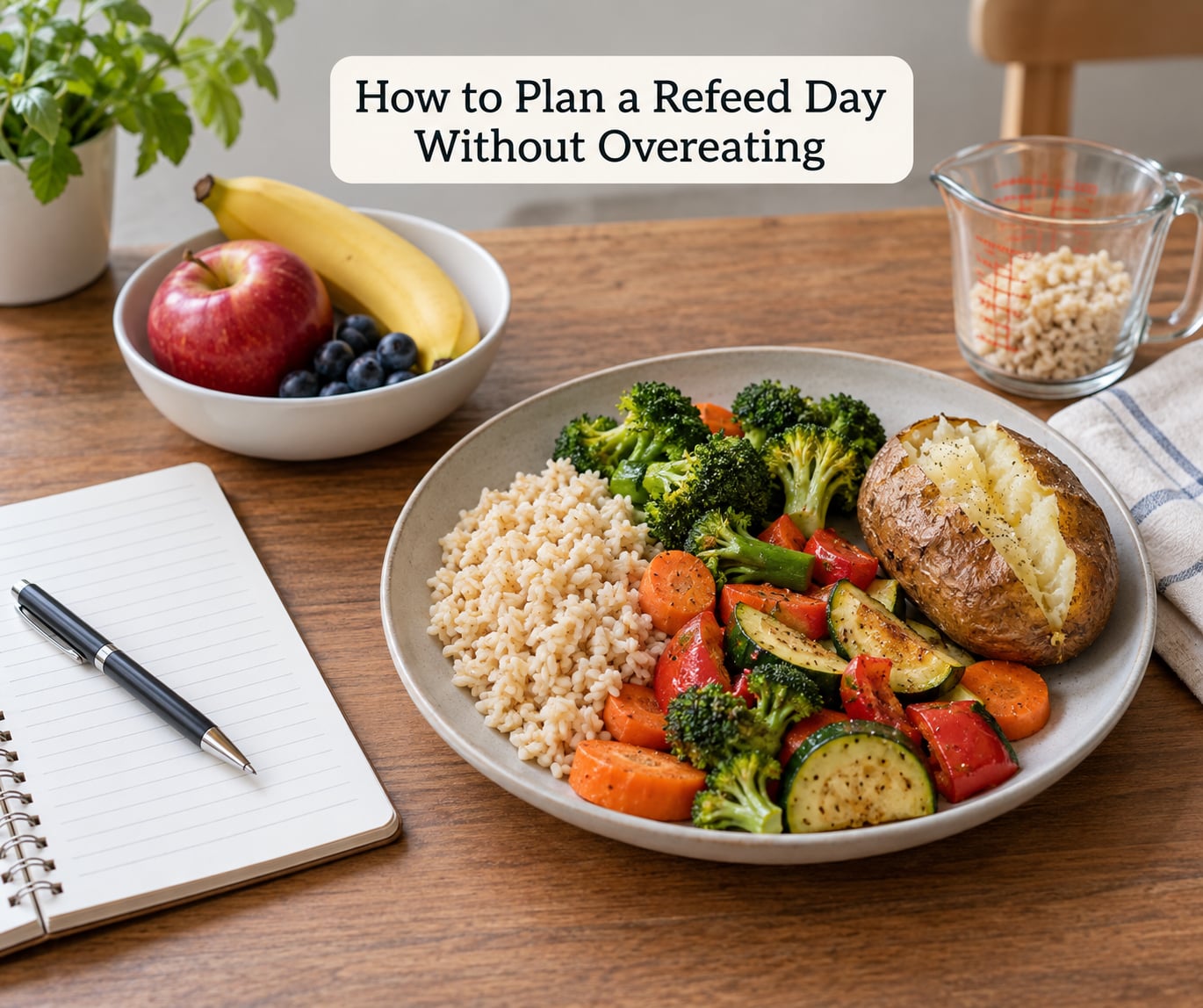
Planning is what separates a refeed from a cheat day. A workable framework has four parts.
Start from your maintenance estimate
Most people use their deficit target as the base and add a set amount, often the difference between a typical deficit day and maintenance. A rough shortcut for maintenance is body weight in pounds times 10 to 12 for a moderately active adult. Treat that as a starting estimate rather than a fact, then sanity-check it against your own trend: if you have been losing about a pound a week on 1800 calories, maintenance is probably somewhere in the 2300 to 2500 range for you.
Pick foods you already know
Familiar foods cause less trouble. This is not the day to try a restaurant you have never been to, at a place where the portions are unknowable, while hungry.
Keep protein steady
Protein does not usually change much on a refeed. Keep it at your normal target so muscle preservation is not on the back burner.
Plan the day after
Decide in advance what the next day’s breakfast is. This single step prevents most of the rebound I have seen people describe, where the refeed goes fine and the following three days go badly.
Some lifters like to spread the increase across two days, since a single large jump can be rough on appetite and digestion. Reddit threads come up with this idea often enough that it is worth knowing.
How Much Should You Eat on a Refeed Day?
There is no universal refeed day menu and no required number of calories. A reasonable range is maintenance calories, or maintenance plus a small amount, rather than a large surplus. Carbs usually absorb most of the difference, with fat held steady or trimmed.
Hunger, training load, your dietary needs and your overall calorie goal are better guides than any formula. On a heavy leg day you might eat closer to maintenance. On a rest day you might sit at maintenance or slightly under it.
What to avoid is the compensatory restriction afterward. Skipping breakfast the next morning, cutting your usual carbs in half, or adding an extra hour on the treadmill does not balance the ledger. It just makes the next day harder and the pattern worth repeating.
What Should You Eat on a Refeed Day?
Carbohydrate is the point, and most of your extra energy should come from it. Beyond that, keep the plate boring and familiar.
- Carbohydrate sources: oats, rice, potatoes, sweet potatoes, pasta, bread, bagels, fruit, oatmeal, granola, corn, beans and lentils if they sit well with you.
- Protein: whatever you normally eat. Chicken, fish, eggs, Greek yogurt, cottage cheese, tofu, lean meat.
- Fruit: useful here because it carries carbohydrate plus fibre and water, which helps with volume.
- Vegetables: still worth keeping on the plate. They add fibre and bulk, which matters on a day when you are eating more.
- Fluids: water across the day. Higher carbohydrate intake pulls water into the muscles with glycogen, so you will get thirstier than usual.
No single food is required, and highly processed food does not become a better choice because the day has a name on it. Some coaches suggest lower-glycaency carbohydrate options rather than fast sugar, since a sharp spike on an already full day often leaves you uncomfortable. Others eat whatever they like. Both work.
For a GLP-1 medication user, the picture is different. These drugs suppress appetite substantially, so a large carbohydrate target may simply be physically uncomfortable. Eating to maintenance calories is still reasonable, but forcing 400 grams of carbs on a day you cannot feel hungry is not a useful goal. Talk to your prescriber before changing how you eat around the medication.
How Often Should You Do a Refeed Day?
There is no evidence-based universal schedule, and anyone giving you a fixed one is guessing. Once a week is the most common number in coaching practice, not in the literature.
For most people it comes down to three situations. Occasional, such as once every two to three weeks, suits people who are dieting moderately and feel fine. Situational, meaning you plan one around a demanding training block, a long weekend or a holiday, suits most people. Unnecessary, which covers a lot of beginners in the first six to eight weeks of a cut who feel energetic and have plenty of weight to lose.
Longer than a day, a structured diet break of one to two weeks at maintenance is the version with the better evidence behind it, and it serves a similar purpose for a lot of people. If you feel you need a refeed every week, you may be better served by a slightly higher deficit or a planned break.
How to Tell Whether a Refeed Helped
The scale is the worst possible judge. Look at everything else.
- Energy: do you feel less like a walkthrough the gym, and more like yourself?
- Hunger: is the background noise quieter for the next few days?
- Training: do your numbers come back on your heaviest compound lifts?
- Digestion: any bloating settles down rather than lingering.
- Confidence: can you return to your normal meals without the rebound spiral?
About the weight. Each gram of glycogen stored holds roughly three grams of water, so a higher-carbohydrate day usually pushes the scale up a pound or two, and people commonly report 2 to 5 pounds the next morning. That is water and glycogen, not fat. It comes back down over the following several days as you return to your normal carbohydrate intake.
Some dieters report dropping their fastest weight in the week after a refeed. That happens, and it is also largely fluid, so it is not proof that anything metabolic kicked in.
Who Should Ask a Doctor or Dietitian First?
Refeeds are generally straightforward food changes, but a few situations deserve professional advice before you change your eating pattern.
- Anyone with a history of disordered eating or binge eating. Structured higher days can be a useful tool, and they can also be a trigger. This is worth discussing with a registered dietitian rather than working out alone.
- Diabetes or insulin resistance. Changing carbohydrate intake and meal timing has implications that depend on your medication and your readings.
- Gastrointestinal problems such as coeliac disease, IBS or a history of disordered eating around food. A big fibre and carbohydrate jump can be genuinely painful.
- Pregnancy or breastfeeding. Energy needs are already elevated and refeeds are not the right tool.
- Anyone returning from very low intake. Rebuilding intake after prolonged severe restriction carries a real risk of refeeding syndrome, which can affect heart, fluid and electrolyte balance and needs medical supervision.
- Women noticing menstrual changes or a loss of libido while lean and dieting. Period changes are a signal that the deficit is too deep, not a problem to refeed around. Get checked.
Stop and get advice if you feel faint, dizzy or unusually weak after changing your intake, or if any symptoms build over several days rather than settling.
Frequently Asked Questions
Is a refeed day a cheat day?
No. A cheat day has no calorie target and no structure, so what you eat is whatever happens. A refeed day is planned, keeps protein steady, and adds mostly carbohydrate to bring you to roughly maintenance calories. Same day off the diet, completely different effect on hunger and training, and a much lower chance of the rebound eating that follows an unplanned day.
Will a cheat day break a plateau?
Usually not. A plateau usually means your actual intake no longer matches your target, and an unstructured day of eating can widen that gap rather than fix it. A structured refeed can help in a different way, by improving how the diet feels and how you train while you are in it. Studies on diet breaks suggest a planned week or two at maintenance can preserve your loss rate, which is more useful than a single blowout.
Is 1200 calories too little for one day?
For most adults, 1200 calories is well under daily needs and getting very close to the lowest intake anyone should sustain without medical supervision. One day at that number is unlikely to cause harm on its own, but a pattern of such days is where problems show up: fatigue, hair loss, poor sleep and, in women, menstrual changes. If your normal intake is that low, a registered dietitian is a better first call than a refeed.
What is a diet break?
A diet break is a planned stretch of several days up to a couple of weeks where you eat at maintenance calories instead of in a deficit. It serves a similar purpose to a refeed day, so hunger and training are easier to manage, but it lasts longer and is usually scheduled in advance. Research by Byrne and colleagues in 2018 found weight-loss rates were largely preserved after a two-week break rather than being lost.
Does a refeed day reset leptin?
It raises leptin, at least briefly, and that is the honest version of the claim. Calling it a reset oversells it. Studies by Campbell and colleagues in 2020 found no meaningful change in resting metabolic rate after a short high-carbohydrate refeed. A rise in leptin that returns to baseline within days is not the same thing as changing your metabolism, so judge a refeed by hunger and training rather than by hormone promises.
Will a refeed day make me gain weight?
Not in any meaningful sense. Most people see one to five pounds on the scale the next morning, which is water and glycogen rather than fat, and it settles over the following several days as carbohydrate intake drops back to normal. A large surplus spread over a single day cannot add meaningful fat. If the number stays high for more than about a week, something else changed rather than the refeed.
What to Do First
Forget the schedule for a minute and ask one question: am I actually struggling right now? Constant hunger, flat training, poor sleep and a mood you do not recognise are all fair reasons to plan a higher day. Feeling fine and simply following a rule is not.
If the answer is yes, eat at roughly maintenance calories, mostly carbohydrate, on a day with familiar food and no big commitments. Then go back to your normal intake the next day without compensating for anything.
This article is general information, not medical advice. If you have a health condition, take medication, or have a history of disordered eating, talk to a doctor or registered dietitian before changing your eating pattern.