Knowing how to use the gym for the first time comes down to three things: book an orientation, spend five minutes warming up, then do two light sets of 8 to 12 reps on four beginner machines such as the leg press, chest press, lat pulldown and seated row. Most first sessions take 45 minutes, and leaving while you still feel like you could do more is the goal.
That last part surprises people. Nobody walks out of a good first session thinking that was the hardest workout of my life. They walk out tired in a pleasant way, knowing exactly where the water fountain is and what to do next time.
The nervousness is real and it is the most common thing beginners bring with them. On r/Exercise, a first-timer who had been lifting in a shed posted asking how to structure a gym day. The follow-up said the gym was quiet, people kept to themselves, and the staff were genuinely helpful during staffed hours. That is the normal experience. Nobody is watching you.
Table of Contents
- What You Need for How to Use the Gym for the First Time
- Step-by-Step
- 1. Arrive Early and Complete the Orientation
- 2. Tour the Gym and Classify the Equipment
- 3. Learn the Basic Equipment Rules
- 4. Choose an Easy Warm-Up
- 5. Complete a Beginner Full-Body Workout
- 6. Cool Down and Record Your First Session
- Common Mistakes
- Frequently Asked Questions
- Do I need to use every machine on my first gym visit?
- What should I do if I feel intimidated or nervous at the gym?
- How much weight should I lift as a beginner?
- How often should I go to the gym when starting out?
- What should I wear to the gym for the first time?
- When should a beginner stop a gym workout?
- Should I hire a personal trainer for my first visit?
- Conclusion
What You Need for How to Use the Gym for the First Time
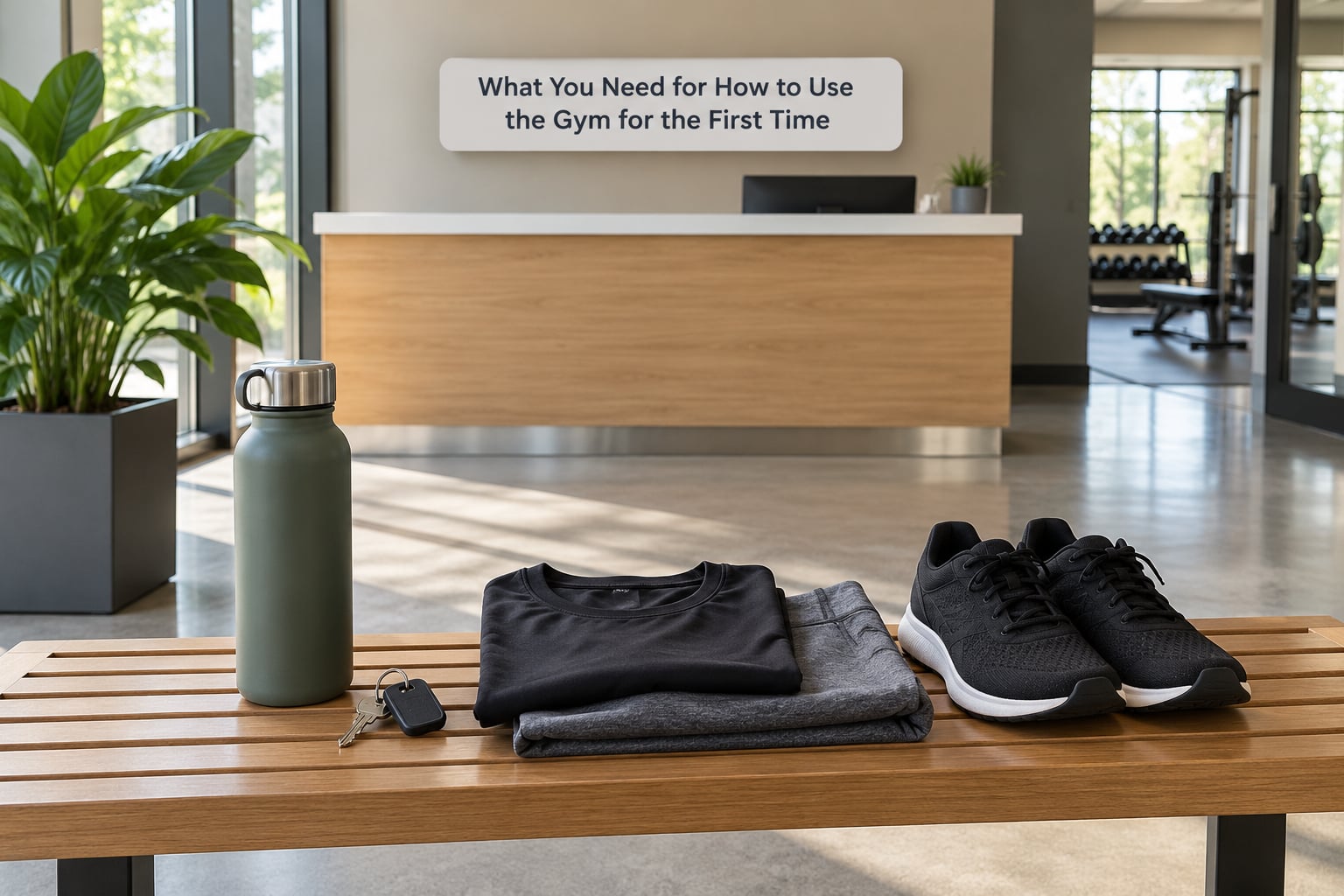
Bring less than you think you need. The gear list for a first visit is short enough to fit in one small bag.
- Clothes you can move in. Any shirt, leggings or shorts that let you squat, press and raise your arms without bunching up. Skip anything with a stiff waistband or a hood you have to fight.
- Supportive trainers. Flat, stable shoes with a decent grip. Running shoes are fine. You do not need lifting shoes for a first session of machines.
- A water bottle. Most gyms have a fountain or a dispenser near the free weights, but check on your tour so you are not wandering.
- A small towel. Especially on machines where you sit or press your back into padding.
- Your phone and membership app. Some gyms check you in with a QR code, and most have an app with the class timetable and the staff rota.
- A photo ID. Frequently needed the first time you check in.
- A pen or note on your phone. You want to record the four exercises and the weight you used. See step 6.
Sort out the health side before you walk in, not at the machines. If you have a heart condition, uncontrolled high blood pressure, a recent injury or surgery, or you are pregnant, mainstream guidance is to talk to a doctor before starting resistance training. The same goes if you get dizzy or breathless during ordinary daily activity. Staff at the gym can talk you through the machines, but they are not there to clear you medically.
One more practical thing: decide how you are paying for that first visit. Plenty of gyms run a trial membership or a day pass, which is a sensible way to learn whether you will actually use the place before you sign anything long. If you do sign a contract, read the cancellation terms and the length of the minimum term before you pay, not after.
Step-by-Step
Here is the whole visit in order. Each step has a signal that tells you it worked, so you can tell whether the session is on track before it is halfway through.
1. Arrive Early and Complete the Orientation
Aim for the middle of a weekday morning, or mid-afternoon on a weekend. Off-peak hours are the least intimidating time, and machines are free, which matters a lot when you do not yet know how to adjust them.
At the front desk, check in, show your ID, and ask three questions: whether they run a free equipment induction, whether a trainer is on the floor for a walkthrough, and where the lockers and showers are. Most gyms will do this walkthrough with you for free, and it takes ten minutes. Take it.
You are ready to move on when you can get from the entrance to the machines, the lockers and the toilets without asking anyone. That is the whole bar.
2. Tour the Gym and Classify the Equipment
Walk the floor once before you touch anything, and sort what you see into five groups. This is the fastest way to make a noisy, mirror-heavy room feel manageable.
- Weight machines. The guided paths for presses, rows, pulldowns and leg work. Start here on a first visit because the weight is set for you.
- Free weights. Dumbbells, kettlebells, barbells. Useful later, harder to control on day one.
- Cardio equipment. Treadmills, bikes, rowers, ellipticals. The bikes and ellipticals are the gentlest place to warm up.
- Free space. Mats, stretching areas, and the floor you need for bodyweight work.
- Staff. Know where the trainers stand before you need them.
Do not worry about the section you do not understand yet. Most people take their first few weeks to use about a third of any gym, and that is completely fine.
3. Learn the Basic Equipment Rules
Four habits cover almost every machine on the floor.
- Set up before you load. Adjust the seat so the machine lines up with your joints. On a chest press the handle should meet your mid-chest; on a leg press your knees should stay behind your toes at the bottom.
- Use the pin, gently. On a weight stack the pin slides into the notch for one plate at a time. Pull it out with a firm tug, it does not need force, and never let go of it once it is free of the stack.
- Start lighter than you think. Do a warm-up set of 10 reps with a stack you can barely feel, then add one plate and see. Choose a weight where you could finish 12 reps but would struggle to reach 15.
- Re-rack and wipe down. Return every weight to its rack at the same height you took it, and use the supplied wipes or a towel on the pads and handles before you leave.
While you are on the floor, learn two etiquette rules that nobody bothers to teach. Wait for a busy machine rather than jumping in, and make eye contact with the person using it to signal you are waiting. And put your phone away between sets. Two sets of eight to twelve reps lasts about a minute and a half. That is not enough time to scroll.
If you get stuck, the script that works is short: Excuse me, have you got a second, how do I adjust this? Beginner forums report that one sentence removes most of the anxiety. Staff say the same thing all day.
4. Choose an Easy Warm-Up
Spend five minutes on a bike or an elliptical at an easy pace, or walk on a treadmill. You are not there to burn calories, you are raising your temperature and getting blood moving.
Add four or five dynamic movements: arm circles, a leg swing each way, walking lunges, body-weight squats that stop at half depth, and shoulder rotations. Skip static stretches like touching your toes for a long hold before you are warm. Save those for the cool-down.
You know it is working when your breathing is a little deeper than normal and you feel looser in the shoulders and hips. If you are panting, you went too hard.
5. Complete a Beginner Full-Body Workout
Pick four movements that cover pushing, pulling, legs and your core. Do two rounds of each, with 8 to 12 reps per set and 60 to 90 seconds of rest between sets. If two rounds feels like a lot on the first day, one round is a complete session.
- Machine chest press, or an incline push-up on a bench. Push the handles away, bring them back slowly. Keep your lower back flat against the pad.
- Seated cable row, or a lat pulldown. Pull toward your waist or your chest, pause a second, then let the weight travel back slowly.
- Leg press, or body-weight squats. Push through your whole foot rather than your heels, and stop the depth at the point where your lower back stays flat.
- Plank, or a dead bug hold. Thirty to forty-five seconds is plenty. Keep your hips level and your breathing steady.
- Easy cardio to finish. Five to ten minutes on the bike or a gentle incline walk.
Effort matters more than weight on day one. Aim for a pace where your last two reps are hard but the form is still clean. You should be able to talk in short sentences between sets, not mid-rep.
Write down the machine name, the stack setting and how it felt while you are still standing there. Doing this now means your second session starts where the first one finished instead of from zero.
6. Cool Down and Record Your First Session
Walk for three to five minutes until your breathing comes down, then hold a few gentle stretches for each muscle group you worked, 20 to 30 seconds each. Nothing should bounce, and nothing should hurt.
Deciding whether the session went well is easy, and it is not the same as deciding whether you are sore. Judge it on three things: did the movements feel controlled, did you finish without pain, and do you feel like you would come back on Thursday.
Muscle soreness 24 to 48 hours later is normal. It is called delayed onset muscle soreness, or DOMS, and it shows up most after movements you are not used to. Sharp pain during the exercise, pain in a joint, numbness, or soreness that is still bad three days later are different signals, and they mean you stop and rest. If any of that persists, get it checked out by a doctor or physiotherapist rather than pushing through it.
Common Mistakes
Nearly every wasted first month traces back to one of these.
- Skipping the orientation. You spend twenty minutes on the floor fiddling with unfamiliar machines. Fix: book the staff walkthrough when you join.
- Copying the most advanced person in the room. The lifter next to you has probably trained for years, and their program is wrong for a beginner. Fix: follow a set of instructions on the wall or in the app instead.
- Lifting too heavy to look impressive. Bad form, wasted effort, and a sore shoulder. Fix: pick a weight you could not lift twice, then add weight over the coming weeks.
- Doing 40 minutes of unfamiliar machines with no plan. You get bored, sore in a scattered way, and never learn a single movement properly. Fix: four exercises, two rounds, then leave.
- Training every day in week one. There is nothing to gain and a lot of soreness to catch up on. Fix: three full-body days with a rest day between each, which is the most common recommendation on beginner fitness forums.
- Judging the session by soreness. DOMS is not a measure of whether your workout worked. Judge form, control and the fact that you finished.
- Quitting after an awkward visit. One off day is a bad day, not a failed plan. Fix: fix the next booking before you leave the gym.
One habit ties the rest together: progression, or adding a little more over time. After a week of clean two-round sessions, add a round. After a fortnight, add one plate. That slow climb is what builds results, and it is not exciting, which is exactly why it works.
Frequently Asked Questions
Do I need to use every machine on my first gym visit?
No. Use four machines on your first visit and the rest of the floor stays there for later weeks. Beginners who wander around trying everything usually end up sore in a scattered way and never learn one movement properly. Four exercises, two rounds, a warm-up and a cool-down is a complete first session. The rest of the gym is not going anywhere.
What should I do if I feel intimidated or nervous at the gym?
Go at an off-peak hour, pick headphones, and start on the weight machines rather than the free weights, because the machines guide your movement and set the load for you. Tell a member of staff you are new. Most staff will happily walk you through a machine, and most regulars are focused on their own session rather than watching you.
How much weight should I lift as a beginner?
Pick a weight you could lift for about 15 reps when you need it to stop at 8 to 12. Do a light warm-up set with no weight or one small plate first, then add a single plate at a time. If your form breaks down or you cannot slow the weight down on the way back, it is too heavy. Progress the weight over weeks, not sessions.
How often should I go to the gym when starting out?
Three full-body days a week is the most common starting point, with a rest day between each one. Beginners recovering well sometimes manage four. Two days a week is still worthwhile if that is all you can fit in, because consistency beats intensity at the start. Avoid training every day in the first month; you will be sore long before you are strong.
What should I wear to the gym for the first time?
Wear clothes you can move in and shoes with a flat, stable sole. That is genuinely all that matters on day one. Bring a small towel, a water bottle, your photo ID and your membership app. Leave the lifting shoes at home, and skip anything with a stiff waistband or a hood you have to push back, because it gets in the way during presses and squats.
When should a beginner stop a gym workout?
Stop if you feel sharp or joint pain, dizziness, or anything that feels wrong in your chest or breathing. Stop lifting, sit down, and tell a member of staff or a doctor. Normal muscle effort and ordinary tiredness are not reasons to stop. Ordinary soreness that appears 24 to 48 hours later and fades within a few days is expected, especially after movements you are not used to.
Should I hire a personal trainer for my first visit?
It is worth one session, mainly to learn machine setup and a handful of movements with good form. Many gyms include a free equipment induction, which covers most of that. A trainer is more valuable later, once you want a program that matches your goal and you are lifting consistently. Ask for a session focused on technique rather than a package deal at the sign-up desk.
Conclusion
Here is how to use the gym for the first time in one sentence: arrive early, take the free orientation, do five minutes on a bike, run two rounds of four simple machine exercises, stretch, and go home before you are tempted to try everything else.
Book the next session before you leave the building, even if you are not sure you will go. That single habit is the difference between a one-off trial and a routine, and the routine is what actually changes how you feel.