For most beginners, start with machines for your first four to six weeks, then add free weights once the movement feels familiar. Free weights vs machines for beginners comes down to skill and confidence, not results — both build muscle and burn fat, but machines let you learn a movement without managing balance and bar path at the same time.
The mistake most people make is treating this as a rules question. It is more of a sequencing question: which tool lets you learn the movement fastest without getting hurt, and which one keeps you training a year from now? Get that order right and the rest takes care of itself.
Table of Contents
- Free Weights vs Machines for Beginners at a Glance
- What Is Easier for a Complete Beginner?
- Free weights vs machines for beginners: what actually differs
- Machines: pros and cons for a new lifter
- Free weights: pros and cons for a new lifter
- How Do Free Weights and Machines Train the Body?
- Which Is Safer for Beginners?
- Free Weights vs Machines for Muscle Gain and Strength
- Which Option Is Better for Weight Loss?
- What About Cost, Space, and Gym Access?
- How Can Beginners Progress Without Overdoing It?
- Your first four sessions at the gym
- Exercise swap table by muscle group
- When are you ready to move to free weights?
- Which Should You Choose?
- Frequently Asked Questions
- Should a beginner start with machines or free weights?
- Do machines work just as good as free weights?
- Can you build muscle with free weights only?
- Is it better to do free weights before or after machines?
- What weights should a beginner start with?
- What is the 3-3-3 rule in gym?
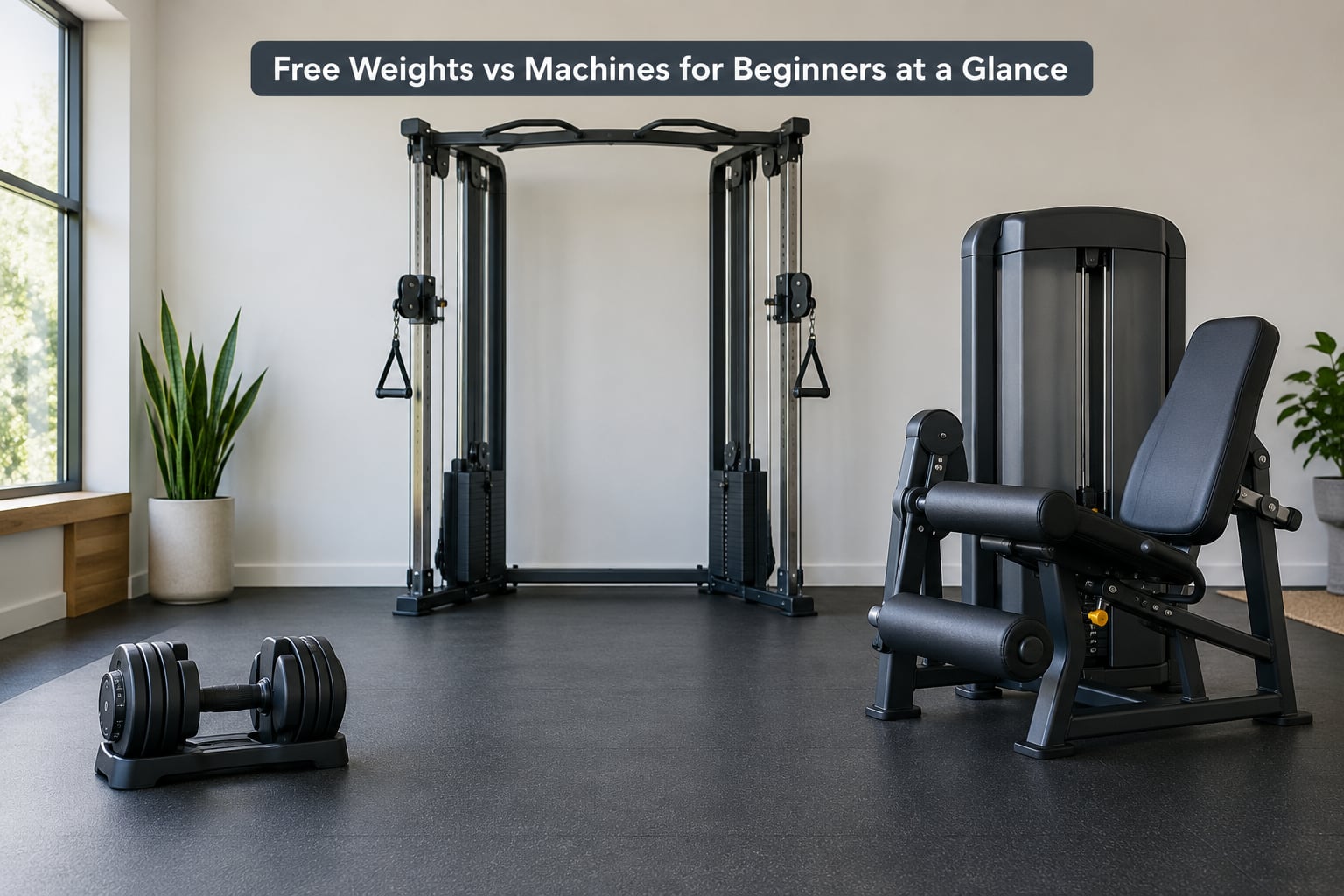
Free Weights vs Machines for Beginners at a Glance
| Criterion | Machines | Free weights |
|---|---|---|
| Setup difficulty | Low — sit down, adjust the pad, pull the pin | Medium — load plates, learn the bar path |
| Instruction needed | Minimal for most movements | Worth one coaching session |
| Stability demand | Handled by the machine | Handled by you, every rep |
| Exercise selection | Whatever the gym owns, often 2-3 per muscle | Hundreds of variations from one pair of dumbbells |
| Progression tracking | Very easy — the stack jumps in fixed increments | Easy — add 2 kg per side or one plate |
| Range of motion | Fixed, sometimes shorter than natural | Set by you and the joint |
| Muscle isolation | Excellent — one muscle does most of the work | Moderate — stabilizers share the load |
| Joint comfort | Can pinch if pads do not fit your proportions | Load is controllable, so easy on joints when light |
| Space and cost | Needs a gym membership or a large dedicated area | A pair of adjustable dumbbells covers most of it |
| Best fit | First 3-6 months, return after a break, joint rehab | Once technique is solid, home training, sport goals |
The honest summary: machines buy you stability and simplicity, free weights buy you control and versatility. Notice that neither row promises more muscle.
What Is Easier for a Complete Beginner?
Free weights vs machines for beginners: what actually differs
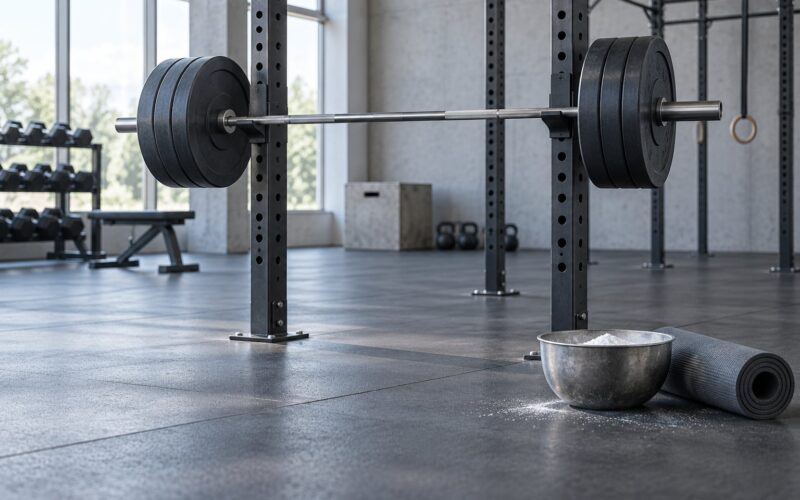
Free weights are unanchored resistance you control in every direction — barbells, dumbbells, kettlebells, weight plates, resistance bands anchored to a fixed point. Machines are resistance devices that guide the weight along a set path using cables, levers, rails and pads.
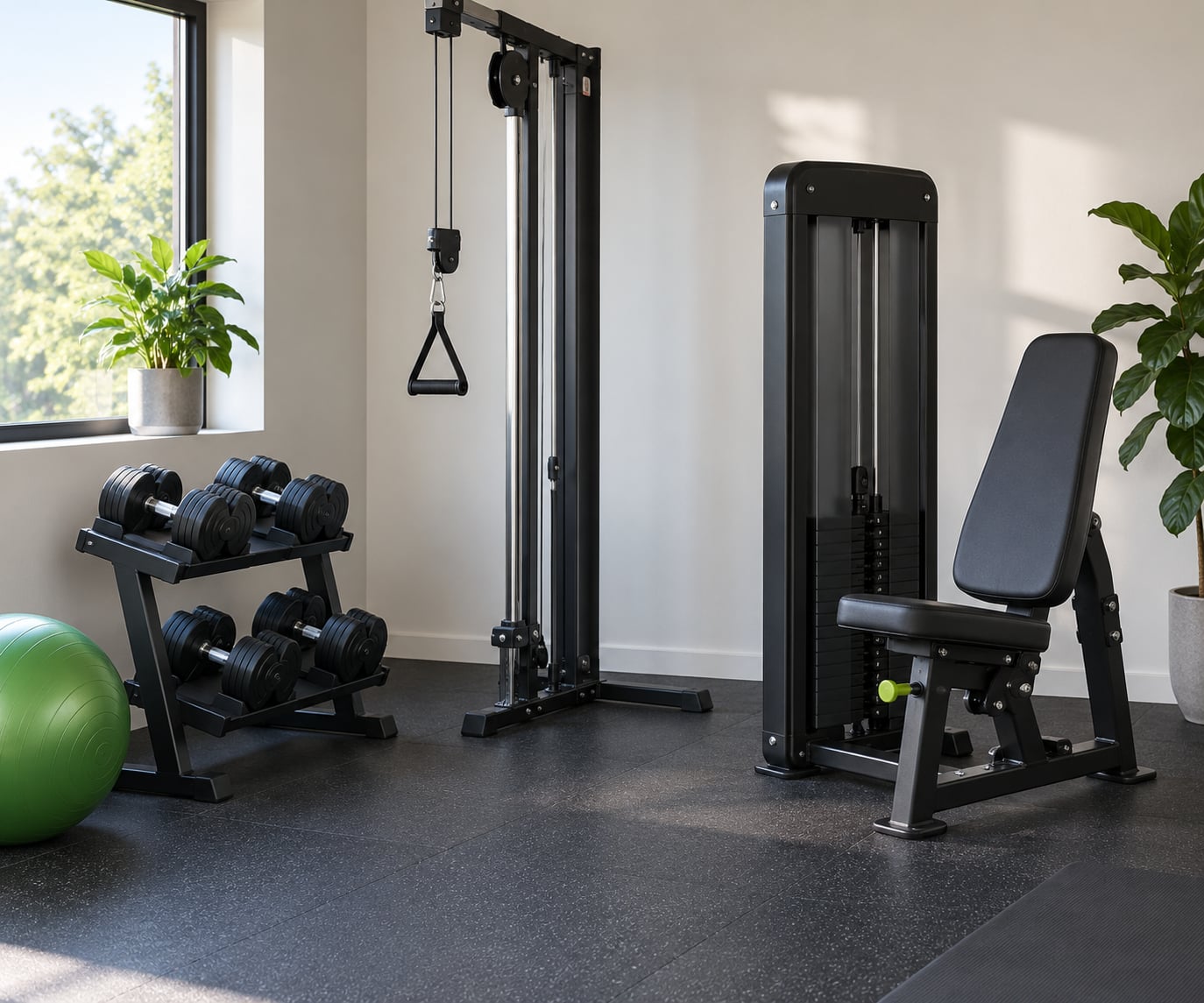
Within machines there are two families. Selectorized machines use a pin and a weight stack, so the load jumps in fixed increments and you never touch a loose plate. Plate-loaded machines take real plates on the ends of a lever, which lets a spotter help and lets you change the load in small jumps. Cables are the in-between: the stack is fixed, but the handle and angle move, so you get variable pulling and pressing paths.
The Smith machine deserves its own mention. The bar is fixed to a vertical track, so it behaves like a barbell in terms of balance and loading while taking away the balance problem. Plenty of beginners use it as a bridge, and plenty of experienced lifters use it for accessories where they do not want balance fatigue.
Machines: pros and cons for a new lifter
- Fixed path — you cannot go wrong on the movement, which means more reps land on the target muscle.
- Easy to adjust — seat height and pad position are the only two things standing between you and a usable set.
- Built-in safety — most selectorized stacks stop at the bottom of the movement, and the frame takes the load if you fail.
- Isolation — a chest press or lat pulldown lets you feel a specific back or chest without fighting a barbell.
- Queues — the popular machines are always busy at peak hours, so the time savings can evaporate in a waiting line.
- Anatomy mismatch — a fixed pad position that does not line up with your shoulder or hip can pinch, and no amount of effort fixes a geometry problem.
Free weights: pros and cons for a new lifter
- Variety — one pair of dumbbells covers presses, rows, carries, lunges and dozens of substitutions.
- Real-world strength — you learn to brace, hold a position and control the load through a full range of motion.
- Load is yours to choose — you can go lighter than the machine’s smallest jump, which matters early on.
- Cost and space — adjustable dumbbells take one corner of a room instead of a dedicated machine footprint.
- Learning curve — bar path, bracing and grip all arrive at once, and a bad first session teaches bad habits.
- Spotting needed — nobody around you is watching the end range of a squat unless a spotter is asked.
How Do Free Weights and Machines Train the Body?
Muscle grows in response to mechanical tension, effort taken close to failure, and progressive overload over time. It does not respond to a brand of equipment. What changes between the two is how much of your body has to work to keep the load where it is supposed to be.
On a lat pulldown the pulleys carry your body weight and hold your torso in place, so your lats supply most of the force. Holding a barbell at the top of an overhead press requires your shoulders, trunk and forearms to stabilise the load while the deltoids push it. More muscles working does not automatically mean better growth, but it does mean a different kind of fatigue.
Range of motion is the other big difference. Machines fix the path, which means the depth is decided by the manufacturer rather than by your joint structure. Free weights let you match depth to your own anatomy — useful when a machine pinches a shoulder that a dumbbell press does not. That adaptability is one reason a lot of experienced lifters mix both.
Coordination and motor learning only improve if you practise the movement. Nobody gets better at holding a bar through a squat by doing leg presses. For a beginner, that learning curve is a real cost, but it is also the part of training that keeps paying out years later.
Which Is Safer for Beginners?
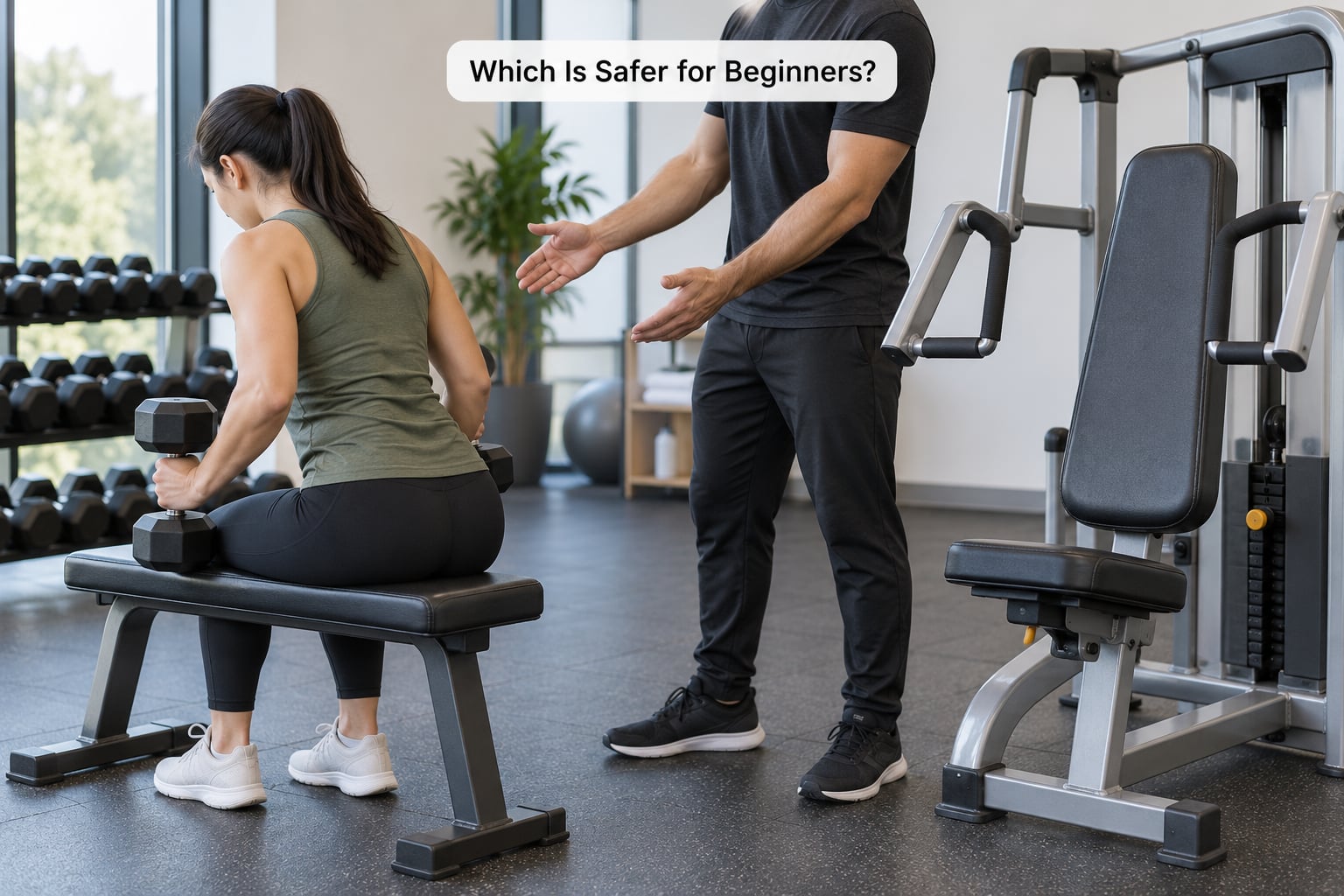
Neither option is automatically safe. Injury data does not support a simple “machines are safer” line — most training injuries trace back to loading too much, poor technique, rushing a movement, or training through pain, not to the equipment category.
What machines genuinely reduce is the number of ways to fail. A plate-loaded or selectorized press has a defined start and end position, and most stacks have safety limits that stop the bar before you hit the bottom. With a barbell, the failure modes multiply: the load rolls, the bar tips forward, the grip gives out at the wrist.
The honest counterpoint is that a machine can be the problem instead. Seat and pad geometry that does not match your frame forces the shoulder into an awkward angle, and a lower back pad that is too short turns a leg press into a hip flexor stretch. Adjust the seat until your knee sits at roughly a right angle at the bottom of a leg press, and set a chest pad level with mid-chest. Five seconds of adjustment is the difference between a comfortable set and a pinched joint.
For anyone returning after a break, managing an injury, or dealing with a condition that affects training, get a doctor or a qualified physiotherapist involved before you load anything. General guidance cannot account for your medical history.
Free Weights vs Machines for Muscle Gain and Strength
Machines and free weights build muscle about equally well. A 2023 meta-analysis in BMC Sports Science, Medicine and Rehabilitation pooled 13 studies and found no meaningful difference in hypertrophy outcomes between the two approaches. The equipment changes the skill required, not the muscle you end up with.
Strength is a different story, and here the principle of specificity decides it. Strength gained on a chest press machine transfers strongly to the chest press machine and less well to a bench press. If your goal is a barbell squat, bench or deadlift, the specificity argument points at the barbell, because that is the movement you want to be strong at.
Progressive overload works in both directions. With a stack, the jump is fixed, so you progress by moving up one pin or adding a rep. With free weights, you add a plate per side or take one more rep before adding load. Whichever route you take, write down the load and reps for every set — progress you cannot see is easy to lose track of.
For muscle, weekly volume and recovery matter more than the label on the machine. Six to ten hard sets per muscle group per week, most of them taken within a rep or two of failure, is a reasonable target once you have a few months of training under you.
Which Option Is Better for Weight Loss?
Both burn calories and both support fat loss, so the deciding factor is adherence rather than equipment. A workout you actually complete three times a week beats a theoretically better session you skip.
For weight loss specifically, machines hold one edge: they are fast to swap between, which makes circuits easy. Ten exercises, 30 seconds each, three rounds, no long rests. That keeps heart rate up and cuts the friction between sets, which matters when your goal is moving more total volume in less time.
The recomp argument matters too. Resistance training is what lets you lose fat while keeping muscle, and holding onto muscle is what stops your weight loss from eating your metabolism. A machine-heavy start is a perfectly good way to get there. If you are dieting hard, keep the loads honest — underfeeding plus light lifting is how people end up weaker than when they started.
What I would not do is pick the “fat burning” equipment. Nothing burns more fat than a session you repeat consistently, and there is no honest way to rank a cable circuit against a dumbbell circuit on calories alone.
What About Cost, Space, and Gym Access?
Machines effectively require a commercial gym, because a single plate-loaded station needs a big footprint and a selectorized stack needs a whole corner of a floor. If you train at home, you are mostly limited to what fits in a spare room or garage — a bench, adjustable dumbbells, a rack, and a cable unit if the ceiling allows.
A home free-weight setup covers a surprising share of what people actually do in a gym. Dumbbell presses, rows, lunges, Romanian deadlifts and carries map almost directly onto the machine versions. What you give up is the long list of single-joint isolation machines, and the option to load heavy for a squat or deadlift.
Access matters as much as money. Commercial gyms buy you two things a home setup does not: a spotter, and a huge exercise menu. For a beginner that combination is worth something, because the spotter closes the gap on the one movement where free weights are hardest to do alone.
Budget-wise, the comparison is membership against equipment. Membership buys variety and supervision; equipment buys consistency and no waiting. Which one is cheaper depends entirely on how long you expect to train and what is already in your house.
How Can Beginners Progress Without Overdoing It?
Here is a simple four-session script that uses machines first and lets free weights earn a place once you are comfortable.
Your first four sessions at the gym
- Session 1 — learn the machines. Six exercises, 2 sets of 10 reps each, light load. Leg press, chest press, lat pulldown, seated cable row, leg curl and a cable pressdown. Learn where the pad goes, not what it feels like.
- Session 2 — same six, add reps. Go for 3 sets of 10 to 12. Stop each set two reps short of failure so you can learn how failure actually feels without hitting it.
- Session 3 — add your first free-weight pair. Keep the machine work and add dumbbell presses and goblet squats in front of it. Dumbbells are the gentlest entry point because your arms can help.
- Session 4 — start progressing load. Add a pin or a plate wherever you hit all your reps cleanly twice. Then repeat that cycle for several weeks.
Exercise swap table by muscle group
| Muscle group | Machine option | Free-weight swap |
|---|---|---|
| Chest | Chest press machine | Dumbbell floor or bench press |
| Back | Lat pulldown | One-arm dumbbell row |
| Legs | Leg press | Goblet squat or a light barbell squat |
| Hamstrings | Lying leg curl | Romanian deadlift with dumbbells |
| Shoulders | Machine shoulder press | Seated dumbbell press |
| Arms | Cable pressdown | Dumbbell overhead extension |
| Core | Ab wheel or cable crunch | Hanging leg raise or a weighted plank |
Do the demanding free-weight movements first while you are fresh, then finish with machines. Trainees on r/Fitness and r/beginnerfitness generally report the same pattern: they feel the free-weight work more, and they notice machines more when tired.
When are you ready to move to free weights?
- You can do 12 reps of the machine version with a controlled tempo and no swinging.
- You know how to set up the equipment without being shown.
- You feel in control at the top and bottom of the movement, not just in the middle.
- You have never been injured or embarrassed by the setup — confidence is a legitimate readiness signal, not a soft one.
- You have a spotter or a plan for the movement where free weights are hardest alone.
Add one free-weight movement at a time, and give it a few weeks before adding another. The most common beginner mistake is doing everything new in the same week.
Which Should You Choose?
Choose machines if you are in your first three to six months, if you feel intimidated in the free-weight area, if a joint complains on machines until you adjust it, or if you are training around a specific injury. Choose free weights if your goal is barbell strength, if you train at home, or if you already have a coach who has corrected your form once. For everyone else, use a mixed approach: heavy compound work with free weights first, machine isolation work after, and let your weekly volume and recovery do the deciding.
Frequently Asked Questions
Should a beginner start with machines or free weights?
Start with machines for your first four to six weeks, then add free weights. Machines give you a fixed path, so you can learn the movement and build confidence without also managing balance and bar path. Once reps feel controlled and you know how to set things up, free weights become worth the extra demand.
Do machines work just as good as free weights?
For muscle growth, yes. A 2023 meta-analysis in BMC Sports Science, Medicine and Rehabilitation pooled 13 studies and found no meaningful hypertrophy difference between machines and free weights. For strength, the answer depends on your goal, because gains transfer best to the movement you actually practise.
Can you build muscle with free weights only?
You can. Plenty of people train with nothing but dumbbells and a barbell and build muscle steadily. The trade-off is that you lose easy isolation work and some exercises become hard without a spotter. If you are in a commercial gym, using a couple of machines for arms and side delts costs you almost nothing.
Is it better to do free weights before or after machines?
Put the demanding free-weight work first while you are fresh, then finish with machines. Machines give you a comfortable way to add volume at the end of a session when your technique is holding up but your energy is not. If your goal is a specific machine movement, that one goes first instead.
What weights should a beginner start with?
Start lighter than you think. Pick a load where you can complete 12 clean reps and feel like two or three were left, and where the movement stays smooth top to bottom. Progress by adding one small increment or one rep. Jumping too heavy early is the most common reason beginners stall or hurt themselves.
What is the 3-3-3 rule in gym?
The 3-3-3 rule is a general training rule, not a specific program: three times a week, three sets per exercise, three weeks at the same level before progressing. It is a rough framework that fits a lot of beginners because it is simple, not because it is physiologically precise. Treat it as a starting template rather than a rule.
Free weights vs machines for beginners is a sequencing decision, not a purity test. Learn the movement on a machine, add free weights once you can control the load, and let consistency do the rest — the equipment you choose barely matters compared with whether you are still training in six months.