A structured beginner gym session has four parts: 5 to 10 minutes of warm-up, about 25 minutes of full-body strength work, 10 to 20 minutes of comfortable cardio, and a 3 to 5 minute cool-down, with every set and rep written down before you walk in. Repeat that same 60-minute template two or three times a week and change only one variable at a time.
Most beginners do not struggle because the workouts are too hard. They struggle because every visit starts with the same problem: too many decisions. Which machine first, how heavy, how many sets, how long to rest. Learning how to structure a gym session as a beginner means deciding all of that once, in advance, so the session itself is just execution.
The plan below fits a 60-minute window, needs no special equipment, and works whether you have trained before or not. Sessions shorter than 30 minutes work too, and I note where to cut instead of scramble.
Table of Contents
- What You Need
- Step-by-Step: A 60-Minute Beginner Gym Session
- 1. Warm Up for 5 to 10 Minutes
- 2. Complete a Simple Full-Body Strength Block
- 3. Add 10 to 20 Minutes of Comfortable Cardio
- 4. Cool Down and Record the Session
- Common Mistakes
- Frequently Asked Questions
- How often should a beginner train at the gym?
- Do I need to do cardio in a beginner gym session?
- How long should a beginner gym session be?
- What should I do if the weight feels too heavy?
- Does stretching prevent soreness?
- When should I ask a professional for help?
- Conclusion
What You Need
The gear list for a first month is short. Anything beyond it is optional, and skipping the gym entirely for a few weeks while you sort it out beats showing up unprepared.
- Shoes you can move in. Flat, stable trainers with a grippy sole. Running shoes are fine. Unbroken-in boots and worn-out soles are not, because both change how you balance under a barbell.
- Clothing that lets you see your own form. Shorts or leggings and a fitted top make it far easier to check whether your hips are sinking in a squat. Wear something you do not mind sweating in.
- Water. A labelled bottle you leave in your bag. Most gyms have free fountains or coolers, and refilling takes five seconds compared with buying a drink.
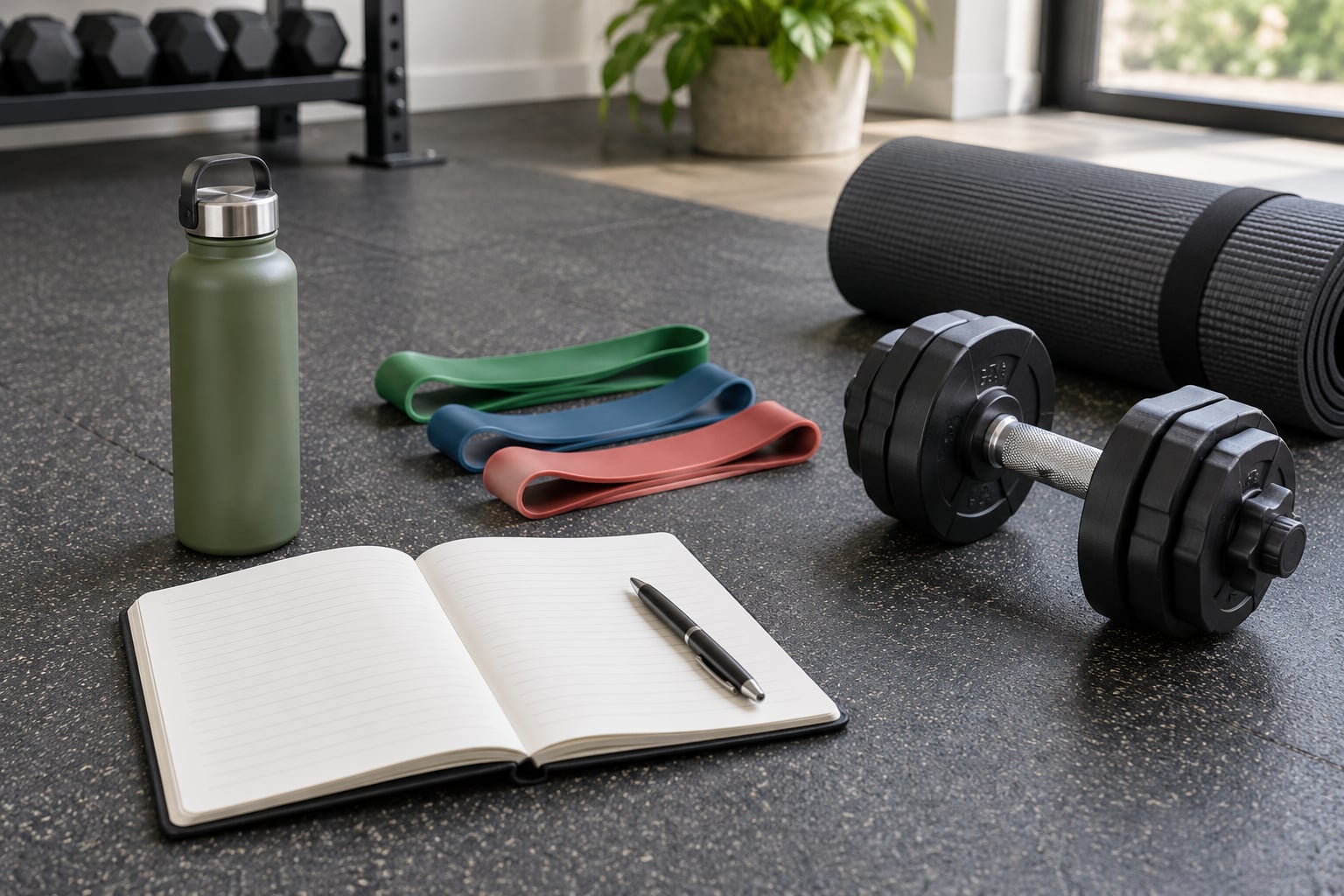
- A training log. This is the one item people skip and later wish they had bought. A cheap notebook or a notes app works. Write down the exercise, sets, reps, weight and one note on how it felt.
- A small towel and hand sanitizer. Wipe the handles of machines and plates before and after your set.
Optional extras help but are not required. A pair of resistance bands, roughly 8 to 10 kg of loop bands, opens up rows, pull-aparts and shoulder work for the price of a sandwich. A single pair of adjustable dumbbells covers nearly every full-body movement once you know the floor space you can use.
You can also begin entirely with bodyweight, and many people never outgrow that. Air squats, incline push-ups on a wall or bench, hip hinges, split squats and a plank cover every movement pattern in this article. Machines are the other sensible entry point because the load path is guided, which makes bad form less likely.
Step-by-Step: A 60-Minute Beginner Gym Session
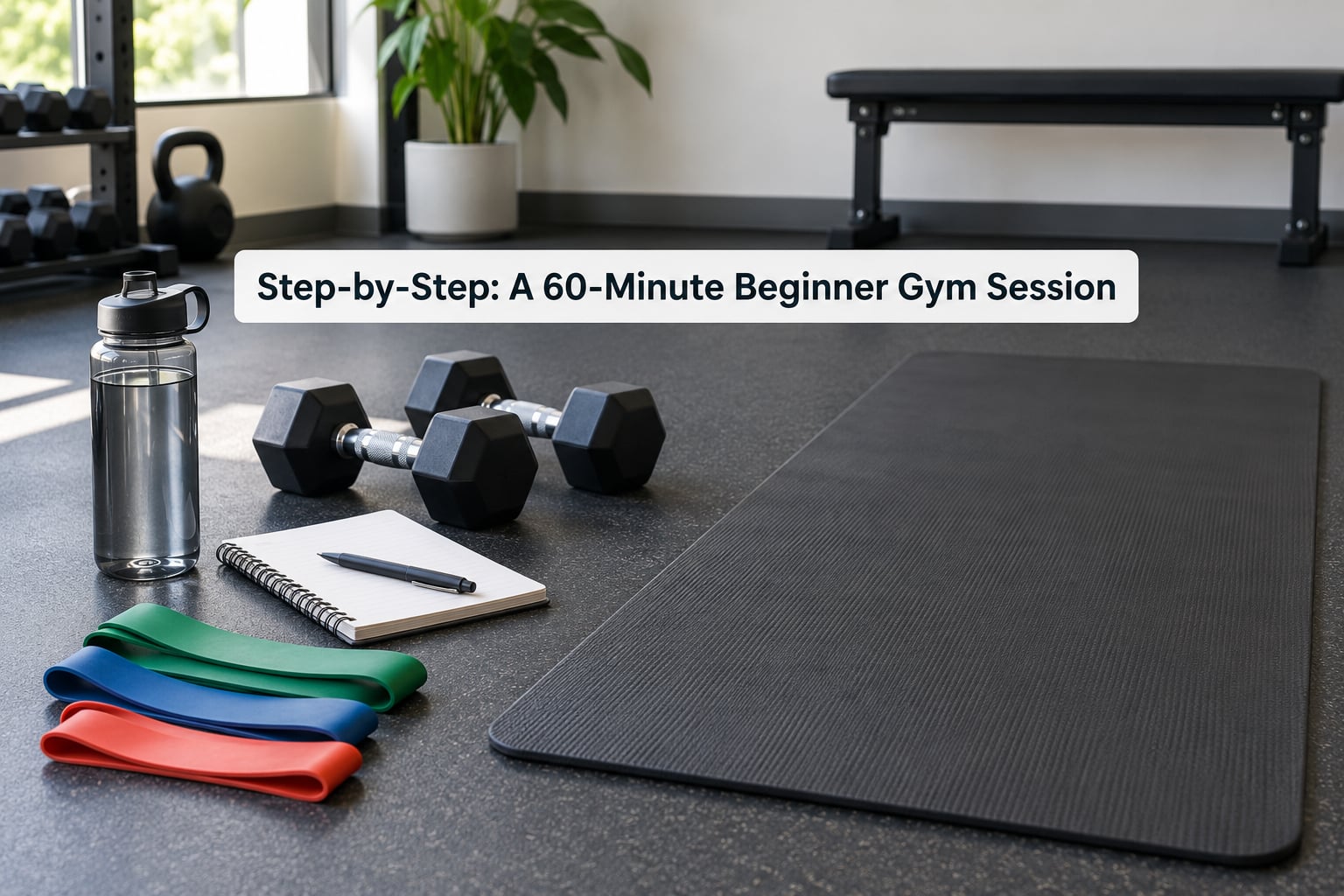
Here is the template at a glance. The minutes are a budget, not a stopwatch: if the warm-up runs to 12 minutes because you are cold, take 2 minutes off the cardio block rather than dropping the strength work.
| Phase | Minutes | What you do | Intensity |
|---|---|---|---|
| Warm-up | 5-10 | Brisk walking or cycling, then dynamic mobility | Easy, conversational |
| Strength block | 20-25 | 4-6 compound and accessory movements | Moderate, 2-3 reps in reserve |
| Cardio | 10-20 | Treadmill, bike or elliptical, intervals or steady | Moderate, talk test passes |
| Cool-down | 3-5 | Easy movement and gentle stretches for what you trained | Very easy |
| Log | 2 | Record sets, reps, weight and difficulty | Seated |
1. Warm Up for 5 to 10 Minutes
Start with easy, rhythmic movement: a brisk walk on a treadmill, cycling, or marching on the spot. Five minutes raises body temperature and gets blood moving without spending the energy you need for lifting.
Follow with dynamic mobility, which means moving through a range rather than holding a static shape. Arm circles, leg swings front to back and side to side, hip hinges where you push your hips back with soft knees, and bodyweight squats at half depth are enough. Ten to fifteen repetitions each, smooth and unhurried.
Stay well below maximum effort here. The warm-up is a cost you pay to lift better, not a workout in itself. Stop and reassess if a movement causes sharp pain rather than general stiffness, and skip the movement until a professional has looked at it.
2. Complete a Simple Full-Body Strength Block
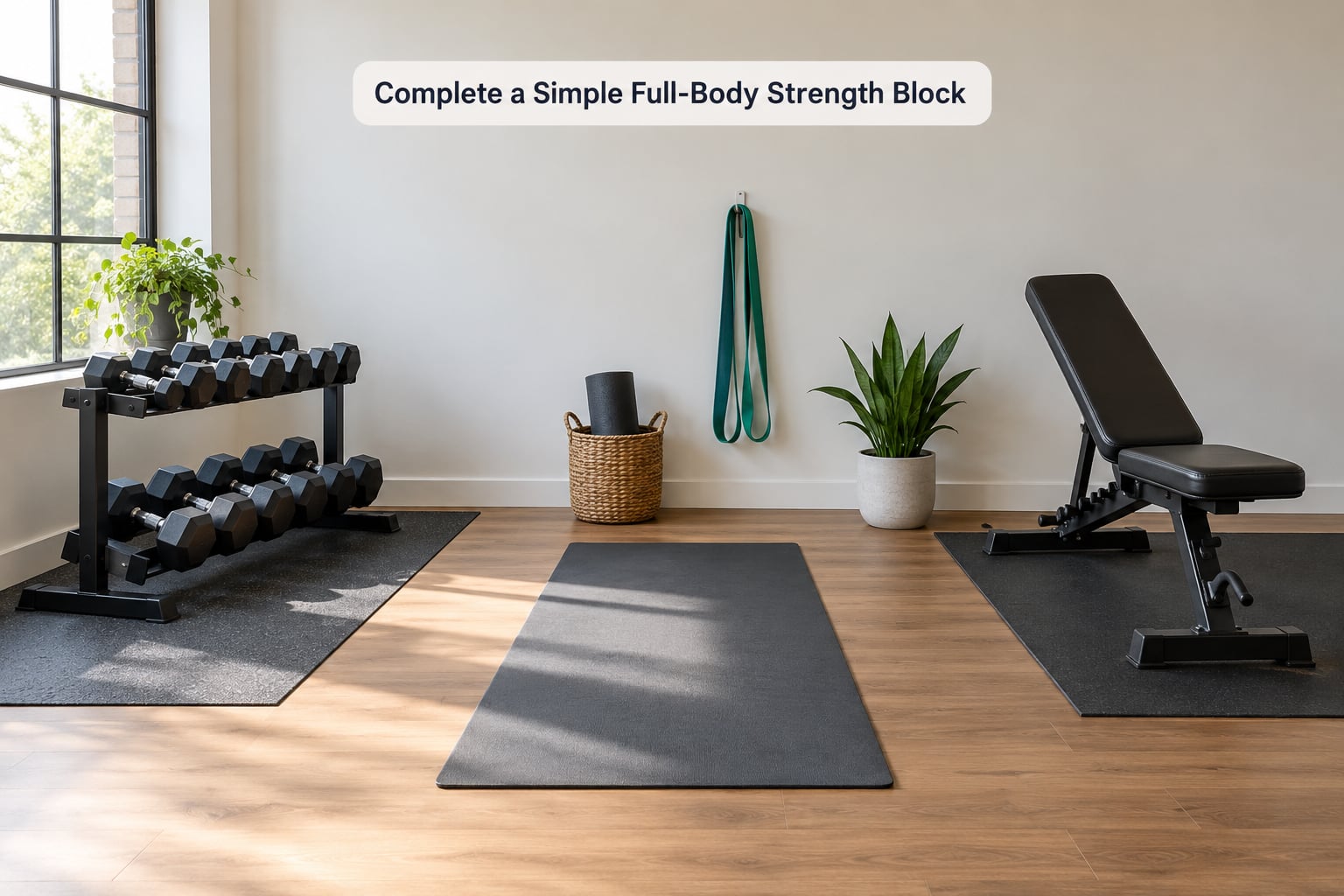
Pick four to six movements that cover the main patterns: a squat, a horizontal push, a horizontal pull, a hinge, and optionally a lunge and a plank. Order them as compounds first, accessory second, core last, because the exercises you care about most go first while you are freshest.
Do two working sets of 8 to 12 controlled repetitions per movement, resting 60 to 120 seconds between sets. That rest is not wasted time. It is what lets each set reach the same quality as the one before it, and cutting it short is a common reason beginners plateau without knowing why.
3. Add 10 to 20 Minutes of Comfortable Cardio
Strength work first, cardio after it. Cardio first eats the energy you need for the lifts and it leaves you walking out wondering why the session felt like a chore.
On the treadmill, bike or elliptical, start with intervals rather than a flat sprint: two to three minutes at a moderate pace, then one to two minutes easy, repeated four or five times. Increase duration before you increase speed, and use the talk test, meaning you can speak a full sentence but not sing.
If you have 45 minutes rather than 60, cut the cardio to 10 minutes instead of trimming the strength block.
4. Cool Down and Record the Session
Spend three to five minutes moving easily and stretching gently the areas you trained, holding each stretch around 30 seconds without bouncing. Static stretching is better suited here than before lifting.
Then write it down: exercises, sets, reps, weight, a difficulty rating out of ten, and one note on how the session felt. That log is what turns a series of visits into progress you can see.
Common Mistakes
These eight errors cover most stalled first months. Each one has a simple correction you can apply at your next session.
- Skipping the warm-up. Correction: keep a five-minute minimum even on short days, and add the dynamic mobility work once you can spare the extra minutes.
- Starting too heavy. Correction: pick a load where your last reps are visibly hard but your form stays clean. Add reps before you add weight.
- Taking every set to failure. Correction: stop two to three reps short of failure. Beginners get stronger faster when every working set still has quality at the end.
- Using unfamiliar machines without instruction. Correction: ask a staff member for a five-second walkthrough. Free weights too. Nobody is watching you fail at an adjustment mechanism.
- Doing only cardio. Correction: keep the strength block and add cardio around it, not instead of it.
- Progressing too quickly. Correction: one variable per week, whether that is two more reps on a set or a little more weight.
- Ignoring pain. Correction: muscle effort and soreness feel different from sharp joint pain. Sharp pain means stop, and ask a doctor or physical therapist about it.
- Not logging anything. Correction: two minutes at a chair, every time. Memory is a poor substitute for a written record.
Consistency beats intensity in the first three months. Three moderate sessions a week for eight weeks will change your body far more than two brutal sessions followed by a month off, and building a routine you can still follow during a busy week matters more than an ideal plan you abandon in week three.
If you have an existing health condition, an injury, or a pregnancy, talk to a doctor before starting, and ask about a certified personal trainer or physical therapist for guidance tailored to you. If you feel faint, dizzy, or unusually short of breath during a session, stop and seek medical advice rather than pushing through.
Frequently Asked Questions
How often should a beginner train at the gym?
Two or three full-body sessions per week is the standard starting point, and spacing them about 48 hours apart gives you time to recover. Monday, Wednesday and Friday works well for most people. Training more often than that usually means the recovery is too short to adapt properly.
Do I need to do cardio in a beginner gym session?
No, cardio is optional and it is not where most of your early results come from. If your main goal is general health or fat loss, add 10 to 20 minutes of easy cardio after your strength block rather than before it, so the lifts still get your best effort.
How long should a beginner gym session be?
Between 45 and 60 minutes is the useful range for most beginners, because that is roughly what you can sustain with good form. Shorter sessions are fine on busy days: keep the warm-up, do two sets per movement instead of three, and finish early.
What should I do if the weight feels too heavy?
Drop the weight by roughly a quarter and aim for a set you can finish with two or three clean reps in reserve. If that still feels hard, use bodyweight or a machine variation until you can control the whole range of motion. Adding weight comes later.
Does stretching prevent soreness?
Not really. Stretching improves range of motion and how a muscle feels, but the soreness you get 24 to 48 hours after a new exercise comes from unfamiliar training volume, not from tight muscles. Warm up well, start lighter than you think, and expect the soreness to fade as your body adapts.
When should I ask a professional for help?
Ask a doctor first if you have a health condition, an injury or are pregnant. Ask a certified trainer or physical therapist when form is unclear, a specific lift hurts, progress has stalled for several weeks, or you are unsure how to program around an old injury.
Conclusion
A beginner gym session is a short, repeatable sequence, not a performance. Warm up for five to ten minutes, spend about 25 minutes on four to six full-body movements at two sets of 8 to 12 reps with 60 to 120 seconds of rest, add 10 to 20 minutes of comfortable cardio if you want it, cool down, and write it all down.
Here is what to do first: write the session on paper tonight, including every set, rep and weight, so you can walk in knowing the plan. Then run it twice next week and change one thing, whether that is two extra reps or slightly more weight. Repeat that a dozen times and you will have the answer to how to structure a gym session as a beginner already settled, in your own log.