Yes, you can still lose weight if you eat out. Weight loss comes from a calorie deficit over weeks, not from a single meal, so a planned restaurant visit does not undo your progress. What breaks a deficit is arriving hungry, ordering whatever looks good, and losing track of the portion sitting in front of you. Fix those three things and the rest is detail.
Most restaurant entrees land somewhere around 1,300 calories, before the drink, the side, and the sauce that came with it. The USDA plate method is the same at a table as it is at home, and the FDA menu labeling rules mean chains in the US have to publish calories, so the information you need is usually there. You just have to look before the food arrives rather than after.
Table of Contents
- What You Need
- How to Eat Out and Still Lose Weight Step by Step
- 1. Look at the Menu Before You Go
- 2. Build a Balanced Meal So You Can Eat Out and Still Lose Weight
- 3. Choose Sides That Add Flavor, Not Extra Calories
- 4. Pick a Drink That Works for Your Routine
- 5. Eat Slowly and Pause Before Ordering Extras
- 6. Save or Plan the Leftovers
- 7. Return to Your Usual Routine Afterward
- Common Mistakes
- Frequently Asked Questions
- How often can I eat out and still lose weight?
- Should I skip a meal before going to a restaurant?
- Are salads always the healthiest restaurant choice?
- How do I handle sauces, dressings, and restaurant portions?
- Can I drink alcohol without undoing my weight-loss progress?
- When should I ask a doctor or registered dietitian for help?
- Conclusion
What You Need
Nothing special. You do not need a detox, a specific diet, or a food scale in your bag. What helps is having two minutes with the menu before you leave the house, and a rough idea of what a normal day of eating looks like for you.
Most adults land somewhere in the 1,200 to 1,800 calorie range for weight loss, though your own number depends on your size and how active you are. You do not need to hit it exactly. You need to know whether tonight is a 1,400-calorie dinner in a 1,600-calorie day, or the 1,300-calorie dinner that pushes a 1,200-calorie day well over.
Three things make the rest easier. A menu link from the restaurant website or its app, so you can read descriptions and nutrition info before committing. A rough sense of your protein target, which keeps the meal from being all carbohydrate. And a plan for what to say at the table, which is easier when you have said it once in your head.
If the restaurant has no published calories, you are not stuck guessing. Cooking method tells you a lot. Grilled, baked, broiled, roasted, steamed and poached dishes come in far lighter than their fried, battered, breaded or creamy cousins.
How to Eat Out and Still Lose Weight Step by Step
Seven steps, in the order they actually happen. Work through them in sequence and the meal takes care of itself, which is the whole point of how to eat out and still lose weight without thinking about it all night.
1. Look at the Menu Before You Go
Two minutes of reading beats twenty minutes of recovery. Most chain restaurants publish full nutrition information online, including calories per serving, and in the US the FDA menu labeling rules require calories to be listed for menu items at covered chain establishments. Independent restaurants often publish nothing at all, so your fallback is the menu language itself.
One detail catches almost everyone: a listed entree is often two servings. Restaurant menus regularly list a single dish as more than one serving, which is why the calorie figure can look alarming and why the plate in front of you looks bigger than the number promised. Assume the entree is two portions and plan accordingly.
When you find the place you want, pick your order now, before the walk over. People on the r/loseit and r/CICO boards say the same thing repeatedly: deciding at the table with a hungry stomach is a completely different decision from deciding at your phone with an hour to spare.
2. Build a Balanced Meal So You Can Eat Out and Still Lose Weight
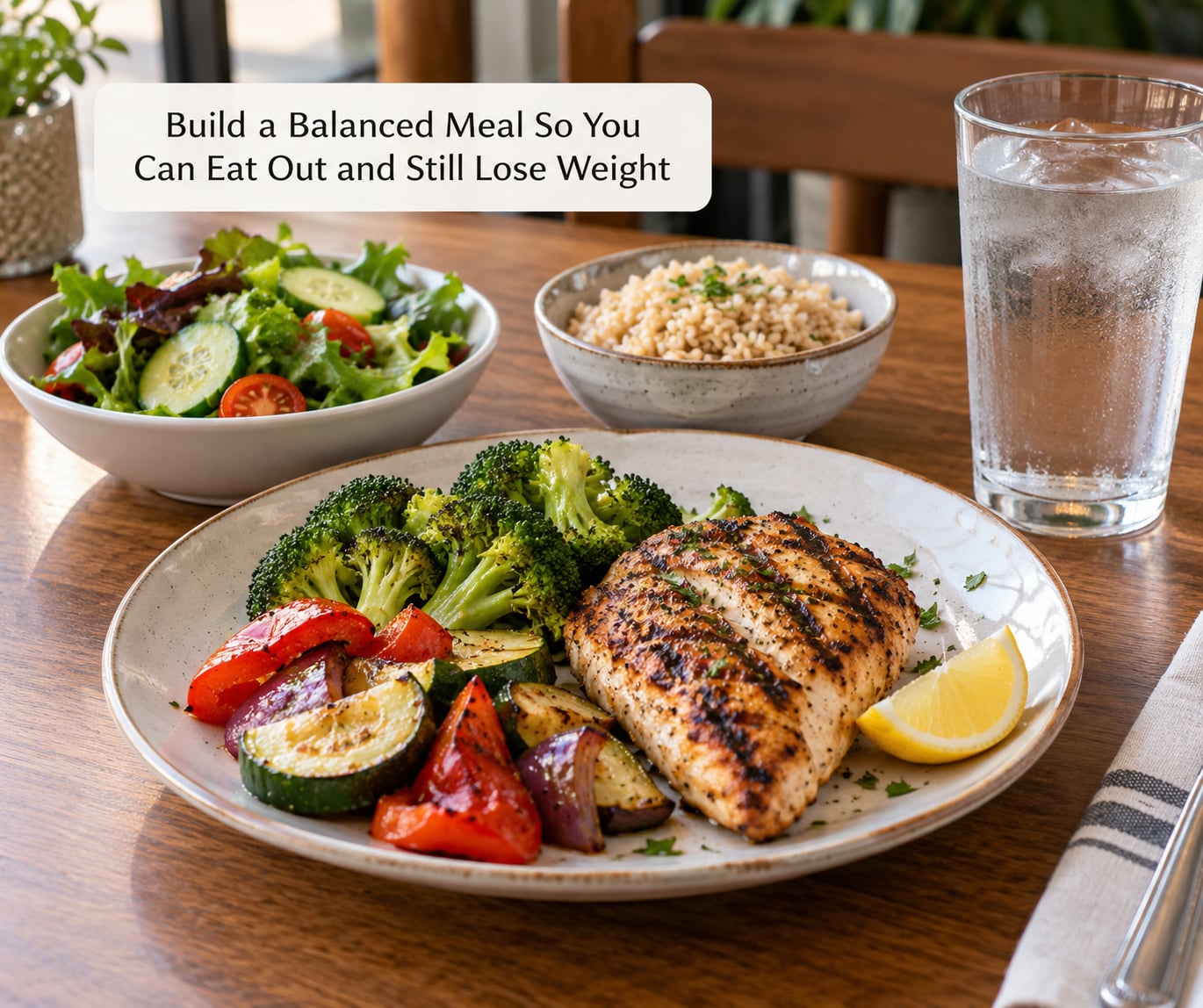
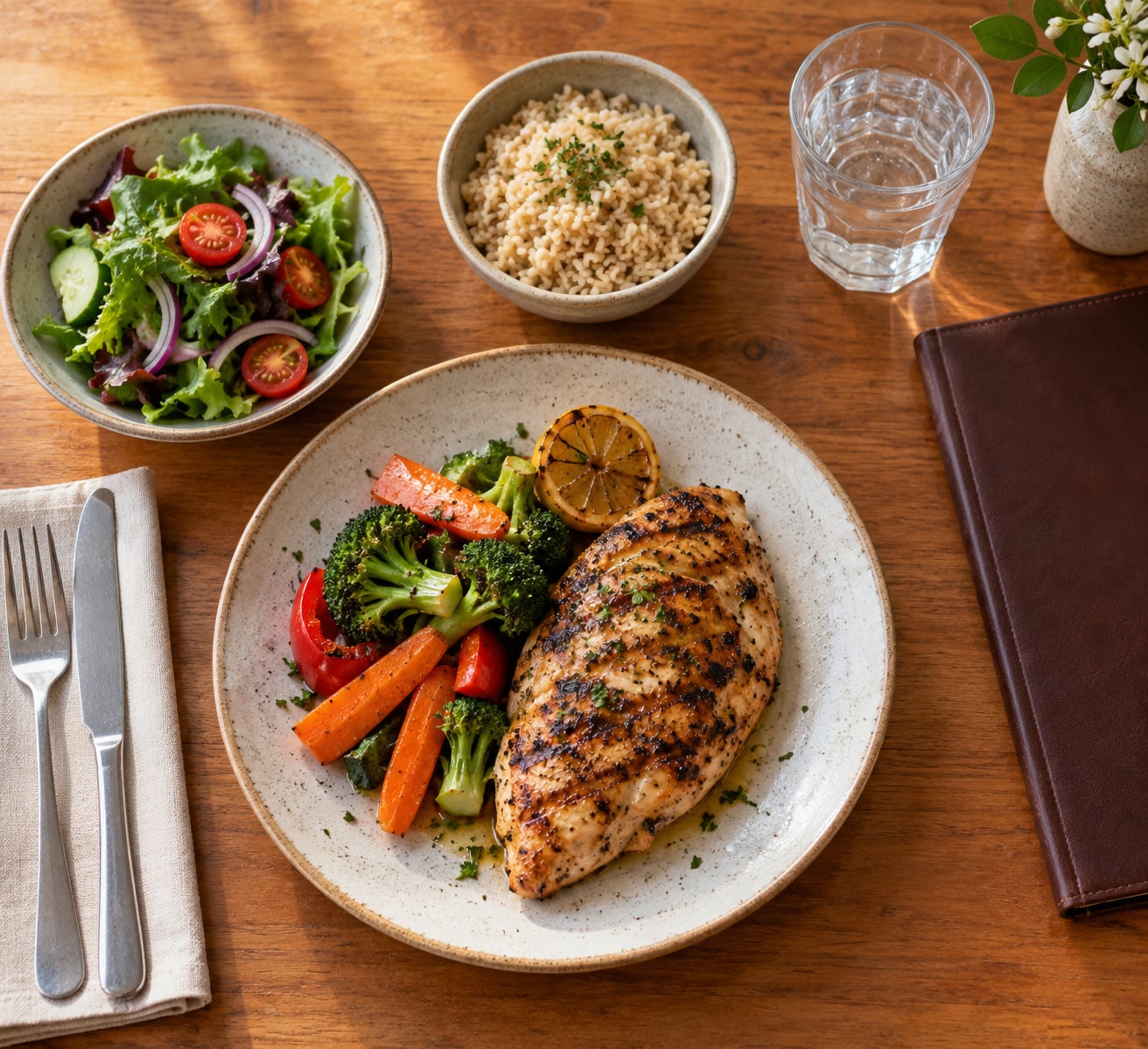
Build a plate, not a single item. That means a protein you actually like, a vegetable or fruit, a sensible carbohydrate, and a drink, in portions you chose rather than portions that arrived.
Think of the USDA MyPlate split: about half the plate non-starchy vegetables, a quarter protein, a quarter grains or starchy vegetables. A restaurant entree is usually just the protein quarter and maybe part of the grain quarter. So the side salad is not a starter here, it is half your meal.
| Restaurant component | Typical calorie range |
|---|---|
| Grilled or baked entree with vegetables | 500-800 |
| Fried or creamy entree | 900-1,500 |
| Large side salad with dressing | 200-400 |
| Fries or a loaded side | 450-700 |
| Cream-based soup | 300-500 |
| Sauces and gravies on the side | 100-250 per serving |
| Beer or a mixed drink | 150-350 |
| Dessert | 300-600 |
Read that table before you order, not after. A grilled entree with a side salad and water is a normal dinner. The same entree with fries, a mixed drink and dessert is a different evening entirely, and most of the gap comes from things that do not fill you up.
Protein does the heavy lifting here. Aim for a palm-sized serving of something you like: chicken, fish, steak, tofu, beans, shrimp. What you are avoiding is a plate that is mostly starch with a garnish of protein on top, because you will be hungry in twenty minutes and that is when the bread basket happens.
3. Choose Sides That Add Flavor, Not Extra Calories
Sides carry more damage than most people expect. Sides are reported as often more calorie-dense than the entree itself, because they arrive in restaurant-sized portions and sit within reach of everyone at the table.
| Choose | Treat with caution |
|---|---|
| Grilled, baked, broiled, roasted, steamed, poached | Fried, crispy, battered, breaded |
| Steamed or grilled vegetables | Au gratin, scalloped, glazed |
| Sauce or dressing on the side | Creamy, smothered, swimming in |
| Salad with a light dressing | Loaded salads with croutons, fried toppings, candied nuts |
| Rice, beans, or a baked potato | Fries, chips, onion rings, loaded potatoes |
The salad warning is worth repeating. A salad with a heavy dressing, croutons, fried chicken strips, bacon and candied nuts is often more caloric than a grilled entree. Ask for dressing on the side and use about a third of it, and nobody at the table will notice.
If the sides look bad, order an appetizer-size salad instead and treat it as the vegetable half of the meal. That is a normal request, not a fussy one.
4. Pick a Drink That Works for Your Routine
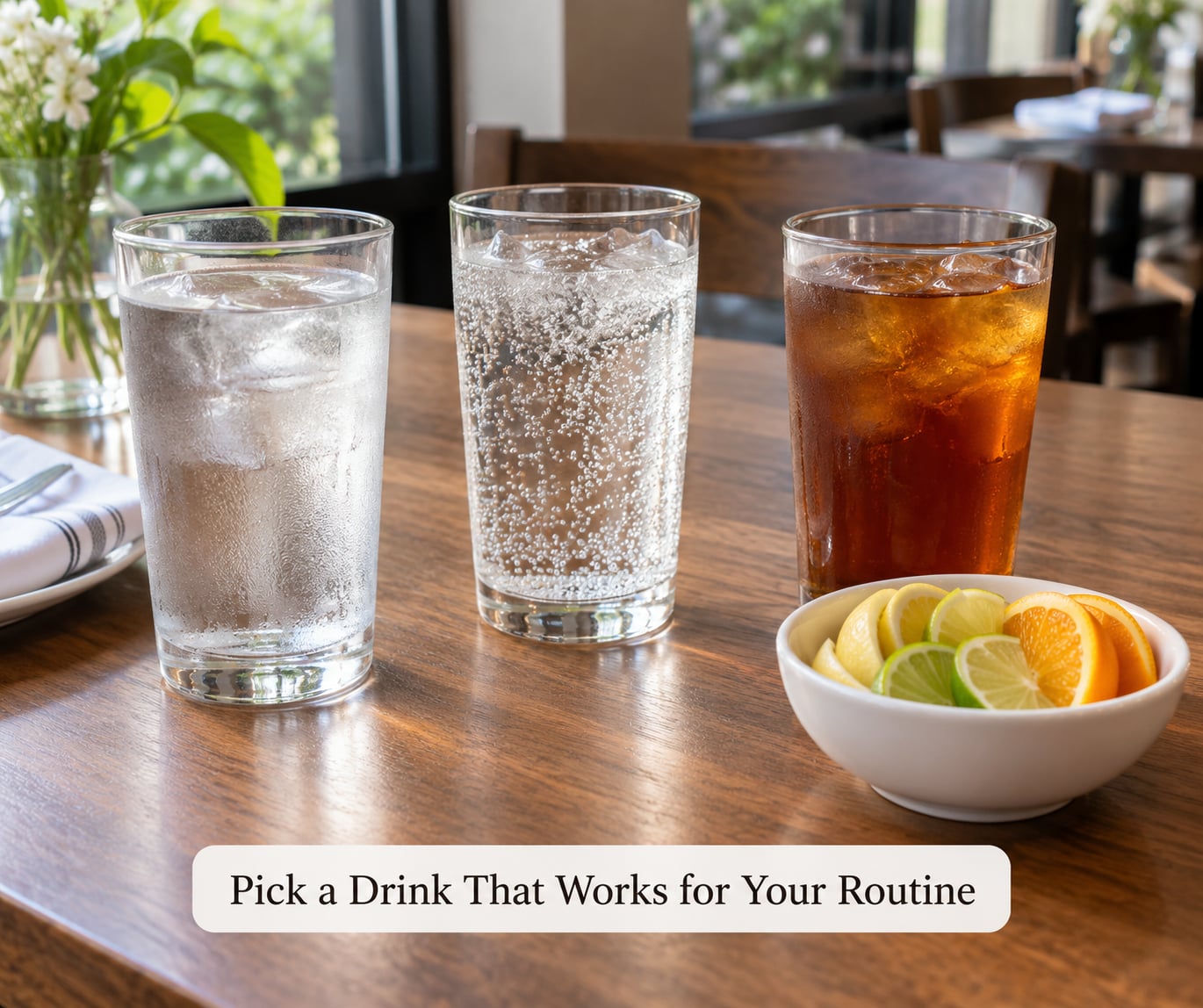
Liquid calories do not register as fullness. A mixed drink can carry more calories than your entree, and you drink it in eight minutes instead of twenty.
| Drink | Typical calories |
|---|---|
| Water or sparkling water | 0 |
| Unsweetened tea or black coffee | 0-5 |
| Dry wine, 5 ounce glass | 100-130 |
| Light beer | 100-110 |
| Sugary soda or iced tea, 16 ounce | 190-240 |
| Margarita or similar mixed drink | 250-400 |
| Mocktail with syrup | 150-300 |
There is no universal number of drinks that is right or wrong here. The useful move is deciding before you sit down. Have one or two, alternate with water, and stop the order there. If you want the taste without the sugar, most places will make a mocktail with fresh fruit, soda water and a splash of mixer.
Two lines that work at the bar: “I’ll start with sparkling water and see how it goes.” And for mixed drinks, “Can you make this lighter, with less syrup?” Nobody minds.
5. Eat Slowly and Pause Before Ordering Extras
Fullness lags behind the food by roughly twenty minutes. Most people finish an entree and immediately assess it as not satisfying, when the meal has simply not caught up yet. Put the phone down, eat the first half, and wait before you decide about anything else.
The pause is also where you split the plate. Ask for a to-go box before the food is even brought over, box half, and push the box down the table out of sight. The highest-upvoted strategy on the weight-loss boards is exactly this, and the reason is not about willpower, it is that you can only eat what you can see.
Then be honest about extras. Dessert, a second drink, fries for the table. Wanting one is fine, deciding it is a moral failure is not. This is dinner, not a test you can fail.
6. Save or Plan the Leftovers
Most restaurant portions are two to three times a sensible serving. That is not waste, it is tomorrow’s lunch already handled, and treating it that way is often what makes a big meal feel ordinary instead of alarming.
Store it properly. USDA guidance is to refrigerate perishable food within two hours of cooking and use it within three to four days. When you reheat, take it to 165°F, and reheat only the amount you will actually eat.
Leftovers also fix the next-morning problem. A planned restaurant meal with half boxed is not a cheat meal undone by breakfast. It is a meal you already sorted out, which is worth remembering on the days when your thinking gets foggy.
7. Return to Your Usual Routine Afterward
The next morning, go back to what you normally eat. No fasting, no punishing workouts, no eating only salad to make up for it. That kind of compensation is the single most reliable way to turn one restaurant dinner into a pattern that ends your plan entirely.
People on the forums who stick with this long enough say the same version of it: eat a bit lighter for the rest of the day if you want, treat it as normal rather than as punishment, and stop measuring. One meal does not move a weekly average much. Three unplanned meals in a row will.
If your weight stops moving for several weeks despite consistent effort, that is worth bringing to a registered dietitian rather than solving with more restriction. A plateau usually means the numbers need adjusting or the plan needs more protein and more movement, not a harsher diet.
Common Mistakes
Skipping meals to save calories for dinner. You arrive ravenous, order the fastest thing on the menu, and eat it in fifteen minutes. Fix: eat a small protein-and-fibre snack earlier, an apple with peanut butter or some yogurt. You are budgeting for the restaurant, not emptying your stomach for it.
Walking in without reading the menu. The decision gets made for you at the counter. Fix: pick your dish before you leave, like a decision you already made.
Treating vegetables as unlimited. A side salad, then the fries someone ordered “for the table,” then vegetables in butter, is a very different plate from the one you planned. Fix: decide your vegetable portion first and eat that much.
Accepting whatever portion arrives. Fix: ask for an appetizer-size serving, or hand the server the to-go box when the food hits the kitchen pass, before it reaches your table.
Pouring the sauce on everything. Dressings, gravies and drizzle sauces add up fast and they do not fill you. Fix: ask for sauce on the side and use a portion of it.
Compensating the next day. This is the mistake that turns a dinner out into a diet ending. Fix: resume your normal pattern the next meal and move on.
Assuming every restaurant is off-limits. That is how the plan becomes impossible to keep. Fix: one planned meal, half boxed, drink chosen in advance, and carry on.
One safety note, because restaurant food is where foodborne illness actually happens. Order poultry and ground meat cooked through, and if anything arrives undercooked, send it back and ask for it again.
Frequently Asked Questions
How often can I eat out and still lose weight?
Two to four planned meals a week fits comfortably inside a calorie deficit, as long as each one follows the same system: a protein and vegetable forward plate, sauce on the side, no drink calories, and half boxed. The deciding factor is not the number of meals but whether they are planned. The same weekly average is reached whether those four meals are carefully built or accidentally eaten, but the planned version usually uses a smaller portion and keeps going afterward instead of stopping.
Should I skip a meal before going to a restaurant?
No. Skipping meals to save calories for dinner is the most common reason a restaurant meal goes wrong, because you arrive hungry and order fast. Eat something small and protein based earlier in the day, such as yogurt, eggs, or fruit with nuts, and drink a glass of water before you leave. You are budgeting space for dinner, not clearing out your entire system to make room for it.
Are salads always the healthiest restaurant choice?
No. A salad loaded with a heavy dressing, croutons, fried chicken or bacon, cheese, and candied nuts regularly carries more calories than a grilled entree with steamed vegetables. Ask for dressing on the side, use about a third of what arrives, and check the toppings. A plain side salad with grilled chicken, greens, and a light dressing is one of the most reliable restaurant orders available.
How do I handle sauces, dressings, and restaurant portions?
Ask for sauce or dressing on the side and control the amount yourself with a spoon. Restaurant portions run two to three times a home serving, so ask for an appetizer-size portion or box half before the food reaches the table. Also check whether listed nutrition figures cover the whole plate or one serving, because menus frequently list a single entree as two servings.
Can I drink alcohol without undoing my weight-loss progress?
Alcohol fits, but it is budgeted, not ignored. A dry wine is around 100 to 130 calories a glass, a light beer about the same, and a sugary mixed drink can run 250 to 400. Decide your limit before you order, alternate with water, and ask for drinks made lighter. The bigger risk is not the calories themselves but the lower inhibitions that come with them, which affect the food choices around the drink.
When should I ask a doctor or registered dietitian for help?
Ask a professional if you have a medical condition, take medication that affects appetite or blood sugar, are pregnant or breastfeeding, or have a history of disordered eating. A registered dietitian is also the right call if you have eaten this way for several weeks without movement on the scale, or if you are considering a loss faster than about 1 to 2 pounds per week. This article is general information, not personal medical advice.
Conclusion
Learning how to eat out and still lose weight comes down to five decisions made before the food arrives: build a plate instead of picking one dish, halve the portion, keep sauce on the side, choose your drink first, and go back to your normal routine the next morning. That is the whole system. Repeat it and restaurant meals stop being the thing that ruins your progress and start being part of a normal week.
For your next visit, do one thing only: open the restaurant’s menu online before you leave the house and decide what you are ordering. Nothing else needs to change yet.