
Knowing how to get motivated to lose weight again starts with treating the restart as its own project, not a repeat of a failed one. Forget waiting for a fresh January or a big burst of energy. Write down one reason that matters more than the scale, pick a single action small enough to do on your worst day, and build the plan around habit and environment rather than willpower.
That is the honest version, and it works better than the dramatic “transform your body in 30 days” pitch. Motivation usually returns through action, not before it. So this guide walks through what you need, a seven-step restart you can begin this week, and the mistakes that quietly end most second attempts.
One note before you start: this is general information, not medical advice. If you have a health condition, take medication, or have a history of disordered eating, talk to your doctor or a registered dietitian before changing how you eat or move. That conversation is free and it can save you months of guessing.
Table of Contents
- What You Need
- An honest starting point
- A flexible food and activity plan
- One way to track progress
- Professional input when health is involved
- How to Get Motivated to Lose Weight Again: Step-by-Step
- 1. Reconnect With Your Personal Reasons
- 2. Set a Small Starting Goal
- 3. Build an Easy Daily Routine
- 4. Track Progress in a Way That Helps
- 5. Use Support and Accountability
- 6. Prepare for Lapses Without Giving Up
- 7. Review and Adjust Every One to Two Weeks
- Common Mistakes and How to Fix Them
- Why the second attempt feels harder than the first
- One motivation tip to keep
- Frequently Asked Questions
- How do I get motivated to lose weight again when I have none?
- Is it harder to lose weight the second time?
- How long does it take to rebuild a habit?
- How do I stop all-or-nothing thinking about weight?
- Is a long weight loss plateau normal?
- When should I ask a doctor or dietitian for help?
- Conclusion
What You Need
Four things make a restart realistic. You do not need a gym membership, a special program, or a specific number on the scale.
An honest starting point
Write down where you actually are right now, not the version of yourself from three years ago. Note the trend over the last month rather than a single morning reading, and treat it as information instead of a verdict.
A flexible food and activity plan
The plan needs room for dinners out, birthdays, and the week your schedule falls apart. Most plans that work for good are boring: regular meals built around vegetables, protein, and a starch you actually like, plus movement you would do anyway.
One way to track progress
Pick a single method before you start. A weekly weigh-in, a tape measure, a habit tracker in your phone’s notes app, or photos every four to six weeks. People who keep photos often say those mattered more to them than the number.
Professional input when health is involved
If you take medication, manage diabetes, blood pressure, thyroid conditions, or joint problems, get medical guidance first. Some prescriptions interact with rapid weight changes, and a clinician can also tell you whether your goals are realistic for your body.
How to Get Motivated to Lose Weight Again: Step-by-Step
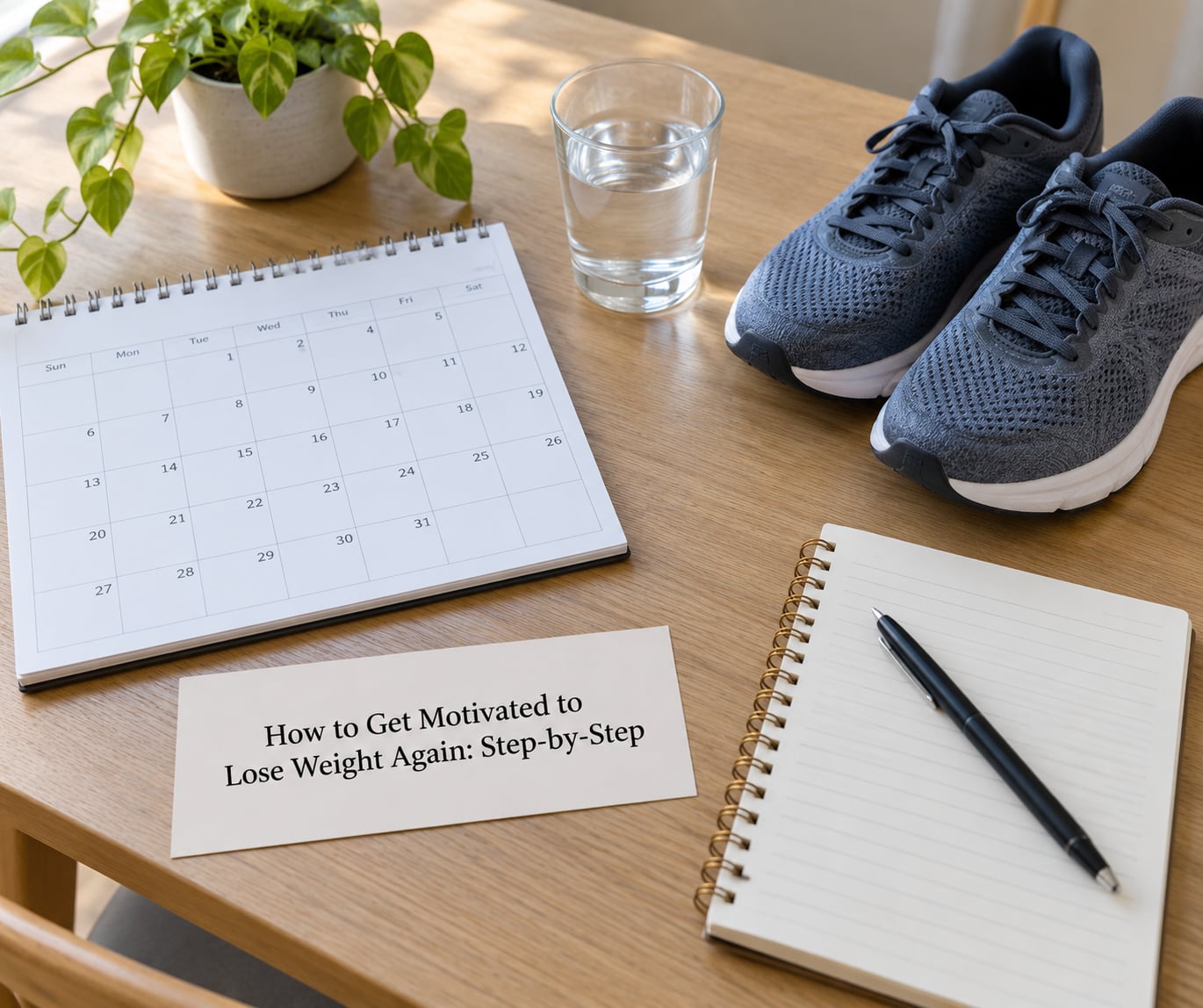
Seven steps, in the order that works best. Skip nothing, but do them slowly enough that you can still be doing step two next month.
1. Reconnect With Your Personal Reasons
Name one reason in your own words that has nothing to do with appearance. Energy through the afternoon, playing with your kids without getting winded, blood pressure numbers, clothes that fit, or simply wanting to keep the body you have for the next thirty years.
Appearance-based reasons tend to fade because they depend on how you feel on a given day. Health and function reasons hold up on bad days. Write it on paper and put it somewhere you will see it when motivation dips.
2. Set a Small Starting Goal
Choose one action for week one and nothing more. A ten-minute walk after dinner. A real breakfast five days out of seven. Replacing one snack with fruit you actually like.
Define what “done” looks like before you begin. If the goal is walking, done means shoes on and ten minutes elapsed, not a step count or distance. A goal you can complete on a bad Tuesday is the one that survives contact with a real week.
3. Build an Easy Daily Routine
Use the plate method as a default rather than a diet: roughly half vegetables or fruit, a quarter protein, a quarter grains or another starch. Regular meals at roughly the same times do more for cravings than any single banned food.
Stack movement onto something you already do. Ten minutes while the coffee brews, a walk around the block after parking, two sets of bodyweight exercises while the TV show loads. Add sleep and stress handling to the same list, because short sleep and high stress reliably make hunger harder to manage.
4. Track Progress in a Way That Helps
Choose measures that mean something to you. Weeks where you hit your walking target, energy levels, sleep quality, strength in a squat or a push-up, how your jeans fit, and the long trend on the scale rather than daily readings.
Daily weigh-in is optional and it is not for everyone. If you do it, treat every number as noise unless you are looking at a weekly average. Judging a month’s effort on one morning reading is the fastest route back to feeling like a failure.
5. Use Support and Accountability
Tell one person the truth about what you are doing and ask for encouragement, not supervision. A specific request works better than vague support: ask them to check in on Sunday evenings, or ask them to walk with you twice a week.
Communities work for some people and make others feel worse. Reddit’s r/loseit and r/WeightLossAdvice both come up often in restart conversations, and an online group is free. If you have medical conditions or take medication, a registered dietitian is the better source than a forum.
6. Prepare for Lapses Without Giving Up
Decide now what happens after a bad meal or a missed walk. The useful rule is one: never skip two days in a row. Missing once is a normal part of the week; quitting usually starts at the second miss.
Keep a written reset plan short enough to use while annoyed: eat your next planned meal, take a ten-minute walk, and do not decide anything about the whole plan until tomorrow. All-or-nothing thinking is what turns a single missed meal into a lost month.
7. Review and Adjust Every One to Two Weeks
Every ten to fourteen days, answer three questions: what worked, what felt hard, and what would I change to make this easier. Change one element at a time. Changing food, exercise, and sleep all at once means you learn nothing about what helped.
If a weight loss has stalled for several weeks, treat it as information. Check sleep, stress, portion creep, and whether the plan is too restrictive to sustain. Your doctor or a dietitian can help you decide whether anything needs to change medically.
Common Mistakes and How to Fix Them
Most second attempts do not fail because the person lacked discipline. They fail because the same five or six mistakes show up again.
| Mistake | What it looks like | The fix |
|---|---|---|
| Starting with the most extreme plan | Skipping meals, cutting out whole food groups, promises of fast results | Choose a plan you could follow on a travel day. Boring plans beat dramatic ones. |
| Waiting for motivation to return first | Nothing changes until you feel inspired | Take the smallest action today. Motivation usually arrives afterward. |
| Chasing a deadline | A wedding, reunion, or New Year sets the finish line | Give the plan three months before you judge it. Early results are mostly water and glycogen. |
| Living by the scale | Mood follows each morning reading | Track weekly averages, energy, strength, and how clothes fit. |
| Going it alone | No one knows, so no one notices a missed week | Pick one person and give them a specific job. |
| Changing everything at once | New diet, new gym, new everything on Sunday | One change for two weeks. Add the next one only when the first feels normal. |
Why the second attempt feels harder than the first
It is usually psychological, not physical. On the first try you had novelty, a clean slate, and no evidence of failure yet. On the second, shame and all-or-nothing thinking take over, and that feeling is heavy enough to stop people before any food changes.
There is also real physiology. After weight is regained, the body often burns less energy at a given weight than it did the first time, an effect researchers call adaptive thermogenesis. Combined with less lean mass and less movement, that makes the second attempt feel like pushing uphill. It is not a character flaw, and it is why slower progress is often the smarter pace.
Forgiving the past is the practical turning point. When you stop treating the regain as proof that you cannot do this, you can look at what actually happened: which meals, which months, which stressors. Posters on Reddit and Quora describe that shift as the moment the restart became possible, and it costs nothing.
One motivation tip to keep
Set your bar at “do the minimum even on bad days.” The minimum keeps your streak alive, and the streak is what carries you through the weeks when motivation is simply not there. People who restart successfully usually describe the same thing: they kept showing up at a low standard instead of quitting until they felt inspired.
Frequently Asked Questions
How do I get motivated to lose weight again when I have none?
Start with an action, not a feeling. Pick one small thing for this week, like a ten-minute walk or five planned breakfasts, and do it before you feel ready. Motivation often follows consistent action rather than causing it. Keeping the bar deliberately low makes the plan survive busy weeks.
Is it harder to lose weight the second time?
Often it is. After weight is regained, the body may burn fewer calories at the same weight than before, and the person has less lean mass and less daily movement. That effect, called adaptive thermogenesis, is real but modest. The bigger obstacle is usually psychological, especially shame and all-or-nothing thinking.
How long does it take to rebuild a habit?
It varies widely, and the popular 21-day figure is closer to a starting estimate than a deadline. Light habits can feel automatic in a few weeks, while habits tied to stress or busy seasons can take months. What matters more than the timeline is that the habit is small enough to keep doing on difficult days.
How do I stop all-or-nothing thinking about weight?
All-or-nothing thinking shows up as: I blew my diet, so I might as well give up. The counter is a written reset rule, such as never skipping two days in a row. A missed meal is one data point, not a verdict. Decide in advance what you do next so you are not improvising while discouraged.
Is a long weight loss plateau normal?
Plateaus lasting several weeks are common and usually mean energy intake and expenditure have balanced out. Look at the trend over a month or more rather than a single week. Sleep, stress, muscle mass, and water retention all move the daily number. If progress has stalled for a long stretch, a doctor or dietitian can help you review the plan.
When should I ask a doctor or dietitian for help?
Ask any time you take medication, manage a condition such as diabetes, blood pressure, or thyroid disease, or have a history of disordered eating. Rapid weight change can interact with prescriptions, and a registered dietitian can build a plan around your medical situation. Getting support early usually saves more time than pushing through alone.
Conclusion
Getting motivated to lose weight again is not about finding a feeling you lost somewhere in the past. It is about rebuilding a plan around a reason you care about, one action you can repeat, and support that keeps you honest on the weeks you do not feel like it.
Do one thing today. Write your reason on a piece of paper, schedule one balanced meal you will actually enjoy, or take a ten-minute walk after your next meal. That is the whole assignment. Everything else in this guide builds on it, and it takes less than five minutes to begin.