To increase NEAT, the part of your calorie burn that comes from everyday movement rather than planned workouts, you swap long stretches of sitting for short walks, standing tasks and movement breaks spread across the day. Most people can start with a ten-minute walk after one meal and build from there, and it takes about two weeks of consistency before the habit stops feeling like work.
NEAT, short for non-exercise activity thermogenesis, is the energy your body spends on everything you do while awake that isn’t a deliberate workout: walking to the car, standing at the kitchen counter, taking the stairs, pushing a vacuum, chasing a dog, pacing during a phone call. It is the most changeable slice of your daily calorie burn, which is why it gets so much attention in weight loss discussions.
The honest part comes first, because nobody else will say it plainly. Adding movement to your day does raise what you burn, but the body compensates. When you eat more than usual for a few days, spontaneous activity tends to drop, and during calorie restriction it often rises slightly before settling back. Researchers at the Mayo Clinic, where James Levine’s team coined the term in the late 1990s, put the useful daily gain somewhere in the range of 280 to 350 calories for most adults, and differences in NEAT between two people of identical size can run to well over a thousand calories a day.
So this is not a get-rich-quick scheme. It is a way to make an ordinary day cost you a few hundred more calories, which compounds quietly over weeks.
Table of Contents
- What You Need
- Step-by-Step
- How to Increase NEAT for More Daily Calorie Burn
- Set a Baseline and Track Your Activity
- Add Short Walks Throughout the Day
- Build More Standing Into Work and Daily Tasks
- Use Small Movement Breaks
- Increase Movement in Your Normal Routine
- Progress Gradually and Review Your Results
- Common Mistakes
- Frequently Asked Questions
- What are some examples of NEAT activities?
- How many calories does NEAT burn in a day?
- Does standing increase NEAT?
- Is walking considered NEAT or exercise?
- Will increasing NEAT alone help me lose weight?
- Can I increase NEAT with a desk job or while working from home?
- Conclusion
What You Need
You need three things, and only one of them involves spending money.
- A rough picture of your current day. Most phones show steps and standing hours without any purchase, and you only need three ordinary weekdays and one weekend day to get a usable number.
- One place you already move. A route around the block, a hallway at work, a driveway, a shopping centre. Familiarity removes the friction that kills new habits.
- Comfortable clothes and shoes you can move in. That is the whole equipment list. No standing desk, no treadmill, no smartwatch required, though any of those can help later.
Set your baseline at whatever your body does comfortably today, not at a fitness influencer’s number. A person with a desk job and a person who walks four miles on delivery rounds have completely different starting points, and both can improve.
Step-by-Step
How to Increase NEAT for More Daily Calorie Burn
Your daily calorie burn, called total daily energy expenditure, splits into four parts: basal metabolic rate, the calories burned just to keep you alive, which is roughly 60 to 70 percent; exercise activity thermogenesis, the deliberate workouts; the thermic effect of food, around 10 percent for digesting what you ate; and NEAT, which is whatever is left.
That leftover is where almost all the everyday room sits. A 34-year-old who sits at a desk for nine hours, walks 3000 steps and never exercises might burn fewer daily calories than a colleague of identical weight who stands, paces and walks 12000 steps without setting foot in a gym. That gap is occupational and lifestyle driven, which is also why it can change.
Set a Baseline and Track Your Activity
Write down three things for a normal week: your average daily steps, the hours you sit in one unbroken stretch, and the amount of time you spend moving but not walking, such as cooking or cleaning. Most phone trackers count steps and, on newer models, standing hours, which is enough.
Do not chase a calorie number here. Tracker estimates for incidental movement are rough, often generous, and they are not reliable enough to add to a daily intake total. Use steps and sitting time as a trend line instead, the same way you would use a bathroom scale. A single good day means nothing; four weeks of data means something.
Add Short Walks Throughout the Day
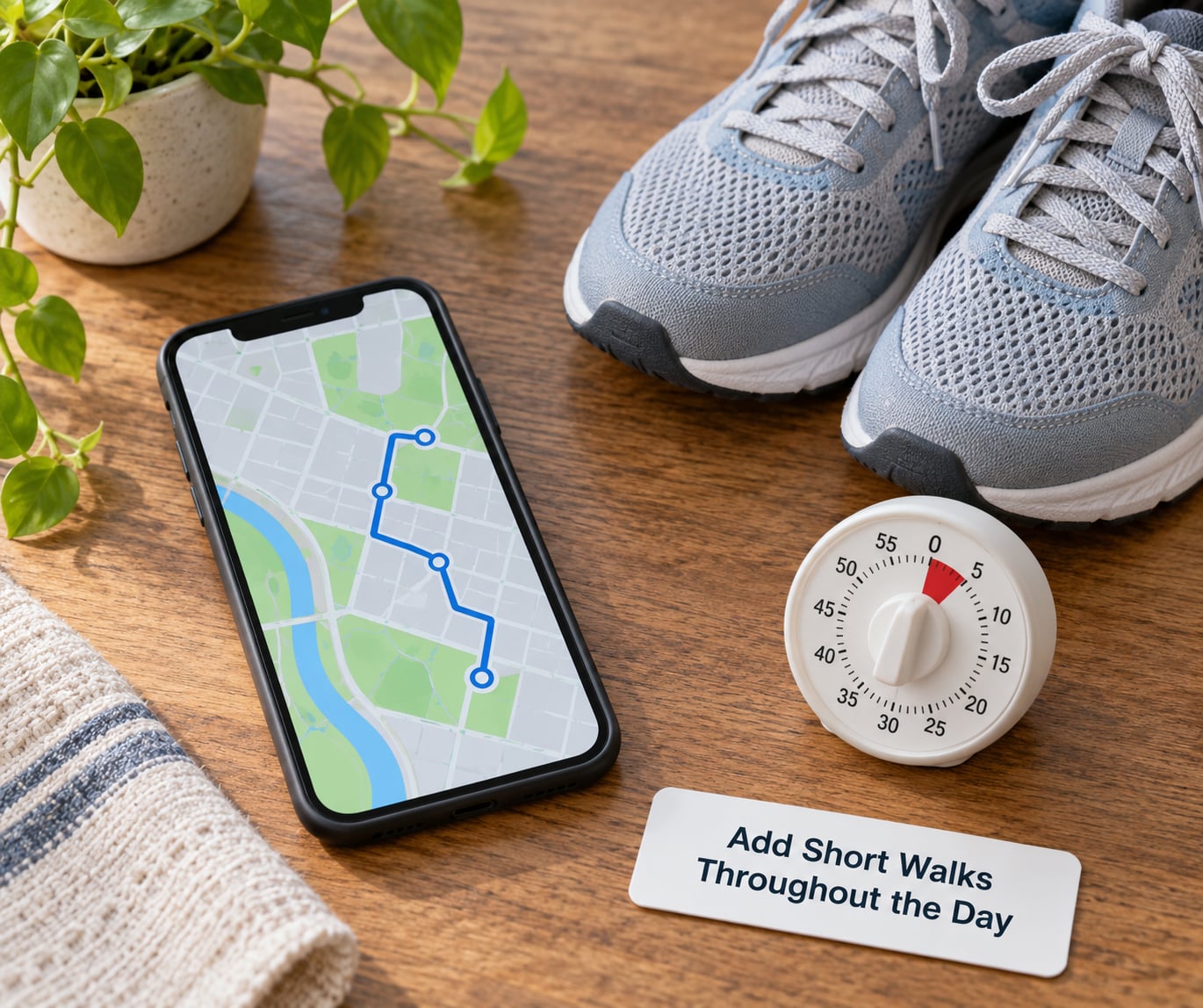
Long walks lose to short walks, because long walks need a good mood and good weather. Most research on sitting breaks suggests the benefit comes from interrupting sitting frequently rather than from one big session.
- Walk for ten minutes after your largest meal. Glucose handling after eating is one of the better-documented effects, and people rarely argue with themselves about a ten-minute walk.
- Take a call standing up and walk the length of your office, your hallway, or your kitchen twice.
- Park one row further away, or get off the bus two stops early. This is the easiest win on the list because it needs no willpower.
- Walk during commercial breaks instead of reaching for a remote.
To build from there, add two minutes per walk per week rather than doubling the distance. Ten-minute walks after two meals, most days, is a realistic target for most desk workers and it is where the habit forms.
Build More Standing Into Work and Daily Tasks
Standing burns a little more than sitting and more than lying down, though the difference is smaller than most standing-desk marketing suggests. The useful part of standing is not the standing itself. It is that standing usually comes with movement, because you pace, shift weight, reach and walk to the kettle.
Try standing for phone calls, doing the dishwasher load on your feet, sorting laundry at a table you have to stand beside, or cooking a meal from scratch instead of reheating. If your job allows it, take a few standing meetings or walk-and-talk calls. Change position often and sit back down when you are tired. Standing still for hours is harder on your legs and back than alternating between sitting and standing, and no standing benefit is worth a daily ache.
Use Small Movement Breaks
Micro-breaks work because they need no equipment and no change of clothes. Set a repeating timer for every 45 to 60 minutes, and the moment it goes off do one of these for two to three minutes.
- Ten squats to a chair, using the chair as the depth limit that keeps your knees happy.
- Twenty calf raises with a counter for balance, which also wakes up circulation in your lower legs.
- A doorway or wall chest stretch for the chest and shoulders after long typing sessions.
- Five minutes of walking to another room and back, twice.
- Hip hinges or a gentle shoulder rotation set if your joints are the problem rather than your desk.
Users on fitness forums describe the small unconscious movements as the ones they miss most when they stop: rolling a ball under the desk while on a call, toe tapping, pen clicking, standing to pace during a difficult phone call. Those habits are worth keeping, just do not expect them to add up to a workout.
Increase Movement in Your Normal Routine
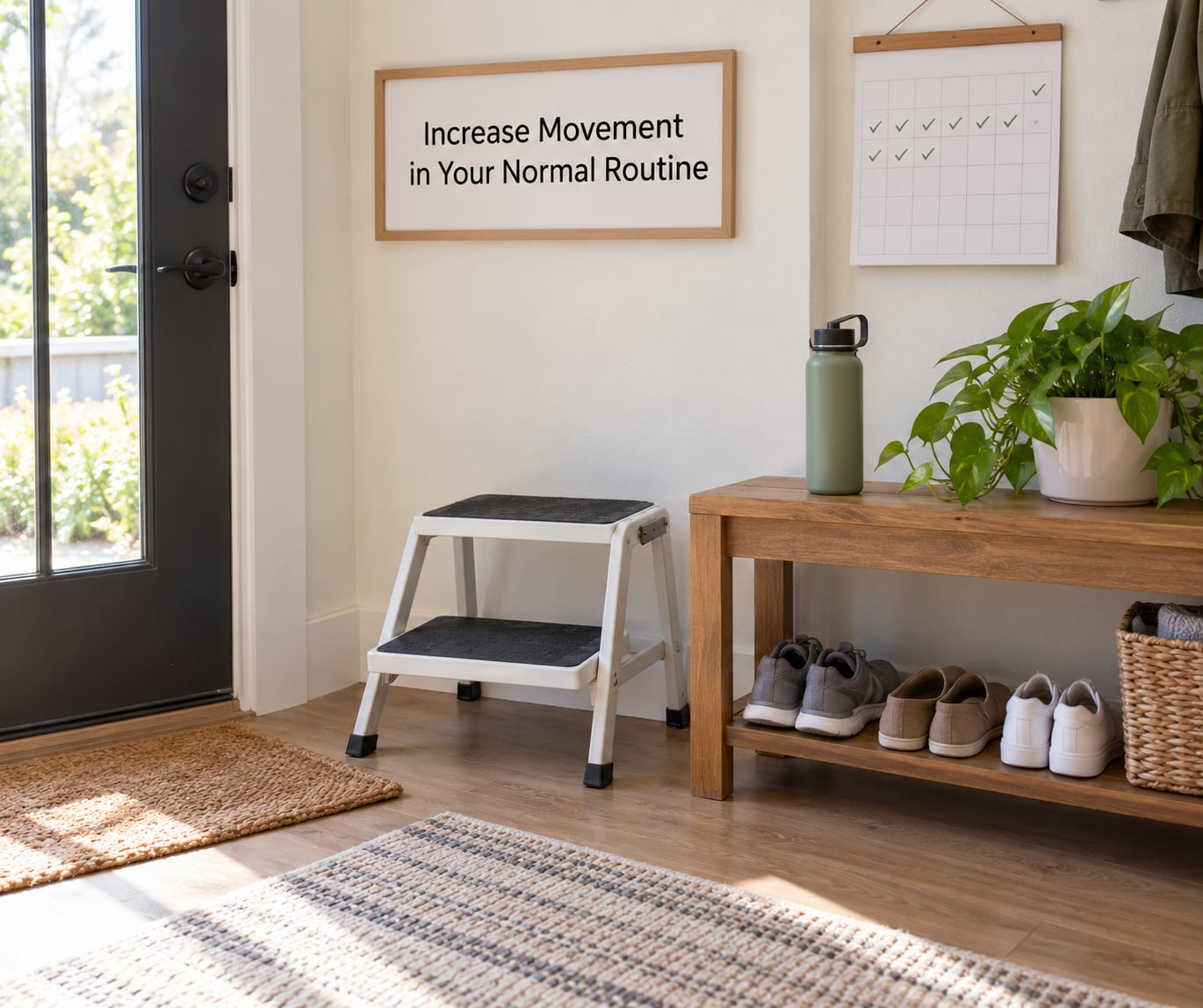
This is where NEAT quietly accumulates for people who never think about it at all.
- Stairs. Skip the lift on the way up, walk one flight at a time down. Daily stair climbing is one of the better-studied forms of incidental activity.
- Errands. Walk to the shop, carry bags in one trip instead of three, queue in a lane that makes you stand and shift rather than sit.
- Housework. Vacuuming, mopping, changing bedding and scrubbing the shower are sustained, repetitive, upright work. Vacuuming for 20 minutes burns more than many people manage in a walk of the same length.
- Gardening and yard work. Digging, weeding and mowing sit in the middle of the effort range and are easy to keep doing because you can see the results.
- Kids and dogs. Walking a dog twice a day and playing in a garden or park with children produces a surprising volume of steps you never chose.
- Hobbies. Dancing in the kitchen, woodworking, decorating a room, sightseeing on foot, gardening. The hobby works because you look forward to it.
If your knees, hips or back limit you, plenty still counts. Seated marching, arm circles, shifting position on a regular interval, light resistance work with a band, and short assisted walks all move the needle. Ask a physiotherapist or a doctor for a plan built around your specific joints, and stop anything that causes sharp pain.
Progress Gradually and Review Your Results
Add one change per week and let it settle before adding the next. A sensible ramp looks like this: week one, a ten-minute walk after one meal; week two, the same walk after two meals; week three, one standing hour per day at your desk; week four, a third walk and a daily two-minute movement break schedule.
Review on Sundays, looking at weekly averages rather than individual days. If your steps are up and you feel fine, hold there for another week. Progress in this kind of habit is a flat line that slowly steps up, not a straight ramp, and the weeks you repeat a level are the ones that make it stick.
Plan for interference. Work trips, illness, bad weeks with kids, deadlines: expect a drop and resume the last comfortable level rather than starting over from scratch. And remember the compensation effect. Your body adjusts spontaneous activity to how much energy you are taking in, so during a strict diet, NEAT tends to drift down on its own. That is physiology, not a character flaw, and it is one more reason to keep a floor under your movement rather than chasing a peak.
Finally, pair the movement with two resistance sessions a week and adequate protein if fat loss is your goal. Cutting calories while losing muscle lowers your basal metabolic rate, which shrinks the biggest part of your calorie burn. Movement you keep, muscle you keep with it.
Common Mistakes
- Starting with everything at once. Adding a step target, a standing desk and three new habits on the same day is how most people quit by week three. Fix: choose one habit for four weeks.
- Trusting tracker calorie numbers for NEAT. Wearables estimate incidental movement with wide error bars and they tend to overshoot. Fix: treat the calories as a rough signal and the step and sitting trends as the real data.
- Counting only steps. Some of your best movement is standing, carrying, lifting and pushing that never registers as a step. Fix: track standing time and housework separately.
- Picking habits you cannot repeat on a bad day. A four-mile hike does not survive a stressful week. Fix: define a floor version, such as five minutes, and treat that as a win.
- Ignoring comfort and safety. Standing all day, launching into stairs with weak knees, or walking in heat without water all cause more damage than they prevent. Fix: change position often and stop at pain.
- Expecting NEAT to replace nutrition or structured exercise. Movement is one input. Fix: use it alongside a sensible eating pattern and two resistance sessions a week, not instead of them.
One more myth worth clearing up: the 10,000-step target is a marketing number that turned into a rule. Going from 4000 steps to 8000 has real value, and going from 8000 to 10000 has less. Set the goal based on where you started, not on a round number.
Frequently Asked Questions
What are some examples of NEAT activities?
Common non-exercise activity thermogenesis examples include walking to the car or the shop, taking stairs, standing while on a phone call, housework such as vacuuming and laundry, gardening, walking the dog, playing with children, dancing, pacing during a call and carrying shopping. Anything upright, repetitive and unplanned counts. The common thread is that you are moving without it being a planned workout.
How many calories does NEAT burn in a day?
It varies enormously between people because occupation and lifestyle dominate it. Mayo Clinic research on the topic puts the deliberately increasable portion at roughly 280 to 350 calories a day for a typical adult, while total daily NEAT across individuals is reported to differ by well over a thousand calories. Sedentary desk workers sit at the low end; people with active jobs sit far above it.
Does standing increase NEAT?
Yes, but by less than most standing-desk marketing claims, and only while you are genuinely standing rather than leaning. Standing burns slightly more than sitting, and the bigger benefit is that standing usually drags along pacing, shifting and walking to the kettle. Standing still for hours does not help much and can leave your feet, legs and lower back sore.
Is walking considered NEAT or exercise?
It depends entirely on the intent rather than the movement. Walking to your car, around the office or to the shops is NEAT because it is incidental. A 30-minute walk you planned and did for exercise is exercise activity thermogenesis. The same 10 minutes of walking can fall into either bucket, which is why the label matters less than the total.
Will increasing NEAT alone help me lose weight?
Usually not on its own, and treating it as the whole strategy is where people stall. NEAT raises your daily calorie burn, but your body partly compensates for it, especially during calorie restriction. The combination that works is added movement plus a sensible eating pattern plus two resistance sessions a week to protect the muscle you already have.
Can I increase NEAT with a desk job or while working from home?
Yes, and remote workers usually have more unused movement opportunity than they realise, since the kitchen and the stairs are a few steps away. Stand for calls, take walking meetings, keep a kettle or water bottle away from your desk so refilling means walking, schedule two-minute breaks every 45 to 60 minutes, and use your lunch break away from the screen.
Conclusion
Start with one thing today: a ten-minute walk after your next meal. That is the whole starting line, and it works whether you have a desk job, a physical one, bad knees or no interest in a gym.
How to increase NEAT for more daily calorie burn is a stacking problem, not a single dramatic change. One habit at a time, four weeks each, tracked on weekly averages rather than a single number, is how it turns from a plan into a way your day works.
Global guidance from the World Health Organization puts adults at 150 to 300 minutes of moderate activity a week, and NEAT is a sensible way to move toward that without rearranging your life. If you are managing a health condition, are pregnant, or have pain that persists, talk to your doctor or a registered dietitian before you change how much you move.