
Most adults burn about 100 to 140 calories walking a single mile, and a 180-pound adult lands close to 90 calories on flat ground at a moderate pace. Your own body weight is the biggest factor in that number. Pace, hills, what you carry and how much you swing your arms all shift it from there.
Walk one mile twice and you’d reach roughly 180 calories. Walk it five times and you’re near 450. That’s the useful part of this number: it turns an activity you already do into something you can plan, budget and measure.
The catch is that nobody can measure your exact calorie burn from the outside. Every figure below is an estimate built from population averages, and the honest version of any of them ends in “roughly.”
This guide is current as of October 2026.
Table of Contents
- How Many Calories Do You Burn Walking a Mile?
- Calories per Mile by Body Weight
- How Body Weight, Speed, and Walking Style Affect the Estimate
- How to Calculate Your Own Calories per Mile
- Walking vs. Running: Do Faster Walks Burn More?
- How Many Calories Does a 30-Minute Walk Burn?
- Simple Ways to Make a Mile Count
- Frequently Asked Questions
- How many calories does a 1,300-pound person burn walking a mile?
- Does walking downhill burn more calories for the same mile?
- How many steps are in a mile for an average adult?
- Is walking one mile enough to lose weight?
- How accurate are fitness watches for calories burned while walking?
- Conclusion
How Many Calories Do You Burn Walking a Mile?
Walking one mile costs a typical adult somewhere between 100 and 140 calories. Below 130 pounds and 300 pounds, the range stretches from about 45 calories to 165 calories, because the estimate scales with the weight doing the walking.
Two things to hold onto when you read any calorie chart. First, published figures for the same mile often differ by 30 percent or more, so a number from a neighbor’s walk is not a number for your walk. Second, almost every chart reports gross calories, the total your body expends while walking, rather than the extra calories above what you would have burned sitting still.
That second distinction matters more than most people expect. A mile at 90 gross calories might be closer to 50 net calories once resting metabolism is subtracted, and that gap is exactly why a watch can report 250 calories for the same walk a chart puts at 90.
Calories per Mile by Body Weight

Body weight drives the estimate almost linearly, which makes it the first and last thing you need. The table below gives calories for one mile on level ground at three everyday walking speeds.
| Body weight | Easy walk (2.5 mph, about 24 min/mile) | Moderate walk (3.5 mph, about 17 min/mile) | Brisk walk (4 mph, about 15 min/mile) |
|---|---|---|---|
| 100 lb | 45 calories | 50 calories | 55 calories |
| 130 lb | 57 calories | 62 calories | 72 calories |
| 150 lb | 65 calories | 72 calories | 82 calories |
| 180 lb | 78 calories | 87 calories | 100 calories |
| 200 lb | 87 calories | 96 calories | 110 calories |
| 225 lb | 98 calories | 108 calories | 125 calories |
| 250 lb | 110 calories | 120 calories | 138 calories |
| 275 lb | 120 calories | 132 calories | 152 calories |
| 300 lb | 130 calories | 145 calories | 165 calories |
A quick sanity check that costs you nothing: multiply your weight in pounds by about 0.5. At 180 pounds that gives 90, which lands on the table. The shortcut works because the estimate is close to proportional to body mass. It drifts low on hills and high when you’re carrying something.
Three assumptions sit behind every cell. The walk is on flat, hard ground such as a sidewalk or track, you are an adult walking normally rather than shuffling, and the figure is total energy expenditure for the mile including normal breathing and circulation.
How Body Weight, Speed, and Walking Style Affect the Estimate
Weight is the loudest factor and the most predictable. Someone at 250 pounds moves roughly 50 percent more mass over each step than someone at 150 pounds, so the same mile costs meaningfully more.
Pace is the one people misread. Speed changes how many calories you burn per minute far more than it changes calories per mile. Walking a mile at 4 mph instead of 3 mph burns a bit more overall, but the gap between the easy and brisk columns above is maybe 15 to 20 calories, not double. You simply cover the mile in a third less time.
Terrain and hills add a real premium. Incline work means lifting your body against gravity on every step, and soft surfaces like sand, gravel or wet grass cost more than pavement at the same speed because your lower leg works harder to keep your foot from sinking.
What you carry matters too. A loaded backpack or a weighted vest raises the mass you’re moving, though wrist and ankle weights are a poor trade because they add strain to small joints rather than building useful work.
Stride length and arm use change the mechanics more than people expect. Shortening your stride, landing closer to your midfoot and letting your arms swing fully raises the cost of each step without any change in speed, which is the basic idea behind power walking.
Fitness level gets misread in both directions. Someone who walks often may do a mile more economically at a slow pace, but their harder effort still costs what a harder effort always costs. Fit walkers rarely out-burn a heavier walker over the same mile.
How to Calculate Your Own Calories per Mile
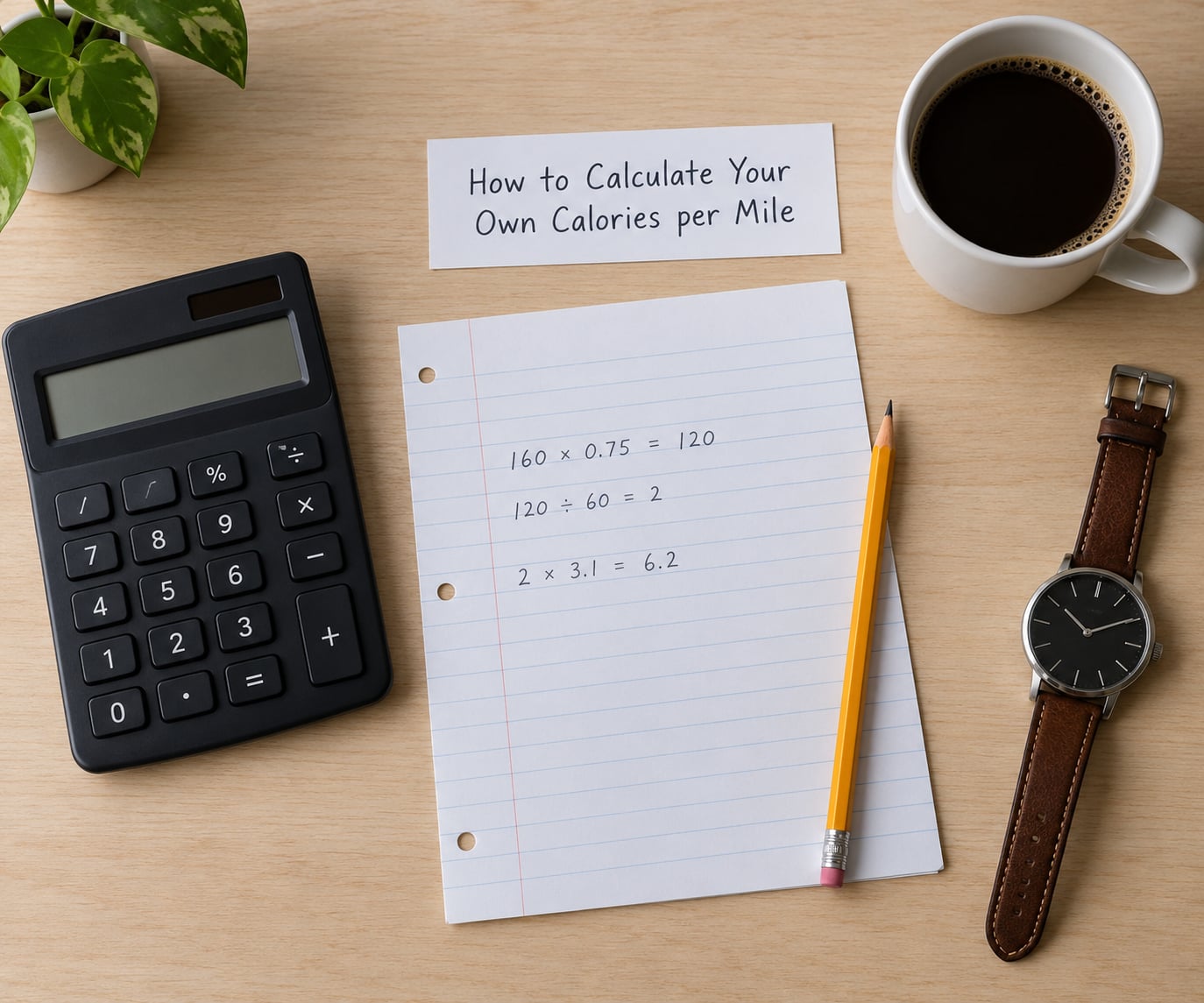
The standard method uses a MET value, a metabolic equivalent that describes how hard an activity is compared with sitting quietly. Multiply the METs by 3.5, by your weight in kilograms, then by your minutes and divide by 200.
Here is the formula in full:
Calories per minute = METs x 3.5 x body weight in kg / 200
A worked example for an 180-pound adult. That is about 82 kilograms, and comfortable walking at 3.5 mph sits near 3.5 METs. The result is 3.5 x 3.5 x 82 / 200, or about 5 calories a minute. A mile at that pace takes roughly 17 minutes, which lands at 85 to 90 calories. The table above gives the same answer.
Notice what the equation does with pace. Slower walking means fewer METs but more minutes, so the products tend to cancel out across normal walking speeds. This is why two calculators can produce very different totals for the same mile while both are technically correct, and why the total for a mile stays in a narrow band even as your pace changes.
Estimates from a watch, a phone app or a treadmill are calculated rather than measured. They usually rely on heart rate, accelerometer data and a generic calorie model, and for easy walking the error runs in one direction: high. Treat any device number as a rough trend line, useful for comparing one walk to the next rather than a measurement to budget your day around.
Walking vs. Running: Do Faster Walks Burn More?
Running a mile burns roughly what walking a mile burns, and sometimes slightly more. Most of the extra demand of running shows up in the time cost, not the calorie cost. A brisk 4 mph mile takes about 15 minutes and roughly 100 calories at 180 pounds; a slow 8 mph run covers the same mile in about 7.5 minutes and lands in the same general neighborhood.
Per minute, the gap is obvious. Running burns closer to three times what relaxed walking does in the same 60 seconds, which is why a running workout feels harder and why running classes are efficient calorie burners per hour.
That framing matters for weight loss, because it points to volume over intensity. Someone doing 20,000 steps a day is creating a larger daily deficit than someone sprinting a mile three times a week. The mile-for-mile calorie similarity also explains why runners hit walls on long walks and walkers tend to keep going. If you are starting out, walking is the cheaper way to build the habit.
How Many Calories Does a 30-Minute Walk Burn?
A 30-minute session is easier to compare across people than a mile, because the clock is the same for everyone. The distance you cover varies with pace, and the totals below reflect that.
| Body weight | Easy 30 minutes (about 1.25 miles) | Moderate 30 minutes (about 1.75 miles) | Brisk 30 minutes (about 2 miles) |
|---|---|---|---|
| 100 lb | 55 calories | 85 calories | 110 calories |
| 150 lb | 83 calories | 125 calories | 165 calories |
| 180 lb | 100 calories | 150 calories | 200 calories |
| 200 lb | 110 calories | 170 calories | 220 calories |
| 250 lb | 140 calories | 210 calories | 275 calories |
| 300 lb | 165 calories | 250 calories | 330 calories |
To turn your own per-mile number into a session goal, multiply by the miles you plan to cover and then adjust for terrain. If your usual route has two noticeable hills, add about 10 percent. If you are walking with a heavy bag, add 5 to 8 percent for every 10 pounds carried.
For weight loss math, a widely used rule is that a deficit of 3,500 calories equals roughly one pound of fat. At 90 calories a mile, that is close to 35 to 40 miles for a pound, which is why walking alone rarely moves the scale quickly. It works well as one piece of a larger routine rather than as the whole thing.
Simple Ways to Make a Mile Count
Most of the value comes from doing more of it, not from squeezing more out of each mile.
Add time in small doses. Going from one mile to two a day for a week is far easier to stick with than doubling again next month, and the extra session is where most of the added calorie burn comes from.
Pick a pace you could hold for 30 minutes without gasping. Comfortable and repeatable beats hard and abandoned, because consistency over months outpaces intensity on any given day.
Use hills when they are available, but treat them as intervals rather than a goal. A few steeper blocks and an easy flat stretch between them is a well-worn approach that raises the cost of the mile without wrecking your recovery.
Trade one route for several. Different streets, a park path and a treadmill all change your stride, your attention and the surface under your feet, which also keeps a familiar walk from turning into a chore.
Get shoes that fit and skip worn midsoles. Supportive footwear matters more for how many miles you accumulate over years than it does for the calories in any one walk. If foot or joint pain shows up, stop and get it looked at.
Read the numbers as context rather than a verdict. A 100-calorie estimate is a planning tool. Turning it into a reason to skip meals is a bad trade, and if you are working toward a specific weight or health goal, a registered dietitian or your doctor can tell you what is actually appropriate for you.
Frequently Asked Questions
How many calories does a 1,300-pound person burn walking a mile?
Scaling the body-weight estimates linearly gives roughly 570 calories per mile at an easy pace, about 625 at a moderate pace and about 715 at a brisk pace on flat ground. These are extrapolations from standard tables rather than measured figures. For anyone at this weight, a doctor or registered dietitian can give guidance calibrated to actual mobility and joint load.
Does walking downhill burn more calories for the same mile?
Downhill work costs less per step than climbing because gravity assists you, so a mile that is entirely downhill usually burns a little less than the same mile on level ground. Hills that go up and down tend to land somewhere near flat cost, though. Walking in deep snow or soft sand burns more, because the surface absorbs energy instead of returning it.
How many steps are in a mile for an average adult?
Roughly 2,000 to 2,200 steps, with about 2,100 a good working average for an adult of average height. Taller people with longer strides take fewer steps, and shorter strides push the count higher, so 10,000 steps lands somewhere between 4.5 and 5 miles for most adults. That puts a 10,000-step day at roughly 400 to 500 calories for a 150 to 180-pound person.
Is walking one mile enough to lose weight?
One mile is worth roughly 90 to 100 calories for a 180-pound adult, which is a fraction of the 3,500 or so calories that represent about a pound of fat. On its own it will not shift the scale much. It becomes useful as part of a consistent routine that also manages intake, and anyone with a specific weight goal should talk it through with a healthcare professional first.
How accurate are fitness watches for calories burned while walking?
Good enough for trends, not for a daily budget. Watches infer calories from heart rate and motion, and for relaxed walking they tend to overestimate, sometimes reporting two or three times the MET-based figure. The error is not random enough to cancel out, so using the number for food decisions works against you. Use your watch for distance and pace instead.
Conclusion
Plan on roughly 100 to 140 calories for a mile if you’re an adult in the middle of the weight range, and use the table above if you fall outside it. Find your row, pick the pace column that matches how you actually walk, and treat the result as a planning figure rather than a measurement.
Then go for one comfortable mile today. Shoes that fit, a route you like, and no particular target attached to it.
If you have a weight or health goal beyond general fitness, a doctor or registered dietitian can put the number in the context of your own situation, which is worth more than any chart on the internet.