Sitting at a desk for hours does a specific, predictable thing to your body: your hip flexors and hamstrings shorten, your chest pulls tight, your shoulders round forward and your neck cranes toward the screen. The five desk stretches to do during the workday below take about five minutes total, need nothing but a chair, and can be done in work clothes without anyone noticing. Here is the routine, in order.
I run a version of this between meetings, and the difference by 3pm is noticeable enough that I stopped skipping it. Last updated for 2026, and still accurate if your chair has wheels you can’t reach.
Table of Contents
- What You Need
- Step-by-Step: Desk Stretches to Do During the Workday
- 1. Seated Neck Reset
- 2. Shoulder Roll and Chest Opener
- 3. Seated Spinal Twist
- 4. Wrist and Forearm Release
- 5. Seated Hip and Leg Reset
- Common Mistakes
- Frequently Asked Questions
- How often should I stretch at a desk job?
- Can desk stretches replace my workout?
- How do I stop a stretch from making pain worse?
- What if I have limited mobility or a desk job I cannot leave?
- When should I stop stretching and see a professional?
- Conclusion
What You Need
Nothing to buy. That is the entire appeal.
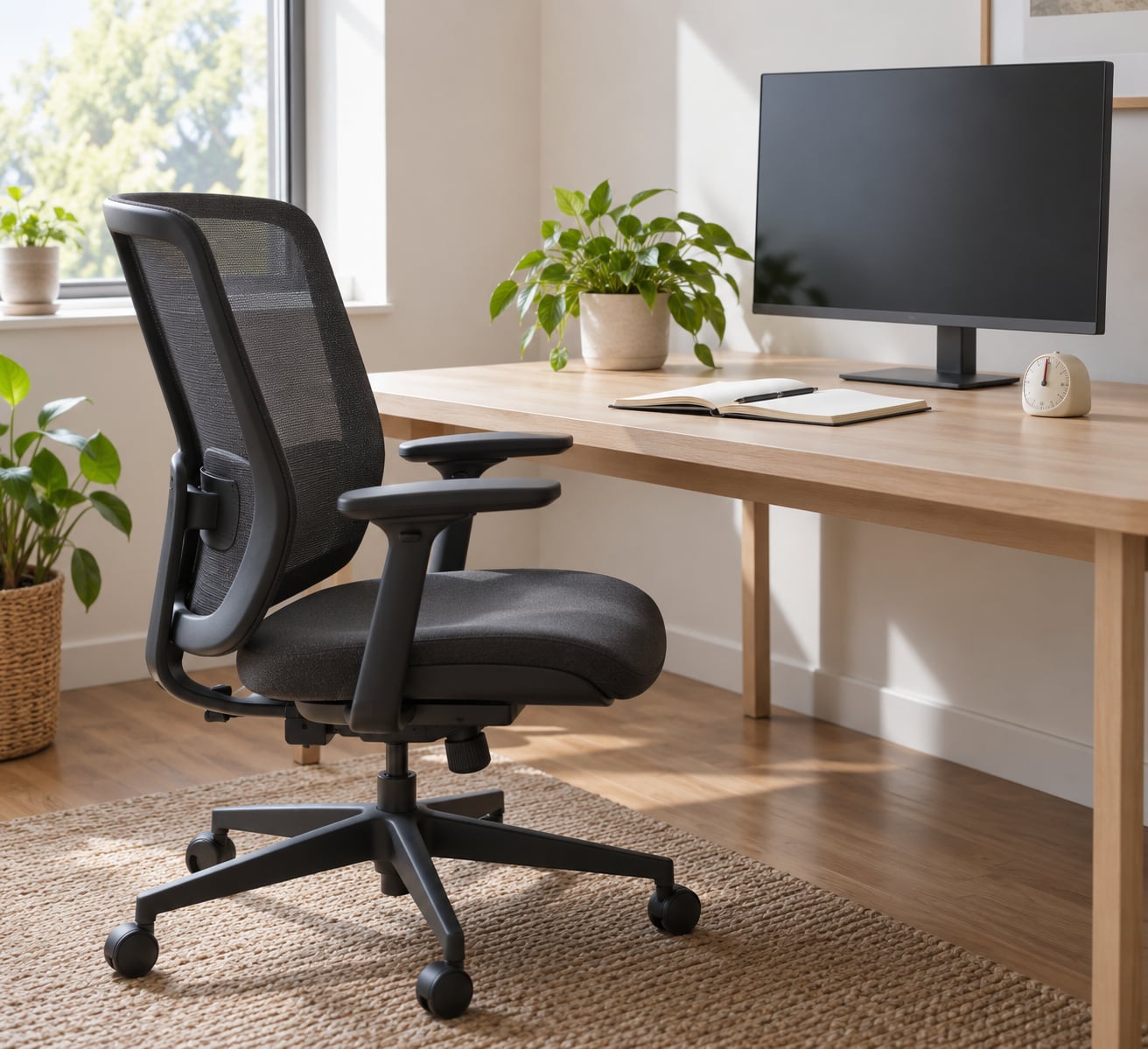
You need a chair that will not roll when you lean into it, which usually means locking the casters or pushing the back against a wall. A stable chair is what makes the twist and the leg reset safe; a rolling one is a good way to end up on the floor during a standup.
You also need roughly a square metre of clear floor behind or beside you for the hip and leg work, and a quiet spot if you would rather not be watched. Roughly two square feet is enough, not a studio.
Almost all of this works while seated, which matters if you are on camera or in an open-plan office. Only step 5 asks you to stand, and even then you can stay in your chair if you prefer. Loosen whatever is tight across your chest and waist first. A reader who mentioned an hour of neck tension asked for this and got the same answer: loose clothes, quiet room, phone timer.
Step-by-Step: Desk Stretches to Do During the Workday
Run the moves in this order, top of the body down to the bottom. Take about 45 to 60 seconds per step and use a timer, because an unhurried timer is the only thing that makes this repeatable. Breathe normally through every hold; do not hold your breath.
1. Seated Neck Reset
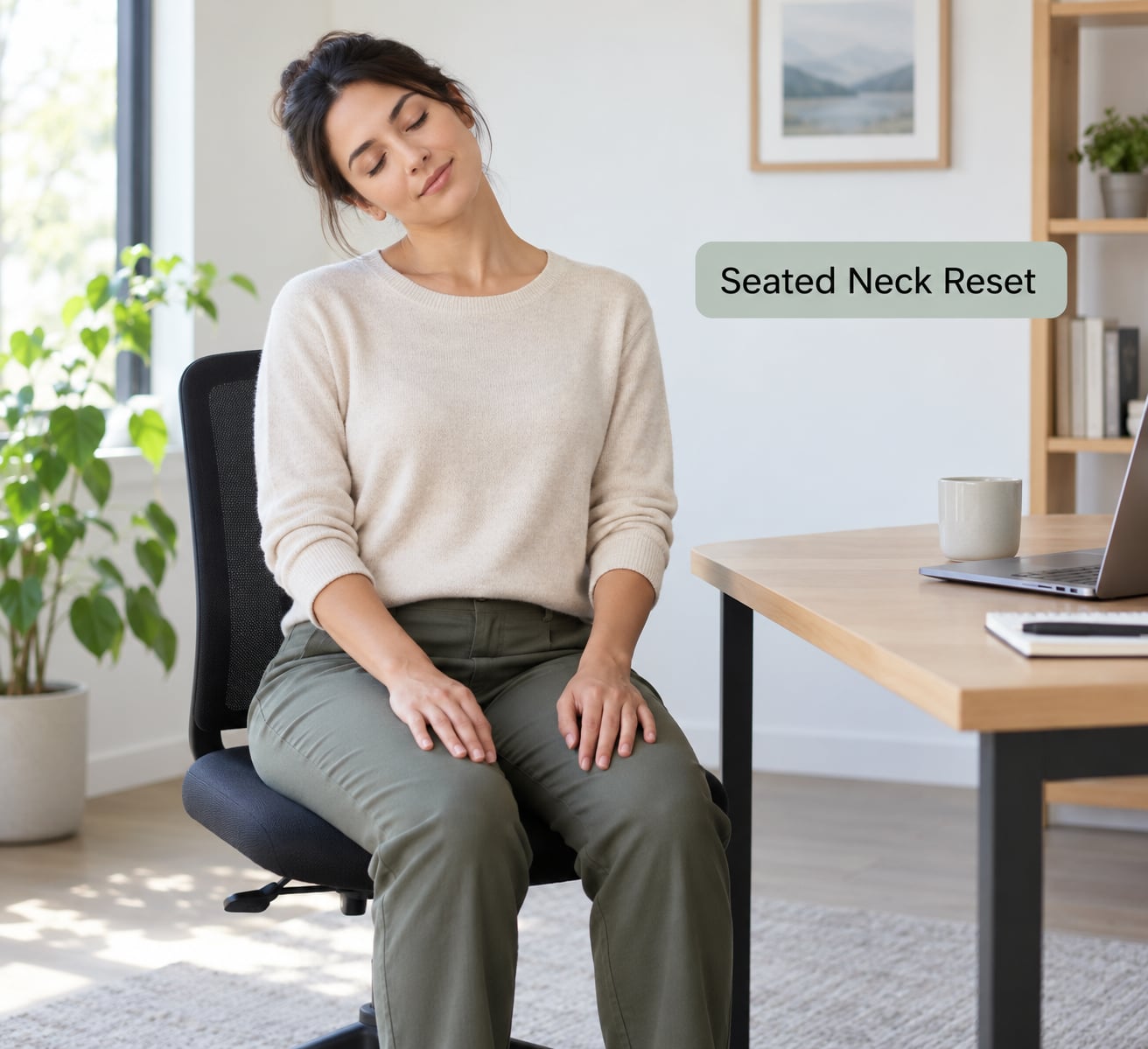
Sit tall with both feet flat and let your shoulders drop away from your ears. Drop your right ear toward your right shoulder until you feel a mild pull along the left side of your neck, then hold for 20 to 30 seconds. Switch sides and hold again.
That is the whole move. What matters is that the shoulders stay heavy and low. When people lift a shoulder to “help” the stretch, they load the neck instead of lengthening it, which is the opposite of the point.
Take it further only if it feels easy: turn your chin about a quarter toward the armpit on the stretched side and breathe into it. You should be able to breathe normally the entire time. If you feel a pinch at the base of the skull rather than a stretch, ease off.
Why it helps: hours of screen focus pull the head forward and load the upper neck, which is where most afternoon tension headaches start. Lengthening here takes about 30 seconds and no equipment.
Best for: neck tension, forward head posture, the tight spot between your ear and your shoulder blade.
2. Shoulder Roll and Chest Opener
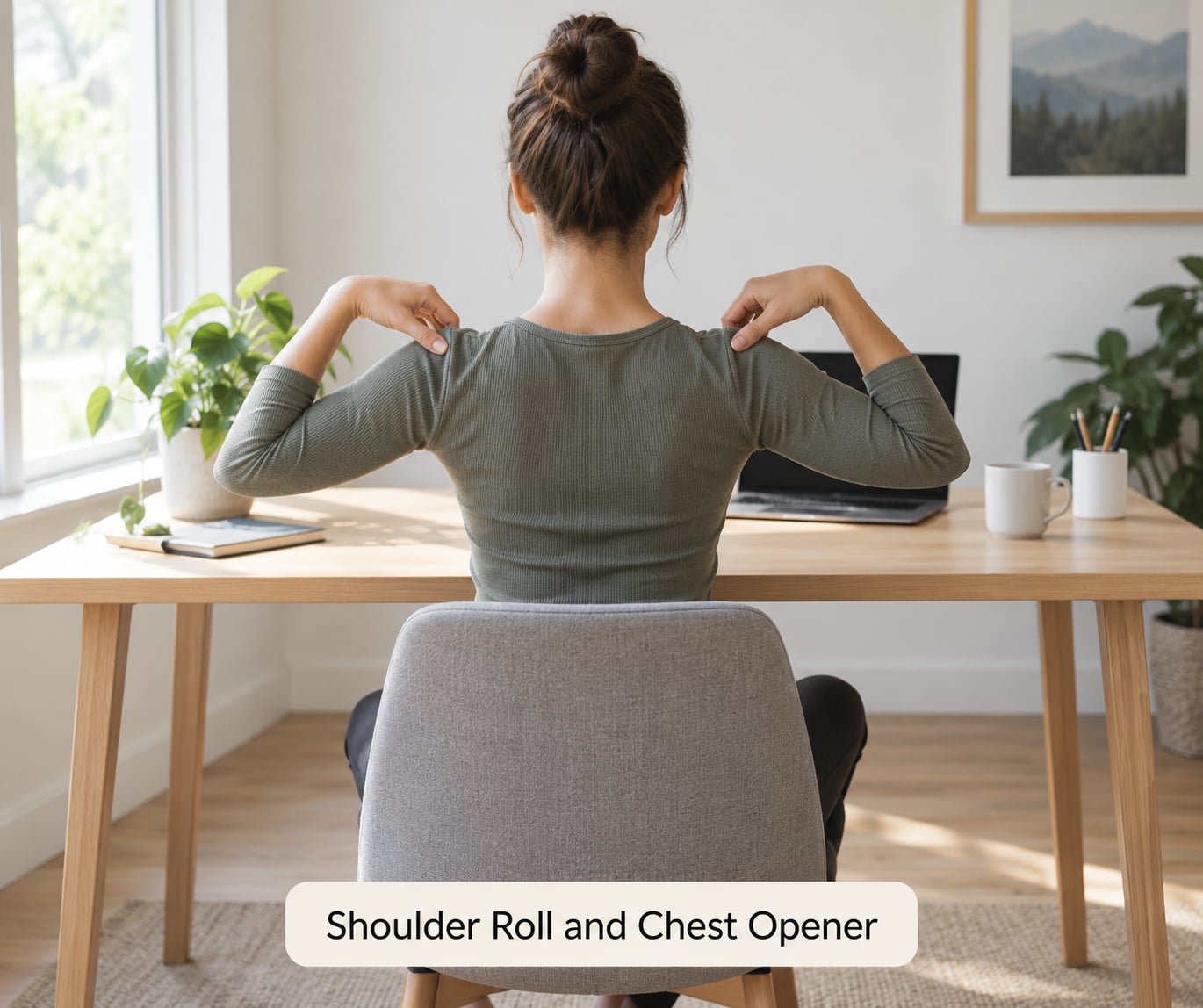
Sit or stand, arms bent, fingertips resting near the tops of your shoulders. Roll both shoulders up, back and down in a slow circle, then reverse direction. Ten rolls each way is plenty.
Finish with the chest opener: clasp your hands behind your back or interlace your fingers in front of your lower back, straighten your arms, and draw the shoulder blades gently together. Lift the chest, keep the chin level, hold 20 to 30 seconds. Unclasp and shake the arms out.
You do not need to arch backwards or squeeze your shoulder blades until they crack. A modest range with a long exhale is more useful than a heroic one, and it will not make you gasp on a video call.
Why it helps: typing and mousing round the shoulders and shorten the chest, so the upper back ends up doing work it was not built for. Opening the front lets the shoulder blades do their job again.
Best for: rounded posture, upper back tension, that tight band across the top of the shoulders.
3. Seated Spinal Twist
Sit sideways on your chair if it has a back, or sit forward and turn from the ribs instead. Place your near hand on the chair back or the desk edge, keep both feet flat and your hips pointing forward, and rotate your torso until you feel a stretch between your shoulder blades.
Hold for 20 to 30 seconds, breathe out as you go in, then change sides. The rotation comes from the middle of your back, not from your hips swinging around. That distinction is the whole exercise.
Stop well before it hurts, and stop immediately if you feel dizzy. Twisting through the lower back under load is the version that ends badly, so keep the movement in the thoracic spine and let the chair carry you.
Why it helps: a seated spinal twist restores rotation you lose when you sit in one orientation for hours, and it moves the lower back without putting weight through it.
Best for: lower back stiffness after a long sitting block, and the mid-back rotation that twisting in your chair never quite gives you.
4. Wrist and Forearm Release
This is the step most desk workers skip and most need. If you have ever felt a dull ache along the inside of your forearm after a long mouse session, this is the one.
Start with the wrist flexor. Extend one arm forward, palm up, and use the other hand to gently pull the fingers down and slightly back until you feel a stretch along the inner forearm. Hold 20 seconds. Then flip the palm down, push the back of the hand gently toward you, and hold 20 seconds to hit the outer side.
Do both arms. Keep the elbows soft rather than locked, and do not bounce or force it. A stretch that needs force is not a stretch that is working.
The second movement is a finger and hand reset: spread your fingers wide, then slowly make a loose fist, ten times each hand. No grip strength required, and it feels ridiculous, which is roughly why it works.
Why it helps: repetitive mouse and keyboard use is the classic setup for repetitive strain injury in the wrist and forearm. Short, frequent releases and a neutral wrist do more than one long session at the end of the day.
Best for: wrist ache, forearm tightness, tingling after a typing-heavy afternoon.
5. Seated Hip and Leg Reset
Stand up and step back from your desk, or stay seated if standing is not an option right now.
Start with a hip flexor stretch: step one foot back into a short lunge, tuck your pelvis under by squeezing the glute on the back leg, and lean forward a couple of centimetres. Hold 20 to 30 seconds per side. If you feel it in the front of the hip rather than the lower back, you are doing it right.
Then sit back down and cross one ankle over the opposite knee, sitting tall. Let the top knee hang open and hinge forward from the hips a few centimetres. Hold 20 to 30 seconds per side. Skip it if the knee feels unstable.
Finish standing on both feet and rise onto your toes for ten slow repetitions, then lower. This gets blood moving back down the legs, which is the part that sitting compresses and stretching alone cannot fix.
Why it helps: hip flexors and hamstrings spend the whole day shortened, and that tightness is what most people feel as lower back ache by late afternoon. Circulation out of the legs matters too.
Best for: tight hips after sitting, lower back ache, and heavy, restless legs.
Common Mistakes
Bouncing through the hold. Bouncing turns a static stretch into something more ballistic and is a common way to pull a muscle instead of lengthening it. Move into the position and stay still.
Holding your breath. The instinct to brace and hold is strong. Breathe out as you move into the stretch; the exhale is what lets the muscle give.
Forcing range of motion. You should feel something, not something dramatic. Range comes back with repetition, and pushing on day one is how people end up sore and quit by day three.
Twisting fast. Speed turns a spinal twist into a rotation under control, which is how backs get tweaked. Slow, and let your breath pace it.
Ignoring pain signals. A stretch can feel tight, odd or mildly uncomfortable. Sharp pain, numbness, tingling or anything radiating down an arm or leg is a different category. Stop, and talk to a doctor or physiotherapist about it.
Waiting for a perfect quiet moment. A five-minute routine you actually do is worth more than a thorough one you never start. Pick a timer you cannot ignore, and pair it with something you already do: your coffee refill, the standup that starts at 10, or the end of a focus block. A colleague on a work forum described the same problem and the same fix, since nobody remembers to stretch on purpose.
Standing all day instead. If you have a sit-stand desk, alternate rather than default. Standing badly for a long stretch tends to move discomfort from the lower back to the neck and shoulders, which is what many standing-desk users on r/backpain describe. If you work standing, alternate sitting and standing every 30 to 60 minutes and keep the monitor near eye level either way.
Two rules cover most of it: hold for 20 to 30 seconds, and use the range you have today rather than the range you want. Everything in this routine is general information. If you have an injury, a recent surgery or persistent pain, check with a doctor or a qualified physiotherapist before making it a habit.
Frequently Asked Questions
How often should I stretch at a desk job?
Move every 30 to 60 minutes, and spend 2 to 5 minutes moving each time. Short, frequent breaks interrupt long sitting better than one long break at lunch, because the stiffening happens gradually through the morning and early afternoon. Two to three moves per break is plenty; you are aiming to reset, not to complete a workout. If you set one timer for the whole day, a 5-minute reset around 10am, 1pm and 3pm covers most desk workers well.
Can desk stretches replace my workout?
No. These five moves are mobility and comfort work, not conditioning, and they will not build strength, raise your heart rate or replace strength training or cardio. What they can do is reduce the stiffness and discomfort that makes a workday miserable, and make your actual training easier to do afterwards. Think of them as maintenance between real sessions rather than a substitute for them. People who stretch most consistently are usually the ones who already train.
How do I stop a stretch from making pain worse?
The difference between a useful stretch and a harmful one is usually sensation, not time. Tightness, a pulling feeling and mild discomfort are expected. Sharp pain, burning, numbness, tingling, or anything that travels down an arm or leg means stop immediately and change the position, usually by reducing the range. Do not stretch through pain to ‘push through it’, and do not stretch an area that is swollen, recently injured or under medical care without asking a doctor or physiotherapist first.
What if I have limited mobility or a desk job I cannot leave?
Every move here has a smaller version, and the smaller version is the one to start with. Skip the standing hip flexor lunge entirely and do the seated ankle-cross version instead, or rotate only as far as is comfortable. Do the neck reset without turning your chin, and the chest opener without interlocking your hands behind your back. Nobody can see these from a short distance, so they work on a video call. Consistency matters far more than range.
When should I stop stretching and see a professional?
Stop and seek advice if you have pain that lasts more than a week or two, pain that wakes you at night, numbness or weakness in an arm or leg, or a recent fall, surgery or injury. The same goes for a stretch that reliably produces sharp pain even at a small range. A doctor or physiotherapist can tell you whether a movement is appropriate for you and what to modify. This guide is general information and not medical advice.
Conclusion
Five minutes, five moves, one chair. Neck reset, shoulder roll and chest opener, seated spinal twist, wrist and forearm release, then the hip and leg reset, in that order, with a 20 to 30 second hold and normal breathing on every one.
Do not try to complete all five on day one. Start with the neck and shoulders, add the twist, and build the habit until the routine is automatic. Then run it three or four times between meetings and you will feel the difference long before you notice the habit itself.